Visa has announced an expansion for its stablecoin pilot, with the payments processing giant adding Arc, Polygon, and three other blockchains.
Visa Has Added Five New Blockchains To Its Stablecoin Pilot
As revealed in a press release, Visa has expanded its global stablecoin settlement pilot with five new blockchains. The pilot enables issuers and acquirers to settle payments in stablecoins rather than traditional banking rails.
Stablecoins are digital assets that are tied to a fiat currency. Since these tokens run on the blockchain, they come with all the benefits that the technology allows, including cheap and fast settlements. This fact has made them gain popularity as a mode of payments, particularly in the cross-border case, and has attracted attention from giants like Visa.
The card payment firm noted:
Over the past year, stablecoins have evolved from a promising innovation to a practical way to move money globally, and Visa’s settlement pilots are helping partners streamline operations.
These fiat-tied cryptocurrencies are available on a range of blockchains. Earlier, Visa’s pilot included four of these networks: Ethereum, Solana, Avalanche, and Stellar. With the new expansion, Arc, Base, Canton, Polygon, and Tempo have also become part of the company’s program.
Rubail Birwadker, Global Head of Growth Products and Strategic Partnerships at Visa, said:
Expanding our stablecoin settlement pilot program to more blockchains means our partners can choose the networks that best fit their needs, while relying on Visa to provide a common settlement layer across all of them.
In the press release, Visa also shared an update on how the pilot is doing in terms of numbers. Compared to the last quarter, the annualized settlement run rate has gone up by 50%, reaching the $7 billion milestone. Visa’s push into stablecoins has come as this class of digital assets has seen regulatory momentum around the world, with perhaps the most important development being the signing of the GENIUS Act in the United States.
The global adoption has given resilience to the sector amid the downturn in the wider cryptocurrency market, with the total market cap associated with the fiat-pegged tokens even setting a new all-time high in mid-April, according to data from DefiLlama.
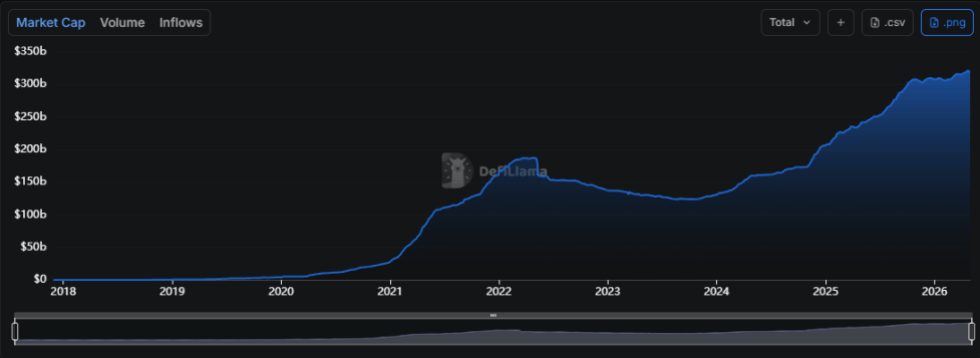
How the stablecoin market cap has changed over the last few years | Source: DefiLlama
From the chart, it’s visible that the stablecoin market cap has followed a slight uptrend since October. In the same period, Bitcoin has gone down roughly 40% instead. Currently, the total valuation of the stables is sitting at about $319.8 billion, shy just $1.5 billion of the record.
Bitcoin Price
At the time of writing, Bitcoin is floating around $76,000, down 1.8% in the last seven days.

The price of the coin seems to have gone down recently | Source: BTCUSDT on TradingView