# On-Chain的所有文章

在 HTX 新聞中心流覽與「On-Chain」相關的最新資訊與深度分析。潘蓋市場趨勢、專案動態、技術進展及監管政策,提供權威的加密行業洞察。

Olympus DAO Myth Reappears? A "Sovereign On-Chain Central Bank" Written with 4000 Lines of Immutable Code

A new project called The Standard Reserve has emerged, branding itself as a "sovereign on-chain central bank." It aims to replicate core central bank functions—currency issuance, money supply adjustment, and reserve accumulation—entirely through 4,000 lines of immutable code, with no human governance. Its core mechanism is a "reflexive monetary policy" based on a single signal: the net ETH flow into or out of the system's sole Uniswap v4 ETH/$STANDARD pool. Sustained net ETH inflows trigger an "expansion" phase, increasing $STANDARD issuance and using protocol fees to buy tokenized gold as a permanent hard reserve. Net outflows (or zero flow) trigger an immediate "contraction" phase, reducing issuance and using fees to buy back and burn $STANDARD. The system involves six key entities: the $STANDARD token (hard-capped at 1 billion), the central Uniswap pool, the Central Bank contract, Charter NFTs (acting as "banking licenses"), Branch units under each Charter (which earn a share of newly minted $STANDARD), and separate Vaults for expansion (buying gold) and contraction (buying back $STANDARD). To participate, users ideally acquire a Founding Charter NFT (initially 1,000 are free via allowlist/public mint). Each Charter comes with one Branch; more can be opened by burning $STANDARD for "expansion permits," increasing revenue share. Retiring a Branch lets users claim accumulated $STANDARD but imposes a dynamic exit fee (higher if many exit simultaneously), with half the fee burned and half distributed to remaining participants. All protocol revenue (from pool fees and Charter auctions) is allocated: 70% to the active Vault (for gold or buybacks), 15% to permanent protocol-owned liquidity, and 15% to the team. The project presents an innovative, game-theoretic model where user actions (expanding Branches by burning tokens or exiting) align with system goals of building reserves or inducing deflation. However, it is fully anonymous, with key parameters undefined and unaudited code, posing significant risks.

marsbit13 小時前

Olympus DAO Myth Reappears? A "Sovereign On-Chain Central Bank" Written with 4000 Lines of Immutable Code

marsbit13 小時前

Kaito Reboots 'Talk-to-Earn Economy', but Many Are Hesitant to Install the New Plugin

Kaito AI has launched a new browser extension called Kaito Pulse, aiming to revitalize what the community terms the "talk-to-earn" or "social-fi" economy on X (formerly Twitter). The plugin displays users' on-chain trading activity, such as positions from platforms like Polymarket, directly within the X timeline. This aims to create a new "attention + behavior verification" system, shifting focus from who generates the most discussion to whose discussions are backed by credible, verifiable actions. However, the launch quickly sparked significant privacy concerns within the crypto community. Critics, led by an analysis from user "Ultra," allege the extension's code enables deep data collection. This includes potential device fingerprinting (using GPU, hardware, and audio data), tracking of X user behavior (browsing paths, clicks, engagement), and verification processes that could access sensitive data from third-party accounts like ChatGPT, Claude, and trading platforms. The debate centers on whether such extensive verification is necessary to combat fake engagement and AI-generated content, or if it constitutes an unacceptable privacy sacrifice. In response, Kaito founder Yu Hu stated the design follows data minimization principles. He claimed Kaito Pulse does not collect or store users' raw data but instead uses verification techniques, including zkTLS, to generate proofs of identity or behavior without exposing the underlying information. Yu Hu acknowledged that some permission descriptions could be misleading and promised improvements in future versions. The controversy highlights a core dilemma for social-fi projects: platforms need more user data to distinguish real influence from artificial hype, but users must decide how much privacy they are willing to trade for potential rewards and ranking within these new incentive systems.

Odaily星球日报08/21 02:10

Kaito Reboots 'Talk-to-Earn Economy', but Many Are Hesitant to Install the New Plugin

Odaily星球日报08/21 02:10

Podcast Notes | Conversation with Bitwise CIO Matt: If You Have 0% Crypto Allocation Now, You Are Actively Bearish on the Market Outlook

Podcast Notes | Interview with Bitwise CIO Matt Hougan: "A 0% Crypto Allocation Today is an Active Bearish Bet" **Key Takeaways from Matt Hougan (CIO, Bitwise):** * **Market Sentiment:** Despite crypto being down ~50% from highs, Wall Street is "ALL-IN." Major institutions like BlackRock, Morgan Stanley, Wells Fargo, and UBS view crypto as a long-term asset class, continuing to build and launch products (e.g., tokenized funds, ETFs) regardless of short-term price or regulatory delays (like the CLARITY Act). * **BTC Resilience:** Bitcoin's recent price stability amid negative news (AI stock sell-off, MicroStrategy sales, fading regulatory odds) signals underlying strength. Hougan argues the "weak hands" have sold; remaining holders are long-term believers. * **Regulatory Outlook:** The CLARITY Act may remain in legislative limbo, but crypto development won't wait. Tokenization of real-world assets (RWA) is a major, irreversible trend backed by large traditional finance players. * **Investment Strategy:** Hougan advocates for a 5% crypto allocation in a traditional portfolio. He calls this the "magic number" for significantly boosting returns without materially increasing overall portfolio volatility. Critically, he states that a 0% allocation is not neutral but an **"active bearish bet"** against the asset class, given crypto's current ~2% share of global equity market cap. * **Ethereum & Altcoins:** Hougan is bullish on Ethereum (price target: $8000), citing its leading role in tokenization and stablecoins. For altcoins, he highlights assets tied to the tokenization narrative (e.g., Solana, Chainlink, Ondo) and those generating "real yield" (e.g., Hyperliquid). * **DCA vs. Lump Sum:** Both strategies have merit. Dollar-cost averaging (DCA) provides behavioral protection against volatility, while a lump sum investment may capture more upside if Bitcoin's suppressed volatility breaks upward.

marsbit08/18 06:56

Podcast Notes | Conversation with Bitwise CIO Matt: If You Have 0% Crypto Allocation Now, You Are Actively Bearish on the Market Outlook

marsbit08/18 06:56

Deciphering TapeOut: A Child Built a CPU On-Chain

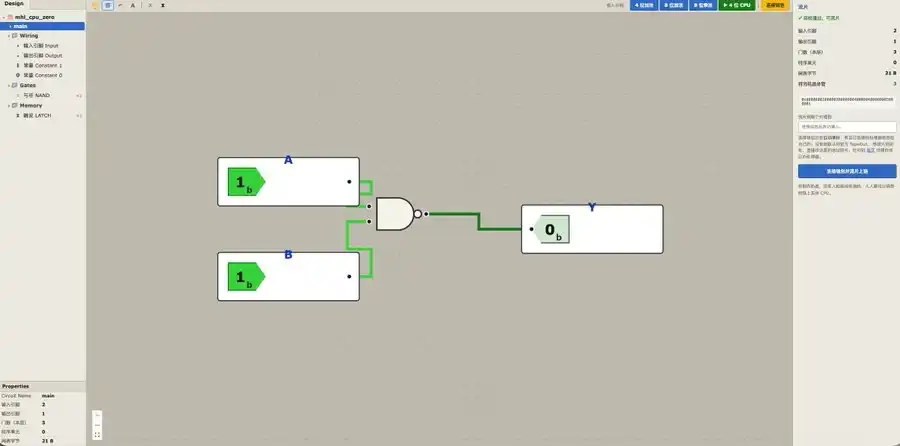
**Title: Understanding TapeOut: A Kid Built a CPU On-Chain** **Summary:** The article explores a remarkable experiment where a young developer named Blonskr has used blockchain technology to build a functional, on-chain CPU. Named "Behemoth," this CPU is based on the 1971 Intel 4004 processor specification. It runs on the BNB Chain, uses block production as its clock (running at a glacial 2.22 Hz), and is perhaps the slowest CPU in existence, yet it represents a novel and intriguing concept in the on-chain space. The core concept is the TapeOut protocol, named after the final "tape out" stage in semiconductor manufacturing. It treats the blockchain as a silicon wafer, with tokens representing fundamental logic components. The protocol's atomic unit is an ERC-1155 token representing a single NAND gate, the fundamental building block of digital logic. Users can visually design circuits on a "canvas," connecting these logic tokens. Once a design is finalized, the underlying tokens are burned, and an ERC-721 NFT representing the permanent, immutable circuit is minted. Blonskr used 2,300 such tokenized NAND gates to construct the Behemoth CPU. Key features of this and any TapeOut circuit include **permanent operation** (running as long as the chain exists), **free, permissionless evaluation** (anyone can query it without gas), and **safe composability** (circuits cannot call external contracts or modify state, making them inherently safe to use). This enables a new form of open, collaborative hardware design, where anyone can build upon and integrate components created by others. While highly niche, TapeOut reimagines the foundations of computation using blockchain's properties of permanence and openness. It pushes the boundaries of what can be built on-chain, potentially enabling future applications like custom mining circuits or decentralized, specialized processors. The experiment demonstrates an exciting combination of extreme technical vision and creative curiosity.

marsbit08/17 05:51

Deciphering TapeOut: A Child Built a CPU On-Chain

marsbit08/17 05:51

Understanding Crypto Payment Cards in 5 Charts: Stablecoins Move from On-Chain to Real-World Spending

5 Charts to Understand Crypto Payment Cards: Stablecoins Move from On-Chain to Real-World Spending Stablecoins are increasingly used for everyday purchases through crypto payment cards, a sector now processing over $750 million monthly. These cards allow users to spend cryptocurrencies at any merchant accepting traditional card networks, with the crypto (primarily stablecoins) instantly converted to fiat currency at checkout. Merchants receive standard payments. Users don't necessarily need a bank account. Some products require holding stablecoins with the issuer, while others work directly with self-custody wallets. These cards provide global access to USD-denominated services. Data shows monthly transaction volume reached $759 million in July 2026, a 2.5x increase from $306 million a year prior, with nearly 9 million transactions that month. The average transaction value is about $86. Initially concentrated on Gnosis Chain (home to Gnosis Pay, the first Visa card linked to a self-custody wallet), transaction volume has diversified across blockchains. As of July, Optimism leads with 29%, followed by Solana and Base at 19% each, while Gnosis Chain has fallen to 2%. Euro-pegged stablecoins, once dominant (88% in early 2024), now represent only 2% of volume. Dollar-pegged stablecoins USDC and USDT now lead, accounting for 58% and 26% of transactions respectively. While still small compared to traditional card networks, the sector is growing rapidly. It leverages existing infrastructure, with nearly all covered products operating on the Visa network. Regulatory developments like the GENIUS Act have contributed to this acceleration.

marsbit08/10 04:40

Understanding Crypto Payment Cards in 5 Charts: Stablecoins Move from On-Chain to Real-World Spending

marsbit08/10 04:40

How Does Circle Incentivize USDC Distribution Channels? From the Hyperliquid Collaboration and On-Chain 9:1 Attribution

How Circle Incentivizes USDC Distribution Channels: Insights from Hyperliquid Partnership and 9:1 On-Chain Allocation Circle employs economic incentives to drive USDC growth, product development, and distribution. The company has signed distribution partnership agreements with over 150 firms, offering tailored incentives for key channels that substantially expand USDC usage. For major partnerships, Circle can co-design arrangements with Coinbase. Their revenue-sharing model for off-platform USDC allocates 50% of the net "Ecosystem Economic Interest" to each after approved third-party incentives. The Hyperliquid partnership illustrates this framework, involving Coinbase, Circle, and Hyperliquid. At quarter-end, approximately 90% of Hyperliquid's USDC reserves were allocated to Coinbase's platform and 10% to Circle's platform, observable on-chain via specific addresses maintaining this ~9:1 balance. However, this allocation ratio represents fund attribution for accounting purposes and does not disclose the precise final revenue split among the three parties, which remains confidential. In summary, Circle's channel incentive program is a long-standing strategy to expand USDC's distribution scale collaboratively with partners, with significant cases like Hyperliquid demonstrating the operational model despite undisclosed exact profit-sharing terms.

marsbit08/08 14:56

How Does Circle Incentivize USDC Distribution Channels? From the Hyperliquid Collaboration and On-Chain 9:1 Attribution

marsbit08/08 14:56

活动图片