Original |Odaily Planet Daily(@OdailyChina)
Author|Golem(@web3_golem)

As the mandatory window in August approaches, discussions about the BIP-110 proposal have heated up again recently.
BIP-110 was proposed by Dathon Ohm in December 2025 and has received support from Bitcoin Core developer Luke Dashjr. The proposal aims to limit arbitrary/non-monetary data in Bitcoin transactions within the next year, primarily targeting large data storage such as Ordinals and Bitcoin NFTs, hoping to reduce "spam transactions" in the network and refocus Bitcoin on its monetary function.
This proposal has been controversial since its introduction, but data shows that BIP-110 is currently not supported by mainstream miners and nodes. The activation threshold for BIP-110 is 55%. According to statistics, the current miner support rate is less than 1%, and only 15,035 out of a total of 102,674 nodes globally are willing to implement BIP-110, a proportion of 14.64%.
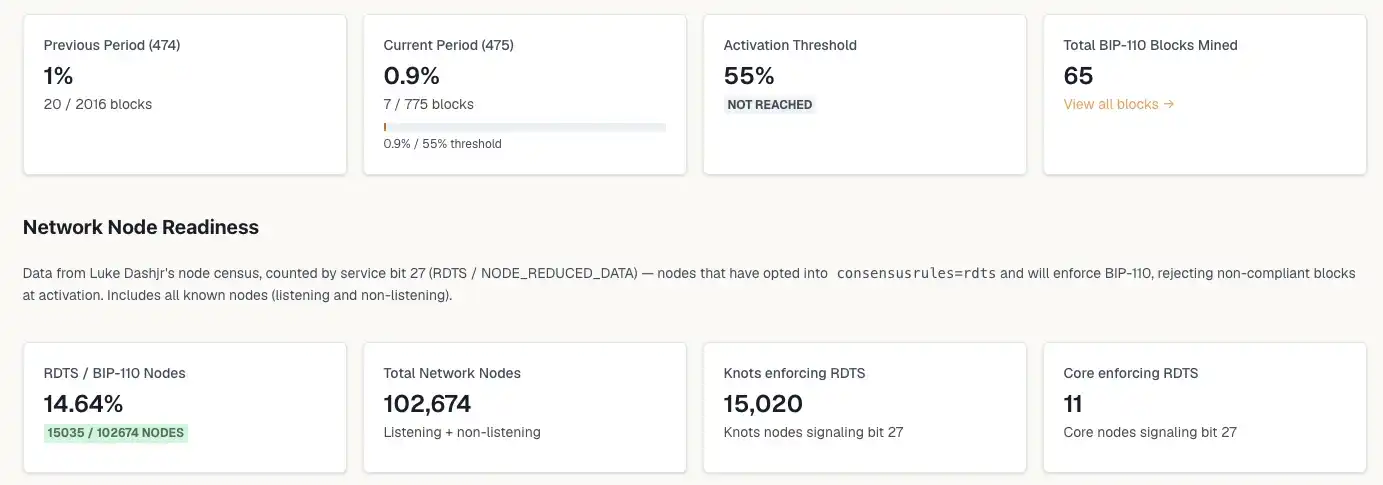
BIP-110 Miner and Node Support Rate
Typically, proposals with such low support rates cannot pass on the Bitcoin network, but the tyranny of BIP-110 lies in the fact that even without consensus, nodes supporting BIP-110 will enforce it. If the 55% activation threshold is not reached before block height 961632, it will enter the mandatory window period (block height 961632-963647). During this period, nodes running BIP-110 will reject non-compliant blocks, forcibly raising the acceptance rate to 100%, ultimately enabling BIP-110 to be forcibly activated at block height 965,664.
Based on the current Bitcoin network block production speed, BIP-110 will enter the mandatory window period in early August. This means that although BIP-110 is a soft fork proposal, a chain fork will occur in the Bitcoin network at that time (the minority chain supporting BIP-110 and the main chain not supporting BIP-110).
BIP-110 Controversy Continues
According to Bitcoin's "longest chain rule", only when the actual mining hash power supporting BIP-110 constitutes a majority (>50%) will they form the longest chain, and the entire network will unify under the new rules, signifying a successful soft fork. Therefore, although the outcome of BIP-110 being forcibly activated is predetermined, its ultimate sustainability still depends on consensus. Otherwise, BIP-110 will end like the vast majority of Bitcoin soft forks in history: dying a natural death.
Proponents: BIP-110 is not a change, but a negation of change
The main representative of BIP-110 supporters is Luke Dashjr and his affiliated mining pool, Ocean. Luke Dashjr was an early radical figure in the Bitcoin developer community opposing BRC-20 and inscriptions, and he also provided original suggestions for the BIP-110 proposal.
Luke Dashjr is regarded as a representative of Bitcoin fundamentalism. They are unwilling to see Bitcoin block space used for any purpose other than Bitcoin transfers. In the BIP-110 proposal, inscriptions that appeared in 2022 are viewed as a "Bitcoin attack" because if arbitrary data embedding in Bitcoin transactions is allowed, it creates a huge and unnecessary burden on nodes. Simultaneously, these "spam data" occupy a large amount of block space, forcing monetary transactions to raise their bidding thresholds to be included in a block, squeezing out Bitcoin's monetary use.
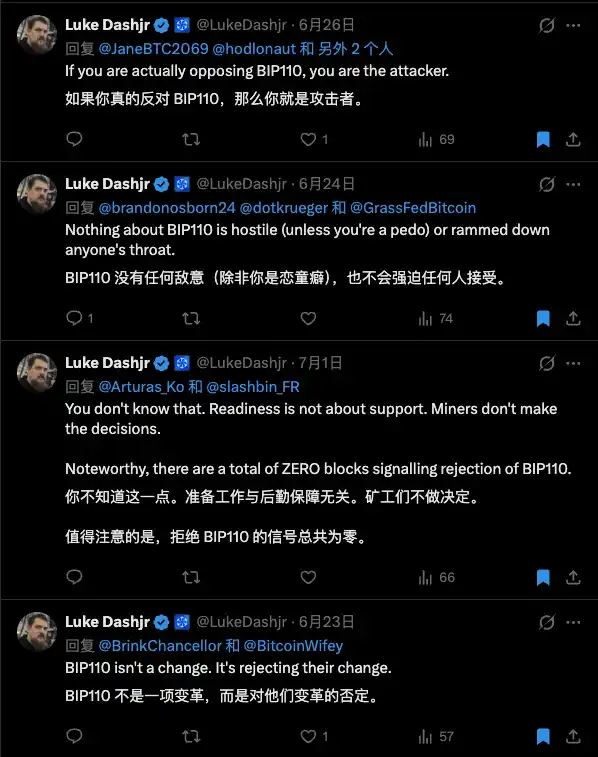
Therefore, Luke Dashjr posted on X platform, stating that BIP-110 is not a change but a negation of change. When facing BIP-110 opponents, he also fully exercised his sophistry skills. On one hand, he claimed BIP-110 has no hostility and does not force anyone to accept it; on the other hand, he argued that those who oppose BIP-110 are the real Bitcoin attackers.
Moreover, although the current approval voting rate for BIP-110 among miners is very low (<1%), Luke Dashjr remains optimistic, believing that the direct opposition voting rate among miners is also almost 0%, implying that miners do not make decisions, and when BIP-110 is activated, they will naturally follow.
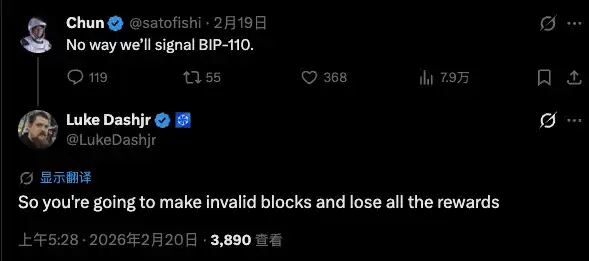
Looking at reality, as of now, the only mining pool publicly supporting BIP-110 is Luke Dashjr's own Ocean. Wang Chun, co-founder of F2Pool, publicly stated as early as February that he would never support BIP-110. Luke Dashjr confidently replied under his post, "Then you will mine invalid blocks at that time and lose all rewards."
According to miningradar data, F2Pool is the third largest Bitcoin mining pool globally, with a hash power share of 13.6%; whereas Ocean's current hash power is only 24.6 EH/s, accounting for 2.6% of the total network hash power.
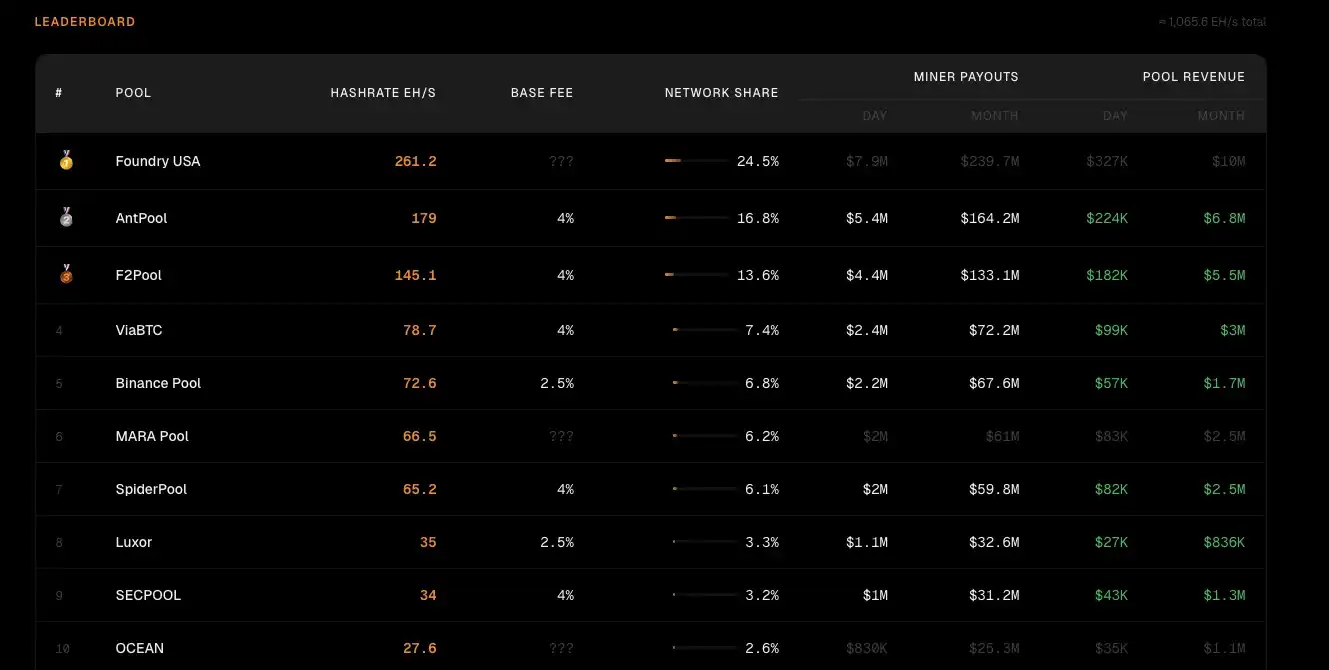
Bitcoin Mining Pool Rankings
If Ocean ultimately remains the only supporting mining pool on the fork, they would only produce 3-5 blocks per day. Such work efficiency and block production speed cannot form the "longest chain" on the Bitcoin network.
Opponents: BIP-110 does not solve the problem while creating more new problems
The opposition to the BIP-110 proposal does not focus solely on whether BIP-110 will succeed after activation. Instead, they criticize it for failing to solve the "spam transaction" problem on the Bitcoin network while simultaneously creating many potential new issues. In short, the BIP-110 opposition strongly opposes it due to concerns about various unintended consequences, not out of any attachment to Ordinals or inscriptions. The representatives of the opposition are cypherpunk pioneer Adam Back, Bitcoin Core developer Jameson Lopp, and Strategy founder Michael Saylor.
First, opponents believe BIP-110 cannot completely solve the "spam transaction" problem faced by the Bitcoin network; the author of the BIP-110 proposal also admits it can only provide temporary relief. Jameson Lopp believes Bitcoin's block size limit and block space bidding market have already alleviated the spam transaction problem to some extent. However, the reason Bitcoin has always been a target for various spam transaction attacks is that almost no one truly uses the Bitcoin network, transaction fees have remained low, and thus sufficient fee pressure to suppress most spam transactions has not formed.
Simultaneously, BIP-110 would stifle Bitcoin's future innovation. The BIP-110 proposal also admits that restrictions on Taproot hinder the implementation of advanced functions or complex contracts like BitVM on the Bitcoin network. Although BIP-110 is described as a temporary one-year restriction, Jameson Lopp believes this is just Luke Dashjr's delaying tactic. If these restrictions severely hinder future Bitcoin upgrades, it could lead to a Bitcoin hard fork rather than a soft fork.
Adam Back focuses more on Bitcoin's censorship resistance and decentralized spirit. He believes BIP-110 would subjectively censor transactions within blocks, fundamentally aiming to regulate others, which runs counter to the neutrality and censorship-resistant spirit Bitcoin has upheld since its inception. It is a dangerous step towards centralization and control for Bitcoin. Adam Back uses Bitcoin fundamentalism to negate the changes proposed by Bitcoin extremists, essentially "using magic to defeat magic."
Michael Saylor summarizes BIP-110 as a "Bitcoin Iatrogenic Proposal", implying that the BIP-110 "treatment plan" itself would harm Bitcoin rather than solve existing problems.
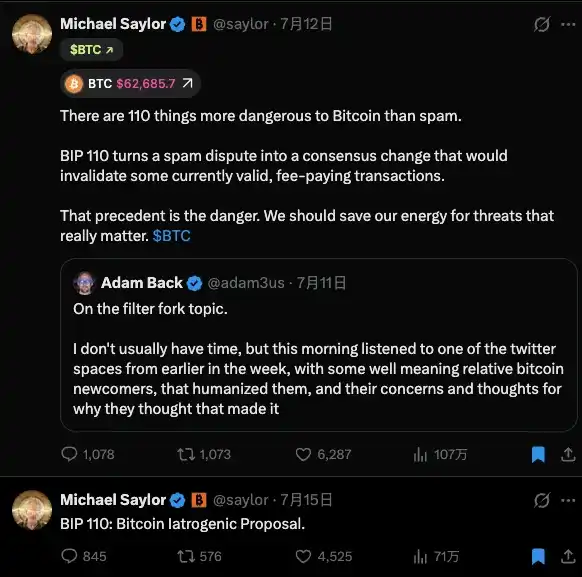
Furthermore, Michael Saylor believes that if BIP-110 is transformed into consensus, some valid paid transactions would also become invalid, and setting such a precedent for censorship is the real danger.
Opponents also worry about another serious consequence: the activation of BIP-110 could split the Bitcoin chain ecosystem. Two competing chains would then vie for the status of "the real Bitcoin." In such a scenario, Bitcoin double-spending risks might arise due to the uncertainty of the fork outcome. Even without causing double-spending, if BIP-110 eventually evolves into a new chain, it would split Bitcoin's developer resources, hash power resources, and monetary consensus.
Opponents believe BIP-110 is attempting to use technical means to solve a cultural problem, which may ultimately generate more unpredictable issues.
Despite their worries, opponents remain confident about BIP-110's failure. Jameson Lopp bet on BIP-110 as early as February, with a minimum stake of 1 BTC. So far, no BIP-110 supporter has publicly accepted the bet.
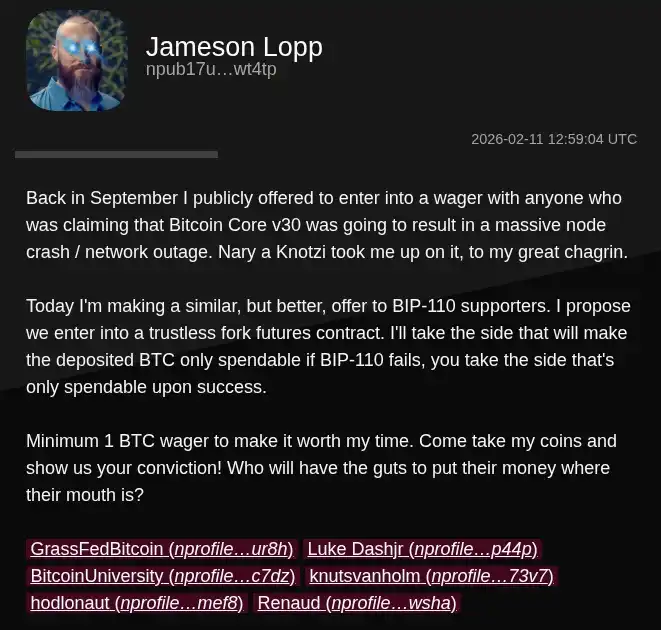
Jameson Lopp's Betting Challenge to BIP-110 Supporters
On the prediction market Predyx, the probability of "BIP-110 being activated and enforced on Bitcoin between September 1-7, 2026" is 10%. The settlement condition for "Yes" is that the BIP-110 chain becomes the "Bitcoin longest chain" accepted by most nodes.
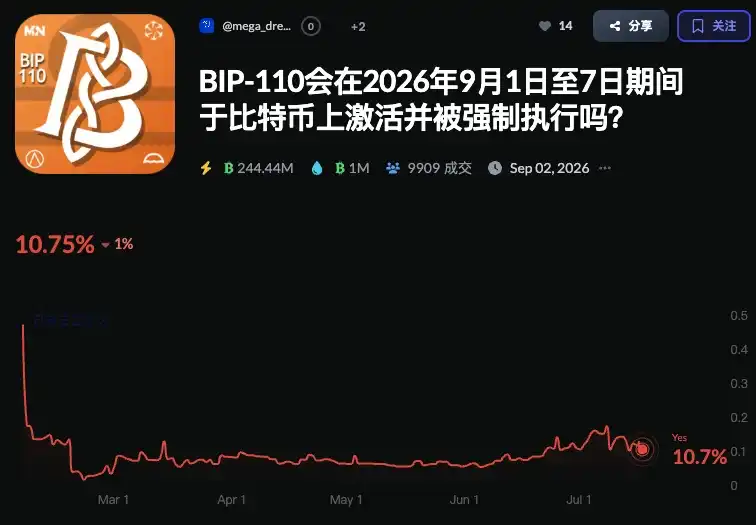
What Will Happen After BIP-110 Activates?
We can now consider some hypothetical scenarios, i.e., what will happen when BIP-110 is finally forcibly activated at block height 965,664 (late August to early September).
The first scenario is as described above. After reaching the activation height, BIP-110 nodes reject main chain blocks, but there aren't enough miners producing new blocks that comply with BIP-110 rules. The BIP-110 block production speed would be extremely slow, eventually stopping and ceasing to "grow".
The second scenario is that a certain proportion of miners support BIP-110. BIP-110 supporters believe they possess an "asymmetric advantage" because BIP-110 rules are stricter. Therefore, although BIP-110 nodes will reject blocks containing违规数据 (inscriptions, etc.), non-BIP-110 nodes (mainstream Core nodes) will consider blocks produced by BIP-110 nodes as valid.
Moreover, currently in Bitcoin block space, inscription transaction proportions have dropped to 5%, with over 95% still being traditional Bitcoin transfer transactions. BIP-110 nodes can still receive a large number of mainstream blocks. Hence, Luke Dashjr believes BIP-110 will ultimately become the "longest chain" and unify the network.
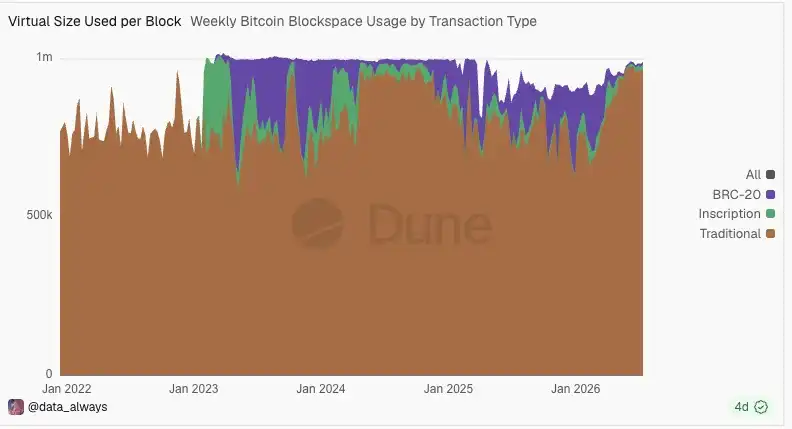
Bitcoin Block Space Usage by Transaction Type
The third scenario is that a certain proportion of miners support BIP-110, but their hash power始终 cannot surpass the existing majority chain. Typically, miners are highly rational because their machines start consuming electricity costs once turned on. In the competition between two chains, miners weigh the pros and cons. Miners on the BIP-110 chain are more likely to abandon sunk costs (mining rewards on the minority chain) and join the majority chain because the minority chain not only lags in chain length but also accumulates fewer Bitcoin rewards than the majority chain. Ultimately, this turns into the first scenario.
So, assuming Luke Dashjr's appeal is extremely strong and miners remain irrational, persistently mining on the BIP-110 chain, what would happen? This chain would continue to operate independently, but block times might be very slow, miners would almost entirely be mining for passion, engaging in meaningless energy consumption. The most reasonable outcome in this situation is that the BIP-110 chain permanently forks into an independent chain under the support of BIP-110 proponents, "manually" adjusts block difficulty, and launches a new network token.
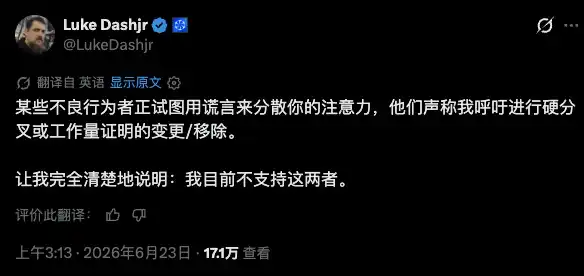
However, Luke Dashjr has repeatedly emphasized his refusal of a BIP-110 hard fork, believing it's not yet time to use hard fork measures. Water can carry a boat but also capsize it. By then, Luke Dashjr might also be swept along by popular will, with the arrow already on the bowstring,不得不发 (having to shoot).
Therefore, the minority chain run by BIP-110 supporters can technically continue to operate, but it will likely struggle to thrive because it depends on economic and ecological factors, including support from wallets, exchanges, users, etc. There are actually many such examples on the Bitcoin network, with most ultimately failing. Even if successful, the ceiling is limited to independent tokens like BCH, BSV, etc.