Ripple Makes New AI Bet As XRP Ledger Targets Agentic Payments

bitcoinist發佈於 2026-02-26更新於 2026-02-26

文章摘要

Ripple has invested in AI infrastructure startup t54 as part of a $5 million seed round, signaling a strategic move into autonomous payments and agent-driven financial systems. The investment aims to integrate the XRP Ledger as a key network for machine-to-machine commerce. t54 is developing a trust layer for the "agentic economy," focusing on verifiable agent identity (KYA), real-time risk assessment, and programmable accountability. The platform spans identity verification, risk management, credit, and settlement, with support for multiple blockchains including XRPL, Solana, and Base. Ripple executives emphasized the need for evolved financial infrastructure as AI agents become active economic participants. Survey data cited by t54 indicates growing consumer willingness to delegate financial tasks to AI, contingent on robust security. At the time of reporting, XRP was trading at $1.4397.

Ripple has backed AI infrastructure startup t54 in a $5 million seed round, a move that ties the company more closely to the emerging market for autonomous payments and agent-driven financial activity. The investment also puts the XRP Ledger in the frame as one of the networks being positioned for machine-to-machine commerce.

Ripple And The XRP Ledger Enter The Agentic Payments Race

t54 announced on February 25 that its seed round was led by Anagram, PL Capital, and Franklin Templeton, with strategic participation from Ripple, alongside Virtuals Ventures, Blockchain Coinvestors, and ABCDE. The company describes itself as a “trust layer for the agentic economy,” focused on a problem that is starting to attract more attention as AI systems move from recommendation to execution: how to verify an agent’s identity, evaluate its risk, and assign accountability when something goes wrong.

That framing was echoed by Ripple President Monica Long, who wrote on X that “as autonomous agents begin managing and transacting with real capital, trust infrastructure becomes a foundational piece of the equation.” She added that Ripple was “proud to be at the forefront of AI innovation,” calling out t54 as a team “building the trust layer for the agentic economy.”

The company’s pitch is that existing financial rails were built around humans, not software agents acting on delegated authority. In the press release, founder Chandler Fang laid that out directly:

“We are building trust infrastructure for the agentic economy. Financial systems were designed around human identity and human decision-making. As agents become autonomous participants, we need agent-native financial primitives—verifiable agent identity (KYA), real-time risk assessment, and programmable accountability—built for how agents operate.”

That thesis is not just about identity in the abstract. t54 says its platform is built across four pillars: identity and verification, risk and fraud, credit, and a broader operating platform that combines controls with settlement. The idea is to give institutions a way to bind agents to verified developers or human operators, monitor their behavior in real time, and decide when they should be allowed to transact, borrow, or execute payment flows.

The company is also making a direct bet on crypto rails as part of that stack. Among the products it listed is an “XRPL x402 Facilitator,” described as infrastructure that lets AI agents pay for services using XRP and RLUSD. It also highlighted an open-source secure layer on x402 and said its ecosystem spans XRPL, Solana, Base, and Virtuals, suggesting it is not building for a single chain, even if Ripple’s involvement gives XRPL special relevance.

That matters because Ripple’s interest here goes beyond venture exposure. Markus Infanger, SVP at RippleX, framed the opportunity as a shift in the nature of economic actors themselves:

“Autonomous systems are becoming participants in economic activity, not just tools. The financial infrastructure that supports them must evolve accordingly. We support t54’s efforts to build the identity and risk capabilities that will be foundational as AI agents operate across payments, treasury, and capital markets.”

Tony Pecore, Franklin Templeton SVP and director of digital asset management, said:

“As institutions embrace tokenization and autonomous systems, the infrastructure layer must evolve to match. t54 is building the trust and verification framework that institutional finance will require as AI agents become participants in financial markets.”

t54 also backed its market argument with survey data. It cited a recent YouGov study showing 42% of US consumers would allow an AI agent to make purchases on their behalf if it secured the lowest price.

At the same time, research from Keyfactor found 86% of cybersecurity professionals believe autonomous systems and AI agents should have unique, dynamic digital identities. Together, those figures capture the tension t54 is trying to monetize: growing willingness to delegate financial actions to software, but only with tighter controls.

For Ripple and XRPL, the bet is clear. If autonomous agents do become active users of payment rails, then Ripple wants XRP Ledger infrastructure to be part of that next layer.

At press time, XRP traded at $1.4397.
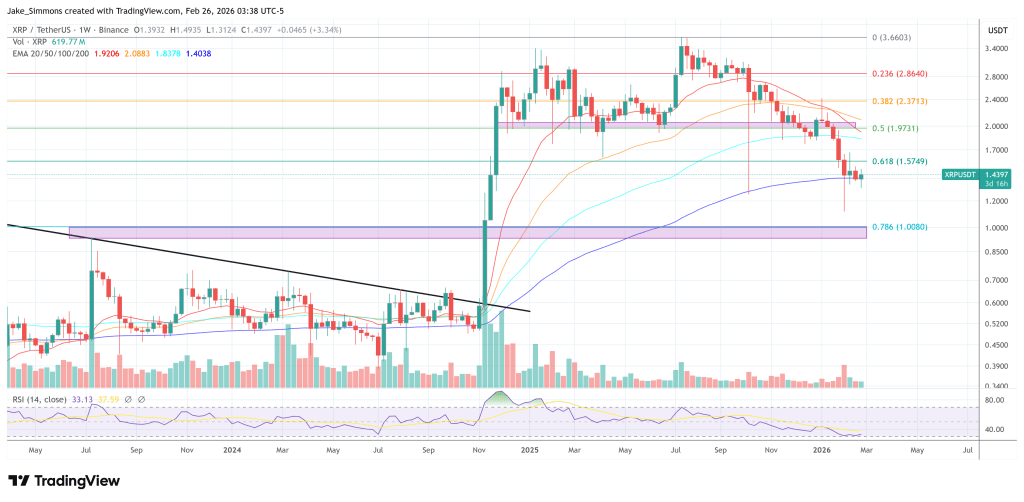
XRP rises back above the 200-week EMA, 1-week chart | Source: XRPUSDT on TradingView.com

熱門幣種推薦

相關問答

QWhat is the main focus of t54, the AI infrastructure startup that Ripple invested in?

At54 is building a trust layer for the agentic economy, focusing on providing verifiable agent identity (KYA), real-time risk assessment, and programmable accountability for autonomous AI agents operating in financial systems.

QWhich financial networks is t54's platform being built to support?

At54's ecosystem spans multiple networks, including XRP Ledger (XRPL), Solana, Base, and Virtuals, indicating it is not building for a single blockchain.

QAccording to Ripple President Monica Long, why is trust infrastructure becoming crucial?

AMonica Long stated that as autonomous agents begin managing and transacting with real capital, trust infrastructure becomes a foundational piece of the equation to ensure security and accountability.

QWhat key statistic from a YouGov study did t54 cite to support its market argument?

At54 cited a YouGov study showing 42% of US consumers would allow an AI agent to make purchases on their behalf if it secured the lowest price.

QHow did Markus Infanger from RippleX describe the shift in economic activity?

AMarkus Infanger described it as autonomous systems becoming participants in economic activity, not just tools, necessitating an evolution in the financial infrastructure that supports them.

你可能也喜歡

如何让自己变得让人工智能永远也无法取代

面对人工智能的冲击,许多人担心工作被取代。然而,真正的威胁在于个人对他人和系统的依赖,以及由此产生的“薪资奴役”——即为生存而从事无意义、枯燥的工作。摆脱这种困境的关键,不是抵制技术,而是成为拥有高自主性的“不可受雇”个体。 文章提出了成功抵御AI替代的五个核心要素:自主性(主动行动的能力)、品味(判断事物价值的经验)、说服力(让他人关注你工作的能力)、毅力(坚持并从错误中学习)和迭代(根据反馈持续改进)。这些能力无法仅通过理论学习获得,必须通过实践来培养。 要启动转变,首先要彻底改变环境,重塑身份认同。其次,应选择一个能获得真实、快速反馈的实践领域,例如创业。在众多技能中,内容创作(媒体)比编写代码更具优势,因为其价值是主观的,需要独特的审美和判断力,这正是AI目前难以完全复制的。 具体行动上,可以从三个步骤开始: 1. **挖掘原始素材**:反思自己长期痴迷的知识领域、轻松解决的难题或童年被压抑的兴趣,找到独特的个人经验。 2. **确立反向思考主轴**:找出你坚信但主流观点错误的地方,或行业内普遍忽视的“皇帝新衣”,形成独特的批判性视角。 3. **立即发布**:将前两步的思考融合,撰写并发布第一个核心内容(如帖子、视频),勇敢接受真实世界的反馈,并在此基础上持续学习和迭代。 最终,抵御AI的关键在于构建一份与自身身份深度契合的毕生事业,通过持续的内容创作和真实互动,建立无法被自动化取代的独特价值和影响力。行动,从今天发布第一个想法开始。

marsbit3 小時前

如何让自己变得让人工智能永远也无法取代

marsbit3 小時前

通过掷骰子离线保管比特币密钥:并非人人愿意为之

文章探讨了通过投掷骰子生成比特币钱包种子短语的安全方法及其现实挑战。核心观点如下: **1. 骰子提供物理熵源** 骰子结果由众多微小变量决定,理论上虽可预测,但实践中无法被攻击者复制或计算,从而提供高质量的随机性。每个六面骰子投掷约产生2.585比特熵,50次投掷即可满足典型12词助记词(128比特熵)的安全需求。 **2. Coldcard漏洞事件凸显手工熵源的价值** 近期Coldcard硬件钱包因固件漏洞导致其内部随机数生成器存在缺陷,致使约1128枚比特币被盗。但那些**完全**通过足量骰子投掷生成种子短语的用户未受此漏洞影响,因为他们的主密钥未使用有缺陷的生成器。 **3. 重要警示:手工种子并非万能保护** 安全研究员指出,即使用户使用骰子生成了安全的种子,若他们使用了Coldcard的其他功能(如生成纸钱包、克隆密钥、共享签名密钥、密码等),这些**衍生密钥**仍可能调用有漏洞的随机数生成器,从而存在风险。安全种子不保证设备生成的所有秘密都安全。 **4. 手工生成熵源的现实局限性** 尽管数学上可靠,但该方法对大多数用户并不友好: * **过程繁琐易错**:需投掷50-99次,精确记录,任何输入错误都会导致钱包完全不同。 * **引入新风险**:用户可能在记录、转换过程中泄露信息,或使用有偏的骰子/投掷方式。 * **用户体验差**:难以想象大规模推广需要用户手动投掷近百次骰子。安全措施需适应现实生活场景和普通用户的知识水平。 **5. 给用户的建议** 受影响的Coldcard用户应: * 更新固件至最新版。 * 检查是否使用过有漏洞的功能生成了次级密钥或密码,如有则需立即更换。 * 考虑采用多签方案,使用不同厂商的设备分散风险。 **结论**:手工投掷骰子生成熵源是技术娴熟用户的一个有效安全选项,但其过程复杂、容易出错,不适合作为主流用户的默认方法。长远目标是依赖安全、透明且无需专业知识的硬件/软件随机数生成方案。

cryptonews.ru6 小時前

通过掷骰子离线保管比特币密钥:并非人人愿意为之

cryptonews.ru6 小時前

交易

現貨

熱門文章

什麼是 XRP 2.0

XRP 2.0:加密貨幣領域的新前沿 XRP 2.0 簡介 在瞬息萬變的加密貨幣領域中,不斷有新項目出現,爭取關注和採用。其中一個有前景的倡議是 XRP 2.0,這是一個新穎的加密貨幣項目,旨在利用先進的區塊鏈技術和強健的加密方法。雖然這個名字與 Ripple 的 XRP 有所關聯,但重要的是要注意 XRP 2.0 獨立運作,專注於增強交易安全性、隱私和擴展性。隨著數字金融領域越來越多地接受去中心化解決方案,XRP 2.0 旨在對 web3 及整體的加密項目擴展做出有意義的貢獻。 XRP 2.0 是什麼? XRP 2.0 本質上是一個加密貨幣項目,旨在創建一個安全和去中心化的數字貨幣生態系統。其基本技術將複雜的區塊鏈原則與尖端的加密技術集成在一起。XRP 2.0 的總體目標是建立自己作為一個可靠和高效的平台,能夠快速執行交易,同時優先考慮為用戶提供增強的隱私保護。 該項目被宣傳為解決現有加密貨幣所面臨的諸多限制的解決方案,提出一個能夠以更高速度和隱私處理更大交易量的系統。這種多功能性使 XRP 2.0 成為數字貨幣市場的重要競爭者。 XRP 2.0 的創建者是誰? XRP 2.0 的創建者身份被標示為「Wilbur」。然而,關於 Wilbur 或其相關實體的詳細資訊仍然難以捉摸。許多加密貨幣創建者的匿名性在行業中並不罕見,通常是為了保持一定程度的隱私和安全。 XRP 2.0 的投資者是誰? 截至目前,與支持 XRP 2.0 的投資基礎或組織有關的具體信息並未公開。在加密貨幣領域,由知名投資者的支持可以顯著影響項目的可信度和成功,但對於 XRP 2.0 的財務支持者的透明度尚未建立。 XRP 2.0 如何運作? XRP 2.0 的特色在於採用了區塊鏈技術和先進的加密算法的組合,以確保安全和去中心化的交易。其創新結構包括設計獨特的功能,旨在促進用戶參與並擴展超出傳統加密貨幣交易的功能。 在這些功能中,XRP 2.0 結合了 AI 驅動的能力,如文本到圖像和文本到語音功能。這些附加功能旨在增強用戶的互動體驗,促進在各個領域的廣泛應用。通過將技術進步與以用戶為中心的設計相結合,XRP 2.0 旨在吸引各種個人和企業,希望將加密貨幣解決方案整合到其運營框架中。 XRP 2.0 的時間線 理解 XRP 2.0 需要檢視至今定義其旅程的一些重要里程碑: 2023 年 7 月 23 日:XRP 2.0 被介紹為一個新穎的加密貨幣項目,旨在革新區塊鏈領域中的安全和去中心化交易能力。 2023 年 9 月 8 日:另一個項目 XRP20 上線,標誌著一個與 XRP 2.0 無關的以太坊區塊鏈上的 ERC-20 代幣的出現。 2023 年 11 月 13 日:XRP 總帳進行重大更新,發布 rippled 服務器軟件版本 2.0.0。值得注意的是,這一發展與 XRP 2.0 加密貨幣項目無關。 XRP 2.0 的要點 為了提煉 XRP 2.0 的本質,有幾個關鍵因素浮現: 獨特特徵:包括 AI 驅動的文本到圖像和文本到語音等功能進一步擴展了 XRP 2.0 的潛在應用。 區塊鏈技術:該框架利用先進的區塊鏈機制和加密協議,確保交易的安全和去中心化環境。 擴展性和隱私性:XRP 2.0 在交易過程中優先考慮增強隱私保護以及滿足不斷增長用戶基礎所需的擴展性。 與 Ripple 無關:重要的是,儘管其名稱如此,XRP 2.0 與 Ripple 的 XRP 沒有任何關聯或合作,顯著區分其在加密貨幣生態系統中的運營框架和目標。 結論 XRP 2.0 代表著在加密貨幣領域的一項雄心勃勃的冒險,旨在提供安全、隱私和高效的數字交易組合。通過整合複雜的技術和用戶友好的功能,該項目旨在擴大加密貨幣在當今數字經濟中所能實現的視野。 儘管其創建者的匿名性和缺乏公布的投資者可能會讓一些人產生疑問,但 XRP 2.0 對先進功能和去中心化的專注提升了其在日益擁擠的加密市場中的吸引力。隨著加密貨幣領域的持續演變,XRP 2.0 可能成為安全和可擴展區塊鏈解決方案擴展中的關鍵角色。

499 人學過發佈於 2024.04.05更新於 2024.12.03

什麼是 XRP 2.0

如何購買XRP

歡迎來到HTX.com!在這裡,購買XRP (XRP)變得簡單而便捷。跟隨我們的逐步指南,放心開始您的加密貨幣之旅。第一步:創建您的HTX帳戶使用您的 Email、手機號碼在HTX註冊一個免費帳戶。體驗無憂的註冊過程並解鎖所有平台功能。立即註冊第二步:前往買幣頁面,選擇您的支付方式信用卡/金融卡購買:使用您的Visa或Mastercard即時購買XRP (XRP)。餘額購買:使用您HTX帳戶餘額中的資金進行無縫交易。第三方購買:探索諸如Google Pay或Apple Pay等流行支付方式以增加便利性。C2C購買:在HTX平台上直接與其他用戶交易。HTX 場外交易 (OTC) 購買:為大量交易者提供個性化服務和競爭性匯率。第三步:存儲您的XRP (XRP)購買XRP (XRP)後,將其存儲在您的HTX帳戶中。您也可以透過區塊鏈轉帳將其發送到其他地址或者用於交易其他加密貨幣。第四步:交易XRP (XRP)在HTX的現貨市場輕鬆交易XRP (XRP)。前往您的帳戶,選擇交易對,執行交易,並即時監控。HTX為初學者和經驗豐富的交易者提供了友好的用戶體驗。

2.6k 人學過發佈於 2024.12.10更新於 2026.06.02

如何購買XRP

相關討論

歡迎來到 HTX 社群。在這裡,您可以了解最新的平台發展動態並獲得專業的市場意見。 以下是用戶對 XRP (XRP)幣價的意見。

活动图片














