OpenAI Official Plugin Strongly Integrated into Claude Code

marsbit發佈於 2026-03-31更新於 2026-03-31

文章摘要

OpenAI has officially released the "codex-plugin-cc" on GitHub, enabling developers to integrate OpenAI’s Codex model capabilities directly into Anthropic’s command-line development tool, Claude Code. This cross-platform integration breaks down ecosystem barriers between major AI tools, allowing developers to leverage the strengths of both models without switching environments. With simple configuration, Claude Code becomes a versatile programming assistant combining the advantages of both companies. Key features include: - Standard code review via the `/codex:review` command, providing expert improvement recommendations and double-checking for logic errors. - Adversarial review using `/codex:adversarial-review`, which challenges design decisions to identify potential performance bottlenecks or security risks. - Task delegation through `/codex:rescue`, allowing complex debugging or repair tasks to be handed off to a Codex sub-agent for collaborative problem-solving. This integration enhances code quality and development efficiency through multi-model collaboration.

Recently, the AI developer community welcomed a major update: OpenAI officially released an open-source project named codex-plugin-cc on GitHub. This plugin allows developers to directly utilize the capabilities of OpenAI's Codex model within the command-line development tool Claude Code, introduced by Anthropic.

This "cross-brand" integration breaks down the ecosystem barriers that previously existed between major AI model tools, enabling developers to leverage the technical strengths of both industry giants without switching environments. With simple command configurations, Claude Code instantly transforms into an all-in-one programming assistant that combines the best of both.
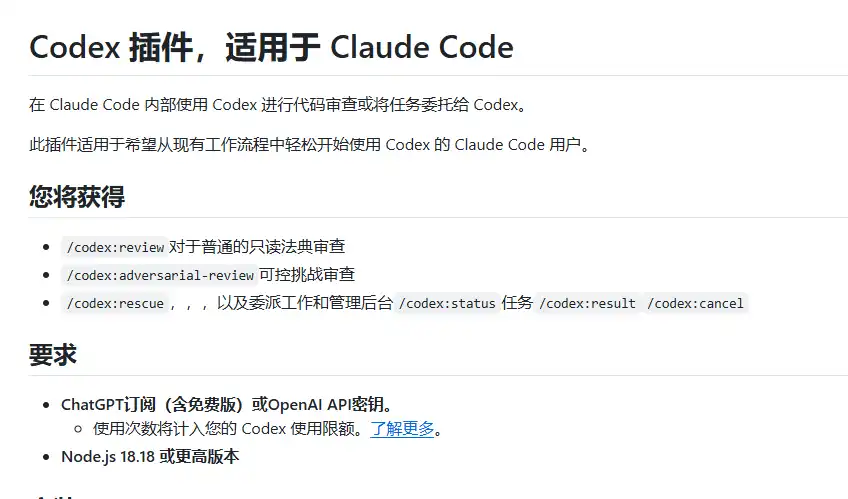
Empowered by this plugin, users can initiate a standard read-only code review using the /codex:review command to receive professional improvement suggestions from Codex. This dual verification mechanism effectively catches logical vulnerabilities that a single model might miss, adding a "double insurance" for code quality.

More uniquely, its "adversarial review" feature allows developers to use /codex:adversarial-review to actively request Codex to challenge existing design decisions. This mode is specifically designed to stress-test the rationality of system architecture, uncovering potential performance bottlenecks or security risks from a "fault-finding" perspective.

Additionally, the plugin introduces a task delegation mechanism, enabling users to transfer complex debugging or repair tasks to a Codex sub-agent via /codex:rescue. This collaborative model achieves automatic task distribution, allowing the primary model and auxiliary models to each focus on their respective areas of expertise.

github:https://github.com/openai/codex-plugin-cc

相關問答

QWhat is the name of the official OpenAI plugin that integrates with Claude Code?

AThe plugin is called codex-plugin-cc.

QWhat is the primary function of the /codex:review command in the new plugin?

AThe /codex:review command is used to initiate a standard read-only code review to get professional improvement suggestions from the Codex model.

QWhat unique feature does the /codex:adversarial-review command provide?

AThe /codex:adversarial-review command enables an 'adversarial review' function, which actively challenges existing design decisions to stress-test the system architecture and uncover potential performance bottlenecks or security risks.

QHow does the /codex:rescue command facilitate task management?

AThe /codex:rescue command allows users to delegate complex debugging or repair tasks to a Codex sub-agent, enabling a collaborative model where the main and auxiliary models work in their respective areas of expertise.

QWhere was the codex-plugin-cc project officially released?

AThe project was officially released by OpenAI on GitHub.

你可能也喜歡

史上最富美联储主席?凯文·沃什即将面临的三个难题

2026年4月,特朗普提名的美联储主席候选人凯文·沃什因持有超过1.3亿美元加密资产引发关注,其投资组合包括Compound、dYdX、Solana等多个项目。若上任,他将成为史上最富有的美联储主席,并面临三大挑战: 第一,降息前提是否成立。沃什曾以强硬通胀派著称,但2025年起转向认为AI将显著降低通胀、提升生产率。然而2026年3月CPI升至3.3%,能源价格大幅上涨,通胀压力重现,他承认“仍有工作要做”,但拒绝给出具体利率路径。 第二,美联储独立性受质疑。民主党参议员沃伦指责他迎合特朗普,但沃什强调总统未干预利率承诺,并认为独立性危机源于美联储自身过去为财政扩张背书、模糊政策边界,而非外部压力。此外,共和党因对鲍威尔的调查暂缓支持其提名,程序受阻。 第三,缩表与降息能否同步推进。沃什长期批评美联储资产负债表“臃肿”,主张大幅但有序缩减,同时让利率重新成为主要工具。市场担忧可能同时进行缩表和降息,导致不确定性增加。他还提议改革数据系统,采用实时价格追踪替代滞后CPI统计,并提及稳定币和链上数据可作为补充指标。 沃什的政策方向被视为“体制切换”,强调工具复位和内部争论,而非参数微调。

marsbit27 分鐘前

史上最富美联储主席?凯文·沃什即将面临的三个难题

marsbit27 分鐘前

AI“中转站”月入百万?五问揭开Token套利真相

该文探讨了AI“API中转站”这一新兴的Token套利模式。中转站本质是利用全球AI服务的价格差和访问壁垒,通过中间层服务将海外AI厂商的API Token以更低价格提供给国内用户,或反向将国产模型出口至海外,赚取差价。 其运作依赖几个关键因素:官方API定价偏高、订阅制与API计费错配、地区访问限制以及用户对高性能模型的强需求。用户使用中转站可降低成本并便捷接入顶级模型,但面临多重风险:上游Token来源可能涉及灰色手段(如盗刷信用卡)而不稳定;中游服务器可能窃取用户Prompt和数据用于训练或出售;末端可能存在模型降级或偷换(如用廉价模型冒充高端模型),导致性能下降。 文章指出,尽管这门生意因需求大、启动成本低而吸引众多参与者,但风控压力巨大,服务不稳定且同行竞争激烈,量价齐跌。同时,合规性风险高,可能涉及违法或导致数据泄露等问题。 对于普通用户,文章建议通过特定Prompt指令(如“ping+自报模型”)检测模型真伪,观察回复简洁性、Token消耗等特征识别掺假。但强调,风险大多不可见,敏感业务应优先选择官方API。 最后总结,中转站是当前全球AI市场错配下的短期套利窗口,非长期解决方案,稳定性和安全性才是核心价值。普通用户需谨慎在非敏感场景使用,开发者应选择官方渠道,创业者需提前规划退出机制以避免法律风险。

marsbit38 分鐘前

AI“中转站”月入百万?五问揭开Token套利真相

marsbit38 分鐘前

交易

現貨
合約
活动图片