Author|Golem(@web 3_golem)

Crypto KOLs active on the X platform are collectively up in arms.
The reason is that on March 1st, the X platform updated its paid partnership policy, which includes two core changes. First, the disclosure requirement for posts published by KOLs as paid partnerships has been changed from mandatory inclusion of the "#ad" tag to mandatory activation of the "Paid Partnership" disclosure label. Second, for non-compliant paid partnership posts, the reporting channel has been changed from sending an email to anonymous submission of a report form.
Besides these two core changes, the X platform also had a mishap during this policy update. In the new list of prohibited industries for paid partnerships on the X platform, the community was surprised to find "Cryptocurrency" included. Just as crypto KOLs were preparing to collectively criticize the X platform for intentionally marginalizing the crypto industry, X's product lead Nikita Bier posted that this change was a mistake and had already removed categories like "financial products, cryptocurrency" from the prohibited promotion list (promotion is still not allowed in Australia, the EU, and the UK).
Subsequently, Nikita Bier posted again to clarify that the "Paid Partnership" label is not targeted at the crypto industry or prediction markets, but rather to strengthen the disclosure mechanism for commercial content. Although the X platform encourages creators to engage in commercial collaborations with third-party brands, undisclosed paid promotional content can still damage the integrity of the product and weaken user trust in the content. The new feature helps fans clearly distinguish between commercial collaborations and organic content.
Although the misunderstanding has been resolved, the two core changes in X's new paid partnership rules still apply to the crypto industry, and the impact of these changes is just beginning to emerge, causing anxiety among crypto KOLs......
The End of the Dark Advertising Boom Era for Crypto KOLs
How much money can a crypto KOL earn by posting a single post for a project? This topic often sparks discussion in the community, primarily because it is a highly opaque income model with significant individual variations. There is no public standard for the pricing system of crypto KOLs. Project parties typically price based on factors such as the KOL's follower count, vertical niche attributes, content influence, and price-driving ability. Sometimes, a project party might pay a KOL simply because the boss likes them.
According to Odaily, Binance offered a well-known crypto KOL with over 30,000 followers $5,000 per month, stipulating that the KOL must not only post a full quota of promotional content for Binance each month but also include exclusivity clauses, meaning they are not allowed to post content promoting other exchanges.
It's not only KOLs with tens of thousands of followers who can secure sponsorships from exchanges. A crypto KOL with 5,000 followers revealed that OKX offered them $600 per month in advertising fees, requiring at least 4 promotional posts for OKX per month, along with including OKX elements in their personal bio and background.
Besides long-term signed contracts with exchanges, crypto KOLs often receive single-post advertisements from project parties, typically including event promotion posts, research analysis posts, or direct shilling posts, etc. The pricing for these types of content varies even more significantly between different KOLs. For example, during bullish markets, meme project "local bosses," to get KOLs with "price influence" to post shills, not only offer thousands of dollars in advertising fees but also directly send tokens to their private addresses.
The immense benefits brought by these diverse cooperation methods once made becoming a KOL a career goal for many in the crypto circle, but all this might become a thing of the past. With the changes to X's paid partnership policy, the boom era for crypto KOLs is over.
X's new paid partnership rules clearly require that paid promotional posts by crypto KOLs must carry the "Paid Partnership" label. This means the covert ads that previously flooded crypto users' timelines will no longer exist. As Nikita Bier said, creators clearly disclosing paid promotional content is responsible to their fans. In the short video and other content industries, it's normal for creators to insert overt ads in their content.
However, in the crypto industry, a KOL clearly stating that they are paid to promote a project is a major taboo.
First, the paying project parties themselves often cannot accept "overt ads." If a post is clearly seen by readers as a paid "praise piece," then no matter how objective the content is, the real strength of the project will be questioned. Therefore, when promoting a token/project, KOLs are usually required to adopt a style of "their own research, their own看好 (optimism)".
Imagine, in the future, to comply with X's requirements, KOLs' paid promotion posts all add the "Paid Partnership" label. When "covert research-based ads" turn into "overt recommendation ads," will fans still blindly follow and buy?
Second, KOLs themselves are also reluctant to take on "overt ads." The crypto industry is an industry closest to money. Crypto users' research behaviors and information acquisition are directly and highly feedbacked into trading decisions. Seeing a KOL shill a project and then buying, profits are credited to the KOL, while losses are quickly blamed on their misleading—this emotional reversal has become the norm.
If fans buy in because they see a KOL's "Paid Partnership" post with a certain project, it will most likely be seen as evidence of the KOL colluding with the project party to rug pull. At best, the KOL's reputation is ruined; at worst, fans seek维权 (rights protection). KOLs cannot take this risk.
What if a KOL thinks: just disguise the project promotion post as their own research as usual, and don't add the "Paid Partnership" label—can it be discovered? The second core change in X's paid partnership policy, changing the reporting channel from email to anonymous form submission, is precisely to use the power of the masses to catch those who slip through the net.
The Cornered KOLs
Users only need to enter the online reporting form, fill in the username of the crypto KOL to be reported and the corresponding post, and then complete the report. The entire process takes less than 1 minute. According to X's latest rules, if a KOL is reported and the violation is confirmed, tiered penalties will be applied.
First-time or minor violations will restrict the visibility of the violating post, removing it from search results and recommendations, limiting interactions like likes, replies, and quote retweets, while also requiring the KOL to delete the violating post. For repeated violations, the KOL's account will be set to read-only mode, restricting functions like posting, retweeting, and commenting, and KYC verification will be required. If the platform deems it a severe violation, the account may be directly suspended.
Several crypto KOLs have already been affected. On March 2nd, crypto KOL Eva 树姐 (X:@EvaCmore) posted that her account was suspended for violating X's new paid partnership terms. Fortunately, her account returned to normal after being required to delete the post. She later posted that due to the risk of being reported, she might not share projects for free anymore.
X's new rules are not only targeting the Chinese crypto circle. On March 1st, overseas crypto KOL Ashley (X:@AshleyDCan) with 190k followers also had her X account suspended. The X platform required her to delete a post from February 27th promoting OKX without disclosing the "Paid Partnership." Currently, Ashley's personal bio clearly discloses her paid partnerships with OKX and Polymarket.
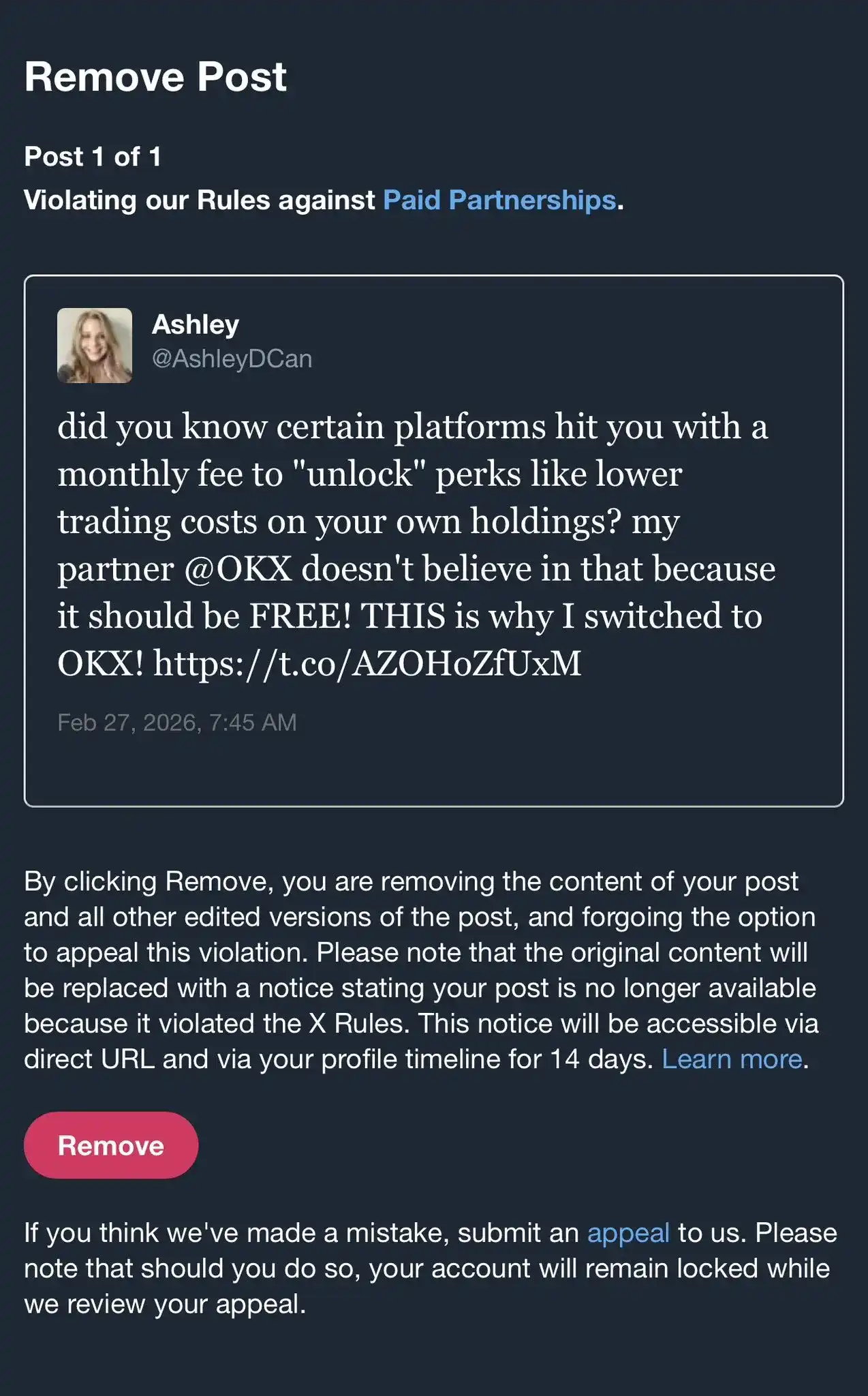
X required Ashley to delete the post promoting OKX
According to X's new "Paid Amplification Partnership Policy," paid amplification mainly includes the following four scenarios:
- The product or service was gifted by the brand or a representative of the brand;
- The creator is compensated for promoting these products or services through cash payment or payment in kind;
- The product or service provides commission to the creator through sales (e.g., via affiliate links or discount codes);
- The creator has a business agreement with these products or services, such as serving as a brand ambassador.
However, the above definitions are still relatively principle-based. Specifically for the crypto industry, what kind of content will be suspended if the "Paid Partnership" label is not added? Where is the boundary between natural research content and paid partnership posts? These questions remain unclear. After being reported, it relies more on X's backend AI review or direct manual judgment. Worse, the responsibility and power asymmetry in the reporting mechanism objectively amplifies the risk of abuse.
The crypto industry is already a dark forest. When the cost of reporting becomes low and the reporter bears no risk, crypto KOLs become naked targets,任由狙击 (任由 - allowing, snipering - sniped).
Before this, there were examples in the industry of maliciously inflating a KOL's followers and comment counts and then reporting them, leading to account suspension. Now, those who suffered losses after following investment advice can mass report the ambiguous content posted by crypto KOLs (previously) that sits between paid and unpaid. As long as enough accounts report simultaneously, it increases the probability of platform penalties. Even if not malicious reporting, there is also the possibility of being mistakenly reported by users.
The force of the new rules will ultimately feedback into the income of crypto KOLs. The various soft ads that KOLs previously cooperated on with project parties are no longer feasible. Some major KOLs are collectively making abstract memes, labeling abstract content with "Paid Partnership" as a form of protest against X platform's new paid content policy.

Crypto KOLs' "Abstract Protest"
However, some argue that crypto KOLs should "fight poison with poison" and label all future posts with "Paid Partnership," so that eventually users will become desensitized to it.
Are Crypto KOLs Migrating Again?
Incentive mechanisms are core to social platforms retaining high-quality content creators. In 2025, X continued to expand its revenue sharing scale for platform content creators. According to official statements, the profit distribution amount in 2025 has already set a record high since the profit-sharing program launched. Simultaneously, shared profit scale will continue to increase in 2026, and 2026 is dubbed the "Year of the Creator."
Some crypto KOLs often share the "salary" Musk sends them each month in their accounts, ranging from tens to thousands of dollars. But after X's new paid partnership advertising rules were released, the importance of this income has diminished because crypto KOLs might lose a larger source of income.
Crypto people never wait for death. Due to changes in the domestic regulatory environment in 2021-2022, Weibo大规模封禁 (large-scale banned) crypto accounts and prohibited publishing crypto-related content. Subsequently, crypto KOLs chose Twitter (now X) as the new crypto base and, in the following years, built a project marketing/promotion model around Twitter involving the "project party-agency-KOL" chain.
Now, when X's content policy changes compress the living space of crypto KOLs, where can they migrate to? The answer might be exchange social platforms like Binance Square. (Sincere disclosure: This is not a paid ad.)
In 2025, relying on the continuous growth of the Binance exchange, coupled with CZ He Yi's引流 (traffic directing) and content mining mechanisms, Binance Square's daily active users and user numbers have greatly increased. Although its main task is still to poach crypto creators from the X platform, it has already accumulated a group of loyal users.
Previously, when Farcaster announced its pivot to wallet business (Farcaster has been acquired by Neynar), I pointed out that exchanges have inherent advantages in building crypto social products—trading naturally creates scenarios and desires for communication. In the article, I also judged that inclusivity towards crypto users is the core competitiveness of exchange social products against X. When X implements policies unfavorable to crypto content creators, the large-scale migration of crypto KOLs 5 years ago might happen again. And building a new project party-KOL promotion system around exchange social products is only a matter of time. (Related reading:Farcaster Pivots, 'Binance Square' and Others Take Over Crypto Social)
If crypto KOLs really flee X, X won't lose much, or rather, the X platform won't do much more to retain the crypto group. Because looking at the entire internet, the crypto circle is just a very small information cocoon; its collapse wouldn't have a major negative impact on the platform.
X's paid partnership policy update this time is not specifically targeting crypto KOLs; it's just that the unique attributes of the crypto industry happened to be in the crosshairs.







