Written by: Deep Tide TechFlow
The theme of the 2025 Binance Blockchain Week (BBW) is: The Next Era.
As the "most ambitious Blockchain Week to date" officially defined, this BBW closely aligns with the theme of "The Next Era" in terms of personnel appointments:
Yi Jia (He Yi), dressed in a bright yellow outfit, announced her appointment as Co-CEO, ushering in the era of dual CEOs at Binance alongside Richard Teng;
On the same day, Nina Rong, the new Growth Executive Director of BNB Chain, took the main stage for the first time representing BNB Chain, sharing how BNB Chain will drive the next wave of ecosystem growth.
After wrapping up the Abu Dhabi BNB Hackathon, Deep Tide TechFlow had the opportunity to engage in an in-depth conversation with our old friend Nina Rong.
Speaking about the hackathon, which received enthusiastic community feedback, Nina said with a smile:
The first-place winner was a team of students from a coding school in Abu Dhabi. This is a very important signal: developers outside the circle, with the help of AI and mentors, were able to quickly create a project on-site that was recognized by everyone and has potential for implementation. This is a very crucial signal.
The essence of a hackathon is a scenario for sparking inspiration. It is both a technical event and a super effective social platform, bringing people together to discuss interesting and meaningful things for the industry.
As the Growth Executive Director, the topic inevitably returns to "growth" itself. Transitioning from Arbitrum (L2 leader) to BNB Chain (exchange public chain leader), Nina's career path spans two different ecosystem logics and growth models. According to the recent BNB Chain 2025 annual review: DAU stabilized at around 3.7 million, with a peak of 5 million, ranking first among all L1 blockchains; DEX trading volume exceeded $2 trillion; stablecoin supply rose to $14 billion.
Faced with such impressive results, how does one open the next chapter of growth? Nina, with her rich experience in growth, gave a "back-to-basics" answer to this question:
A public chain, as a foundational infrastructure product, roughly has three types of user groups: retail users, institutional users, and developer users. Therefore, the Growth Director is responsible for better serving these three groups.
The BNB technical team is excellent, and it also has a very large user base and very complete infrastructure. I think it will become increasingly difficult for future competitors to reach the scale that BNB Chain has achieved today.
Finally, as a seasoned industry professional, Nina also offered the most direct and sincere advice to community members who want to join Web3 and BNB:
Cultivate a founder's spirit, possess the determination and resilience to get things done; and never detach from the market, truly participate in trading to maintain a fresh feel for the market and a sense of热度 (heat/trends).
In this issue, let's follow Nina's sharing and step into the winning rules of growth in the加密 (crypto) world.

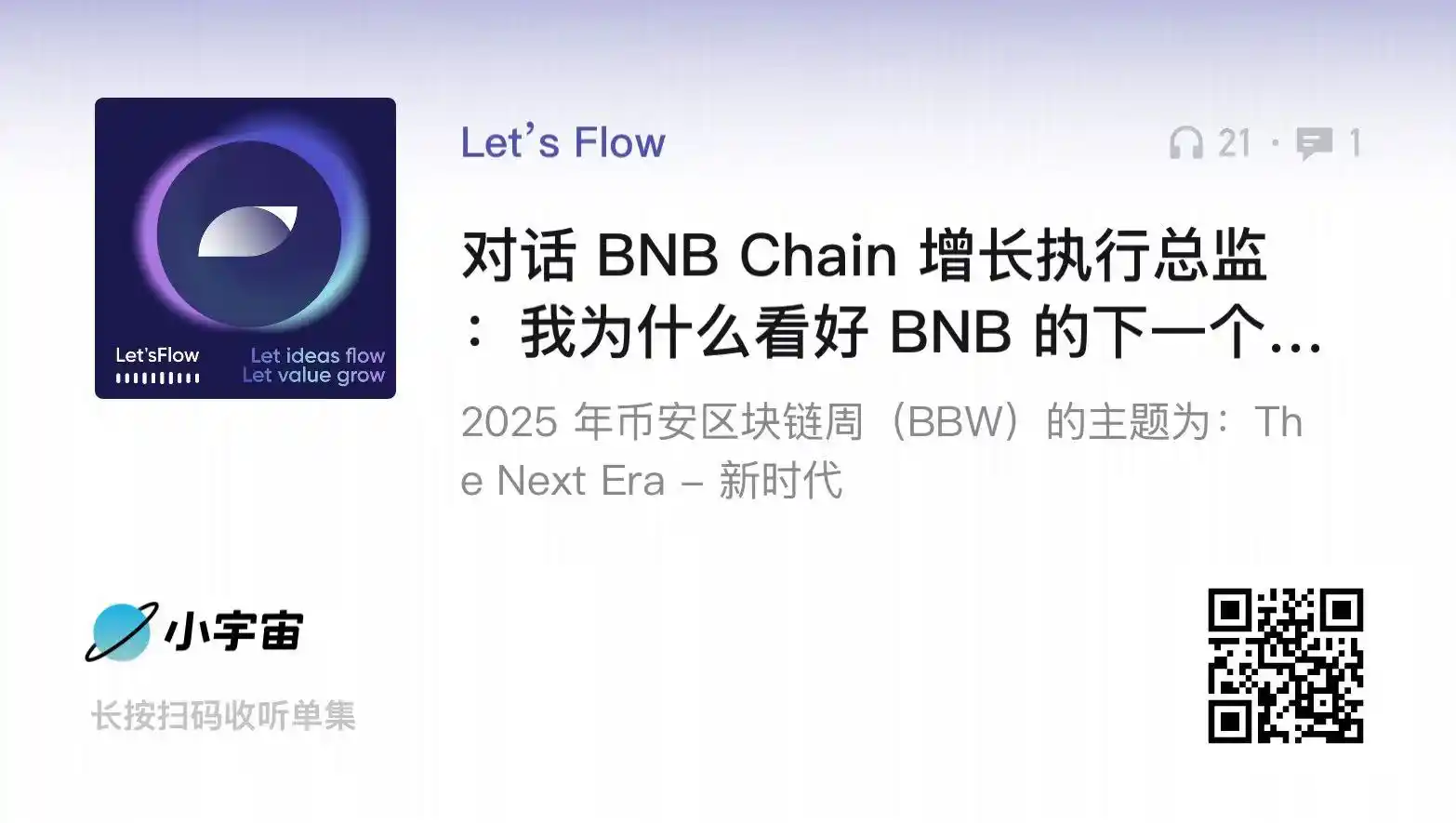
The following content is the text transcript of our conversation. The podcast audio version is also同步上线 (synchronously launched). Welcome to subscribe to "Let's Flow" on Xiaoyuzhou.
Click Xiaoyuzhou Link or scan the QR code in the image to listen:
A Successful Hackathon is an Efficient Social Connection
Deep Tide TechFlow: Congratulations on your new role, Nina, joining BNB Chain. We see you've been busy with Binance Blockchain Week and the BNB Chain Hackathon these past two weeks. Can you share your recent work experience?
Nina:
Hello everyone, I'm Nina, currently serving as the Growth Executive Director at BNB Chain. Thank you to my old friend TechFlow for the invitation, and I'm very happy to have this opportunity to communicate with everyone.
It has been quite busy since I just joined the team, but I've also deeply felt everyone's enthusiasm. Especially at the recently concluded Binance Blockchain Week, I could personally feel the high level of attention and热烈的氛围 (enthusiastic atmosphere) from the community and developer groups.
The success of this hackathon also exceeded my expectations. It not only gathered many technical, product, and KOL partners, but also many industry friends I hadn't seen for a long time came to show their support. Overall, we could feel the vitality of the BNB ecosystem and the close connections within the community.
For this hackathon, our Marketing team members were very capable. I actually played more of a supporting role. The overall execution was basically led by the Marketing team, which fully demonstrated the team's professional ability—they can execute a relatively small event to the extreme.
Deep Tide TechFlow: The BNB Chain hackathon was also very火爆 (hot/booming). Did you see any eye-catching projects or ideas?
Nina:
There were many excellent projects in this hackathon.
The first-place winner was a team of students from a coding school in Abu Dhabi. They were not developers within the circle and didn't know about blockchain technology at all—they were just a group of students—but they built the project in a short time.
Several mentors on-site provided them with inspiration, such as "create a Dashboard for on-chain DeFi mining APY," and they quickly built this product.
In my opinion, this is a very important signal: developers outside the circle, with the help of AI and mentors, can quickly create a project on-site that is recognized by everyone and has implementation potential. This is a very crucial signal for the entire industry.
Deep Tide TechFlow: May I ask, did the team统计 (statistics) how many Web2 developers or students participated in this hackathon? What was the ratio? Has it increased?
Nina:
We haven't specifically统计 (counted) the student ratio yet, but this hackathon was held at a coding school, so it was naturally closer to the student群体 (group). In the coming year, we will also cooperate with many universities.
I believe that hackathon activities cannot demand that exceptionally good projects will definitely emerge; it's a probabilistic event of "being blessed by the heavens." The essence of a hackathon is a scenario for碰撞灵感 (colliding inspiration). As a public chain, what we can do is provide developers with as many and as good platforms as possible to explore more innovation.
Many ecosystem developments do not come from hackathon participants but from between mentors and mentors, between mentors and visiting friends, or between other ecosystem teams, who start talking about cooperation again because of this opportunity. For example, some projects originally belonging to another ecosystem, after attending the BNB Chain hackathon and feeling the good atmosphere, might also consider joining the BNB ecosystem.
So a hackathon is both a technical event and a super effective social platform, bringing people together to discuss interesting and meaningful things for the industry.
Deep Tide TechFlow: A side note: Many people found the location of your hackathon quite interesting. Can you share the story behind the venue selection?
Nina:
The event location was actually chosen because a member of our team happened to know the founder of this coding school. Additionally, the venue really fit the theme of this hackathon well, so everyone hit it off immediately.
As for the "campus" remark, that was完全 (completely) everyone joking. Because this school is in Abu Dhabi, we took a bus from Dubai. When the bus was almost at the destination, some friends jokingly said: Hey, why does it feel like we're arriving at a campus?
Haha, actually I didn't know its location would be so remote beforehand, but the facilities inside the school were very complete, helping everyone have a better experience during the hackathon.
Public Chains That Will Still Exist in 10 Years Will Definitely Include BNB Chain
Deep Tide TechFlow: Was there anything you found different from your expectations after actually joining the team?
Nina:
Overall, the onboarding process was quite smooth.
One thing that might be relatively unexpected is that I didn't expect I could still do this much work. Perhaps once you're really in this position, and there are indeed many things to do in front of you, you become像打了鸡血一样 (like injected with chicken blood - very motivated), wanting to do everything well.
So for me, it's also a breakthrough of my personal ability ceiling.
Deep Tide TechFlow: Many friends are somewhat unfamiliar with the title "Growth Executive Director." Could you introduce your career history and what the "Growth Executive Director" role at BNB Chain mainly entails?
Nina:
Literally understood, the Growth Director is responsible for the growth of the public chain.
A public chain, as a foundational infrastructure product, roughly has three types of user groups: retail users, institutional users, and developer users. Therefore, the Growth Director is responsible for better serving these three groups.
Deep Tide TechFlow: So previously at Arbitrum, you mainly focused on the ecosystem, but now at BNB Chain, this is a role covering all growth-related aspects?
Nina:
You could say that. Perhaps when I was at Arbitrum, I wasn't responsible for as many market-related things; there was a dedicated market team for that. At BNB Chain, BD and Marketing related work might both be involved.
Deep Tide TechFlow: Many people got to know you when you were responsible for the Arbitrum ecosystem. A few years ago, you witnessed the explosion of the entire Layer2赛道 (track), and Arbitrum was a standout. What considerations led you to join BNB Chain now?
Nina:
First, leaving Arbitrum and joining BNB Chain are two completely independent events. I left Arbitrum in March this year and joined BNB Chain around the end of September/beginning of October. The two things are completely unrelated. When I left Arbitrum, I did not anticipate I would join BNB.
Then, regarding joining BNB Chain, I think it's a normal career progression. If you stay in the same company, the same position for too long, it might not be the optimal choice for both the individual and the company. Of course, my relationship with Arbitrum and the three founders is still very friendly now, and I respect them very much, but at that time I wanted to take a break, and I also hoped that new forces would later join Arbitrum to help the project grow.
Personally, I believe BNB Chain is a public chain with great potential. If we talk about which public chains will still exist in 10 years, I think BNB Chain will definitely be one of them. It has very strong technical resources, institutional resources, and a user base. You could say it has gathered all the necessary elements. I think this is very rare in Crypto, and I am honored to be able to join the team.
Deep Tide TechFlow: What differences do you see between the BNB Chain ecosystem and the Arbitrum ecosystem?
Nina:
I think Arbitrum's overall positioning is more technology-driven; whereas BNB Chain has a larger user base, each with its own advantages and focus.
Of course, the ideal state for an ecosystem is to have both users and developers. So if I were still at Arbitrum, I might prioritize user-side things; now at BNB Chain, I will prioritize developer-side things, serving the developers in the ecosystem well. This is the focus of my work going forward.
Deep Tide TechFlow: We saw that you also shared that listening to Yi Jia's (He Yi's)分享 (sharing) was very rewarding, often "gaining new insights each time you listen." What kind of person is Yi Jia in your mind? What inspiration or收获 (gains) did she give you?
Nina:
Actually, my communication and interaction with Yi Jia so far has not been much. We invited her to speak at the hackathon this time, which was the opportunity to真正见到 (truly meet) her. So, like many others, my understanding of her is more from the perspective of a "fan."
Ordinary people may not have the opportunity to stand in Yi Jia's position, where every word and action can even affect the entire industry, so the perspective from which they view things and the way they handle problems will be very different. But from my perspective, I feel that many of the points Yi Jia makes can resonate no matter what stage of life you are in. The many experiences she summarizes also make me feel very inspired for my own life.
For example, one sentence from Yi Jia left a particularly deep impression on me:
God will keep dealing you the same hand of cards until you find a better way to play that hand and win; when you find the solution, God won't deal you that hand again.
I think this sentence is a source of strength for people facing challenges in life. If you encounter a great difficulty at the moment, since God is repeatedly dealing me the same hand, I should take this opportunity to play the cards in my hand well, rather than give up and leave the table. Often, some of Yi Jia's views can make people feel鼓起勇气 (summon the courage) to face difficulties.
Technology, User Base, and Complete Infrastructure: Three Major Mountains New Public Chains Find Hard to Surpass BNB
Deep Tide TechFlow: Talking about public chain competition, in the current market cycle (especially facing competition from Solana and Base), where do you think the untapped potential of BNB Chain lies?
Nina:
I think the most underestimated point of BNB Chain is that BNB's technical team is excellent.
I specifically mentioned this in my speech at Blockchain Week: Although BNB technical team members rarely appear publicly, they are all very powerful engineers and researchers.
At the same time, I also hope that during my tenure, I can better represent them and communicate the results of our technical research to the industry, so that the outside world can better understand our contributions to the entire Crypto industry at the technical level.
Deep Tide TechFlow: In your opinion, do public chains have moats? Why? If so, where is BNB Chain's moat?
Nina:
I believe a very big advantage of BNB Chain is that it has a very large user base.
For developers, they actually follow the users. As developers, they might not care so much about what infrastructure the program is built on, but care more about whether there are users for the product. So the user volume itself is a kind of moat.
Another point is whether the public chain's infrastructure is complete enough to allow users to enter very easily. A lot of work needs to be done around this, such as connecting with exchanges, integrating cross-chain bridges, communicating with RPC service providers, improving developer tools, etc. Only by preparing a series of things in advance can developers and users be better empowered, and BNB Chain completed these five or six years ago.
After the basic construction is mature, at least the basic subsistence of the ecosystem can be solved. In the current highly competitive public chain赛道 (track), new public chains need to spend a lot of money on infrastructure, which will lead to long-term financial decline. Many new public chains cannot even provide the most basic subsistence for developers. From the current perspective, BNB Chain does not have this problem.
Putting aside the term moat, I think it will become increasingly difficult for other competitors in the future to reach the scale that BNB Chain has achieved today.
Deep Tide TechFlow: Do you think there is still opportunity for new public chains now?
Nina:
I think it's very difficult for new public chains to break through. Just like I said before, providing basic subsistence for developers is already a very expensive thing. On top of that, if the new public chain cannot prove at the product level why it is better than the existing public chains, then why would developers and users use it?
This is also why I didn't join a new public chain, because I couldn't convince myself that the market really needs another new public chain.
Deep Tide TechFlow: I've observed some directions before. Some projects are not a separate public chain; they might provide certain services for public chains, but they do have a chain themselves. Do you think this direction has opportunity?
Nina:
I don't think this counts as a public chain; it should be categorized more as an application chain.
From this perspective, I think this direction has opportunities, including within the BNB ecosystem itself. BNB is actually three chains: BSC, opBNB, and the storage solution Greenfield.
As a public chain, if it needs to run smart contracts, it might not be suitable to simultaneously handle some specific loads in certain specific scenarios. These specific scenarios can be handed over to application chains to solve. I think this is reasonable.
The Chinese-Speaking Market is Our Advantage; Focus Points Differ for Europe/US, Latin America, and Middle East Markets
Deep Tide TechFlow: A consensus among Chinese-speaking users is that Chinese-speaking users and developers make up the majority on BNB Chain. Is this true? Is the proportion of Chinese-speaking users really large? Is there any related profile or data?
Nina:
I don't have particularly specific data on hand at the moment. Because the blockchain itself is Permissionless, it's actually very difficult to accurately judge which users or developers are from the Chinese-speaking market.
It can only be said that BNB is very popular in the Chinese-speaking ecosystem. This is an objective fact, and I believe it is an important advantage.
For me, BNB Chain as a whole is still in a relatively early stage. We still have many things to do, and the entire blockchain industry also needs everyone to raise the ceiling together and make the pie bigger.
In this process, the Chinese-speaking market is an extremely important user group. We will not abandon this advantage, and on this basis, we will continue to expand into markets like the US and Europe. This will also be a very important direction for us next year.
Deep Tide TechFlow: Regarding the growth of the BNB Chain ecosystem, where is the focus of your work currently, in terms of regions or directions? What is the growth strategy?
Nina:
Europe/US, Latin America, and the Middle East will all be key focuses, but the发力点 (point of effort) is different for each region:
In Europe and the US, especially the US, we might focus more on institutional cooperation and university cooperation;
In Latin America, we might focus more on individual developers;
And in the Middle East, which has more relaxed and friendly regulation, we might pay more attention to directions like RWA.
Each region will have different points of effort, and we will also hire different talents to be responsible for different sectors.
Deep Tide TechFlow: For you personally, which growth metrics/data do you value most?
Nina:
Basically, the growth metrics for all public chains are similar, including TVL, trading volume, number of projects, number of tokens, etc.
Deep Tide TechFlow: How do you view the Chinese-speaking community and the East Asian community? What directions do you think are particularly worth paying attention to?
Nina:
Looking at the global market, the Chinese-speaking market is one of the very few regions that is strong in developers, strong in users, and strong in institutions. So we won't just focus on one point; we will exert effort on all fronts.
Additionally, for the Korean market, we also have community managers. Korea is currently偏 (leaning towards) community operations, doing more content and activities related to traders. But this is not absolute. We also serve Korean developers, and if we see the number of Korean developers increase in the future, we will also start doing more developer-related content. It's just that the demand we see currently is still mainly from traders.
Cultivate a Founder's Spirit, Never Detach from the Market
Deep Tide TechFlow: As a seasoned industry professional, what advice would you give to entrepreneurs who want to enter Web3 from 0 to 1 now on how to start?
Nina:
I think my career development is something many friends have watched grow—from a beginner in the circle learning with everyone to where I am now. Thank you everyone for your affection and support.
Over the past few years, I have always tried to introduce excellent talents from outside the circle to join Crypto, but not many stayed. Many people feel the Crypto industry is still relatively early, and they already have a relatively decent job in Web2, so they are unwilling to try Web3深入 (deeply).
Therefore, my first suggestion is to give yourself a chance to try. Don't be overly concerned about gains and losses. Truly try it out. Spend half a year or a year to see what kind of results you can achieve in Web3.
Second, I think Web3 is an industry that requires very strong self-discipline and independent learning. This is one of its barriers. You also can't像 Web2 一样 (like in Web2), get a certificate through some courses or exams and then get employed in Web3. Currently, people mainly look on Twitter. For example, some people will hear about this content today, and some won't. The industry currently lacks systematic education and summarization, so one's own learning ability is very important. If you really want to enter Web3, you must establish your own high-quality information flow as early as possible and ensure you have a set of efficient learning methodologies to keep growing with the industry.
Deep Tide TechFlow: Are there any important workplace experiences or industry insights you can share with practitioners who are building in the industry?
Nina:
The core share is: Never detach from the market.
I suggest all Web3 practitioners take a small amount of money, maybe even just $1,000, to truly participate in the market, make trades, play with some new projects, to maintain a fresh feel for the market and a sense of热度 (heat/trends). In the long run, this is quite helpful for career development and control over the industry.
Deep Tide TechFlow: We see many people online asking "Can I join the BNB Chain team?" May I ask what your talent standards are? If someone wants to join the BNB Chain team or develop projects based on BNB Chain, through which channels can they contact you?
Nina:
BNB's talent recruitment standards, I believe, have two core points.
First, is Founder Spirit. Specifically, it is the determination and resilience to get things done, the drive for continuous self-improvement, the willingness to push projects forward in a highly uncertain environment, and even turning things that originally seemed impossible into possible.
Second, is the understanding of the essence of the industry. The core is still what I said before: you cannot operate detached from the market. If you are in marketing, you must truly understand marketing: What effective strategies are there in the market? What kind of content or activities can drive users to interact? If you are in BD, you need to have a relatively deep understanding of the entire ecosystem landscape: Which projects are competitive? Which are more suitable for deep cooperation? Who are the key players in different sectors? In recruiting talent, I particularly value the candidate's insights into the industry and whether they can truly translate these insights into decisions and actions.
Deep Tide TechFlow: For ecosystem projects that want to enter the BNB ecosystem to Build, what channels are available?
Nina:
For ecosystem projects, you can submit information through a link set up on our official Twitter. Also, many of our BD partners have their own public accounts on Twitter; you can DM them directly.
For job applications, we are hiring for BD and Marketing positions. If interested, you can directly send your resume to me via private message. I read every private message and comment one by one. If suitable, I will reply directly. If not suitable, then we'll see each other another time, haha.