The US Securities and Exchange Commission has proposed narrowing Exchange Act Rule 15c2-11 so that it applies only to equity securities, a technical change that could carry outsized significance for crypto market structure. For digital assets, the proposal signals a more tailored regulatory approach after years of trying to force crypto into frameworks built for traditional securities.
In a press release issued March 16, the SEC said Rule 15c2-11 has historically focused on preventing manipulative and fraudulent schemes in over-the-counter equity markets. The proposed amendment would revise the rule so it refers only to equity securities, rather than leaving room for broader application to other asset classes.
Quiet But Meaningful Win For Crypto
That matters because Rule 15c2-11 governs certain information gathering and review requirements for broker-dealers that publish quotations for, or maintain a continuous quoted market in, securities in the OTC market. By explicitly tying the rule to equities, the SEC appears to be drawing a cleaner line around where those obligations begin and end.
SEC Chairman Paul S. Atkins framed the move as a matter of regulatory fit rather than ideology. “Regulations should be appropriately tailored to fit the asset class to which they apply,” Atkins said. “This proposal would clarify regulatory obligations when publishing quotations and affirm what was always understood: Rule 15c2-11 applies to equity securities.”
For crypto market participants, the proposal reads as more than a drafting cleanup. Marty Bent, writing on X (@TFTC), argued that the shift quietly reverses the posture that defined much of the prior SEC era. “The SEC just proposed excluding crypto assets from OTC market rules that govern broker-dealer quotations. These are regulations originally designed for penny stocks and thinly traded equities.”
He went further, casting the amendment as a subtle but meaningful break from the agency’s past playbook. “This is a quiet but meaningful shift. Instead of forcing Bitcoin and crypto into existing securities frameworks, the SEC is explicitly carving it out. The rules being amended (Rule 15c2-11) dictate how broker-dealers can publish quotes for securities. By clarifying that crypto doesn’t fall under these requirements, the SEC is signaling it doesn’t view these assets through the same lens as traditional equities.”
That interpretation is likely to resonate because Rule 15c2-11 was never designed with digital assets in mind. Its original function was tied to OTC equities, particularly the kind of thinly traded names that have historically been vulnerable to quote manipulation and fraud. In that context, the SEC’s proposal does not create a bespoke crypto regime, but it does something nearly as important: it narrows the set of legacy securities rules that might otherwise be stretched to cover crypto by default.
Bent also contrasted the proposal with the enforcement-heavy approach associated with former Chair Gary Gensler. “Under Gensler, the approach was the opposite, force everything into existing rules, then sue when companies couldn’t comply. This is the regulatory posture flipping from ‘prove you’re not a security’ to ‘these rules weren’t built for you.’”
The proposal is now headed to the standard public process. The SEC said the release will be published on SEC.gov and later in the Federal Register, with a 60-day comment period beginning after Federal Register publication. That leaves room for revisions, but the message is already clear enough: the agency is increasingly willing to distinguish crypto from the infrastructure and assumptions of legacy equity markets.
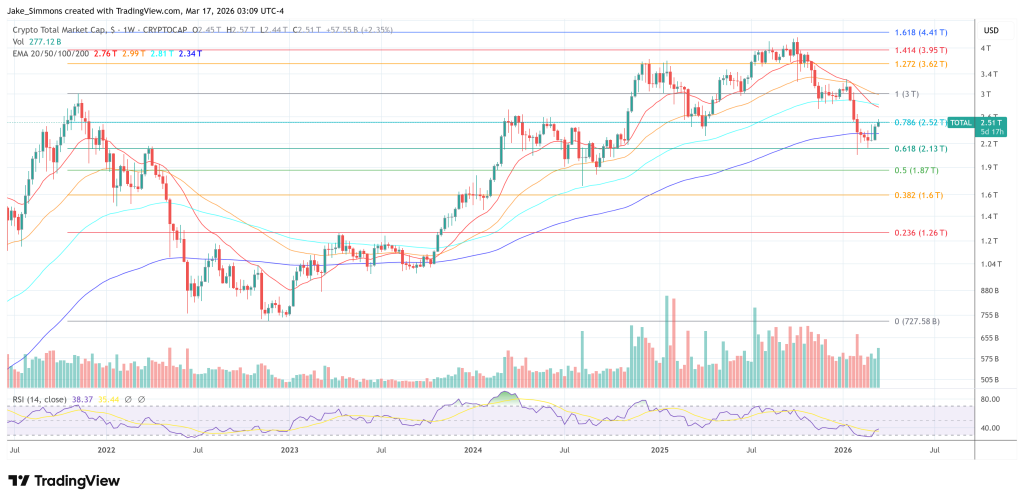
At press time, the total crypto market cap stood at $2.51 trillion.