Input Output said it progressed 16 of 18 treasury-funded Cardano commitments across Q4 2025 and Q1 2026, framing the period as a test of whether ecosystem funding can translate into publicly verifiable delivery. Two commitments, Acropolis and tiered pricing, were canceled, with funding returned to the treasury, according to IO’s delivery report.
The report positions Cardano’s treasury model in unusually direct terms: funding either produces trackable output, or it goes back. “In Q4 2025 and Q1 2026, IO delivered measurable progress across 18 treasury-funded commitments. Sixteen were progressed successfully. Two – Acropolis and tiered pricing – were canceled, and their funding returned. Every outcome in this report is publicly verifiable.”
Cardano Adoption Moves From Roadmap To Usage
The most immediate adoption milestone was the launch of USDCx on Cardano in Q1 2026. IO said the asset went live 84 days after announcement, with more than 15 million USDCx minted in its first week. During that period, Cardano DeFi total value locked rose from $127 million to $142 million, while Minswap, Liqwid and SundaeSwap supported live liquidity pools.
Interoperability was the second major adoption theme. LayerZero’s announced integration with Cardano and Midnight connects the ecosystem to more than 160 blockchains and over $80 billion in omnichain assets, according to the report. IO called it “the single largest interoperability unlock in the ecosystem’s history,” with particular relevance for Midnight’s selective disclosure and zero-knowledge proof architecture.
The report also cited several external milestones around the Cardano ecosystem, including CME Group’s launch of Cardano futures in February, Coinbase adding ada as collateral for on-chain loans, Midnight’s mainnet launch, and ada acceptance at 137 SPAR stores in Switzerland.
IO’s engineering update centered on node reliability, security and upgrade readiness. The company shipped Cardano node versions 10.5.4 and 10.6.2, with improvements to network connectivity, system monitoring, and support for future protocol versions, including v11 and v12.
The KES agent also reached version 1.0. The tool separates cryptographic key management from the main node process, reducing key-related attack surface for stake pool operators. IO linked that work directly to the needs of Cardano’s more than 3,000 stake pools.
UTXO HD was another major infrastructure item. By moving the UTXO set from memory to disk, IO said Cardano node memory utilization was reduced by up to 80%. That matters for operators because lower memory requirements can reduce infrastructure costs and make running nodes less resource-intensive.
Mithril, Hydra And Leios All Reach Working Code
Scaling was presented as a three-track strategy rather than a single upgrade. Mithril reached its first stable release, with distribution 2603.1 adding support for the decentralized message queue protocol. IO said this moves Mithril closer to operating without a central coordinator.
Hydra moved further into production-oriented work, with releases from 1.0.0 through 1.3.0. The report highlighted faster node restarts, chain-sync drift reporting, deposit and decommit fixes, and active work with real users. It also cited Pondora’s Echo as the first non-custodial Hydra implementation and noted the VTech Hydra SDK.
Leios, Cardano’s base-layer throughput upgrade, produced its first working prototype. IO said the prototype now produces and distributes endorser blocks in a local multi-node network, including large blocks with hundreds of transactions and optional simulated network delays.
Beyond scaling, IO emphasized developer tooling and formal methods. Plutus received Van Rossem hard fork features, faster Flat decoding, optimized bytestring-integer primitives, and improved Plinth tooling. Cardano High Assurance opened early access to five companies testing automated formal verification at the UPLC level.
Research also remained part of the delivery narrative. IO said Work Package 25 closed with all funding milestones complete after a public consultation reaching more than 24,000 people. Two papers were published at Financial Cryptography 2026, and IO chief scientist Professor Aggelos Kiayias was named an ACM Fellow.
Looking ahead, IO listed several Q2 targets: the protocol version 11 intra-era hard fork coordinated by Intersect, node v10.7, Mithril 2608, a Leios public testnet, Work Package 26, and the Cryptographic Tools for the Blockchain workshop at Eurocrypt 2026.
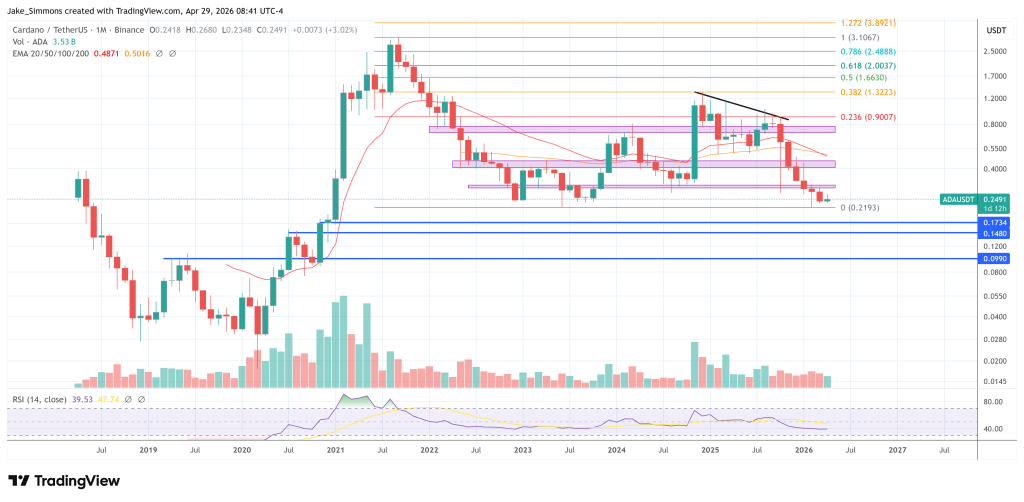
At press time, Cardano traded at $0.2491.