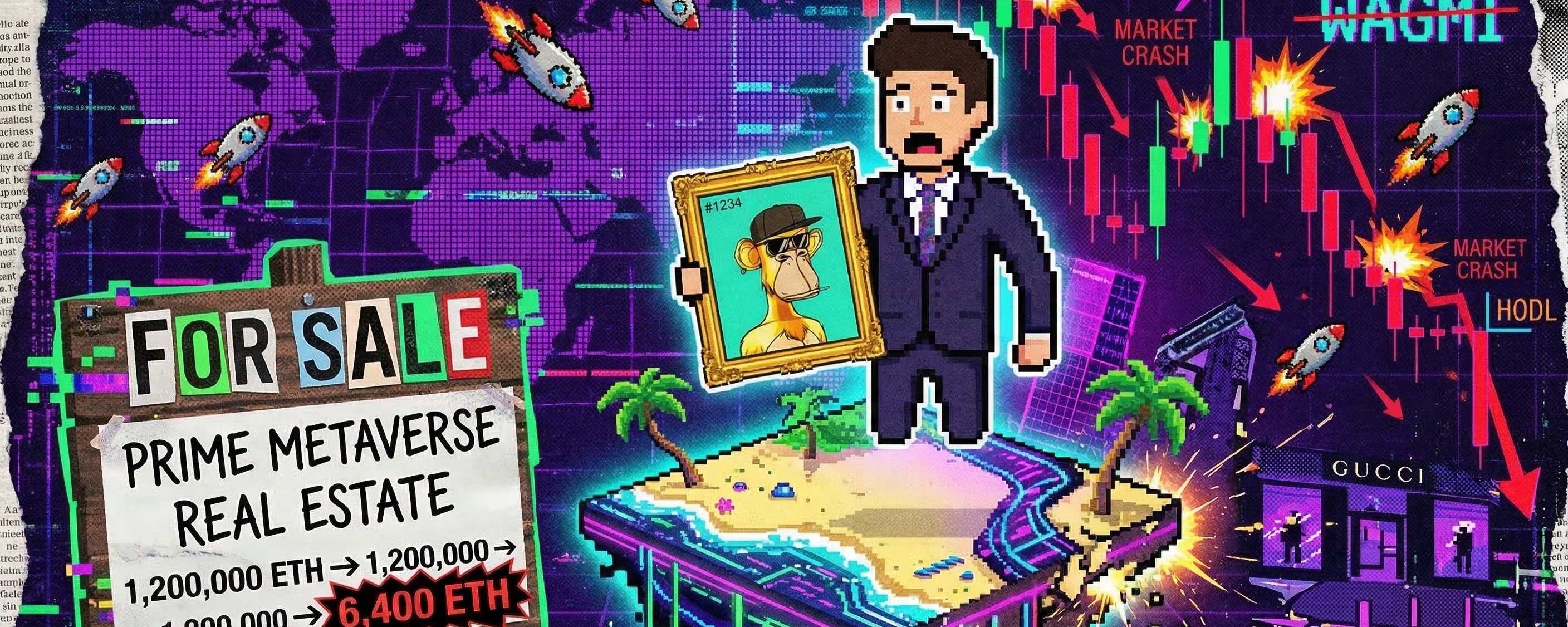
Author: @gothburz
Compiled by: Big Pliers | PANews Lobster
Original Title: Metaverse Real Estate Victim's Account: My $1.2 Million Is Now Only $6,400
"Diamond hands" means: even if your investment drops by 94%, you never sell. We’ve packaged this financial paralysis as a personality trait.
My net worth peaked at $1.2 million.
But not a single cent of that money was real.
I’m not speaking philosophically. I mean, it existed on some servers—and those servers are now shut down.
I owned eleven properties in the metaverse. Three in Decentraland, four in The Sandbox, two in Voxels, one in Otherside. And a seaside villa in Horizon Worlds—I paid $214,000 for it because Mark Zuckerberg himself said it was the "next frontier."
Last week, that "frontier" closed.
It’s now a mobile app.
Last year, I sent the same message to 340 people: "You have no idea how early we were."
I stopped sending those messages later. Not because I admitted I was wrong, but because most of them had blocked me.
I entered the metaverse real estate market in November 2021. Everyone was buying back then. Someone spent $450,000 just to be Snoop Dogg’s neighbor in a game. In a video game. Where the avatars didn’t even have legs.
Yes, those avatars had no legs.
But I thought that was actually a good sign.
"Legs are coming eventually," I told everyone in the Discord group. "Legs are on the product roadmap." Three hundred people immediately replied with rocket emojis.
I gave myself a title—"Digital Real Estate Tycoon."
I put it in my Twitter bio.
I put it in my LinkedIn job title.
I even went on a podcast to talk about it. That podcast had eleven listeners. Three were bots. The rest were my own alt accounts.
My combined virtual properties were larger than my actual apartment.
But my actual apartment has furniture.
Location, location, location.
My most valuable asset was a plot right next to a virtual Gucci store.
In 2023, Gucci pulled out.
The store is still there. No one goes in. It’s like a shopping mall in Ohio—but with worse graphics and no food court.
I didn’t sell.
Diamond hands.
That’s what we always said—"diamond hands." It means: even if your investment drops by 94%, you never sell. We packaged this financial paralysis as a personality trait.
There was a guy in my Discord group who spent $2.4 million on a manor on a prime 618 plot in Decentraland. Prime location. High foot traffic.
I asked him what "foot traffic" meant on a platform with a daily active user count of 38.
He said I didn’t understand the technology.
He was right, I didn’t.
But I kept buying more.
We had a DAO—a decentralized autonomous organization. Meaning, everyone votes on decisions.
There were nine of us total. Three never showed up. Two voted on everything without reading the proposals. The other four were me and my alt accounts.
We voted to "acquire strategic plots."
Unanimously approved.
I cast four votes myself.
My portfolio peaked at $1.2 million. I told everyone. I made a spreadsheet. I predicted a 40x return by 2025. I made a business plan. One slide said:
"We are building a digital economy."
That slide had a rocket emoji.
That was my entire financial model.
In 2023, I spent $189,000 on a Bored Ape NFT.
Now it’s worth $14,000.
I don’t talk about that ape.
But I still use it as my profile picture. If someone asks, I say "I’m long-term bullish."
"Long-term bullish" means: if I sold, I’d cry in a Panera Bread.
My mom asked me what a Bored Ape was.
I said: "Digital art on the blockchain."
She asked why it was more expensive than her car.
I said: "You don’t understand Web3."
She said: "All I know is you live in a studio apartment."
She’s not in my Discord group.
Justin Bieber spent $1.3 million on one.
Now it’s probably worth around $90,000.
Hearing that made me feel better.
That’s the power of community.
WAGMI. We're All Gonna Make It.
We said it every day. In group chats. As the floor price kept dropping. As trading volume dried up. As 95% of NFT projects went to zero.
We’re all gonna make it.
None of us made it.
But we said it with absolute conviction, paired with laser-eye profile pictures. That has to count for something, right?
It doesn’t.
But we said it did. That’s called decentralized consensus.
Meta spent $84 billion on the metaverse.
Let me say that again.
$84 billion.
More than the GDP of Luxembourg. More than the combined GDPs of Iceland, Luxembourg, and Malta. They poured that money into a platform where avatars had no legs, the graphics looked like a 2006 Wii game, and the concurrent user count was lower than the lunch rush at a Chipotle in Des Moines.
They just removed Horizon Worlds from VR headsets.
It continues to exist as a mobile app.
My seaside villa is now a mobile app.
Location, location, location.
Zuckerberg renamed the entire company for this. Facebook became Meta. A $900 billion company changed its legal name because the CEO watched *Ready Player One* and said, "I want that."
Reality Labs division: lost $10 billion in 2021, $14 billion in 2022, $16 billion in 2023, $18 billion in 2024, $19 billion in 2025.
This isn’t strategy; it’s speedrunning.
This year, they laid off 1,500 employees from Reality Labs. Shut down three VR studios. Canceled Supernatural. Put the entire VR social vision in a coffin and announced: "We’re pivoting to AI and wearables."
This pivot took four years and burned $84 billion.
I pivoted too.
I’m now an AI real estate investor.
I bought a plot in an AI-generated virtual world that doesn’t exist yet. The founder said it’s at the "intersection of spatial computing and large language models."
I have no idea what that means.
I gave him $40,000.
He has a whitepaper, 47 pages. I read the title and the tokenomics section. That section was a pie chart. I love pie charts. They make everything look planned.
This project has a roadmap. Q1: Build community. Q2: Launch beta. Q3: Expand ecosystem. Q4: Blank.
Q4 is always blank.
That’s the slot reserved for the exit.
My accountant asked me to value my metaverse portfolio for tax purposes.
I said: $1.2 million.
He said: Current market value.
I said: $6,400.
He stared at me for eleven seconds.
I know because I counted.
He asked if I had any other investments.
I showed him my NFTs.
He stared longer.
I said these are "cultural artifacts with long-term provenance."
He asked if I had considered buying a 401(k).
I said 401(k)s are "legacy artifacts of traditional finance."
He told me to leave his office.
The metaverse is dead.
I don’t accept that.
I am a digital real estate tycoon. I own eleven properties across four platforms. I have a seaside villa that’s now a mobile app, a plot next to an empty Gucci store, and a cartoon monkey that cost more than my actual car.
Location, location, location.
This location is nothingness.
But I was early.
I’m always early.
It’s the same thing as being wrong—just said with more confidence.
Twitter:https://twitter.com/BitpushNewsCN
Bitpush TG Discussion Group:https://t.me/BitPushCommunity
Bitpush TG Subscription: https://t.me/bitpush







