Grayscale: The Three Evolution Stages of Stock Tokenization and a Review of Core Beneficiary Public Blockchains

marsbit發佈於 2026-07-14更新於 2026-07-14

文章摘要

Grayscale outlines three key phases in the adoption of tokenized stocks, each benefiting different blockchain infrastructures. Phase 1: The "Wrapper Model." Third-party platforms create tokens representing claims on an SPV that holds the underlying stocks. While not conferring direct ownership, these tokens enable DeFi use and retail access. This currently dominant model (~70% by market cap) primarily operates on Ethereum, Solana, and BNB Chain. Phase 2: The "Entitlement Model." Major financial institutions like DTCC tokenize existing, regulated securities through their post-trade infrastructure to enable on-chain settlement and movement. The upcoming DTCC pilot on Canton Network exemplifies this institutional-led approach. Phase 3: The "Issuer-Led Model." Companies natively issue securities directly on a blockchain, as recently demonstrated by Securitize. This model offers the greatest long-term potential but requires more regulatory clarity. It is expected to favor open-architecture blockchains like Ethereum and Solana, as well as hybrid networks like Avalanche. The report posits that all three models will coexist. The primary blockchain networks poised to benefit from tokenized equity growth are Ethereum, Solana, BNB Chain, Avalanche, and Canton Network.

Author| Zach Pandl, Head of Research at Grayscale

Compiled| WuBlockchain

The tokenization process of global stock markets is advancing. Tokenized stocks promise various benefits for users, including 24/7 trading. The next significant development will be DTCC's [1] launch of a tokenization pilot on the Canton Network [2]. This pilot will allow tokenized stocks and other assets to circulate within the regulated financial system via blockchain infrastructure.

We believe stock market tokenization will progress through three stages, each bringing value to different types of blockchain infrastructure (see Chart 1).

The first stage is the third-party "wrapper" model [3]. In this model, an issuer holds stocks through a special purpose vehicle (SPV) [4], and the tokenized stock represents a claim on that SPV. Currently, over 70% of tokenized stocks by market value use this model. Wrapper-type tokenized stocks do not represent true stock ownership but can be used in DeFi and may appeal to retail investors. These assets currently trade on networks such as Ethereum, Solana, and BNB Chain.

The second stage is the "entitlement" model [5], represented by DTCC's pilot. Instead of creating new versions of securities, DTCC will record existing eligible securities on-chain through its regulated post-trade infrastructure, with the Canton Network serving as the initial blockchain network for this pilot.

The third stage is the issuer-led model, where companies directly issue securities natively on-chain. Last week, Securitize [6] became the first publicly listed company to tokenize its own common stock upon listing on the New York Stock Exchange. We believe this model holds the greatest long-term potential but still requires further regulatory clarity. In our view, the issuer-led model will be more favorable to open-architecture blockchains like Ethereum and Solana, as well as hybrid networks like Avalanche.

These three tokenization models are likely to coexist for many years to come.

Core View: Multiple models exist for tokenized stocks. In our view, the blockchain networks most likely to benefit from tokenization growth include Ethereum, Solana, BNB Chain, Avalanche, and the Canton Network.
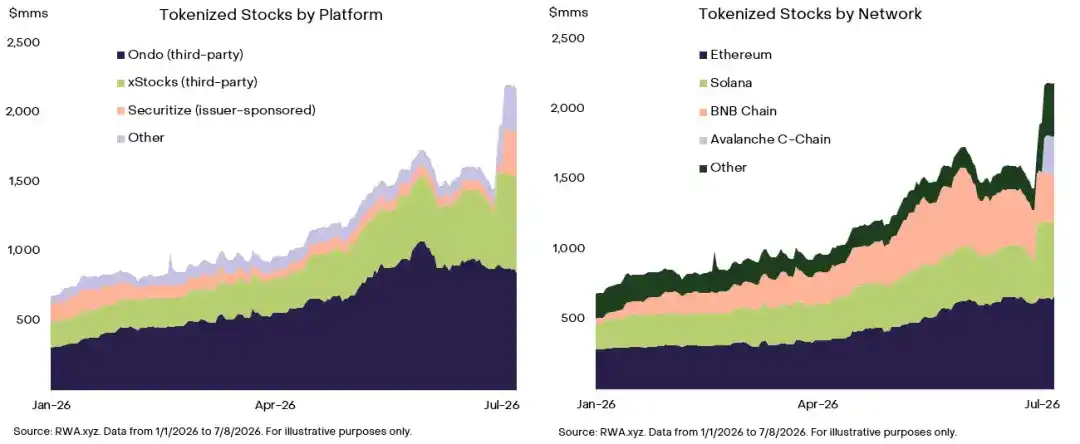
Chart 1: Third-party platforms currently dominate the tokenized stock market, while Ethereum, Solana, and BNB Chain hold the majority of on-chain assets.

Notes:

[1] DTCC: The Depository Trust & Clearing Corporation, a core U.S. post-trade securities infrastructure entity responsible for services such as clearing, settlement, and custody of securities transactions.

[2] Canton Network: A blockchain network for institutional financial assets, emphasizing privacy, compliance, and interoperability of assets among different financial institutions.

[3] Wrapper model: A model where a third-party platform holds underlying stocks through an intermediary structure and issues on-chain tokens representing claims on that structure. Investors hold claims on the structure rather than direct ownership of the stocks themselves.

[4] SPV: Special Purpose Vehicle. In the context of tokenized stocks, it typically refers to an entity established by the issuer to hold the underlying stock assets, with the investors' tokens representing claims on that entity.

[5] Entitlement model: A model that does not re-issue a new security but instead records or maps existing eligible securities onto a blockchain through a regulated post-trade system, enabling them to circulate on blockchain infrastructure.

[6] Securitize: A platform for digital securities and real-world asset tokenization. The article mentions its simultaneous tokenization of its own common stock upon listing on the NYSE.

熱門幣種推薦

相關問答

QWhat are the three evolutionary stages of stock tokenization as described in the article?

AThe three evolutionary stages are: 1) The third-party 'wrapper' model, 2) The 'entitlement' model, and 3) The issuer-led model, where companies natively issue securities on-chain.

QWhich blockchain networks are currently hosting most of the tokenized stock assets in the wrapper model stage?

AEthereum, Solana, and BNB Chain are currently hosting most of the tokenized stock assets in the wrapper model stage.

QWhat is the Canton Network, and what role does it play in the tokenization pilot mentioned?

ACanton Network is a blockchain network for institutional financial assets, emphasizing privacy, compliance, and interoperability between financial institutions. It is designated to be the first blockchain network for DTCC's tokenization pilot, which will allow tokenized stocks and other assets to flow within the regulated financial system via blockchain infrastructure.

QAccording to the article, which blockchain networks are seen as most likely to benefit from the growth of tokenized stocks in the long term?

AThe article suggests that Ethereum, Solana, BNB Chain, Avalanche, and Canton Network are the blockchain networks most likely to benefit from the growth of tokenized stocks.

QWhat is a key advantage of the 'entitlement model' of tokenization, as represented by the DTCC pilot?

AA key advantage of the 'entitlement model' is that instead of creating new versions of securities, it tokenizes existing, eligible securities through regulated post-trade infrastructure (like DTCC), enabling them to be transacted and settled on-chain while maintaining their established regulatory status and legal framework.

你可能也喜歡

如何监管单股杠杆ETF?周四,全市场都盯着韩国政府这场会

一款上线仅一个半月的单股杠杆ETF产品,已导致韩国股市剧烈波动,并促使韩国最高经济决策层介入。韩国“F4”高层协调机制(财政经济部、金融委员会、韩国银行及金融监督院)将于本周四召开紧急会议,研究应对方案。 事件导火索是本周一KOSPI指数暴跌逾8%,触发年内第七次熔断。市场认为,这类允许对三星电子和SK海力士进行2倍押注的杠杆产品,其每日调仓机制在市场波动时会“涨时助涨、跌时助跌”,加剧价格偏离。自5月27日上线以来,KOSPI波动显著加剧。 金融监管层措辞罕见升级,金融监督院院长李赞镇直言“后悔没有拼尽全力阻止”产品推出,并承认存在“结构性困境”:一方面个人投资者已净买入近10万亿韩元,强制清算困难;另一方面产品经合法程序推出,强制退市将损害法规公信力。 目前监管层正从三条路径研究对策:提高保证金要求、限制每日价格波动幅度、调整杠杆比例上限。但官员也承认这些可能是临时修补。 数据印证了产品的冲击:产品上线后,KOSPI单日涨跌超3%的天数比例从之前的27%飙升至52%;今年市场已触发35次“边车”暂停交易,远超去年全年3次,熔断触发次数也超过该机制自2000年引入以来总数的一半。 随着市场持续震荡,外界对产品仓促上线的批评声高涨。周四的F4会议结论,将决定后续政策走向。

marsbit40 分鐘前

如何监管单股杠杆ETF?周四,全市场都盯着韩国政府这场会

marsbit40 分鐘前

交易

現貨

熱門文章

如何購買CORE

歡迎來到HTX.com!在這裡,購買Core DAO (CORE)變得簡單而便捷。跟隨我們的逐步指南,放心開始您的加密貨幣之旅。第一步:創建您的HTX帳戶使用您的 Email、手機號碼在HTX註冊一個免費帳戶。體驗無憂的註冊過程並解鎖所有平台功能。立即註冊第二步:前往買幣頁面,選擇您的支付方式信用卡/金融卡購買:使用您的Visa或Mastercard即時購買Core DAO (CORE)。餘額購買:使用您HTX帳戶餘額中的資金進行無縫交易。第三方購買:探索諸如Google Pay或Apple Pay等流行支付方式以增加便利性。C2C購買:在HTX平台上直接與其他用戶交易。HTX 場外交易 (OTC) 購買:為大量交易者提供個性化服務和競爭性匯率。第三步:存儲您的Core DAO (CORE)購買Core DAO (CORE)後,將其存儲在您的HTX帳戶中。您也可以透過區塊鏈轉帳將其發送到其他地址或者用於交易其他加密貨幣。第四步:交易Core DAO (CORE)在HTX的現貨市場輕鬆交易Core DAO (CORE)。前往您的帳戶,選擇交易對,執行交易,並即時監控。HTX為初學者和經驗豐富的交易者提供了友好的用戶體驗。

582 人學過發佈於 2024.12.13更新於 2026.06.02

如何購買CORE

相關討論

歡迎來到 HTX 社群。在這裡,您可以了解最新的平台發展動態並獲得專業的市場意見。 以下是用戶對 CORE (CORE)幣價的意見。

活动图片