Solana 2025 Report Card: Annual Revenue of $1.5 Billion, Surpassing the Combined Total of 'Hyperliquid + Ethereum'

Odaily星球日报發佈於 2026-01-04更新於 2026-01-04

文章摘要

Solana's 2025 Performance: A Record-Breaking Year with $1.5B in Revenue In 2025, Solana emerged as the top-performing blockchain network, generating a total revenue of $1.5 billion, surpassing the combined revenue of Hyperliquid and Ethereum. According to Nansen, its on-chain fee income alone reached $603 million, exceeding that of Tron and Ethereum and securing its position as the leader in public blockchain earnings. Key metrics underscored Solana's dominance: it recorded over 10.5 billion active addresses and approximately 23.01 billion transactions, both figures leading all major blockchains. Its on-chain spot trading volume hit $1.6 trillion, surpassing all centralized exchanges except Binance, indicating a significant shift of crypto activity to on-chain platforms. Solana's revenue structure is composed of four main components: base fees (burned for deflation), priority fees (paid to validators), MEV-related income, and minor sources like storage fees. This efficient model supports high transaction volumes while maintaining a median fee below $0.01. The report highlights that public chains, Perp DEXs (like Hyperliquid with $908M revenue), and launchpads (like Pump.fun with $549M revenue) remain the most profitable crypto sectors, second only to stablecoins. Solana's growth is attributed to its scalability, low costs, and vibrant ecosystem, including meme coin trends and DeFi innovations.

Original|Odaily Planet Daily(@OdailyChina)

Author|Wenser(@wenser 2010 )
The year 2025, which belonged to cryptocurrency, has passed. This year, in addition to a series of favorable policies, the regulatory layer development was even more rapid.

From the Meme coin issuance wave sparked by Pump.fun, to the on-chain Perp DEX trend led by Hyperliquid, and then to the stablecoin and PayFi financial wave driven by Circle (CRCL) going public, the on-chain ecosystems of numerous public chains have also entered a period of explosion. Among them, Solana, with its ecological vitality, underlying infrastructure construction, and its "application-first" internet-style capital network positioning, surpassed Ethereum to become the "New King of Annual On-Chain Networks".

Odaily Planet Daily will梳理 (sort out) the Solana on-chain ecosystem in this article, attempting to explore the "best business model" in the current crypto market (Odaily Note: Data sources vary, statistical calibers differ, for reference only).

Solana On-Chain Revenue Exceeds $600 Million, Outperforms Ethereum and TRON to Become the "Strongest Public Chain"

Solana's "year-end report card" starts with public chain revenue. Although the price of SOL has been falling since it rose to a new high of nearly $300 last year, and the highest rebound did not reach $270, from the perspective of public chain operation, its ability to generate revenue is already "fragmented and first".

2025 Solana On-Chain Fee Revenue Breaks Through $600 Million

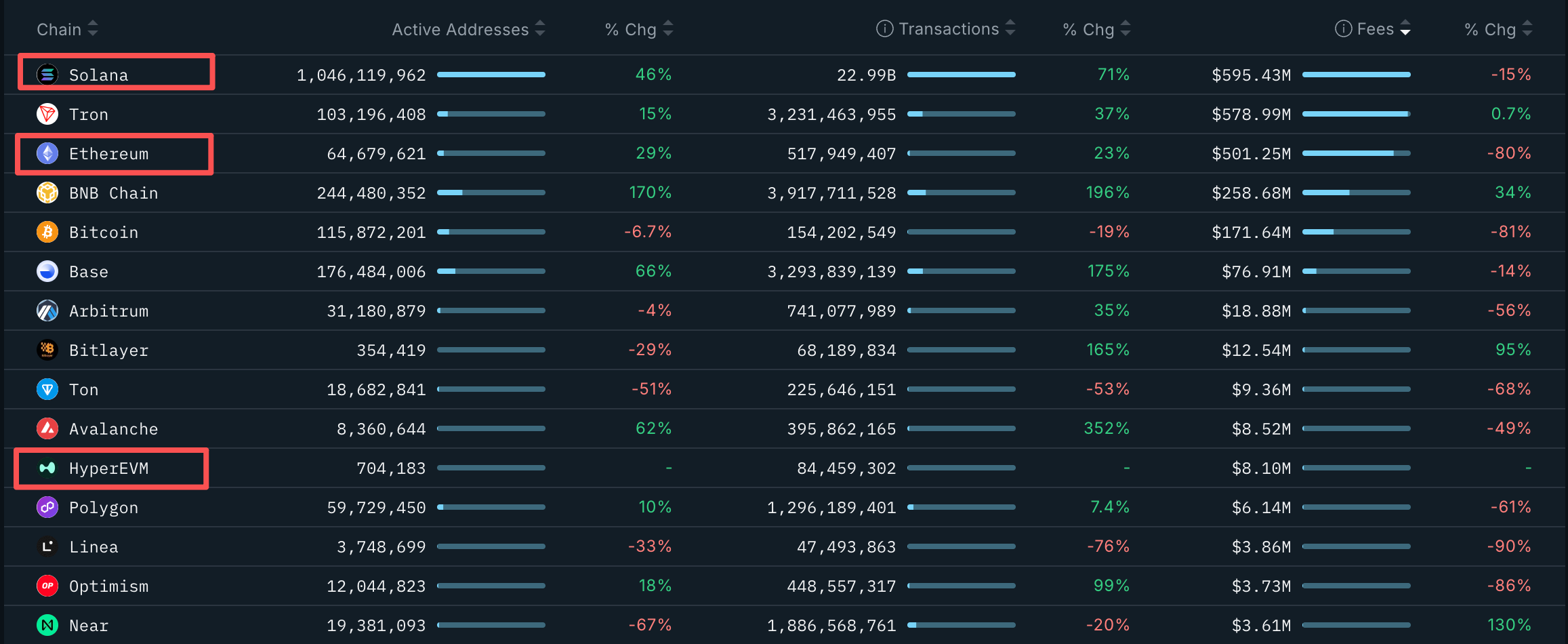
On January 2nd, Nansen data showed that Solana's on-chain fee revenue in 2025 broke through $600 million, surpassing TRON and Ethereum to rank first. The top five blockchains by on-chain fees last year were:

  • Solana ($603 million);
  • TRON ($581 million);
  • Ethereum ($514 million);
  • BNB Chain ($259 million);
  • Bitcoin ($172 million).

In addition, the number of active addresses on the Solana chain exceeded 1.05 billion, and the number of on-chain transactions was about 23.01 billion, both higher than public chains such as Ethereum, Bitcoin, and Tron.

Latest data shows that,as of the time of writing, Solana has maintained its first position in terms of number of active addresses, number of transactions, and revenue fees within the past year.
2025 Solana Annual Revenue Exceeds $1.5 Billion, Surpassing the Combined Revenue of "Hyperliquid + Ethereum"

According to Blockworks Research data, Solana's full-year revenue in 2025 exceeded $1.5 billion, leading all public chain networks. Hyperliquid followed closely with revenue of $780 million; Ethereum generated $690 million in the same period, both lagging behind Solana. At the same time, and even more commendable, Solana achieved this revenue achievement while its median transaction fee remained below 1 cent.

In this regard, Solana co-founder Anatoly Yakovenko affirmed this achievement and pointed out that capacity growth and cost-effectiveness are the core driving forces. He believes that network scale, not high fees, supports sustainable revenue expansion.

2025 Solana On-Chain Spot Trading Volume Reaches $1.6 Trillion, Surpassing All CEXs Except Binance

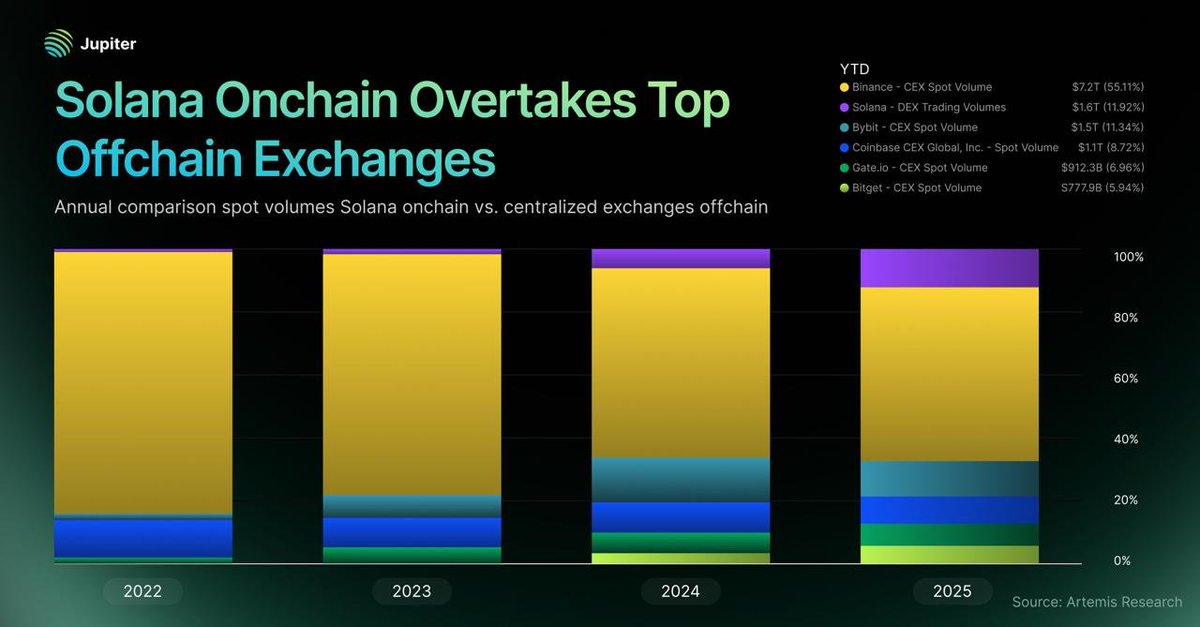
Recently, The Kobeissi Letter stated that the on-chain spot trading volume on Solana in 2025 officially reached $1.6 trillion, surpassing all centralized exchanges except Binance.

According to data from JupiterExchange, the proportion of Solana's on-chain trading volume to total trading volume has grown from 1% to 12% since 2022. In 2025, Solana's total trading volume officially exceeded that of Bybit, Coinbase Global, and Bitget, second only to Binance.

At the same time, Binance's market share has dropped from 80% to 55% since 2022. This also means that industry activity in cryptocurrency is rapidly shifting on-chain.
Revealing the Composition of Solana Ecosystem On-Chain Revenue: 4 Components Support Over $600 Million

Based on available information, Solana's network revenue mainly comes from on-chain transaction fees. Unlike Ethereum and others, its fee mechanism design focuses more on deflation and validator incentives. The composition of the total fee revenue of $603 million in 2025 is as follows:

First Revenue: Base Fee

  • A very low fixed base fee is charged per transaction (about 5000 lamports).
  • This portion of the fee is entirely burned, not distributed to validators, directly reducing the total supply of SOL, creating deflationary pressure.
  • Accounts for a large proportion of total fee revenue, especially in 2025 with explosive transaction growth, the burning mechanism significantly enhanced SOL's scarcity.

Second Revenue: Priority Fee

  • An additional fee that users can optionally pay to speed up transaction confirmation.
  • During periods of high congestion (e.g., meme coin craze, large DEX trades), priority fees increase significantly, becoming a major source of revenue increment.
  • This portion of the fee is distributed to block producers (Leaders) and stakers, and is the main reward source for validators.

Third Revenue: MEV (Maximal Extractable Value) Related Revenue

  • Tips paid by searchers through MEV clients like Jito further supplement income.
  • The proportion of MEV revenue increased in 2025, closely related to complex arbitrage opportunities in DEX and meme coin trading.

Fourth Revenue: Other Minor Sources

Such as account rent (storage fees), voting fees, etc., accounting for a small proportion.

In the overall distribution mechanism, about 50% of the fees indirectly benefit all SOL holders through the burning mechanism (deflation); about 50% is directly distributed to validators and stakers, incentivizing network security. Unlike Ethereum, where protocol revenue fees mainly go to validators, Solana's burning mechanism gives its network revenue greater long-term value capture capability, which is also the key to maintaining low fees under high transaction volume.

Overview of Crypto Money-Making Machine Business Models: Public Chains, Perp DEXs, Launchpads Remain the Most Profitable Tracks, Second Only to Stablecoins

Finally, synthesizing existing market information, public chains (Solana, Ethereum, TRON), on-chain perp DEXs (like Hyperliquid, Aster, etc.), and on-chain Launchpads (like Pump.fun) are still the most profitable tracks in the crypto industry, second only to stablecoin projects that collect interest and have stable issuance.

Although we previously analyzed the awkward survival state of current public chain projects in the article "Only 10 Public Chains Have Weekly Revenue Over $100,000: Swimming Naked After the Tide Recedes", the existence of public chains like Solana, Ethereum, TRON, and Base tells us: public chains are still the most profitable crypto track today, perhaps even without exception.

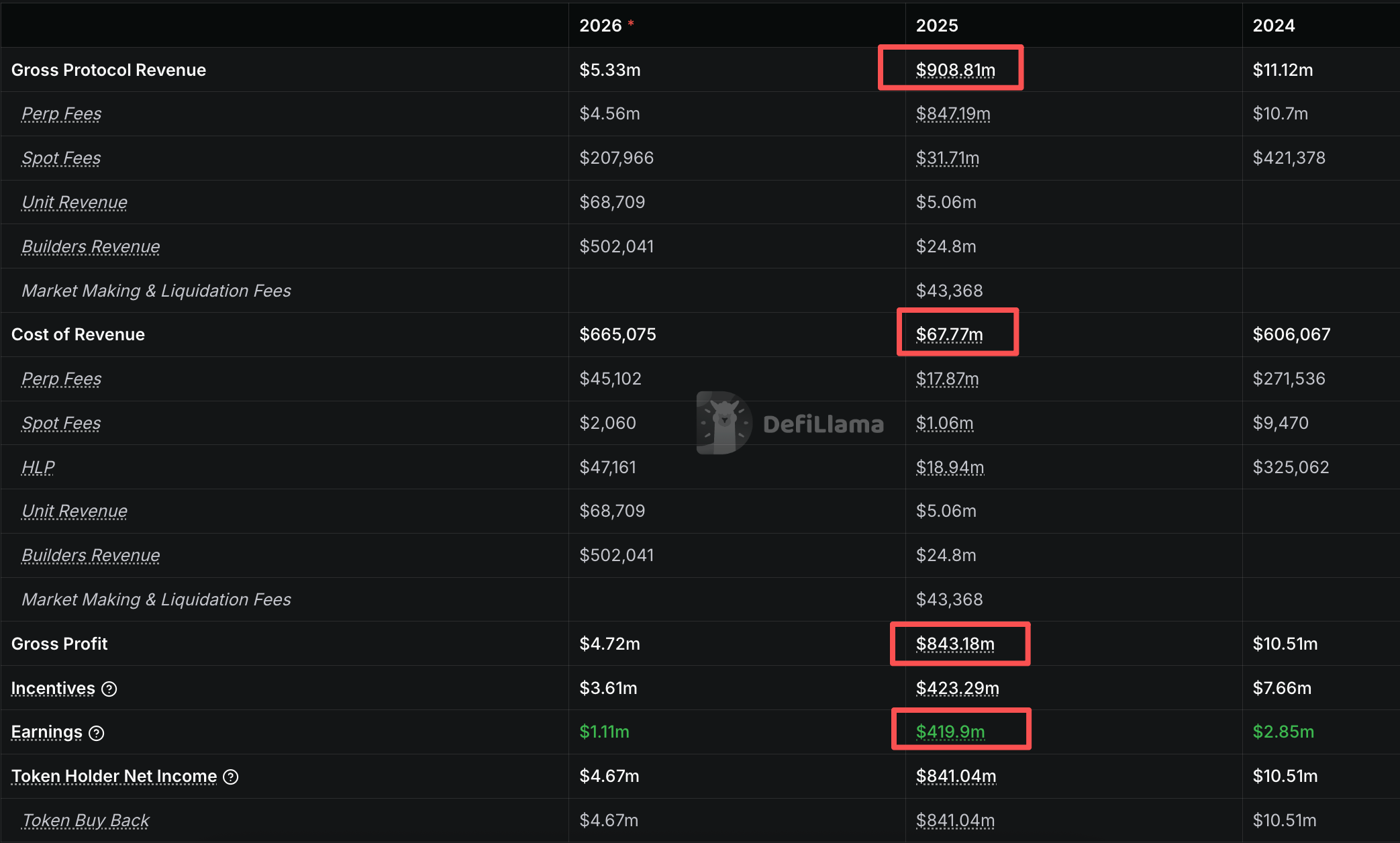
According to DefiLlama data, Hyperliquid's revenue in 2025 was $908 million; its cost of revenue was approximately $67.77 million, and its annual net profit was approximately $843 million. Excluding incentive-based expenses, the net profit attributed to the platform in 2025 was as high as approximately $420 million.
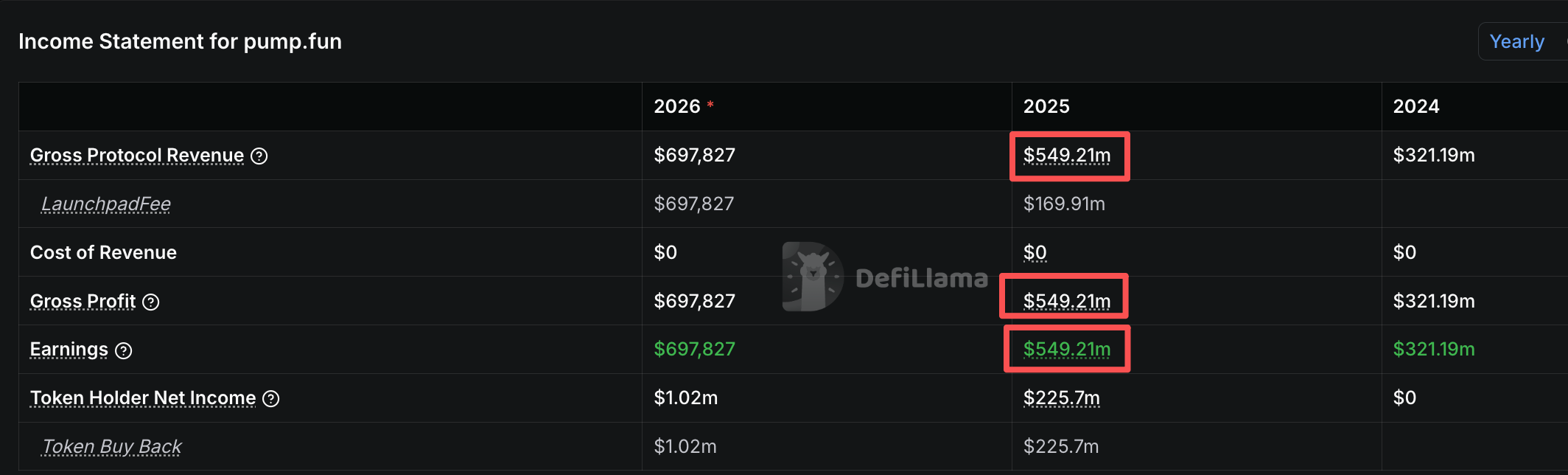
According to DefiLlama data, Pump.fun's annual revenue in 2025 was approximately $550 million. Unlike on-chain perp DEX platforms like Hyperliquid, as a "one-click coin issuance platform", Pump.fun does not need to incur incentive expenses, so its platform's annual net profit is approximately equal to its annual revenue, i.e., $549 million.
Based on the above information, the industry's mainstream revenue-generating machines are still top applications like public chains, on-chain Perp DEXs, and Launchpad coin issuance platforms, second only to stablecoins (e.g., Tether's net profit related to the stablecoin sector alone reached $7.43 billion in 2025).


相關問答

QWhat was Solana's on-chain fee revenue in 2025, and how did it rank compared to other major blockchains?

ASolana's on-chain fee revenue in 2025 was $603 million, ranking it number one among all major blockchains, surpassing Tron ($581 million) and Ethereum ($514 million).

QWhat was Solana's total annual revenue for 2025, and how does it compare to the combined revenue of Hyperliquid and Ethereum?

ASolana's total annual revenue for 2025 was over $1.5 billion, which is more than the combined revenue of Hyperliquid ($780 million) and Ethereum ($690 million).

QWhat were the four main components that made up Solana's $603 million in on-chain fee revenue?

AThe four main components were: 1. Base fees (burned, creating deflationary pressure), 2. Priority fees (paid to validators and stakers), 3. MEV (Maximal Extractable Value) related income, and 4. Other minor sources like account rent and voting fees.

QHow much on-chain spot trading volume did Solana process in 2025, and what does this volume surpass?

ASolana processed $1.6 trillion in on-chain spot trading volume in 2025, surpassing the volume of all centralized exchanges except for Binance.

QAccording to the article, what are the most profitable business models in the crypto industry,仅次于稳定币?

AThe most profitable business models,仅次于稳定币, are public chains (like Solana, Ethereum, Tron), on-chain Perp DEXs (like Hyperliquid), and on-chain Launchpads (like Pump.fun).

你可能也喜歡

Coinbase在最新扩张中为英国用户推出加密支持的USDC贷款

基于其在美国的成功经验,加密货币交易所Coinbase已为英国居民推出以加密货币为抵押的USDC贷款服务,接受比特币(BTC)和以太坊(ETH)作为抵押品。此举进一步扩展了该交易所在该地区不断增长的金融服务范围。 英国用户现可通过链上协议Morpho(基于Base网络)使用比特币、以太坊及Coinbase包装质押以太坊(cbETH)作为抵押,即时借入USDC。根据抵押的BTC数量,用户最高可借入500万美元的USDC。抵押品将锁定在Morpho智能合约中,直至贷款全额偿还,且无固定还款计划,但若贷款价值比超过特定阈值,抵押品将被清算并收取罚金。 自2025年1月在美国推出以来,该贷款服务需求强劲,截至2026年4月14日,通过Morpho的贷款发放总额已超过21.7亿USDC。Coinbase计划近期在更多国家推广此项服务。 此外,Coinbase于2025年2月成功获得英国金融行为监管局(FCA)注册为加密服务提供商,随后在2025年11月和2026年4月分别推出了英国储蓄账户和去中心化交易所(DEX)交易服务。近期还与Better Home & Finance合作推出抵押贷款产品,允许用户使用加密货币作为购房首付抵押,并获得了美国货币监理署(OCC)的条件批准,成立Coinbase国家信托公司,迈向联邦监管加密托管机构的重要一步。

bitcoinist1 小時前

Coinbase在最新扩张中为英国用户推出加密支持的USDC贷款

bitcoinist1 小時前

交易

現貨
合約

熱門文章

什麼是 ETH 2.0

ETH 2.0:以太坊的新時代 介紹 ETH 2.0,廣為人知的以太坊 2.0,標誌著對以太坊區塊鏈的一次重大升級。這次過渡不僅僅是表面上的改造;其目標是從根本上增強網絡的可擴展性、安全性和可持續性。ETH 2.0 透過從能量密集型的工作量證明(PoW)共識機制轉向更高效的權益證明(PoS),承諾為區塊鏈生態系統帶來變革性的改變。 什麼是 ETH 2.0? ETH 2.0 是一系列獨特且相互連接的更新,專注於優化以太坊的能力和性能。這次全面改革旨在解決現有以太坊機制所面臨的主要挑戰,特別是交易速度和網絡擁堵問題。 ETH 2.0 的目標 ETH 2.0 的主要目標圍繞著改善三個核心方面: 可擴展性:旨在顯著提升網絡每秒可以處理的交易數量,ETH 2.0 希望突破目前約每秒 15 笔交易的限制,潛在地達到數千筆。 安全性:增強的安全措施是 ETH 2.0 的核心,特別是提高抵抗網絡攻擊的能力以及保護以太坊的去中心化精神。 可持續性:新的 PoS 機制旨在不僅提高效率,還大幅降低能耗,讓以太坊的運營框架與環保考量相符。 誰是 ETH 2.0 的創造者? ETH 2.0 的創建可追溯至以太坊基金會。這個非營利組織在支持以太坊發展方面發揮著關鍵作用,由著名的聯合創始人 Vitalik Buterin 主導。他對於更可擴展和更可持續以太坊的願景,是這次升級的推動力,並吸引了來自全球的開發者和愛好者的貢獻,共同致力於改善協議。 誰是 ETH 2.0 的投資者? 雖然有關 ETH 2.0 的投資者的具體信息尚未公開,但以太坊基金會已知方向來自區塊鏈及技術領域的各種組織和個人支持。這些合作夥伴包括創投公司、技術公司和慈善機構,它們共同致力於支持去中心化技術和區塊鏈基礎設施的發展。 ETH 2.0 如何運作? ETH 2.0 以引入一系列關鍵特性而著稱,使其與前身有所區別。 權益證明(PoS) 轉向 PoS 共識機制是 ETH 2.0 的標誌性變化之一。與依賴於能量密集型挖礦進行交易驗證的 PoW 不同,PoS 允許用戶根據他們在網絡中抵押的 ETH 數量來驗證交易和創建新區塊。這導致能量效率的提升,能耗降低約 99.95%,使以太坊 2.0 成為一個相當綠色的替代方案。 分片鏈 分片鏈是 ETH 2.0 的另一個關鍵創新。這些較小的鏈與主要的以太坊鏈平行運行,使得多筆交易可以同時處理。這種方法增強了網絡的整體容量,解決了困擾以太坊的可擴展性問題。 信標鏈 在 ETH 2.0 的核心是信標鏈,它協調網絡並管理 PoS 協議。它在某種程度上充當了組織者:它監督驗證者,確保各分片與網絡的連接,並監控整體區塊鏈生態系統的健康狀況。 ETH 2.0 的時間軸 ETH 2.0 的旅程標誌著幾個關鍵里程碑,描繪了這次重大升級的演變: 2020年12月:信標鏈的啟動標誌著 PoS 的引入,為 ETH 2.0 的遷移鋪平了道路。 2022年9月:“合併”的完成代表著以太坊網絡成功從 PoW 轉型為 PoS 框架,預示著以太坊的新時代。 2023年:預期分片鏈的推出旨在進一步增強以太坊網絡的可擴展性,鞏固 ETH 2.0 作為去中心化應用和服務的強大平台。 主要特性和優勢 改進的可擴展性 ETH 2.0 最重要的優勢之一是其改進的可擴展性。PoS 和分片鏈的結合使網絡能夠擴大容量,允許其處理的交易量遠超舊有系統。 能源效率 PoS 的實施對於區塊鏈技術中的能源效率來說是一個巨大的進步。通過大幅降低能源消耗,ETH 2.0 不僅減少了運營成本,還與全球可持續發展目標更加一致。 增強的安全性 ETH 2.0 的更新機制提高了網絡的安全性。PoS 的部署,加上通過分片鏈和信標鏈建立的創新控制措施,確保了對潛在威脅更高程度的保護。 降低用戶成本 隨著可擴展性的改善,交易成本也會明顯降低。預期增強的容量和減少的擁堵將轉化為用戶更低的手續費,使以太坊在日常交易中變得更可及。 結論 ETH 2.0 標誌著以太坊區塊鏈生態系統的一次重要演變。隨著其解決可擴展性、能源消耗、交易效率和整體安全性等關鍵問題,這次升級的重要性不言而喻。轉向權益證明、引入分片鏈以及信標鏈的基礎性工作,顯示出以太坊未來能夠滿足去中心化市場日益增長的需求。在一個由創新和進步推動的行業中,ETH 2.0 是區塊鏈技術在為更可持續和高效的數字經濟鋪路方面能力的見證。

166 人學過發佈於 2024.04.04更新於 2024.12.03

什麼是 ETH 2.0

什麼是 ETH 3.0

ETH3.0 與 $eth 3.0:以深入分析以太坊的未來 介紹 在快速發展的加密貨幣和區塊鏈技術領域,ETH3.0,通常標記為 $eth 3.0,已成為一個備受關注和猜測的話題。該術語包含兩個主要概念,值得說明: 以太坊 3.0:這代表潛在的未來升級,旨在增強現有的以太坊區塊鏈的能力,特別集中於提高可擴展性和性能。ETH3.0 表情符號代幣:這個獨特的加密貨幣項目旨在利用以太坊區塊鏈創建一個以表情符號為中心的生態系統,促進加密貨幣社區的參與。 理解這些 ETH3.0 的方面不僅對加密愛好者至關重要,也對觀察數字空間中的更廣泛技術趨勢的人有所幫助。 什麼是 ETH3.0? 以太坊 3.0 以太坊 3.0 被認為是對已建立的以太坊網絡的擬議升級,自其誕生以來,它一直是許多去中心化應用程式(dApps)和智能合約的支柱。預想的增強主要集中於可擴展性——整合先進技術,如分片和零知識證明(zk-proofs)。這些技術創新旨在促進每秒交易數量的前所未有(TPS),潛在地達到數百萬筆,從而解決當前區塊鏈技術面臨的最重大限制之一。 這次改進不僅是技術性的,更是戰略性的;它旨在為以太坊網絡的普遍採用和未來的實用性做準備,因為該未來將面臨對去中心化解決方案日益增長的需求。 ETH3.0 表情符號代幣 與以太坊 3.0 不同,ETH3.0 表情符號代幣進入了一個更輕鬆和更具玩樂性的領域,通過將互聯網表情符號文化與加密貨幣動態相結合。該項目使用戶能夠在以太坊區塊鏈上購買、出售和交易表情符號,提供一個促進社區通過創造力和共同利益參與的平台。 ETH3.0 表情符號代幣旨在展示區塊鏈技術如何與數字文化交匯,創造出既有趣又具有經濟價值的使用案例。 誰是 ETH3.0 的創造者? 以太坊 3.0 對以太坊 3.0 的倡議主要由以太坊社區內的一個開發者和研究人員的聯盟推動,特別是包括 Justin Drake。他因對以太坊演變的見解和貢獻而聞名,Drake 在關於將以太坊轉變為新共識層的討論中是一個重要人物,這被稱為「Beam Chain」。 這種協作開發的方式標誌著以太坊 3.0 不是單一創造者的產品,而是集中精力促進區塊鏈技術進步的集體智慧的體現。 ETH3.0 表情符號代幣 關於 ETH3.0 表情符號代幣的創造者的詳細資料目前無法追溯。表情符號代幣的特性通常導致更分散和社區驅動的結構,這可以解釋為什麼缺乏具體的歸屬感。這與更廣泛的加密社區的精神相符,該社區的創新往往源於協作而非個人努力。 誰是 ETH3.0 的投資者? 以太坊 3.0 對以太坊 3.0 的支持主要來自以太坊基金會以及一個充滿熱情的開發者和投資者社區。這種基礎聯繫提供了相當程度的合法性,並增強了成功落實的前景,因為它利用了多年網絡運營建立的信任和可信度。 在快速變化的加密貨幣氣候中,社區支持在推動開發和採用中發揮了關鍵作用,將以太坊 3.0 置於未來區塊鏈進步的重要競爭者地位。 ETH3.0 表情符號代幣 雖然目前可用的來源並沒有明確提供支持 ETH3.0 表情符號代幣的投資機構或組織的具體信息,但這反映出表情符號代幣典型的資金模型,通常依賴於基層支持和社區參與。此類項目的投資者通常由因社區驅動的創新潛力以及在加密社區中發現的合作精神而受到激勵的個人組成。 ETH3.0 如何運作? 以太坊 3.0 以太坊 3.0 的區別特點在於其擬議的分片和零知識證明技術的實施。分片是一種將區塊鏈劃分為更小、更易管理的單元或「分片」的方法,這些分片能夠同時處理交易,而不是按序處理。這種處理的去中心化有助於避免擁堵,並確保即使在高負載下,網絡也能保持響應。 零知識證明(zk-proof)技術通過允許交易驗證而不揭示涉及的基本數據,增加了一層複雜性。這一方面不僅增強了隱私性,還提高了整個網絡的效率。還有討論將零知識以太坊虛擬機(zkEVM)納入此次升級,進一步擴大網絡的能力和實用性。 ETH3.0 表情符號代幣 ETH3.0 表情符號代幣通過利用表情符號文化的受歡迎程度而脫穎而出。它建立了一個市場,讓用戶參與表情符號交易,不僅僅是為了娛樂,也是為了潛在的經濟利益。通過整合質押、流動性供應和治理機制等特性,該項目營造了一種促進社區互動和參與的環境。 通過提供娛樂和經濟機會的獨特結合,ETH3.0 表情符號代幣旨在吸引多樣的觀眾,範圍從加密愛好者到隨便的表情符號愛好者。 ETH3.0 的時間表 以太坊 3.0 2024年11月11日:Justin Drake 暗示即將到來的 ETH 3.0 升級,重點是可擴展性改進。這一公告標誌著關於以太坊未來架構正式討論的開始。2024年11月12日:預期中的以太坊 3.0 提案將在曼谷的 Devcon 上公佈,為更廣泛的社區反饋和潛在的開發後續步驟奠定基礎。 ETH3.0 表情符號代幣 2024年3月21日:ETH3.0 表情符號代幣正式在 CoinMarketCap 上列出,標誌著其進入公眾加密領域,並增強了其基於表情符號的生態系統的可見性。 關鍵要點 總之,以太坊 3.0 代表了以太坊網絡內的重要演變,集中於通過先進技術克服可擴展性和性能的限制。其擬議的升級反映出對未來需求和可用性的主動應對。 另一方面,ETH3.0 表情符號代幣 encapsulates 加密貨幣領域中以社區為驅動文化的本質,利用表情符號文化來創建鼓勵用戶創造力和參與的平台。 理解 ETH3.0 和 $eth 3.0 的不同目的和功能對於任何對加密領域中正在進行的發展感興趣的人來說都是至關重要的。隨著這兩個倡議鋪展獨特的道路,它們共同凸顯了區塊鏈創新動態和多樣化的本質。

169 人學過發佈於 2024.04.04更新於 2024.12.03

什麼是 ETH 3.0

如何購買ETH

歡迎來到HTX.com!在這裡,購買Ethereum (ETH)變得簡單而便捷。跟隨我們的逐步指南,放心開始您的加密貨幣之旅。第一步:創建您的HTX帳戶使用您的 Email、手機號碼在HTX註冊一個免費帳戶。體驗無憂的註冊過程並解鎖所有平台功能。立即註冊第二步:前往買幣頁面,選擇您的支付方式信用卡/金融卡購買:使用您的Visa或Mastercard即時購買Ethereum (ETH)。餘額購買:使用您HTX帳戶餘額中的資金進行無縫交易。第三方購買:探索諸如Google Pay或Apple Pay等流行支付方式以增加便利性。C2C購買:在HTX平台上直接與其他用戶交易。HTX 場外交易 (OTC) 購買:為大量交易者提供個性化服務和競爭性匯率。第三步:存儲您的Ethereum (ETH)購買Ethereum (ETH)後,將其存儲在您的HTX帳戶中。您也可以透過區塊鏈轉帳將其發送到其他地址或者用於交易其他加密貨幣。第四步:交易Ethereum (ETH)在HTX的現貨市場輕鬆交易Ethereum (ETH)。前往您的帳戶,選擇交易對,執行交易,並即時監控。HTX為初學者和經驗豐富的交易者提供了友好的用戶體驗。

3.6k 人學過發佈於 2024.12.10更新於 2025.03.21

如何購買ETH

相關討論

歡迎來到 HTX 社群。在這裡,您可以了解最新的平台發展動態並獲得專業的市場意見。 以下是用戶對 ETH (ETH)幣價的意見。

活动图片