When the Terra system and its UST algorithmic stablecoin collapsed in May, it triggered a meltdown in the crypto world that has been compared with the Great Financial Crisis of 2008. Some people called Terra/UST “Crypto’s Lehman.” Others think the crypto fund Three Arrows Capital, which collapsed in June and took a number of crypto lenders down with it, is more like Lehman and Terra/UST perhaps more akin to Bear Stearns.
But although it’s tempting to draw analogies with the Great Financial Crisis, there’s one crucial difference. In the Great Financial Crisis, the U.S. Federal Reserve intervened to keep markets functioning and bail out banks. But there’s no Federal Reserve for crypto. Although the Fed manages dollar liquidity, it does not take any account of conditions in crypto markets. There’s no U.S. government institution supporting crypto.
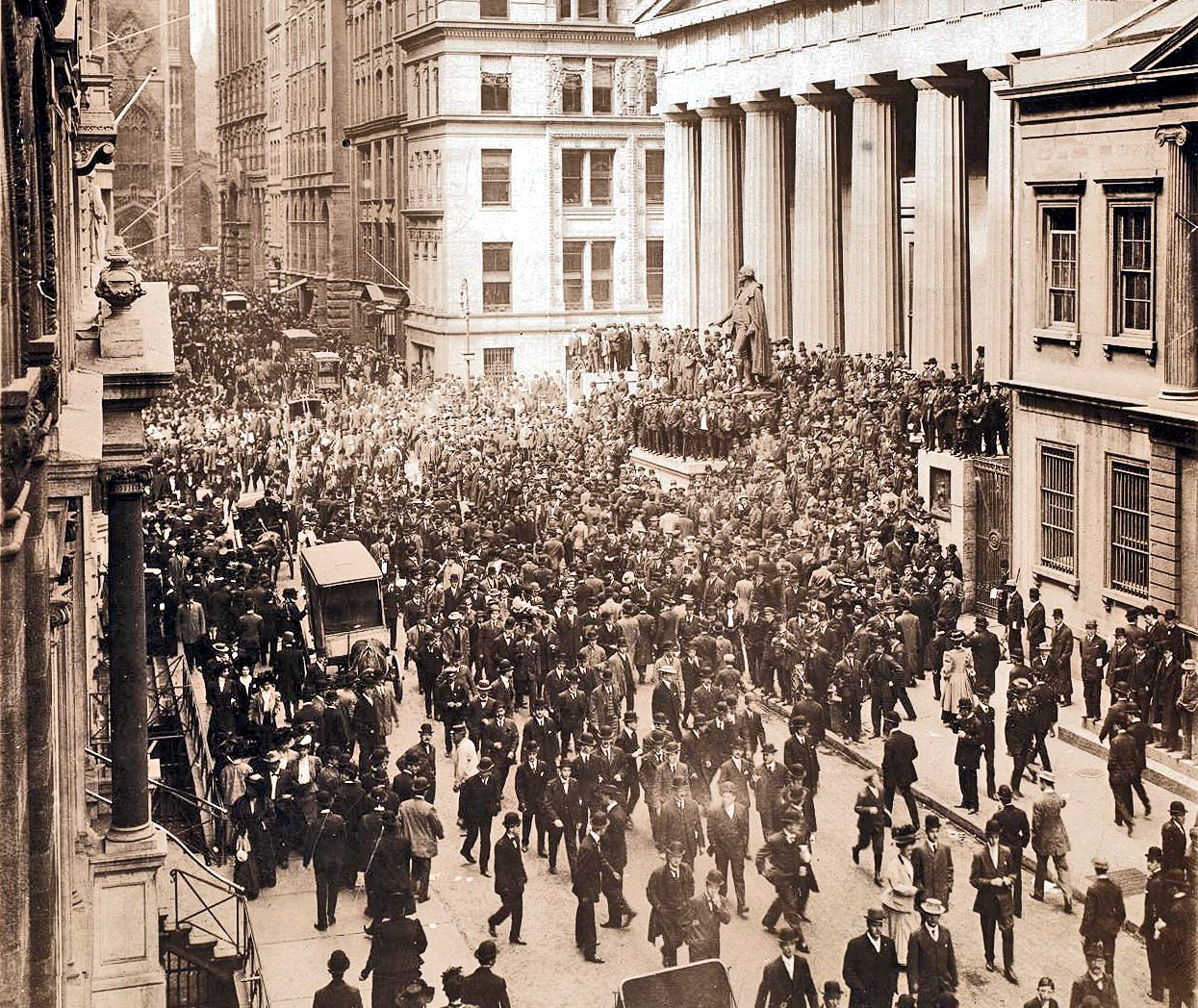
The real equivalent of this crypto meltdown is not the 2008 financial crisis, nor even the 1929 Wall Street crash. No, it’s a crisis that pre-dates the creation of the Fed – the “Panic” of 1907.
We tend to think of financial crises, whether in traditional finance or crypto, as network failures. But in the 1907 crisis the story is really about interconnected individuals. One man’s disastrous mistake caused systematic collapses of institutions connected to him by personal relationships. Similarly, underlying this year’s crypto meltdown is a story of broken friendships and betrayed trust.
The dramatis personae of the 1907 crisis were the brothers F. Augustus and Otto Heinze; the banker Charles W. Morse; Charles T. Barney, president of the Knickerbocker Trust Company; and the financier John Pierpont Morgan. The bank Morgan founded is today one of the largest in the world, and still bears his name: JPMorgan.
The crisis started with the dramatic collapse of a copper mining company, United Copper Company, which was majority-owned by the Heinze brothers. Otto Heinze believed speculators were borrowing United Copper’s stock in order to short it. So he tried to corner the market, as Charles Morse had done with New York City’s ice market. Otto Heinze bought large quantities of the stock to push up the price and squeeze the speculators out – what is known as a “short squeeze.” But Otto’s belief was mistaken. Traders were able to cover their positions. The short squeeze failed. The company collapsed, and the Heinzes, who had borrowed heavily to buy the stock, were financially ruined.
Failure of a copper company shouldn’t have triggered a financial crisis. But the Heinzes, and their close friend Morse, were extraordinarily well connected. Augustus Heinze owned a bank, the State Savings Bank in Butte, Montana, which was holding United Copper stocks as collateral against some of its lending. When United Copper collapsed, it became insolvent. This triggered a run on three banks connected to Morse.
All three banks were members of “clearinghouses,” consortiums of banks that collectively guaranteed to clear each other’s checks. So the deposits that ran from them simply ended up in other banks. The New York Clearing House Association eventually stopped the runs by forcing Morse and Heinze to resign all their banking interests. But by that time the crisis had widened to another group of financial institutions – the trust companies.
Sam Bankman-Fried is today’s Morgan, sole arbiter of which companies live and which are allowed to die.
Trust companies were unregulated deposit-taking and lending institutions – what we would now call “shadow banks.” They could invest customers’ funds in a wider range of assets than banks, including risky assets such as common equity in the proliferating startup enterprises of that time. And because they could take more risks, they could pay higher interest rates, out-competing banks for deposits. Not surprisingly, depositors looking for higher interest rates flocked to them, believing they were as safe as banks.
But trust companies did not have banks’ protection from illiquidity. They did not have to maintain even the 5% cash reserves required of banks at that time. They were not clearinghouse members, though some gained access to clearinghouse guarantees by forming alliances with banks. If a trust company got into trouble, no bank or trust company would bail it out. Like today’s crypto banks, it would simply collapse, taking its customers’ money with it.
Trust companies marketed themselves as robust institutions that were as safe as or safer than banks. But in reality they were highly leveraged and very fragile – just like the crypto banks that marketed themselves as better than banks and claimed banking guarantees to which they were not entitled.
The Knickerbocker Trust Company was among America’s largest trust companies. It occupied an imposing building in New York City, on the northwest corner of Fifth Avenue at West 34th Street. Its president, Charles T. Barney, was a respectable financier. No one thought the Knickerbocker could fail.
But among Barney’s close connections was Charles Morse. Rumors spread that Barney had used Knickerbocker Trust funds to finance the Heinzes’ attempted “corner.” Depositors flocked to withdraw their money. The Knickerbocker paid out $8 million in three hours, wiping out its liquidity and forcing it to close its doors. Barney appealed to J.P. Morgan for assistance. But Morgan decided the bank was insolvent and he refused to bail it out – just as in the crypto meltdown, billionaire FTX CEO Sam Bankman-Fried decided crypto lender Celsius Network was insolvent and refused to bail it out after the Terra crash.
The Knickerbocker Trust’s failure triggered a widespread run on banks and trust companies. Banks stopped lending to each other and stock prices collapsed as brokers, unable to obtain liquidity, stopped trading. Morgan brought together a consortium of wealthy individuals to provide immediate liquidity to the market, and persuaded banks and trust companies to support each other.
But the crisis rolled on, becoming too much for even these very wealthy men to handle. So Morgan used the press and the clergy to send reassuring messages to the public. In the end it was spin doctoring, backed by a $100 million liquidity guarantee from the New York Clearing House, that ended the systemic runs – though not for long. A second phase of the crisis started in November 1907, this time triggered by failure of a brokerage that had unwisely accepted shares in a failing steel company as collateral. Again, Morgan was forced to intervene to rescue banks and trust companies.
The entire U.S. financial system had come to depend on one man. No wonder Congress decided something more robust was needed. The 1907 crisis led directly to the creation of the Federal Reserve banking system.
In 2022, as in 1907, one man brought down the system, and one man has shored it up. Do Kwon is crypto’s equivalent, not of Otto Heinze but of Charles Morse, the banker whose personal interconnectedness created such terrible fragility. Sam Bankman-Fried is today’s Morgan, sole arbiter of which companies live and which are allowed to die.
And the lesson for crypto from the 1907 crisis is that financial stability ultimately depends not on the reliability of technology, but on the trustworthiness of people.