Overnight, GPT-5.6 Sol Was Accelerated 14x by OpenAI

marsbit發佈於 2026-08-14更新於 2026-08-14

文章摘要

OpenAI, in collaboration with chipmaker Cerebras, has unveiled a limited preview of an "Ultrafast Mode" for its flagship GPT-5.6 Sol model. This new service tier reportedly achieves output speeds of up to 750 tokens per second—a 14x increase over the standard mode's baseline of ~53 tokens/s—without any loss in quality. Key to this acceleration is Cerebras's wafer-scale architecture (WSE-3), which houses model parameters entirely in on-chip SRAM to eliminate the memory bandwidth bottlenecks typical of traditional GPU clusters. In benchmark testing on the challenging "Humanity's Last Exam" (HLE), GPT-5.6 Sol in Ultrafast Mode answered all 2500 questions in 11 hours and 11 minutes, compared to over 78 hours for a competitor model, while maintaining similar accuracy. The speed boost also translated to a 5.6x faster end-to-end performance on the GDP-Val benchmark for economically valuable knowledge work. OpenAI highlights several potential applications for such rapid inference, including real-time event response and reliability analysis, dynamic financial research and security, complex customer support, interactive shopping assistance, and accelerated research and experimentation workflows that enable multiple iterative cycles within a single workday. This advancement may allow users to deploy the highest-tier models for tasks previously requiring slower secondary models, significantly compressing multi-step agent workflows from hours to minutes.

Is AI starting to leverage information asymmetry?

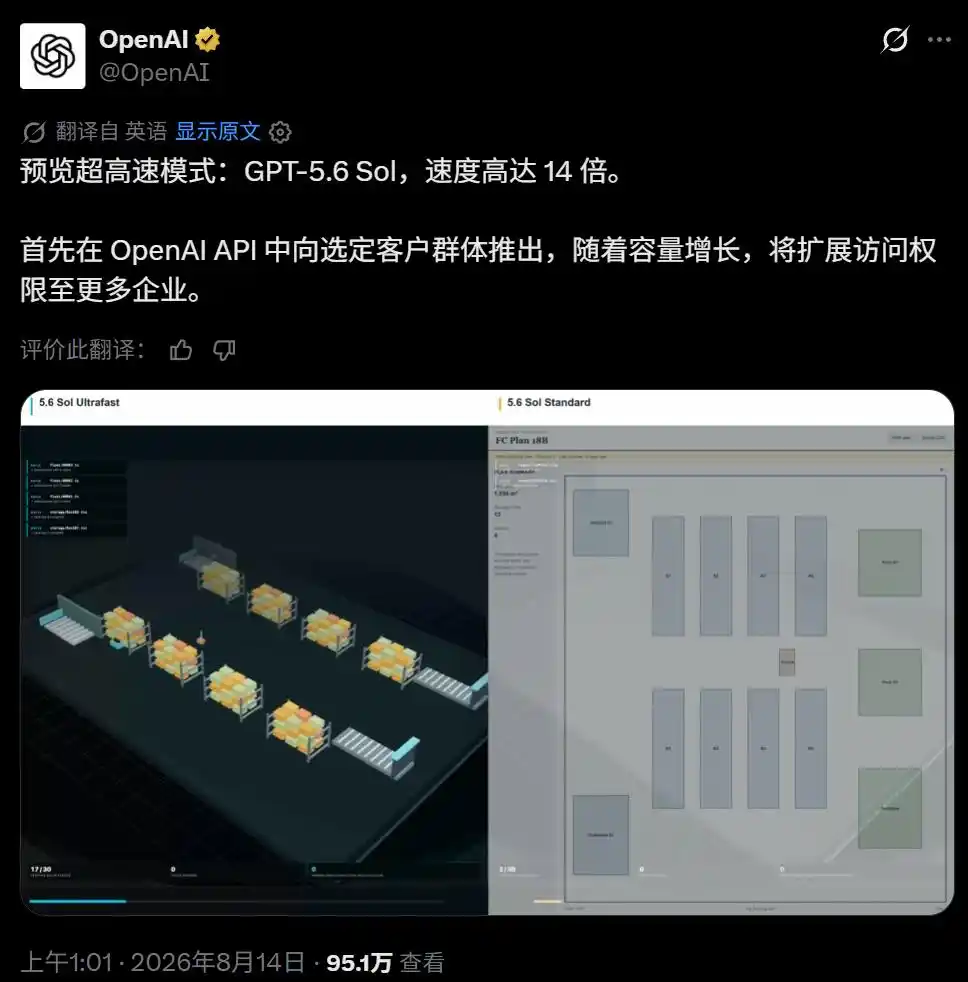
In the early hours of August 14th, OpenAI, in partnership with AI chip manufacturer Cerebras, officially previewed a new service tier called "Ultrafast Mode" for its flagship model GPT-5.6 Sol.

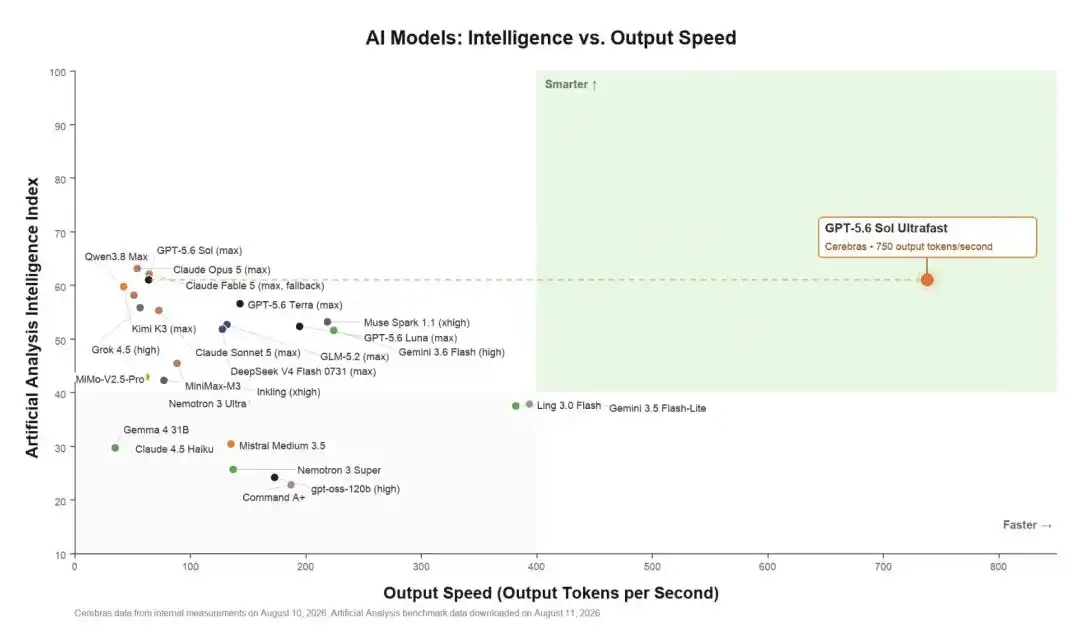
In this mode, the output speed of GPT-5.6 Sol can reach up to 750 tokens/s. Compared to the baseline inference speed of about 53 tokens/s in the current Standard mode, this represents a speed increase of up to 14 times, with no reduction in quality. For perspective, the accelerated GPT-5.6 Sol is 11 times faster than Fable 5 and 5 times faster than Opus 4.8 in its Fast mode.

The Ultrafast mode will be launched first in the OpenAI API and is currently available in a limited preview to some customers.
For this, OpenAI and Cerebras also created a comparison table showing the current speed and intelligence of leading AI large models. GPT-5.6 Sol Ultrafast holds an absolutely leading position:
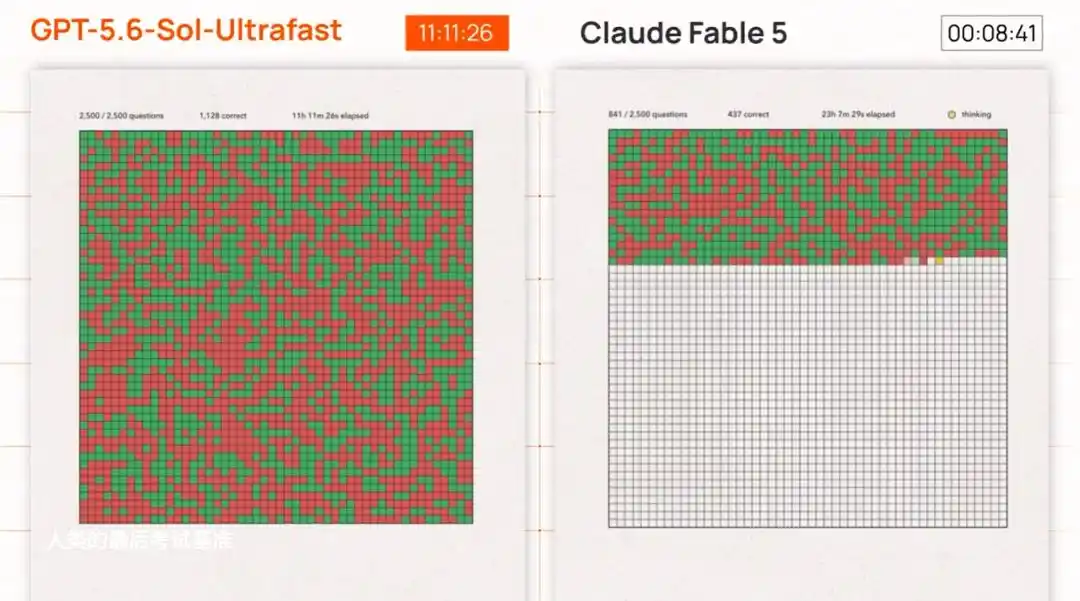
In Cerebras's blog, engineers described tests conducted on the "Humanity's Last Exam" (HLE) benchmark, where they compared the Ultrafast-accelerated model with direct competitors. As we know, HLE is a challenging model benchmark containing 2500 questions, typically only solvable by Ph.D.s in fields like chemistry, economics, and literature.

GPT-5.6 Sol in Ultrafast mode answered all questions in just 11 hours and 11 minutes. In contrast, Claude Fable 5 required 78 hours and 27 minutes—over three days of continuous computation—to reach the same conclusions. GPT's Ultrafast mode completed the frontier of human knowledge in a single workday, achieving nearly 7 times the speed of Claude Fable while maintaining similar accuracy.
As model capabilities continue to improve, the application scope of fast inference will also expand. GPT-5.6 Sol is OpenAI's best-performing model to date for legal documents, financial models, and engineering reports. On the GDP-Val benchmark (which measures economically valuable knowledge work tasks), Ultrafast achieved a 5.6x end-to-end speed improvement without any drop in quality, fully demonstrating how faster reasoning speeds can accelerate economically valuable work.
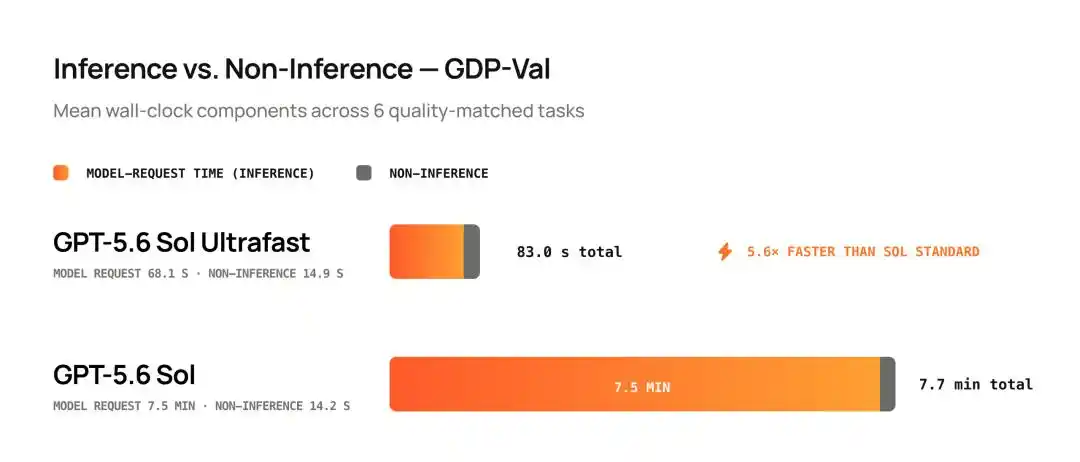
Faster AI processing adds significant possibilities to emerging workflows. People can now deploy agents onto the critical path of problems. OpenAI lists some application scenarios for you:

  • Incident response and reliability: When critical systems fail, AI analyzes application logs, recent code changes, and engineer reports to identify potential causes and help prepare fixes while the incident is still ongoing.
  • Financial research and security: Analyzing market signals, evaluating trades, and identifying suspicious activities in rapidly changing market conditions.
  • Customer support and voice: Resolving complex customer issues in real-time, even when finding answers requires multiple steps or systems, without interrupting the conversation.
  • Commerce: Answering product questions, checking inventory, personalizing recommendations, and resolving checkout issues while shoppers are still deciding, preventing hesitation from turning into abandoned carts.
  • Real-time research and experimentation: Transforming research that previously required overnight processing into interactive work sessions, allowing teams to test ideas, check results, adjust methods, and run another experiment without breaking their workflow.

Internally at OpenAI, developers tested GPT-5.6 Sol in Ultrafast mode. Incident response is an example of using Ultrafast. When an alert triggers, engineers need to build an accurate picture of the incident while systems and evidence are still changing. With Sol-level intelligence, teams can quickly read logs, analyze traces, summarize conversations, determine the next steps for investigation, and assist in preparing or verifying fixes. Ultrafast mode reduces the delay between observing a signal, verifying hypotheses, and choosing the next action, while engineers remain responsible for judgment and deployment.

In research, the OpenAI team uses Ultrafast to quickly search knowledge bases, query data, and rapidly gather, organize, and summarize information from various tools. A common research workflow used to involve team members launching a batch of experiments overnight and reviewing results the next morning. With Ultrafast, the discovery process can be shortened, supporting multiple iterations within a single workday.

The breakthrough of Ultrafast mode lies in breaking the memory bandwidth bottleneck of traditional GPU clusters during the autoregressive decoding stage of large models. Its implementation primarily relies on Cerebras's wafer-scale hardware architecture.
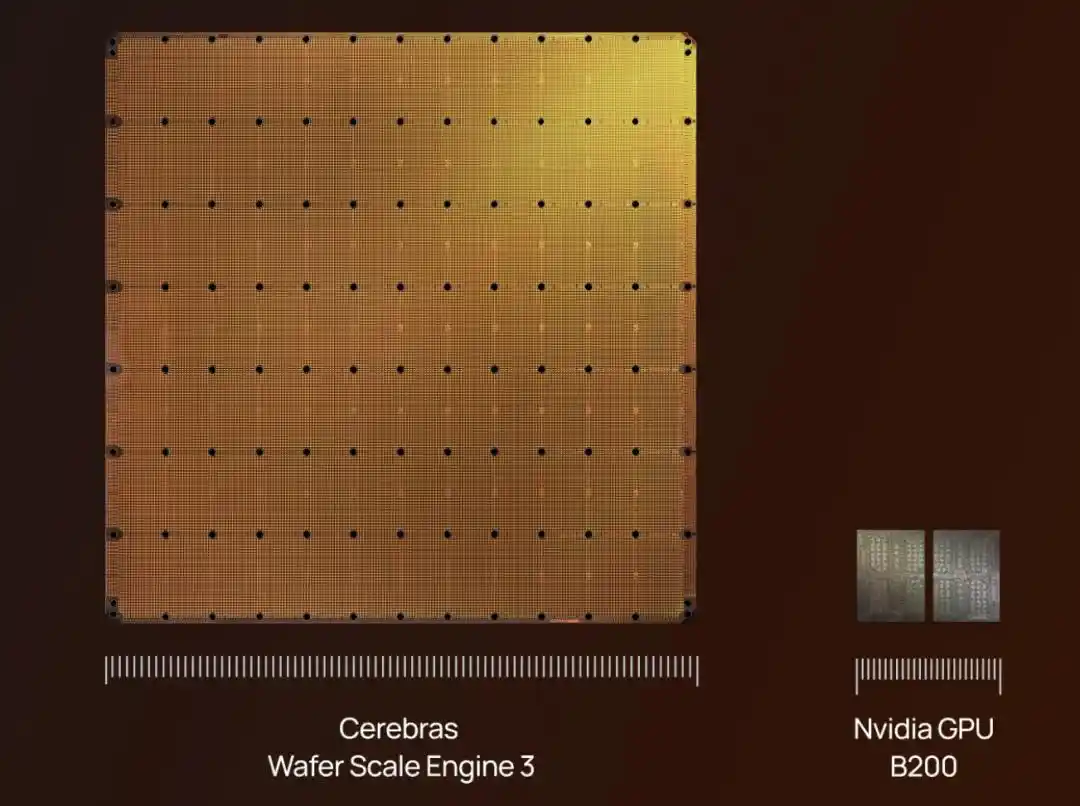
Among AI chip manufacturers, Cerebras's solution is unique: its successive chip generations are manufactured from entire silicon wafers, integrating vast numbers of computing cores and ultra-high-speed interconnection networks on a single die.

Traditional GPUs, when running autoregressive token generation for large models, are limited by memory bandwidth, requiring constant transfer of massive model weights between off-chip HBM and computing cores. Additionally, multi-card partitioning introduces communication delays across chips (via PCIe/NVLink).

In contrast, each of Cerebras's latest wafer-scale chips (WSE-3) integrates 4 trillion transistors, delivers 125 petaflops of AI compute power, and features up to 44 GB of on-chip high-speed SRAM. Model parameters reside directly in the high-bandwidth on-chip SRAM, eliminating the wait time associated with repeatedly loading weights from off-chip memory.

Of course, as a cutting-edge flagship model, the full parameter count of GPT-5.6 Sol obviously far exceeds the chip's capacity. Cerebras also has a "Pipelined across wafers" mechanism. This distributes the various network layers of the model across multiple wafers, with each layer's parameters residing in the SRAM of its respective chip, allowing tokens to seamlessly flow between wafers in a pipeline.

For many large model users, a 14x speedup for the flagship model means that many tasks that previously required switching to secondary models (like Luna and Terra) can now be confidently run at full power. For Agent tasks requiring multi-round tool use, code generation/debugging, and complex chain-of-thought reasoning, processes that used to take hours can be compressed into minutes.

Faster speeds might also mean a shift in how we use AI:
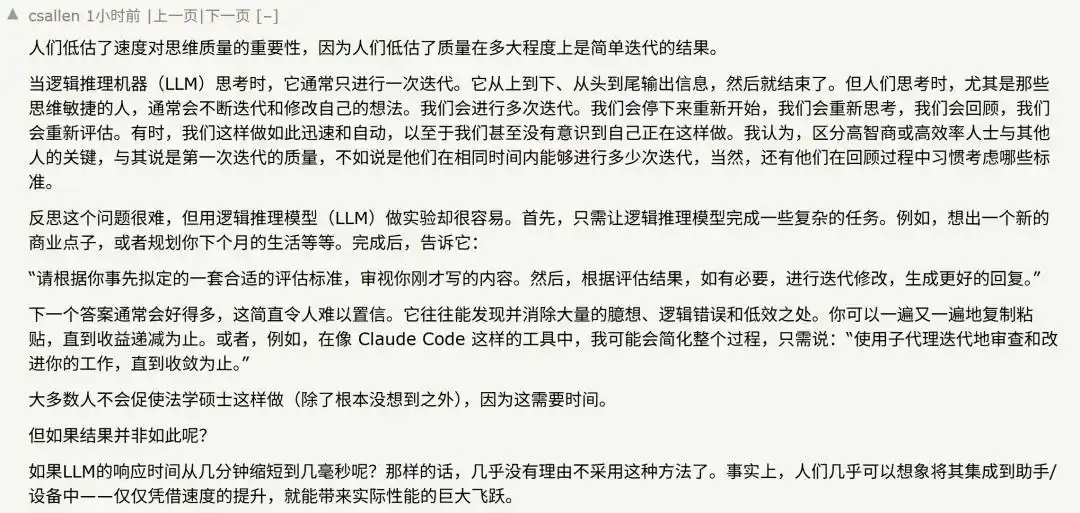
Within the AI community, people are already looking forward to Ultrafast mode versions for Luna and Terra. The only question is whether Cerebras's chips will be sufficient.

References:

https://openai.com/index/previewing-ultrafast/

https://www.cerebras.ai/blog/accelerating-gpt-5-6-sol-ultrafast-with-openai

This article is from the WeChat public account "Almost Human" (ID: almosthuman2014), by the machinehearts team focused on large models.


熱門幣種推薦

相關問答

QWhat is the key feature of OpenAI's newly previewed 'Ultrafast Mode' for GPT-5.6 Sol, and what is its claimed performance improvement?

AThe key feature is a 14x increase in output speed, reaching up to 750 tokens per second (tokens/s), compared to the Standard mode baseline of approximately 53 tokens/s, without any reduction in quality.

QWhich AI chip manufacturer did OpenAI partner with to achieve the speed boost for GPT-5.6 Sol's Ultrafast Mode?

AOpenAI partnered with the AI chip manufacturer Cerebras to achieve the speed boost for the Ultrafast Mode.

QAccording to the article, in what major test did GPT-5.6 Sol Ultrafast demonstrate a significant speed advantage over its competitor Claude Fable 5?

AIn the 'Humanity's Last Exam' (HLE) benchmark test, GPT-5.6 Sol Ultrafast answered all 2500 questions in 11 hours and 11 minutes, while Claude Fable 5 took 78 hours and 27 minutes, making it almost 7 times faster.

QWhat is the fundamental technical reason mentioned for the speed breakthrough in Ultrafast Mode, addressing a limitation of traditional GPU clusters?

AThe breakthrough comes from Cerebras's wafer-scale hardware architecture, which keeps the entire model's parameters in the chip's high-bandwidth on-chip SRAM. This eliminates the memory bandwidth bottleneck and the latency caused by repeatedly loading weights from external memory (like HBM in GPUs) and cross-chip communication.

QWhat are two potential application scenarios for Ultrafast AI models listed in the article?

ATwo potential application scenarios are: 1) Event response and reliability: Analyzing logs and reports in real-time to help diagnose and fix critical system failures as they occur. 2) Real-time research and experimentation: Turning overnight research processes into interactive sessions, allowing teams to iterate on ideas and test results multiple times within a single workday.

你可能也喜歡

交易

現貨

熱門文章

什麼是 SOLANA

HarryPotterWifHatMyroWynn10Inu,$solana: 一窺這個潮流迷因幣項目 介紹 在不斷演變的加密貨幣世界中,創新的項目層出不窮,吸引著投資者和愛好者的想像。其中一個項目是 HarryPotterWifHatMyroWynn10Inu,$solana,一個已經開始在加密社區中佔有一席之地的迷因幣。本文章旨在為您提供有關該項目的全面概述,闡明其目的、架構、創建者、投資者以及在發展過程中的重要里程碑。 什麼是 HarryPotterWifHatMyroWynn10Inu,$solana? 概述 HarryPotterWifHatMyroWynn10Inu,$solana 是一個基於 Solana 區塊鏈的迷因幣項目—這是一個以其擴展性和速度而著稱的平台。該項目旨在為加密空間帶來快樂和創意,不僅作為交易代幣,還作為生成和分享迷因內容的催化劑。其核心的社區受到鼓勵參與,提供一個動態生態系統,在這裡創造力和協作得以蓬勃發展。 目標和宗旨 該項目的本質是培養一個讓迷因愛好者聚集、分享和創作新穎迷因內容的環境。這種以敘事為驅動的方式在社區中注入了興奮感,推動了參與,同時展示了 Solana 區塊鏈內在的強大功能。通過建立一個以社區為中心的項目,HarryPotterWifHatMyroWynn10Inu,$solana 亦希望探討數字貨幣作為表達手段的社會影響。 HarryPotterWifHatMyroWynn10Inu,$solana 的創建者是誰? HarryPotterWifHatMyroWynn10Inu,$solana 的創建者身份仍然神秘莫測。該項目的結構是以放棄所有權的方式設計的,因此它作為一個由社區主導的倡議蓬勃發展。這種去中心化促進了所有利益相關者之間的透明性和民主參與。在迷因幣的世界中,這種方法越來越受歡迎,因為社區參與是至高無上的。 HarryPotterWifHatMyroWynn10Inu,$solana 的投資者是誰? 截至目前,沒有公開可得的關於支持 HarryPotterWifHatMyroWynn10Inu,$solana 的具體投資者或基金會的信息。知名投資者的缺席進一步強調了該項目的以社區為導向的精神,它獨立於傳統金融框架。這種獨立性使項目能夠在沒有外部壓力的情況下發展其身份,而是依賴於用戶基礎的集體興趣。 HarryPotterWifHatMyroWynn10Inu,$solana 如何運作? 經濟模型 該項目采用了一種獨特的經濟模型,支撐其功能性和用戶參與。HarryPotterWifHatMyroWynn10Inu,$solana 內部的交易旨在對所有參與方都有益。每一筆交易都會收取費用,這些費用隨後會在現有持有者中重新分配,同時增強流動性池。 這一模型的關鍵組成部分包括: 反射機制:交易費用的一部分會返回給持有者,促進對代幣的長期投資。 流動性池獲取:資金被分配以增強流動性,確保買賣操作可以順利執行。 燒毀機制:部分代幣可能會被燒毀以創造稀缺性,隨著需求的上升可能會增加價值。 這種設計鼓勵了一個自我維持的生態系統,在這裡社區互動和投資得以繁榮。 社區參與 HarryPotterWifHatMyroWynn10Inu,$solana 的核心價值在於社區參與。通過使用戶能夠通過創作迷因和促銷等各種活動參與項目的發展,該項目培育了一個充滿活力的生態系統,讓創造力得以蓬勃發展。 HarryPotterWifHatMyroWynn10Inu,$solana 的時間軸 HarryPotterWifHatMyroWynn10Inu,$solana 的發展軌跡上有多個值得注意的事件,塑造了它在加密社區中的當前地位: 創建:具體的創建日期仍未披露,但該項目的起源植根於貫穿數位時代的迷因文化之中。 社區接管:在創建者放棄所有權後,該項目過渡為由社區主導的模式,讓所有參與者都有份於它的成功。 審計和 NFT 收藏:為了增強可信度,該項目完成了一次徹底的審計,同時推出了一個 NFT 收藏,體現其以迷因為中心的精神。 夥伴關係和發展:該項目目前正在尋找潛在的夥伴關係,並組織基於其傳奇迷因的獨特網站和商品選項的發展。 要點 總結而言,HarryPotterWifHatMyroWynn10Inu,$solana 在加密貨幣的迷因幣領域中是一個值得注意的參與者。以下是一些關鍵要點: 社區主導的倡議:該項目作為一項合作努力蓬勃發展,鼓勵社區成員積極貢獻,同時與所有權聲索分離。 創新的經濟模型:利用反射、流動性獲取和燒毀機制,為用戶創建一個強大而引人入勝的財務環境。 NFT 和商品參與:通過推出 NFT 收藏,該項目旨在深化社區參與,強化迷因文化與數字貨幣之間的聯繫。 探索夥伴關係:該倡議並非靜止不前—持續的發展和潛在的夥伴關係表明了一種面向未來的增長取向。 結論 隨著 HarryPotterWifHatMyroWynn10Inu,$solana 在加密貨幣領域中不斷擴展,其獨特的社區參與、創新經濟結構以及迷因文化的融合勾勒出其未來的潛在路徑。即使其起源和投資者關係仍帶有神秘色彩,該項目卻講述了一個富有魅力的故事,體現去中心化創新的本質。在一個加密貨幣往往被視為純金融視角的世界中,HarryPotterWifHatMyroWynn10Inu,$solana 展示了加密運動融合了創造力、社區和合作的特性。無論您是經驗豐富的投資者還是新手,這個迷因幣項目的發展過程無疑是一個值得關注的迷人案例。

1.5k 人學過發佈於 2024.04.04更新於 2024.12.03

什麼是 SOLANA

什麼是 SOLANA 2.0

BarbieCrashBandicootRFK777Inu, $SOLANA 2.0:加密貨幣界的新玩家 BarbieCrashBandicootRFK777Inu, $SOLANA 2.0 介紹 在不斷演變的加密貨幣市場中,新興項目不斷吸引著投資者和愛好者的注意。在這些新興項目中,有一個名為BarbieCrashBandicootRFK777Inu,以加密貨幣符號$SOLANA 2.0代表。這個獨特的計劃結合了魅力、冒險和迷因文化的元素,旨在在高度競爭的領域中挑戰預期。這個項目抱有增長和創新的願景,捕捉到一種努力對抗已建立的巨頭的精神。 BarbieCrashBandicootRFK777Inu, $SOLANA 2.0 是什麼? 在其核心,BarbieCrashBandicootRFK777Inu是一個受到多種標誌性文化參考啟發的加密貨幣項目。它包括與Barbie相關的優雅和魅力,Crash Bandicoot的動感能量,以及RFK所代表的堅韌驅動,該項目的目標是在加密貨幣的世界中提供多面化的體驗。 BarbieCrashBandicootRFK777Inu項目的主要目標是將這些不同的元素融合成一個吸引廣泛受眾的凝聚生態系統。通過擁抱迷因文化的奇想,同時堅守去中心化和財務賦權的原則,該項目已定位為對於成熟投資者和加密世界的新手都具有吸引力的選擇。 BarbieCrashBandicootRFK777Inu, $SOLANA 2.0 的創造者是誰? 儘管對BarbieCrashBandicootRFK777Inu的關注不斷增長,關於其創造者的信息仍然 largely未知。創始人或開發團隊的匿名性引發了對項目結構和治理的疑問。在加密貨幣的世界中,項目沒有公開創始人是很常見的。這一缺乏信息可能會使某些潛在投資者卻步,而其他人則可能將其視為擁抱許多加密貨幣項目所基礎的去中心化精神的機會。 BarbieCrashBandicootRFK777Inu, $SOLANA 2.0 的投資者是誰? 目前,關於支持BarbieCrashBandicootRFK777Inu的投資基金或機構的信息相對較少。項目缺乏詳細的投資支持突顯了許多加密貨幣的獨立性。在這種情況下,項目的資金是否來自基層社群的支持或更大金融實體的支持,仍有待觀察。 BarbieCrashBandicootRFK777Inu, $SOLANA 2.0 如何運作? BarbieCrashBandicootRFK777Inu設計了多項功能,使其在擁擠的加密空間中獨具一格。雖然具體的技術細節仍然保密,但該項目預計將融入旨在增強用戶參與度和促進社區增長的功能。從時尚和冒險到遊戲的多樣影響力的結合,促進了一種迎合多樣興趣的包容氛圍。 此外,該項目與$SOLANA 2.0生態系統的聯繫暗示著潛在的技術優勢。這可能包括創新的交易速度、可擴展性和成本效益,與Solana區塊鏈的技術能力相一致。項目的創始人似乎正在依靠這一技術基礎,以創建持久的社區體驗和實質性的產品供應。 BarbieCrashBandicootRFK777Inu, $SOLANA 2.0 的時間表 BarbieCrashBandicootRFK777Inu的旅程包含幾個關鍵里程碑,提供了該項目迄今為止的發展見解: 項目概念化:最初的想法圍繞著魅力、冒險和迷因文化的融合,為項目的獨特概念提供了框架。 代幣創建:象徵性的$SOLANA 2.0代幣建立,旨在體現項目的願景並吸引潛在投資者的興趣。 項目開發:目前,該項目正進行進一步開發,重點是挑戰加密空間中的現有玩家並提供創新的產品。 這些里程碑反映了項目的增長軌跡,同時突顯了其致力於開發一個開創性的加密貨幣體驗的承諾。 關於BarbieCrashBandicootRFK777Inu, $SOLANA 2.0 的要點 獨特概念:BarbieCrashBandicootRFK777Inu通過將魅力、冒險和迷因文化的元素融合到一個加密貨幣項目中而脫穎而出。 弱者精神:該項目擁抱弱者的角色,旨在挑戰現有的加密貨幣項目並在行業中開闢一塊市場。 開發階段:正在進行積極的開發工作,旨在提供符合社區和投資者期望的新鮮和創新的產品。 結論 BarbieCrashBandicootRFK777Inu,以符號$SOLANA 2.0呈現,是加密貨幣市場中一個引人入勝的新進者。其獨特的文化參考混合和雄心勃勃的願景,可能引起尋求在加密領域尋找替代項目價值的人的共鳴。 雖然創始人和投資者的未知狀態可能會引發疑問,但該項目對魅力和冒險的重視展現了擴展加密貨幣可能體現的界限的迷人敘事。隨著項目的持續發展,觀察其在更廣泛的加密市場中的演變及其如何在競爭對手中定位自己,將會非常有趣。對於那些參與者來說,BarbieCrashBandicootRFK777Inu可能會解鎖重新定義與數字資產互動的驚喜體驗。 目前,隨著項目的推進,其旅程提醒著我們,加密空間的創新沒有界限,提供了一切從興奮和娛樂到財務賦權的潛力。

329 人學過發佈於 2024.04.05更新於 2024.12.03

什麼是 SOLANA 2.0

如何購買SOL

歡迎來到HTX.com!在這裡,購買Solana (SOL)變得簡單而便捷。跟隨我們的逐步指南,放心開始您的加密貨幣之旅。第一步:創建您的HTX帳戶使用您的 Email、手機號碼在HTX註冊一個免費帳戶。體驗無憂的註冊過程並解鎖所有平台功能。立即註冊第二步:前往買幣頁面,選擇您的支付方式信用卡/金融卡購買:使用您的Visa或Mastercard即時購買Solana (SOL)。餘額購買:使用您HTX帳戶餘額中的資金進行無縫交易。第三方購買:探索諸如Google Pay或Apple Pay等流行支付方式以增加便利性。C2C購買:在HTX平台上直接與其他用戶交易。HTX 場外交易 (OTC) 購買:為大量交易者提供個性化服務和競爭性匯率。第三步:存儲您的Solana (SOL)購買Solana (SOL)後,將其存儲在您的HTX帳戶中。您也可以透過區塊鏈轉帳將其發送到其他地址或者用於交易其他加密貨幣。第四步:交易Solana (SOL)在HTX的現貨市場輕鬆交易Solana (SOL)。前往您的帳戶,選擇交易對,執行交易,並即時監控。HTX為初學者和經驗豐富的交易者提供了友好的用戶體驗。

3.0k 人學過發佈於 2024.12.12更新於 2026.06.02

如何購買SOL

相關討論

歡迎來到 HTX 社群。在這裡,您可以了解最新的平台發展動態並獲得專業的市場意見。 以下是用戶對 SOL (SOL)幣價的意見。

活动图片