
Author: Zen, PANews
The major Asian Web3 industry conference, WebX, just concluded in Tokyo. Japanese Prime Minister Takaichi Sanae stated in a video address that she hopes the synergy between the WebX conference and government policies will further advance the development of Japan's innovation ecosystem.
The bustling crowd at the venue contrasted sharply with the current chill in the crypto market, leading many participants to joke that they felt "the beauty of a crypto bull market" at the event.
As part of the expanding business footprint of Japanese financial group SBI Holdings, this conference also allowed this "old-timer" actively involved in the crypto market to "steal the spotlight" on-site. Not only was SBI the title sponsor, but the group's Chairman, Yoshitaka Kitao, also delivered a keynote speech. Just last October, SBI acquired a 51% stake in CoinPost, the Japanese crypto media organizing WebX, and incorporated it into the group.
This change somewhat echoes SBI's recent flurry of activity in the digital asset space. Over the past month or so, SBI Holdings has participated in a $175 million funding round for decentralized lending protocol Morpho, launched the yen-pegged stablecoin JPYSC, and listed Ripple's U.S. dollar stablecoin RLUSD in Japan.
Entering July, it also invested $125 million in the DeFi risk management and yield strategy platform Gauntlet, and during the WebX conference, established a strategic partnership with the Solana Foundation, planning to expand business around stablecoins, RWA, cross-border settlements, and institutional on-chain services.
Compared to its previous broad-ranging layouts around Ripple, exchanges, market-making, and digital securities, SBI's recent strategic focus has become more concentrated. This 27-year-old traditional financial group is attempting to reassemble traditional financial elements like settlements, asset issuance, trading, credit, and asset management onto the chain.
From Dispersed Layouts to On-Chain Finance: SBI Integrates Its Digital Asset Businesses
SBI's entry into the crypto industry spans a decade. Early investments in Ripple, participation in enterprise blockchain company R3, and the successive establishment of crypto trading, institutional liquidity, and digital securities businesses have made it one of the traditional Japanese financial groups with earlier and broader coverage in digital assets.
However, the early businesses were relatively disconnected. SBI VC Trade handled crypto asset trading and custody, B2C2 provided global institutional liquidity, while the digital securities business explored tokenization of bonds, funds, and other real-world assets. It wasn't until recent years that "on-chain finance" began to emerge as a new framework connecting these businesses.
In strategic materials released in May 2026, SBI divided on-chain finance into six layers: settlement, assets, markets, yield vaults, distribution, and investors, proposing the construction of an "SBI On-Chain Asset Management Platform."
According to its plan, JPYSC, USDC, and RLUSD handle settlement and fund transfers; blockchains and RWA platforms host asset issuance and trading; DeFi improves capital efficiency; while the group's internal asset management, securities, and digital asset businesses are responsible for product design and customer outreach.
Judging from recent investments, SBI is strictly following this structure and layering for its layout. In its own strategic materials, SBI categorizes Circle's finance-oriented blockchain Arc under the "settlement layer," Morpho under the "markets layer," and Gauntlet corresponds to the "yield vaults layer."
This classification also reveals SBI's investment rationale—to fill the missing foundational capabilities in its on-chain financial system.
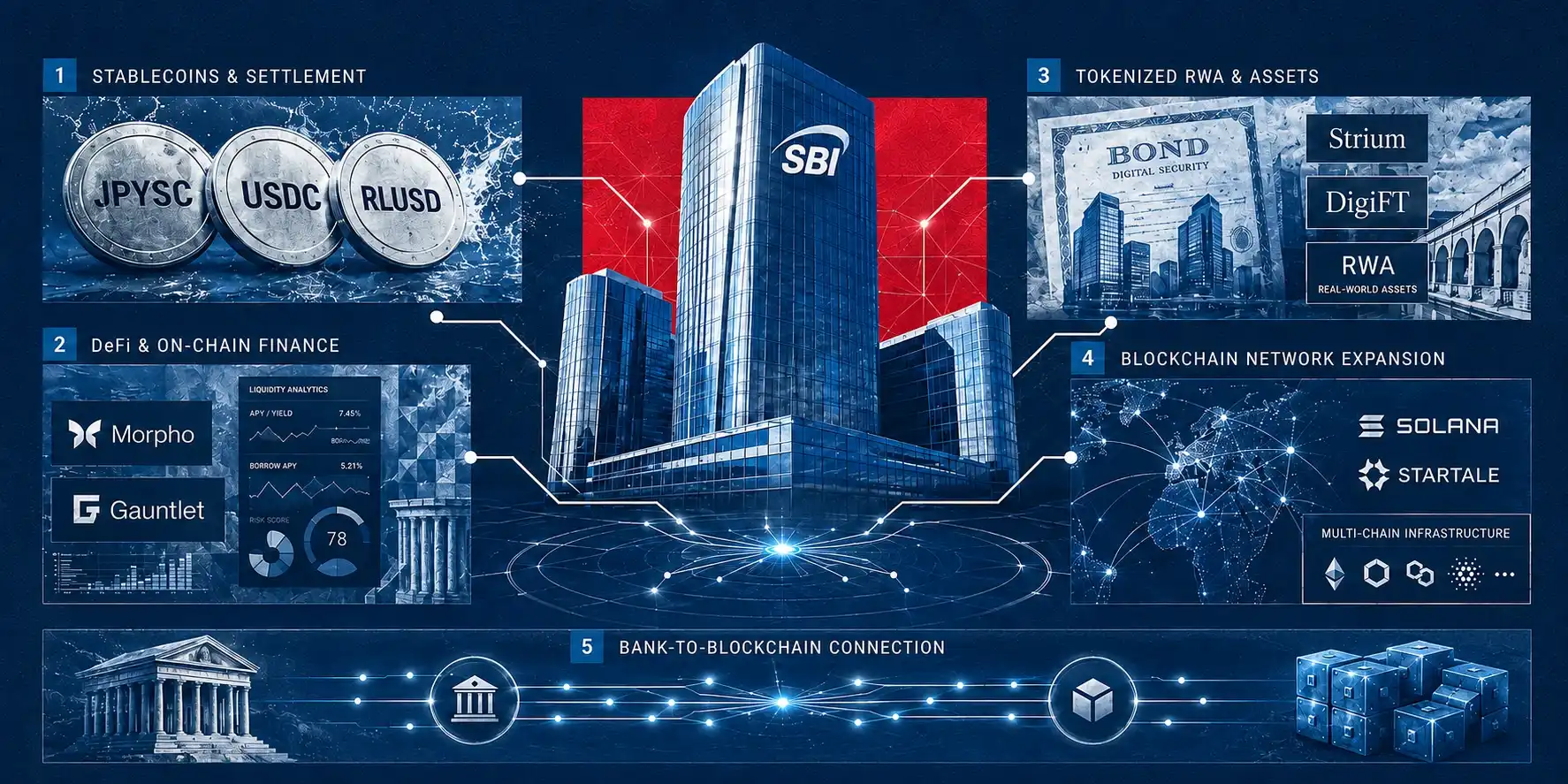
Stablecoins First, Building Yen and Dollar Settlement Networks
In SBI's on-chain finance framework, stablecoins are the first part to enter actual operation.
On June 24, JPYSC, co-developed by SBI and Startale, officially launched. JPYSC is issued by SBI Shinsei Trust Bank, with SBI VC Trade responsible for circulation and Startale handling the primary technical development. As Japan's first trust-structured yen-pegged stablecoin, JPYSC is designed according to the "Type 3 Electronic Payment Instrument" under Japan's Payment Services Act. Reserve assets are managed by the trust bank, with 1 JPYSC pegged to 1 yen.
A key difference brought by the trust structure is that JPYSC is not subject to the 1 million yen remittance and holding limits imposed on "partial fund transfer type" and "overseas-issued" stablecoins. In theory, this makes it more suitable for corporate fund transfers, large-value settlements, RWA transactions, and cross-border payments.
However, JPYSC is still some distance away from open on-chain circulation. Currently, the product is only offered internally within SBI VC Trade accounts; users cannot deposit or withdraw JPYSC to/from external wallets. SBI stated that it will transition to public blockchain circulation only after further clarification of relevant legal interpretations, tax practices, and operational arrangements.

While external transfers are not yet open, SBI has already begun expanding JPYSC's use cases within the platform. SBI VC Trade announced that it would accept applications for JPYSC lending services starting July 16, with the service officially launching on July 23. Users can lend their held JPYSC to the platform and receive yields paid in JPYSC upon maturity; the initial annualized yield is 3%, with the regular rate expected to remain between 1% and 3%.
Beyond the yen stablecoin, dollar stablecoins provide connectivity on the other end.
In March 2025, SBI VC Trade became Japan's first platform to offer USDC trading services to retail users. Since then, SBI's collaboration with Circle has extended from stablecoins to capital and business levels.
In March 2025, the two parties signed an agreement to establish a joint venture, Circle SBI Japan, with SBI and Circle each holding a 50% stake. It is primarily responsible for promoting USDC circulation in Japan and expanding payment and other financial applications. In June of the same year, when Circle was listed on the New York Stock Exchange, the SBI Group purchased $50 million worth of Circle shares as a strategic investor.
In March 2026, SBI VC Trade further launched a USDC lending service, extending stablecoin applications from trading and payments to yield products.
Besides USDC, SBI VC Trade listed RLUSD in June of this year. RLUSD is issued by Ripple's regulated trust company and is treated by SBI as Japan's first "Type 4 Electronic Payment Instrument." Thus, SBI's licensed digital asset platform now simultaneously covers JPYSC, USDC, and RLUSD, forming a product structure with both yen and dollar stablecoins.
The three stablecoins do not play identical roles. JPYSC connects Japan's domestic bank funds and yen-denominated assets; USDC possesses broader global on-chain liquidity; RLUSD continues SBI's decade-long collaboration with Ripple and targets institutional payments and cross-border financial scenarios.
SBI also hopes to further promote cross-currency settlements between JPYSC and dollar stablecoins and explore stablecoin applications in card clearing, cross-border payments, and tokenized asset settlements. The group has already engaged in digital finance cooperation with Visa and tested USDC offline payments.
Bringing Traditional Assets On-Chain, Connecting to Global Markets
Stablecoins address how funds enter the chain; the next step is to bring investable financial assets onto the chain.
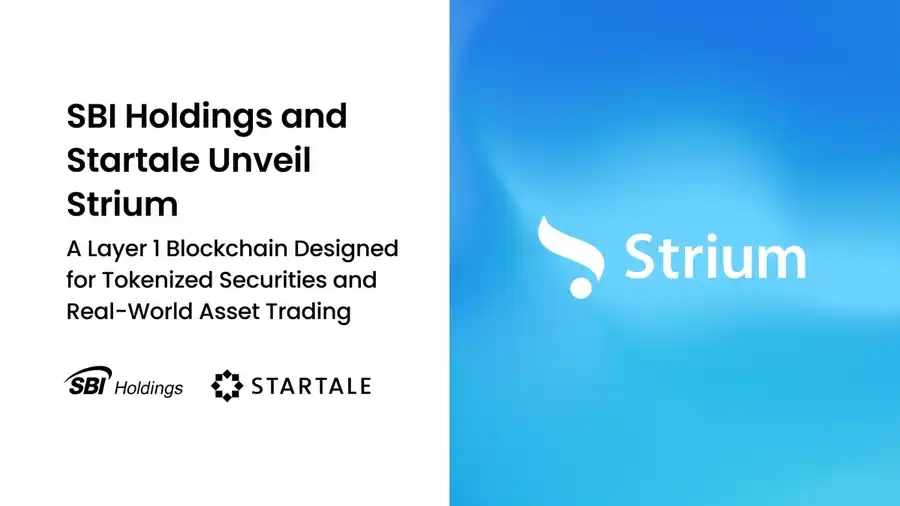
At this stage, Startale is becoming a crucial technical partner for SBI. In March of this year, SBI announced an investment of approximately $50 million in Startale and plans to make it an equity-method affiliate. The two parties are currently jointly advancing two core products: the yen stablecoin JPYSC and the Layer 1 network Strium, designed for tokenized securities and RWA trading.
The Strium project was officially announced in February this year. This network plans to support round-the-clock spot and derivatives trading of tokenized stocks, bonds, and RWA-related products, attempting to establish an on-chain market unrestricted by traditional trading hours. Currently, Strium is still in the proof-of-concept phase, with testnet and commercial deployment timelines yet to be formally determined.
SBI also established a joint venture, SBI Onchain, with Singapore-licensed RWA platform DigiFT, with SBI holding a 60% stake. This platform plans to build tokenization, legal, and risk management frameworks around Japanese assets and connect with overseas on-chain capital. SBI's long-term vision is to transform the group's internal securities, funds, and other financial products into on-chain assets, then use stablecoins to complete trading and settlement.
The partnership with Solana on July 13th further supplements this framework. According to the plan, the Solana Foundation will participate in the subsequent development of SBI R3 Japan, which is proposed to be renamed "SBI Solana Global." Business will revolve around stablecoins like JPYSC, RWAs such as corporate bonds and commercial paper, cross-border settlements, institutional on-chain financial services, and AI agent payments.
This collaboration also reflects SBI's move to strengthen a multi-chain approach. The group continues to co-develop Strium, geared towards tokenized financial assets, with Startale, while retaining layouts on XRPL, Canton, and Ethereum; Solana provides a high-performance public chain and a global liquidity gateway. How different networks will divide labor in the future has not been fully disclosed, but SBI has explicitly stated it does not want to bind financial products and customers to a single chain.
From Morpho to Gauntlet, Completing On-Chain Credit and Asset Management
If stablecoins and RWA primarily address "how funds and assets get on-chain," Morpho and Gauntlet correspond to the question: once funds are on-chain, how are lending, allocation, and yield generation accomplished?
In June, SBI participated in Morpho's new funding round, which raised $175 million. This round was co-led by Paradigm, a16z crypto, and Ribbit Capital. Compared to early DeFi lending models where the protocol uniformly set asset and risk parameters, Morpho adopts a modular architecture, allowing institutions and developers to establish isolated lending markets and choose their own collateral, risk conditions, and yield strategies.
SBI categorizes it under the "markets layer" of on-chain finance in its official strategic materials, valuing precisely this credit infrastructure that can be embedded into banks, fintech platforms, and asset management products.
In July, SBI, through its U.S. subsidiary, led Gauntlet's $125 million Series C funding round. Gauntlet was initially known for its DeFi risk models, having provided market parameters, liquidation risk, and stress testing services for multiple lending protocols. In recent years, it has gradually shifted towards yield vault management, designing on-chain allocation strategies based on assets, yield targets, and risk preferences.
Morpho and Gauntlet are highly complementary in their businesses. Morpho provides the underlying credit network for establishing lending markets, while Gauntlet assesses risks, designs vaults, and allocates funds on top of these markets. The former is closer to market infrastructure in on-chain finance, while the latter handles asset management and risk optimization functions.
Through recent intensive deployments, SBI's on-chain finance blueprint has formed a relatively clear outline. The advantage of this structure is that SBI does not need to build all technical modules from scratch. The group can introduce technologies from native on-chain companies through investments and partnerships, then leverage its own financial licenses, customer base, and distribution network to drive adoption.
However, this on-chain financial system is still in the construction phase, with many components some distance away from large-scale implementation. At this stage, SBI has established a relatively complete strategic framework. Still, whether different businesses can form synergies and ultimately transform into a continuously operating on-chain financial system requires time and validation through practical application.