Curve Governance Upheaval: 17 Million CRV Funding Proposal Rejected, Capital Entities Become New Decision-Making Core

marsbit發佈於 2025-12-26更新於 2025-12-26

文章摘要

A significant governance proposal within the Curve DAO, requesting 17 million CRV in funding for development team Swiss Stake AG, was recently rejected. Major veCRV holders, including Convex and Yearn, voted against the proposal, effectively blocking its passage. The rejection reflects two key concerns within the community: a demand for greater transparency and accountability regarding the use of previous grants and future spending plans, and a reluctance from large token holders to dilute the value of their veCRV holdings without a clear, direct return on investment. The article highlights a shift in DeFi governance, moving away from a model of automatic funding approval. It contrasts the veToken model, used by Curve, with standard governance systems. The ve model binds voting power to long-term token lock-ups, attracting capital-heavy players focused on long-term gains. This, combined with the prevalence of vote-aggregating protocols like Convex, is centralizing decision-making power with large capital providers rather than the broader community or even project founders. The outcome of this vote suggests that future governance power in Curve may lie primarily with these major stakeholders.

Original Author: CM(X:@cmdefi)

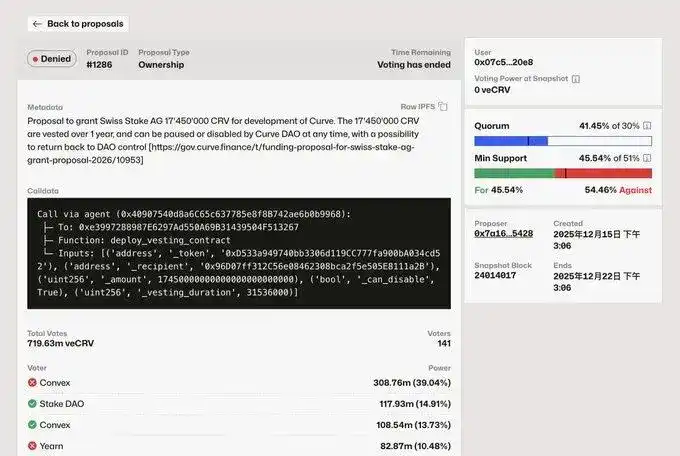
A few days ago, a funding proposal on Curve was rejected. It involved allocating 17M $CRV in development funds to the development team (Swiss Stake AG). Both Convex and Yearn voted against it, and their voting power was sufficient to influence the final outcome.

Since the governance issues at Aave began to gain attention, governance has started to be scrutinized by the market, and the habitual practice of approving funding requests is being broken. Behind this Curve proposal lie two key points:

1. Some voices in the community are not opposed to funding AG, but they want clarity on how previous funds were used, future plans for usage, sustainability, and whether the projects have generated returns for the protocol. Simultaneously, this primitive grant model means that once funds are disbursed, there are no constraints. In the future, the DAO needs to establish a Treasury, ensure transparent revenue and expenditure, or add governance constraints.

2. The large veCRV holders do not want to dilute their value. This is a clear conflict of interest. If the projects supported by CRV grants cannot foreseeably create benefits for veCRV holders, they likely won't receive support. Of course, Convex and Yearn also have their own private interests and agendas, but we won't delve into those issues here.

This proposal was initiated by Curve founder Mich. AG is also one of the teams that has been maintaining the core codebase since 2020. For this funding round, AG's presented roadmap included continuing to advance llamalend, including support for PT and LP, as well as expansion into on-chain foreign exchange markets and crvUSD. These seem like worthwhile endeavors, but whether they justify a 17M $CRV grant is another calculation. Particularly because Curve's governance differs significantly from Aave's; its power is distributed among several teams with distinct stances.

Let's compare the ve model with conventional governance models:

First, the conclusion: most conventional governance models currently have essentially no design advantages. Of course, if a DAO is mature enough, traditional structures can also function well, but unfortunately, no project in Crypto has yet matured to that level, as evidenced by the problems even at market-consensus leaders like Aave.

So, if we talk specifically about model design, the ve model has some advanced aspects. Firstly, it has cash flow; it is backed by liquidity control rights. When there is external demand for liquidity, this power is "bribed." Therefore, even if you don't want to lock your tokens long-term, you can delegate them to proxy projects like Convex/Yearn to earn收益 (yield).

Thus, the ve model binds voting rights with cash flow. Its future evolution will likely follow the path of "governance capitalism." The vetoken binds voting rights with "long-term locking," essentially筛选 (screening for) those with large capital, the ability to bear liquidity loss, and the capacity for long-term博弈 (game theory). Over time, the result is that governors gradually shift from ordinary users to the "capital class."

Furthermore, due to the existence of proxy layers like Convex/Yearn, many ordinary users, even loyal ones, who wish to gain yield without losing liquidity and flexibility, will increasingly choose to delegate their governance power to these projects.

This vote also reveals some clues. In the future, Mich may not be the main character in Curve's governance; instead, power lies with these large vote holders. When governance issues arose at Aave, some proposed ideas of "delegated governance/elite governance," which is quite similar to the current structure of Curve. As for whether this is good or bad, it will take time to tell.
相關問答

QWhat was the main reason for the rejection of the 17M CRV grant proposal for Swiss Stake AG?

AThe proposal was rejected primarily because major veCRV holders, such as Convex and Yearn, voted against it. They were concerned about the dilution of their token value and the lack of a clear, sustainable plan for how the funds would be used to generate tangible benefits for veCRV holders.

QHow does the ve (vote-escrowed) tokenomics model differ from conventional governance models according to the article?

AThe ve model binds voting rights to long-term token lock-ups, which inherently attracts large capital providers who can afford illiquidity and engage in long-term planning. This contrasts with conventional governance models, which the article argues have few inherent design advantages and often struggle without a highly mature DAO structure. The ve model also provides direct cash flow to holders through 'bribes' from protocols seeking liquidity.

QWhat role do proxy platforms like Convex and Yearn play in the Curve ecosystem?

AProxy platforms like Convex and Yearn allow ordinary CRV holders to delegate their voting power and locked tokens to them. In return, the users receive a share of the platform's revenue (e.g., from bribes) while maintaining liquidity and flexibility, as they are not locking tokens directly with Curve. This consolidation of voting power makes these platforms major decision-makers in governance.

QWhat does the article suggest about the future of Curve's governance power dynamics?

AThe article suggests that future governance power in Curve will increasingly reside with large capital holders and proxy platforms like Convex and Yearn, rather than with the founder, Michael Egorov, or the broader community. This shift represents a move towards 'governance capitalism,' where decision-making is concentrated among those with significant financial stakes.

QWhat were the key community concerns regarding the grant proposal, beyond simple opposition to funding?

ABeyond simply rejecting the grant, a part of the community wanted greater transparency and accountability. Their concerns included how previous funds had been used, the sustainability of the development plan, whether the projects would generate measurable returns for the protocol, and a desire for a more structured Treasury with transparent revenue and expenditure reporting, rather than an open-ended grant model.

你可能也喜歡

SuperEx 的火星探索梦想:数字货币是打通星际时代经济往来的钥匙

2016年,马斯克在国际宇航大会上公布了火星移民计划。2017年,迪拜政府也推出了“火星科学城市项目”。SuperEx的创立初衷正是向人类探索星空的勇气致敬,并决定成立太空基金,资助包括马斯克火星计划在内的全球太空探索项目。用户在SuperEx的每一笔交易,其部分盈利都将用于支持人类的火星探索事业。 从探索火星到星际移民,不仅需要科技突破,经济体系也需适应星际时代。主权货币难以在星际间自由流通,而数字货币凭借其去中心化、无国界的特性,被认为是打通未来星际经济往来的关键。Web3.0技术为数字货币的发展提供了土壤,使其更具开放性、安全性和自主性。 现实中,加密货币体系正在重塑未来:DAO组织在全球兴起(如SuperEx DAO)、美国政府推动加密货币立法、高盛等传统金融机构提供加密服务、法拉利等企业接受加密货币支付。这些迹象表明数字货币的影响力与日俱增。 SuperEx致力于搭建全球首家基于Web3.0的数字货币交易平台,为未来星际时代的经济体系奠定基石。平台目前拥有超过1000万用户,支持1000多种币种的交易,并整合了去中心化钱包,兼顾交易效率与资产安全。 SuperEx的最终目标是建立完全去中心化的DAO自治,打破传统公司架构,实现社区共治。目前其DAO已覆盖全球20多个国家和地区。SuperEx的愿景是创造一个自由、无边界的金融世界,推动整个数字货币行业共同发展,成为迈向星际时代的助力。

链捕手48 分鐘前

SuperEx 的火星探索梦想:数字货币是打通星际时代经济往来的钥匙

链捕手48 分鐘前

交易

現貨
合約

熱門文章

如何購買CRV

歡迎來到HTX.com!在這裡,購買Curve DAO Token (CRV)變得簡單而便捷。跟隨我們的逐步指南,放心開始您的加密貨幣之旅。第一步:創建您的HTX帳戶使用您的 Email、手機號碼在HTX註冊一個免費帳戶。體驗無憂的註冊過程並解鎖所有平台功能。立即註冊第二步:前往買幣頁面,選擇您的支付方式信用卡/金融卡購買:使用您的Visa或Mastercard即時購買Curve DAO Token (CRV)。餘額購買:使用您HTX帳戶餘額中的資金進行無縫交易。第三方購買:探索諸如Google Pay或Apple Pay等流行支付方式以增加便利性。C2C購買:在HTX平台上直接與其他用戶交易。HTX 場外交易 (OTC) 購買:為大量交易者提供個性化服務和競爭性匯率。第三步:存儲您的Curve DAO Token (CRV)購買Curve DAO Token (CRV)後,將其存儲在您的HTX帳戶中。您也可以透過區塊鏈轉帳將其發送到其他地址或者用於交易其他加密貨幣。第四步:交易Curve DAO Token (CRV)在HTX的現貨市場輕鬆交易Curve DAO Token (CRV)。前往您的帳戶,選擇交易對,執行交易,並即時監控。HTX為初學者和經驗豐富的交易者提供了友好的用戶體驗。

562 人學過發佈於 2024.12.11更新於 2025.03.21

如何購買CRV

相關討論

歡迎來到 HTX 社群。在這裡,您可以了解最新的平台發展動態並獲得專業的市場意見。 以下是用戶對 CRV (CRV)幣價的意見。

活动图片