Key Takeaways
What does the recent stablecoin surge indicate?
It signals strategic capital rotation, with investors moving into stablecoins as safe havens while risk assets retraced.
Is the market showing signs of a bottom?
Capital is flowing back on-chain, suggesting the recent flush shook out weak hands while stronger hands remain, setting up a stronger rebound.
Typically, a negative correlation between liquidity flowing into stablecoins and draining from the rest of the market is a bullish signal. It suggests that capital isn’t leaving the market. Instead, it is simply repositioning.
Right now, we’re seeing a similar setup.
It’s been exactly 10 days since the flash crash that wiped out liquidity across the board. However, looking at the flows over this period, it looks like capital was sitting on the sidelines, waiting for a clear entry point.
Given this context, the total crypto market cap has jumped roughly $150 billion to $3.71 trillion in less than 72 hours. Could this be an early sign that the market has found a near-term bottom?
USDT & USDC minting reflect strategic capital moves
The post-crash liquidity flows are pretty clear from the data.
First, TOTALES (market cap ex-stablecoins) dropped roughly $630 billion. Meanwhile, stablecoin market cap jumped to a record $318 billion, showing that capital rotated into stablecoins while risk assets were retracing.
On top of that, the top two stablecoin issuers were quick to react. Since the crash, about $6 billion in Tether [USDT] and Circle [USDC] has been minted, signaling a move that looks strategically timed.

Source: Glassnode
Meanwhile, net flows tell a similar story.
Glassnode data shows that USDT flows have been outflow-heavy. Over the past week, nearly $2 billion moved into exchanges, while roughly $3 billion moved out, highlighting that capital is rotating rather than exiting.
In other words, strategic investors moved to safety as the market flipped risk-off. The bigger question now is whether this sideline capital is starting to rotate back in. If it is, it could indicate that FOMO has officially returned.
Where the money goes: Stablecoin supply by network
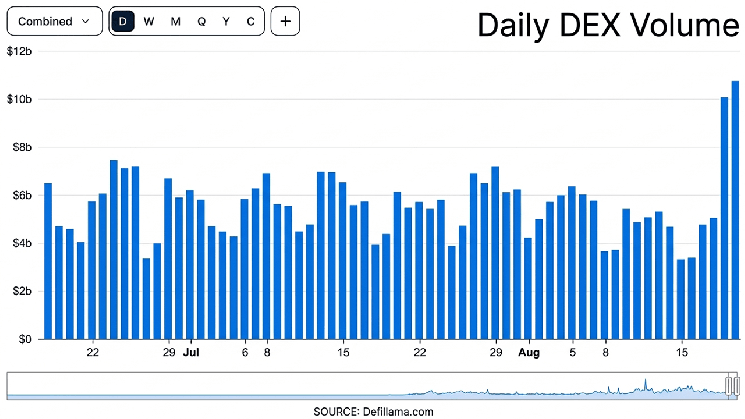
Looking at network-level flows, capital is starting to rotate back on-chain.
Ethereum [ETH] is leading the 7-day stablecoin supply change. Data from DeFiLlama shows that stablecoin supply on Ethereum jumped $5.6 billion to a record $164 billion, a 4% weekly increase.
At the same time, ETH’s Total Value Locked (TVL) spiked 2.73% in the past 24 hours, adding roughly $4 billion. In short, capital is flowing back in, highlighting renewed on-chain activity and growing investor confidence.

Source: DeFiLlama
Against this backdrop, the stablecoin minting signals a strategic move.
The $6 billion liquidity surge shows investors rotating into safe havens rather than exiting the market. Now, with that capital flowing back on-chain, it confirms that the market is actively repositioning after the crash.
From this perspective, the recent market flush looks like a solid “bottom,” where weak hands were shaken out and stronger hands stayed in, setting the stage for a more sustainable rebound.