Stablecoins are rapidly becoming one of the dominant use cases linking crypto and tradfi.
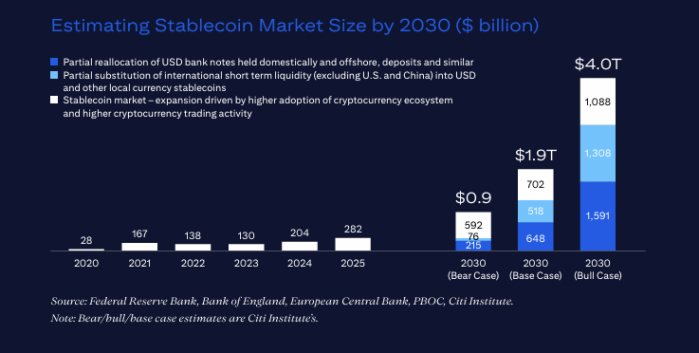
Recent forecasts, institutional moves, and regulatory efforts suggest the sector is reaching an inflection point. And now, at least one analysis believes the stablecoin market cap alone could reach $4 trillion by 2030.
That’s twice the current size of the entire crypto economy in stablecoins alone.
Forecasting a Stablecoin Boom
That projection originates from Citi, whose analysts now estimate a base case of $1.9 trillion in stablecoin issuance by 2030, up from earlier forecasts. In a bullish scenario, the bank predicts issuance reaching $4 trillion.
If stablecoins were to be integrated everywhere, the analysts suggest they could support as much as $100T of annual transaction volume, a scale dwarfing today’s markets.
The biggest real opportunity is in cross-border settlement, where inefficiencies still exist. Even so, Citi highlights that tokenized bank deposits may surpass stablecoins in usage by 2030.
Bank tokens are tokenized deposits, deposit tokens, and other bank-issued tokenized assets. They provide the trust, familiarity, and regulatory safeguards of bank money, and many corporations prefer them over stablecoins.
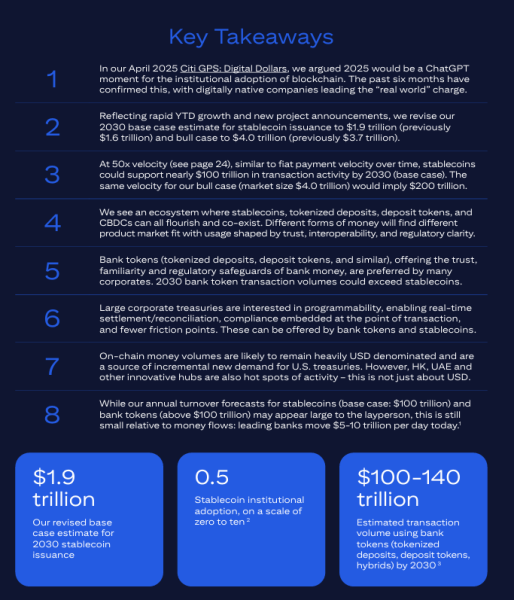
The final takeaway from the report highlights just how big the market could be. Still, just how much growth remains – even in a bullish case of $100T in payments annually, stablecoins would be a small percentage of the $5T-$10T leading banks send and receive daily.
The current stablecoin market grew from around $200B in early 2025 to nearly $280B, despite experiencing significant market swings. Governments and regulators are actively discussing how to regulate the issuance, backing, and redemption of these asset instruments.
Beyond market risk, stablecoins carry macro and geopolitical stakes.
The more stablecoins proliferate, the more issuers will likely hold U.S. Treasuries as reserve backing.
This creates a strategic vulnerability for Europe: a foreign digital currency could undermine domestic monetary control.
Europe’s Move: Consortium for a Euro-Backed Stablecoin
In response, nine European banks — including UniCredit, ING, CaixaBank, SEB, and Raiffeisen — have teamed up to launch a euro-denominated stablecoin, aiming for a debut in late 2026.
The goal is more than technological innovation; it is part of a broader strategy for European payment sovereignty in the midst of concerns over a growing US stablecoin lead.
The stablecoin project aligns with the enforcement of the EU’s MiCA regulation and complements efforts by the European Central Bank to push forward a digital euro.
There’s a bit of urgency to the project – the dominance of U.S. dollar tokens could erode monetary control and expose Europe to external leverage. U.S. stablecoin incumbents like Tether ($USDT) and Circle ($USDC) already command massive network effects and liquidity.
For the European project to succeed, it must overcome regulatory barriers, build trust, and provide liquidity – and fast.
Best Wallet Token ($BEST) – The Best Non-Custodial Wallet for Stablecoins and Crypto Presales
Best Wallet Token ($BEST) is the latest offering in a growing, powerful Best Wallet ecosystem. At the core, there’s a non-custodial Web3 wallet where users can safely store, swap, and send their tokens.
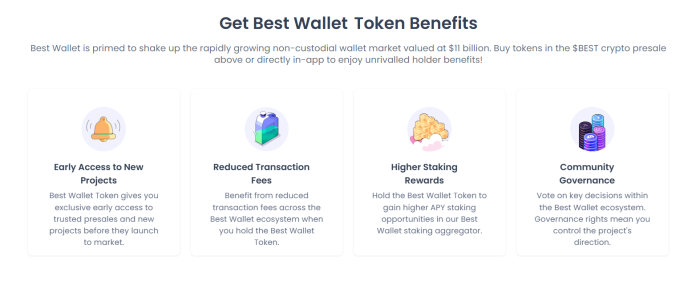
Next comes the $BEST utility token. With $BEST, investors get lower transaction fees and higher staking yields. There’s also access to the best crypto presales, where investors can find a curated selection of upcoming projects. Research and purchase tokens directly within the app.
What is Best Wallet token? It’s the key to powering up a vibrant wallet-based suite of tools. The upcoming Best Card will make it even easier to spend your crypto. In the meantime, learn how to buy $BEST and see why our price prediction thinks the token could reach $0.72,
Visit the Best Wallet token presale page for the latest information.
The coming years may well decide whether stablecoins become pillars of a hybrid financial future or remain niche infrastructure. Citi’s forecasts hint at the scale and ambition of stablecoins, and Best Wallet gives investors the tools they need to navigate a stablecoin future.
Authored by Bogdan Patru on Bitcoinist — https://bitcoinist.com/stablecoins-$4-trillion-by-2030-best-time-to-try-best-wallet

Related Posts