Tether And Circle Inject $12.75B To The Market In 30 Days – Details

bitcoinist發佈於 2025-09-12更新於 2025-09-13

文章摘要

The stablecoin market is once again in the spotlight after Tether minted another $1 billion USDT just a few hours...

Trusted Editorial content, reviewed by leading industry experts and seasoned editors. Ad Disclosure

The stablecoin market is once again in the spotlight after Tether minted another $1 billion USDT just a few hours ago. This fresh injection of liquidity comes at a time when the crypto market is entering a volatile phase, with uncertainty surrounding both macroeconomic conditions and investor sentiment. Bitcoin and altcoins are beginning to show shifting dynamics, and stablecoin issuers like Tether and Circle are emerging as critical players in shaping these movements.

Large mints from Tether have historically coincided with aggressive price swings across the crypto market, as the arrival of new liquidity often fuels increased trading activity. Whether this supply is immediately deployed or gradually filters into exchanges, the effect on market psychology is significant. Traders and investors frequently view such events as early signals of potential inflows into risk assets.

With Bitcoin consolidating near key levels and altcoins attempting to recover from recent corrections, the timing of this mint underscores the importance of stablecoins in the broader ecosystem. As liquidity expands, the coming days could see heightened volatility, with the possibility of strong directional moves. For now, all eyes are on how this $1 billion issuance will ripple across the crypto landscape.

Tether and Circle Add Liquidity Into The Market

According to data from Lookonchain, Tether and Circle have minted a combined $12.75 billion in stablecoins over the past month, marking one of the most significant liquidity injections in recent cycles. This expansion underscores the crucial role stablecoins play in the crypto ecosystem, acting as the backbone of trading activity and serving as a bridge for capital flowing into risk assets.
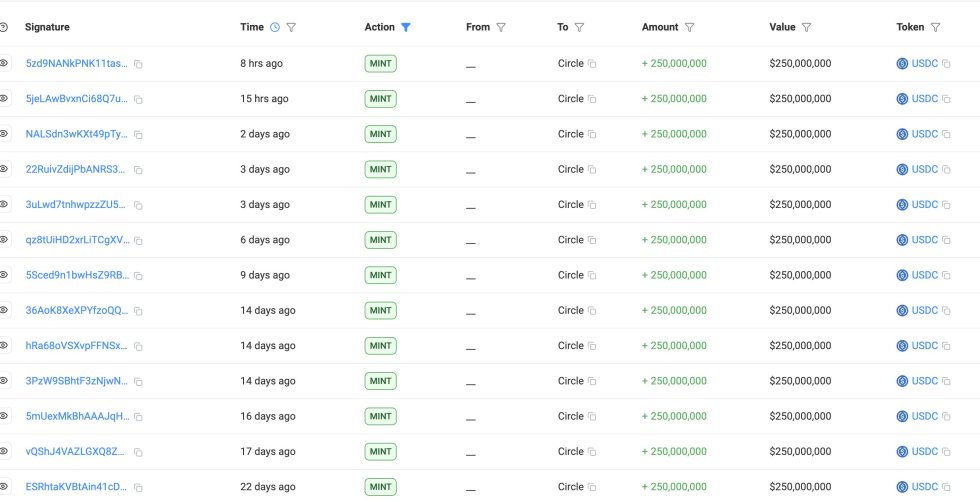
Tether and Circle Stablecoin Mints | Source: Lookonchain

The timing of this surge is notable. Bitcoin and Ethereum are consolidating near critical levels, and altcoins are beginning to show signs of renewed momentum. Historically, large stablecoin mints have preceded uptrends in crypto markets, as fresh liquidity provides the fuel for traders and institutions to deploy capital more aggressively. The $12.75B increase, therefore, reflects more than just stablecoin supply growth—it signals a market preparing for potential expansion.

Still, risks remain elevated. Some analysts caution that the broader economic environment is highly unpredictable, with lingering concerns over global growth, inflationary pressures, and liquidity conditions. The volatility of traditional markets often bleeds into crypto, making sudden swings a persistent threat.

All eyes are now on the US Federal Reserve, with investors widely anticipating a rate cut at next week’s meeting. Such a move would reinforce the bullish implications of the stablecoin surge, further boosting liquidity and supporting higher valuations across digital assets. Conversely, any hesitation or unexpected policy shift could magnify uncertainty, creating sharp volatility.

USDT Dominance Suggests Risk Appetite

Tether (USDT) dominance currently stands at 4.29%, showing a modest decline after testing resistance near 4.5%. The weekly chart reveals that USDT’s market share has been in a gradual downtrend since peaking above 9% in mid-2022. This decline reflects a healthier appetite for risk assets, as capital shifts out of stablecoins and into Bitcoin, Ethereum, and altcoins.
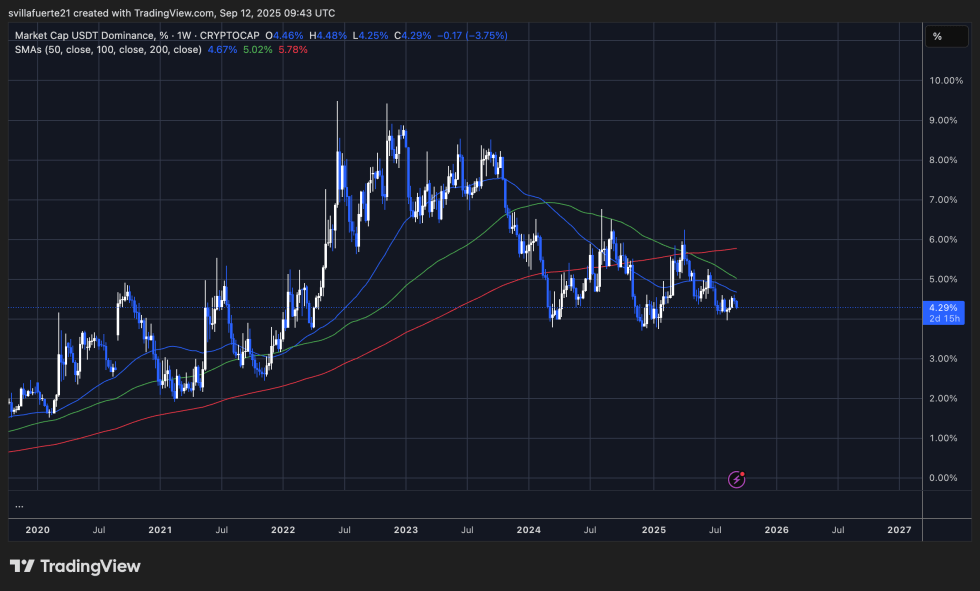
USDT Market Cap Dominance | Source: USDT.D chart on TradingView

The 50-week SMA at 4.67% and the 100-week SMA at 5.02% are both trending lower, confirming persistent weakness in dominance. Meanwhile, the 200-week SMA at 5.78% sits well above current levels, acting as a ceiling that reinforces the longer-term bearish structure for USDT’s market share. As long as USDT dominance remains below the 5% threshold, the market backdrop favors capital rotation into risk assets.

However, short-term support has emerged around the 4.2%–4.3% zone, where dominance has stabilized multiple times this year. A breakdown below this range would likely signal further risk-taking by investors, potentially fueling stronger rallies in crypto. Conversely, a bounce back toward 5% would indicate rising caution and renewed demand for stablecoins.

Featured image from Dall-E, chart from TradingView

Editorial Process for bitcoinist is centered on delivering thoroughly researched, accurate, and unbiased content. We uphold strict sourcing standards, and each page undergoes diligent review by our team of top technology experts and seasoned editors. This process ensures the integrity, relevance, and value of our content for our readers.

Sebastian's journey into the world of crypto began four years ago, driven by a fascination with the potential of blockchain technology to revolutionize financial systems. His initial exploration focused on understanding the intricacies of various crypto projects, particularly those focused on building innovative financial solutions. Through countless hours of research and learning, Sebastian developed a deep understanding of the underlying technologies, market dynamics, and potential applications of cryptocurrencies. As his knowledge grew, Sebastian felt compelled to share his insights with others. He began actively contributing to online discussions on platforms like X and LinkedIn, focusing on fintech and crypto-related content. His goal was to expose valuable trends and insights to a wider audience, fostering a deeper understanding of the rapidly evolving crypto landscape. Sebastian's contributions quickly gained recognition, and he became a trusted voice in the online crypto community. To further enhance his expertise, Sebastian pursued a UC Berkeley Fintech: Frameworks, Applications, and Strategies certification. This rigorous program equipped him with valuable skills and knowledge regarding Financial Technology, bridging the gap between traditional finance (TradFi) and decentralized finance (DeFi). The certification deepened his understanding of the broader financial landscape and its intersection with blockchain technology. Sebastian's passion for finance and writing is evident in his work. He enjoys delving into financial research, analyzing market trends, and exploring the latest developments in the crypto space. In his spare time, Sebastian can often be found immersed in charts, studying 10-K forms, or engaging in thought-provoking discussions about the future of finance. Sebastian's journey as a crypto analyst and investor has been marked by a relentless pursuit of knowledge and a dedication to sharing his insights. His ability to navigate the complex world of crypto, combined with his passion for financial research and communication, makes him a valuable asset to the industry. As the crypto landscape continues to evolve, Sebastian remains at the forefront, providing valuable insights and contributing to the growth of this revolutionary technology.

你可能也喜歡

造ChatGPT的人,已经不用ChatGPT干活了

不到一年时间,OpenAI已将内部主力AI工具从ChatGPT聊天机器人转向了智能体Codex。截至2026年6月,Codex处理了公司每周99.8%的输出token,而10个月前这一比例还不足10%。 这一转变始于去年9月左右,Codex在接入了更强模型、补齐更多能力后,能够承担更复杂的任务。员工发现,与其进行一问一答的对话,不如将整件长周期任务直接交给它自主运行。如今,OpenAI人均超过85%的输出token由Codex产生,各部门均将其作为头号AI工具。 智能体正在改变知识工作的基本单位:从单次问答转变为可“丢出去”独立执行数分钟到数小时的任务。如今近四分之一的Codex请求对应的是人类需耗时一小时以上的工作。 最初是工程师广泛采用Codex,但火势迅速蔓延至法务、财务、招聘等非技术部门。到2026年4月前后,这些部门集体转向,使用速度甚至超过工程部。一个关键信号是,大量原本不写代码的用户开始使用Codex。例如,财务团队用它处理了数万份税表,公关团队搭建了自动处理邀约的Slack智能体。业务人员用Codex完成的工作中,超过四分之一涉及编程,岗位界限正在模糊。 Codex的角色已从代码补全工具转变为通用工作流智能体,能独立完成包括实现、调试、测试在内的完整工程链。重度用户单日可调度Codex产出超过60小时的智能体工作量。其底层模型GPT-5.5不仅能高效处理长任务,甚至被用于优化自身的系统负载算法,提升了性能。 报告显示,办公的默认动作正从打开聊天框提问,转变为将整件事交给智能体执行。未来的差距将取决于人们敢于将多大规模的任务交由AI独立完成。

marsbit20 分鐘前

造ChatGPT的人,已经不用ChatGPT干活了

marsbit20 分鐘前

拉美稳定币的兴起,本质上不是“加密技术的胜利”

本文探讨了拉美稳定币兴起的本质,并非加密技术的胜利,而是源于该地区深厚、迫切的跨境资金流动需求。文章以墨西哥华人餐馆老板黄先生的家族汇款史为引,指出其背后是绵延数百年的“银信”传统——一种依靠熟人社会网络与信用约束完成的跨境资金转移。 拉美地区普遍存在类似需求,大量家庭依赖海外汇款维持生计,形成了巨大的汇款市场。稳定币在此地的流行,并非人们青睐区块链技术,而是因其恰好解决了传统跨境汇款中的痛点:银行渠道慢且贵,传统汇款公司费用高,本地货币波动剧烈。在阿根廷、委内瑞拉等国,稳定币被当作“数字美元”用于保值与日常交易;在巴西、墨西哥等国,则更多嵌入跨境汇款与结算环节。 文章强调,稳定币的核心价值在于其高效的“中间清算层”,但真正的挑战在于“两头”:如何接入发送方的资金来源(如美国工资),以及如何无缝对接接收方的本地支付网络(如巴西Pix、墨西哥SPEI)。成功的服务需将稳定币技术隐藏于后台,让用户只感知到“钱快速到账”。 最后,作者指出监管机构关注的是稳定币可能形成的平行外汇体系及其风险。因此,稳定币在拉美的未来,在于成长为合规、高效的新一代汇款基础设施,无缝连接全球资金与本地生活,而这本质上是古老“银信”需求的现代表达。

marsbit1 小時前

拉美稳定币的兴起,本质上不是“加密技术的胜利”

marsbit1 小時前

交易

現貨
活动图片