Recent reports revealed that South Korea is set to ease its restrictions on institutional crypto investment. Secretary-General of South Korea’s Financial Services Commission (FSC) announced the watchdog’s plan to review its restrictions amid the ongoing changes in South Korea’s regulatory approach.
FSC Planning To Ease Restrictions
On Wednesday, Yonhap News Agency reported that FSC’s Secretary-General Kwon Dae-young announced legal entities will be allowed to invest in cryptocurrencies starting this year. Kwon stated that the regulatory agency plans to relax its restrictions on institutional crypto trading and investment to “strengthen collaboration between financial institutions and fintechs.”
According to the report, the FSC is set to consider a proposal to allow the issuance of real-name accounts to corporations, which is currently restricted. Real-name accounts are required for virtual asset investments, as only the accounts that have completed this verification under the Specified Financial Transaction Information Act are allowed to invest in digital assets.
Nonetheless, financial authorities have limited institutional crypto trading by guiding banks not to issue these accounts to corporations, despite the absence of any legal barrier or official ban.
In the “Major Work Plan for 2025,” the FSC revealed this change would be gradually implemented, with the financial regulator working on a “detailed plan” to allow non-profit corporations first through its Virtual Asset Committee, and slowly expand.
Moreover, the South Korean watchdog plans to promote the second phase of the Virtual Asset User Protection Act, which includes regulations on the distribution of digital assets.
The FSC’s Secretary-General explained that the regulator needs “to discuss how to create listing standards, how to deal with stablecoins, and how to create rules for the behavior of virtual asset exchanges,” adding that the government will align with global crypto regulations.
Additionally, the report notes that the FSC plans to introduce a “screening system for the eligibility of major shareholders of virtual asset operators through amendments to the Special Financial Transactions Act.”
The regulator will also work on improving self-regulation by implementing criteria for reviewing memecoins and other cryptocurrencies to protect investors, and it will introduce forensic equipment to investigate unlawful trading behavior.
South Korea’s Changing Crypto Landscape
Over the last few years, South Korea has attempted to shift to a more regulated and stable environment for investors. Kora Exchange’s Chairman, Jeong Eun-bo, has called for a change in lawmakers’ and financial institutions’ view of crypto assets.
Jeong suggested that the country’s regulator consider incorporating virtual assets into institutional finance to revitalize the market, “create added value,” and compete with other countries.
It is worth noting that the FSC’s stance on virtual assets has been criticized for seemingly challenging the market’s development and international competitiveness.
Nonetheless, the ongoing shift has seen the creation of the Virtual Asset Committee to advise and discuss industry-related policies. Moreover, the FSC announced that this group would soon review the long-standing ban on crypto-based investment products.
As reported by Bitcoinist, Jeong announced the Korea Exchange’s plan to explore crypto exchange-traded funds (ETFs) in 2025 after the country’s capital markets faced substantial challenges in 2024.
Additionally, the country has postponed the crypto taxation policy by two years. The policy, previously set to be introduced in January 2025, will collect 20% capital gains tax from investors trading digital assets. Following the delay, the tax policy is expected to be implemented in 2027.
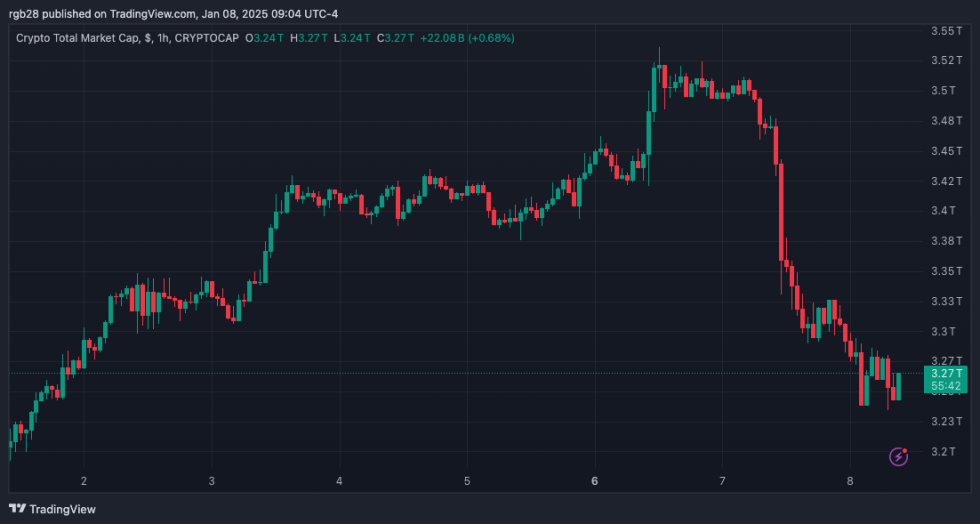
Total crypto market capitalization is at $3.27 trillion in the one-week chart. Source: TOTAL on TradingView

Related Posts