ON BANKING, WITH FORMER SEC CHAIRMAN JAY CLAYTON
I had a fun conversation on banking and blockchain with former SEC Chairman Jay Clayton at the Bloomberg Invest Conference on June 8th. Here are the important excerpts of our talk, moderated by Carol Massar of Bloomberg:
Carol Massar: “On lending and banks, regional banks, obviously the other crisis….”
Dan Morehead: “I think the crisis is a harbinger for the future. If you think about it, banks are a terribly-designed stablecoin. “I’ll pitch you a stablecoin idea…”
Carol Massar: “Do you agree? Do you agree, Jay?”
Jay Clayton: “Banks serve an incredibly important function and they have been the source of liquidity transformation throughout the growth of our economy.”
Dan Morehead: “Let me pitch a stablecoin idea:
I invest $15 million in equity in my project.
Then I sell to the public $195 million stablecoins.
With those proceeds I buy $210 million in risky assets.
I promise the stablecoin holders incredible liquidity. With just one click on their smartphones, they can get their money back same-day – in unlimited amounts.
When asked:
‘Isn’t 13-to-one leverage kind of aggressive on a stablecoin?’
I’m honest – I tell everybody the truth: ‘If the risky assets go up, I’m keeping all the profits. But, if they fall in value, I’m going to stiff the taxpayer.’
“Unfortunately, that’s what a bank is.”
Jay Clayton: “Look, I’ll put my bank hat on. I think that’s about as stark as you could do it, because that’s why we have bank regulation. We actually need liquidity transformation in our society.”
BANKS, TERRIBLY-DESIGNED STABLECOINS
If I pitched that 13-to-1 leveraged stablecoin idea – where I get all the upside and others get all the downside – on Twitter, the backlash would probably break the internet.
But that’s exactly what a bank is. Recent massive failures in U.S. banks were just that. The only difference is putting the word “billions” in where I used “millions”.
Banks are terribly-designed stablecoins.
TRADITIONS
Carol Massar [to the audience]: “How many people buy Dan’s explanation of the banking system? How many are with Jay – more traditional?”
Jay Clayton: “Hey, I’m always traditional.
“Dan did wear a tie today.”
Dan Morehead: “I was born and raised on Wall Street.”
MEDICI
It’s not that banks weren’t once a good idea. They were.
In the 15th century, the Medici used the power of a newly-invented technology called double-entry accounting to build a global banking empire. They pioneered what we now called distributed ledger technology (DLT). They literally distributed physical ledgers to their various nodes (offices in Florence, Milan, London, Geneva, Bruges, etc.).
And the world paid these banks vast profits to maintain the ownership books of their letters of credit (now called tokens).
Banks still take a huge amount of value out of society. They account for the third largest sector market capitalization of the S&P 500 behind Information Technology and Healthcare.
The Bitcoin ledger is the next evolution in distributed ledgers.
U.S. GOVERNMENT IS BOTH SIDES
Let’s get to Chairman Clayton’s important comment: “We actually need liquidity transformation in our society.” We do, or at least did before blockchain – but do banks actually do private sector liquidity transformation anymore?
Dan Morehead: “The stark reality of some of these regional bank failures is that the US government is on both sides of their balance sheet. It’s half of their assets and all of their deposits.
“Why is a bank getting paid to intermediate between two parts of the US government?”
The sad thing in the bank blowups is that the US Government is both the lender and the borrower in these blowups (not to mention the regulator, as well). In SVB’s case, the U.S. government was 43% of the lending side and ultimately 100% of the borrowing side (all of SVB’s deposits were bailed out by the government).
What a weird system where the Fed gives “forward guidance” to banks – telling them that the entity that controls rates doesn’t plan to raise them. That encourages banks like SVB to use 43% of their assets as loans to the U.S. government.
Bank shareholders and management got all the upside. Now we, the taxpayers, get all the downside.
Banks are terribly-designed stablecoins.
SAME STORY :: S&L CRISIS
Unfortunately this is the same old story.
During the week that SVB was going under, a young analyst on our team did a ton of work on the situation. He came back so proud of his analysis:
Apparently what had happened was that banks bought a bunch of long-term, fixed-rate bonds when yields were very low. This was fine when the Fed was providing unlimited money for free. But the Fed found themselves way behind the inflation curve and began normalizing the funding rate. As the funding rate rose above the interest the banks were earning on the bonds, they became insolvent.
The analyst was crestfallen when his Nobel dreams were shattered. I told him, unfortunately we’ve seen this movie before – it’s called the S&L Crisis.
Since November 2021 we’ve been making the point that economic policies have created the 70’s all over again. It would have been helpful if banking regulators read the Wikipedia entry on the S&L Crisis – pretty much sums up what just happened:
“Starting in October 1979, the Federal Reserve of the United States raised the discount rate that it charged its member banks from 9.5 percent to 12 percent in an effort to reduce inflation. At that time, S&Ls had issued long-term loans at fixed interest rates that were lower than the newly mandated interest rate at which they could borrow. When interest rates at which they could borrow increased, the S&Ls could not attract adequate capital from deposits and savings accounts of members for instance. Attempts to attract more deposits by offering higher interest rates led to liabilities that could not be covered by the lower interest rates at which they had loaned money. The end result was that about one-third of S&Ls became insolvent.”
– Wikipedia[2]
SATOSHI
Bitcoin was created in response to the penultimate financial crisis. Satoshi Nakamoto was concerned that governments were forever bailing out wealthy bank clients with printed money over centuries. Satoshi created a form of money that could not be debased. People all around the world could save their earnings in bitcoin without fear of their savings being diluted by excessive money printing.
“The Times 03/Jan/2009 Chancellor on brink of second bailout for banks.”
Satoshi appended that bailout headline from The Times (of London) in the first block of Bitcoin – the so-called genesis block:
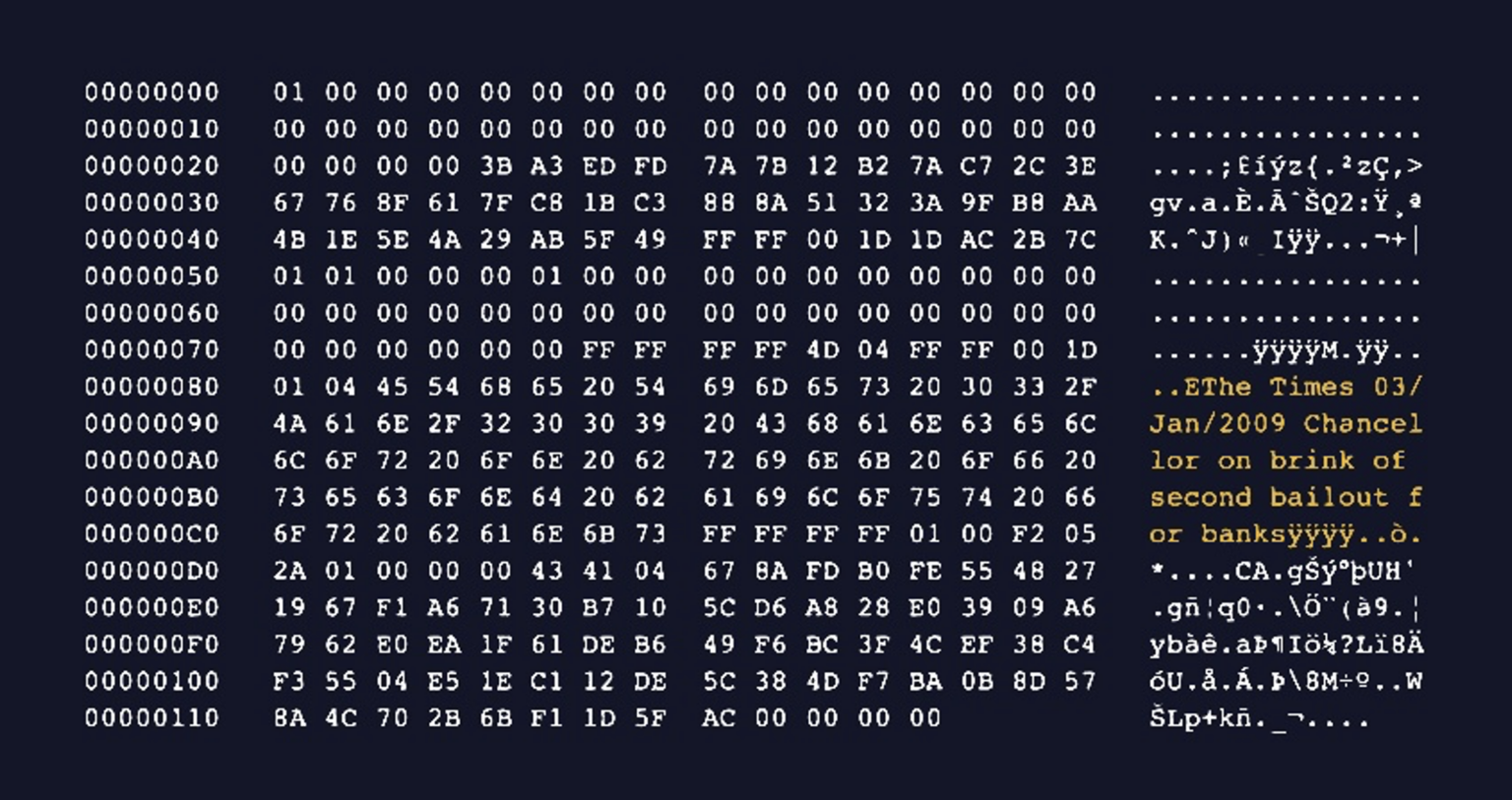
I really miss the quaint old days when somebody could get really pissed off about a £50 billion bailout. So mad indeed, that Satoshi started a 300-million-person movement in response.
The US prints that amount of money every four days now. The Fed printed $300 billion in funding just to bail out deposits at SVB and Signature Bank in March.[3]
SATOSHI’S THESIS
Bitcoin’s original thesis is reaffirmed by the recent crisis in banking. Bitcoin was born out of the 2008 financial crisis in response to the failures of our banking system.
This does prove the need for trustless systems — a theme that has guided us for a long time. That any time you have groups of humans involved — hubris, risk taking, or whatever ultimately happens and bad things often result. But decentralized systems work 24/7 and they can’t be compromised, they don’t take excessive leverage, they are transparent and honest, which is what it really comes down to.
Transparency is the key, and that’s been the problem with FTX, Celsius, BlockFi, and now SVB. Not enough people knew what risk they were taking. Whereas with blockchain, all the risks are clearly defined and everyone know what they’re getting into.
THE FUTURE
We have the answer – blockchain. Transparent, open blockchain ledgers are the future. The opaque, leveraged old-school ledgers that we call banks are the half-a-millennia-old past.
Each time this happens lots of handwringing and promises that we will never let this happen again. Banks can’t get too big to fail. Laws are passed.
Jay Clayton: “Technology has enabled an evolution in credit creation and we’re in the middle of it. Banks are going to be here 10, 15, 20, 50 years from now. They’re going to provide services, but the banking industry’s dominance of credit formation, that’s a thing of the past.”
Dan Morehead: “I definitely agree with Jay that…it’s going to take time. But, in the end, blockchain is the future, banks really are the past. The Medici used a very new thing called double entry bookkeeping to create banks. Now, we have distributed ledger technology. It’s the future. That’s where we’re heading.”
MR. MARKET SPEAKS
I’m not just some Bitcoin nut saying this. Mr. Market spoke:
Credit Suisse was sold for one-third of Dogecoin’s market capitalization.
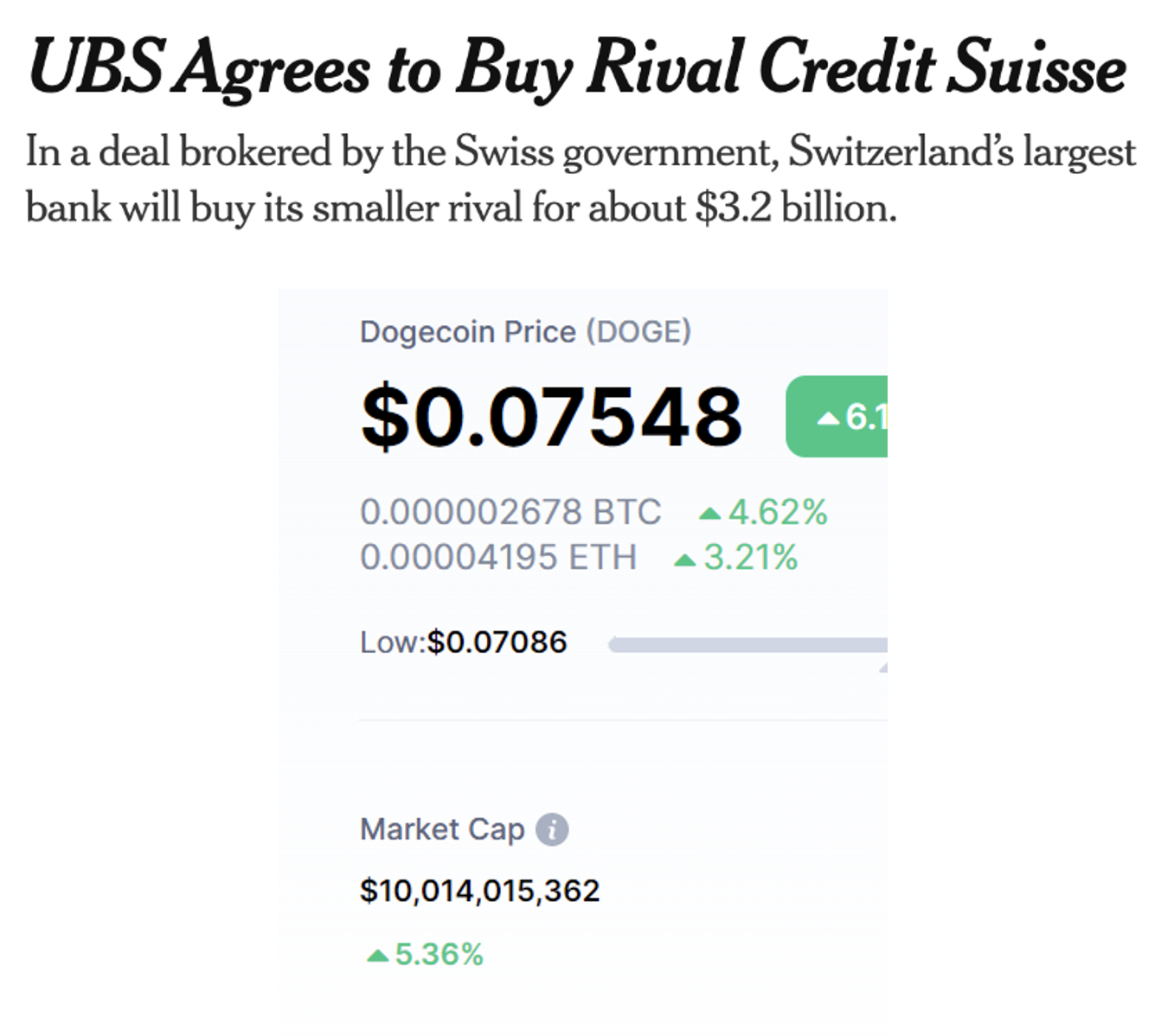
For those of you who don’t know, Dogecoin is a slightly modified copy of Bitcoin. Dogecoin is currently the 6th most valuable cryptocurrency (excluding stablecoins).
Honestly, that’s just wild. As bullish as I am on blockchain, it’s happening very quickly. Credit Suisse was founded in 1856 to fund the development of Switzerland’s rail system. The market now values the future – blockchain’s version of the decentralized distributed ledger technology – over the past – the Medici’s version of expensive, over-leveraged, centralized “DLT”.
BLOCKCHAIN WORKED
Over the SVB crisis weekend, we checked in with all of our portfolio companies. Most were fine, but a few really did have an existential crisis because they had all of their cash at the bank and were trying to figure how to make payroll. Everybody is sitting there on a Sunday stressing, “The FDIC shut down our bank, wires aren’t open on Sunday, how can we make payroll?”
It’s called Bitcoin!
Bitcoin and other cryptocurrencies are the answer. Nobody can shut them down, close them, they operate 24/7. You don’t need Janet Yellen’s permission to make payroll.
It was a fantastic moment for blockchain. Blockchain is the answer.
USDC
Alongside Bitcoin and Ethereum, USDC is another great way of making payroll in crises like these and in the long run, normal course of business. USD Coin (USDC) is a digital stablecoin pegged to the United States dollar. USD Coin is managed by a consortium called Centre, which was founded by Circle and includes members from the cryptocurrency exchange Coinbase.
Over the weekend, free markets were open when banks were frozen. Circle’s stablecoin USDC traded down to 87 cents on the dollar because of concern that USDC used SVB for 8% of its deposits.
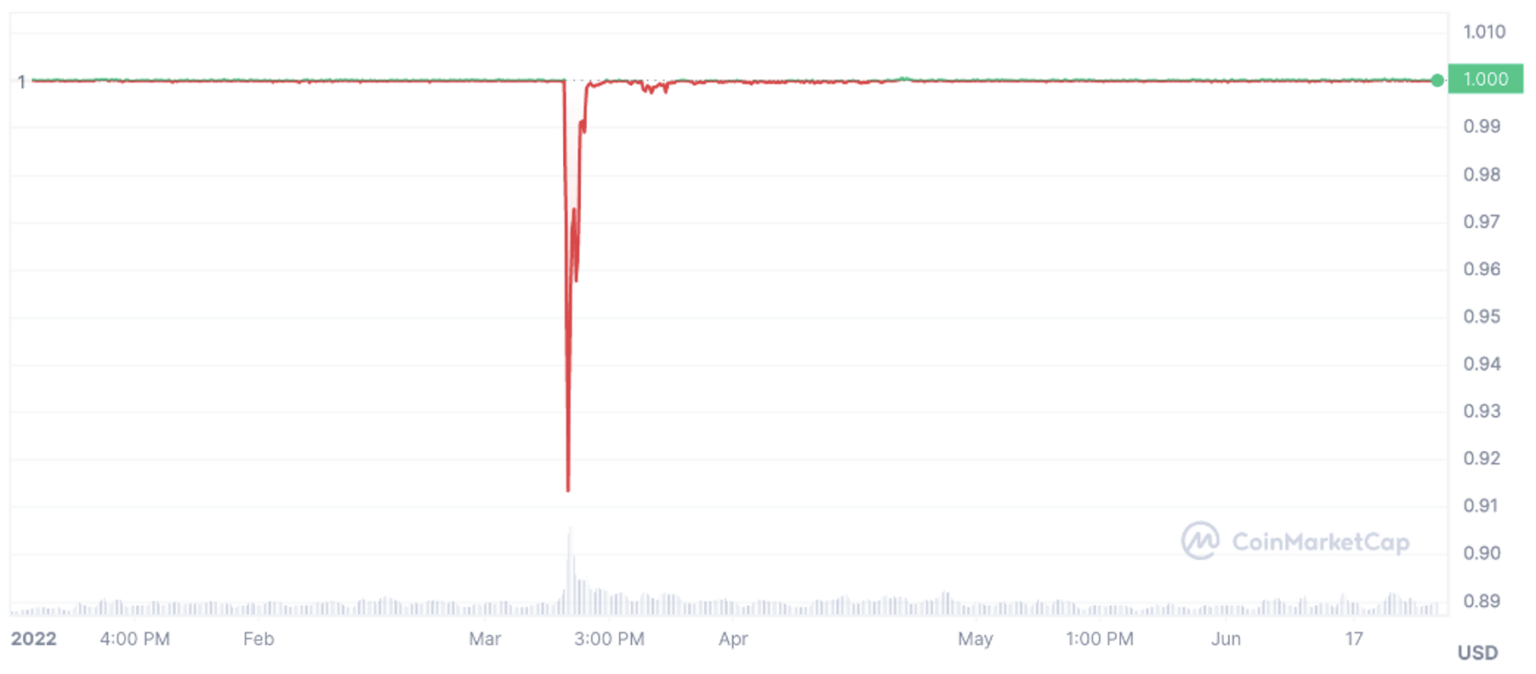
In our opinion, this was not that worrisome because, at worst, they could lose 10-20% of that. The beauty of USDC is that they are making 4.7% on the float, so it wouldn’t take very long to pay all that back. Centre and USDC did very well with this and it really does highlight that blockchain has huge advantages over centralized systems.
I also really love the irony of a blockchain project being hammered for having exposure to a fiat bank.
But, the market’s logic was backward as a fully-collateralized, transparent unleveraged stablecoin is much safer than a regional bank could have been.
USDC functioned 24/7. No centralized entity must give you permission to use it.
DEFI WORKED
As with all of the other crises in the last twelve months caused by centralized finance, all of DeFi (decentralized finance) showed its resilience.
On March 8, Silicon Valley Bank and Signature Bank were both, according to public disclosures, “well capitalized,” the optimal level of health by federal regulatory standards.
A lot of government hearings already on How Could We Have Known?!??
“The question we were all asking ourselves over that first week was, ‘How did this happen?’”
– Federal Reserve Chair Jerome Powell
Bank regulators could have seen this disaster looming with one question:
“How many Ginnie 2.5s do you own?”
This is what we got.
“The supervisory team was apparently very much engaged with the bank [and] repeatedly was escalating.”
– Federal Reserve Chair Jerome Powell
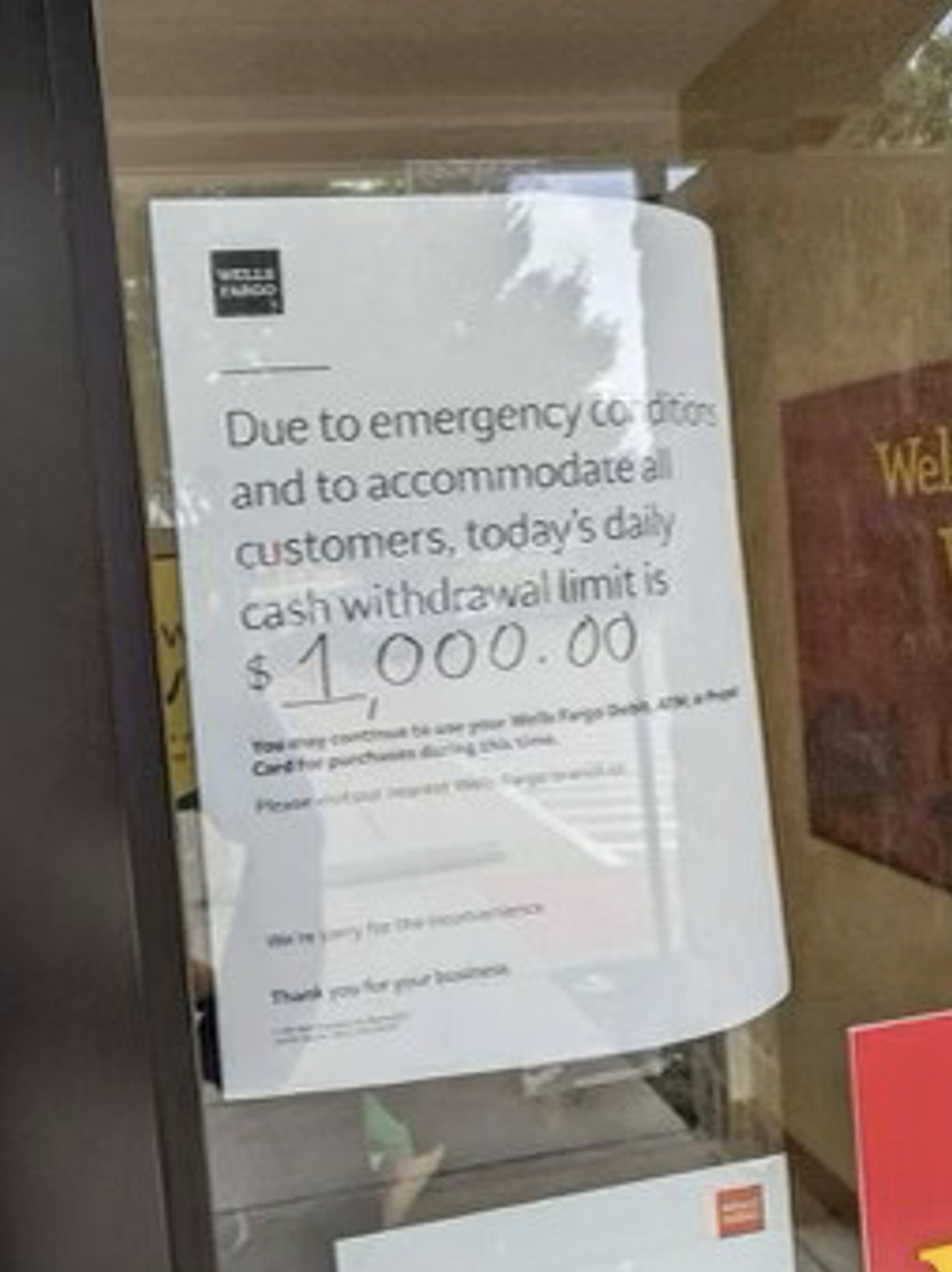
Not even really sure what “escalates” means, but what I do know is DeFi executes.
And, DeFi never does this to you:
BLOCKCHAIN (FINALLY) DECOUPLING
Carol Massar: “What was really interesting is that as regional bank stocks sold off, I saw crypto moving up. How are we supposed to think about. … I think initially we thought about the crypto world, Dan, as kind of a disconnect, a way to hedge stuff that’s going on in the rest of the market. Although, we have seen some correlation as well between regular assets or traditional assets selling off in crypto. We certainly saw that last year. How are you thinking about it?”
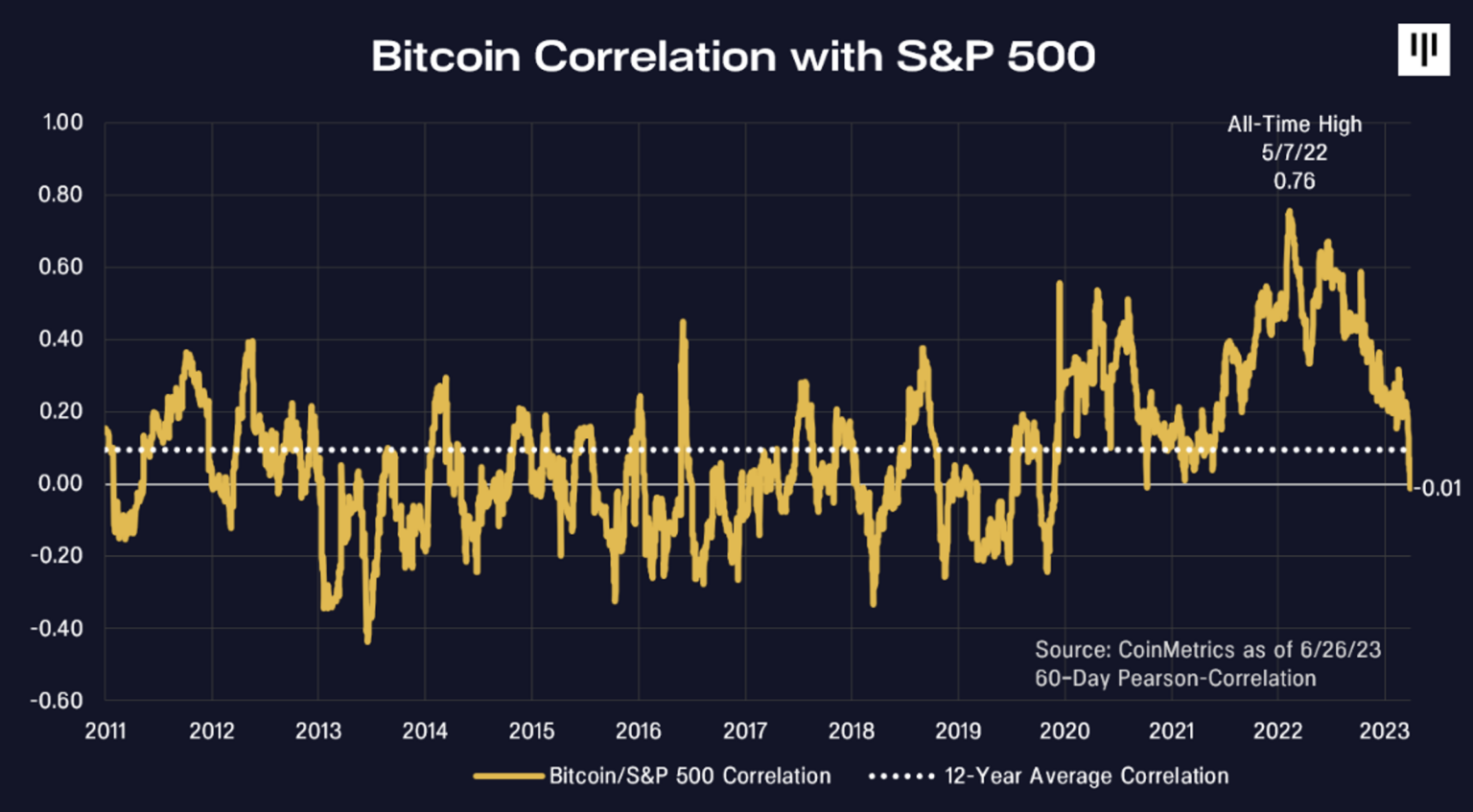
This is a hugely important development. For most of the history of blockchain assets they had essentially no correlation to risk assets. Using Bitcoin as a proxy for blockchain, the correlation with the S&P 500 over its first nine years of existence was 0.03.
Blockchain has been rallying through its first twelve years because it’s a massive, secular trend. There should be only short-term correlations to cyclical changes in interest-rate-sensitive asset classes like stocks and bonds.
That was a huge part of the argument: when you find a new asset class with incredibly high historical returns and essentially no correlation with typical assets – that’s the dream investment.
Unfortunately, all of the excessively-leveraged centralized entities and the alleged criminal Sam Bankman-Fried in our space, caused the correlation to spike up. In the middle of last year, correlation peaked at 0.76.
As blockchain is in no way connected to interest rates, it should have a very low correlation to the main asset classes (stocks, bonds, real estate), which are all tightly driven by rates.
Our thesis is playing out this year. In fact, over the past few days, the correlation has gone back to zero.
Many asset classes are directly linked to interest rates. However, there are some assets which have no direct connection to rates, such as gold and other commodities.
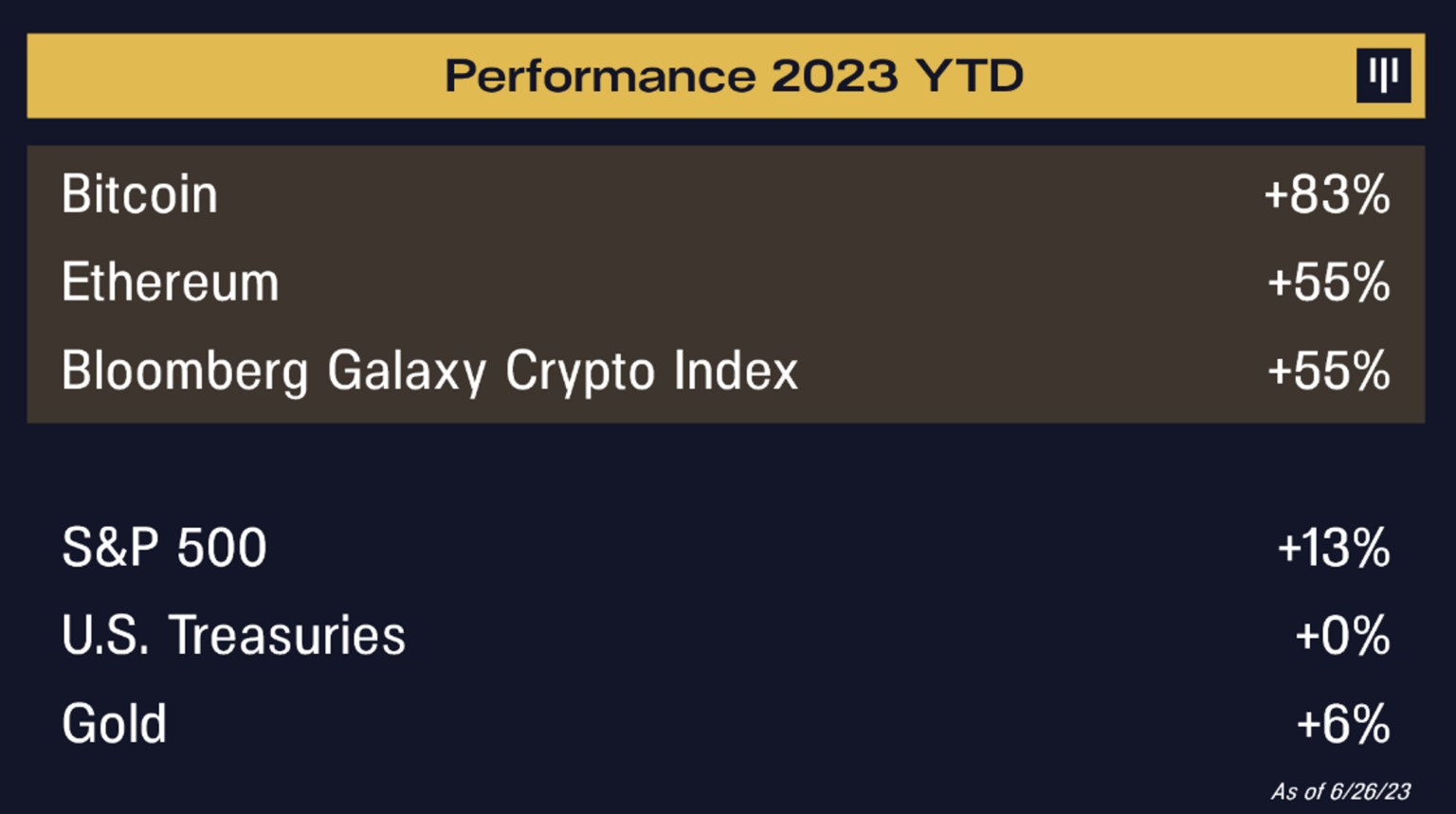
We believe that “digital gold” (blockchain) can decouple and trade independently like gold. In the first rising interest rate environment in forty-two years, there will be a desire to invest in things that don’t have to continue to go down as the Fed unwinds its twin mistakes. In our view, blockchain and other commodities are likely the only place to hide in a world with massively rising rates.
It’s beginning to happen.
IN EVERY COUNTRY’S NATIONAL INTEREST
Carol Massar: “Then how do you think of the role of crypto and blockchain? I know we kind of lump a lot of stuff together, but how do you think about it, Jay, going forward. It’s not going away. The US is not going to not have a role in it.
Jay Clayton: “What do we know? We know that blockchain is unlikely to be going away. We do need to update our technology stack in the financial system. No one disagrees with that. It’s not going away. What’s also not going away is rigorous regulation of retail investment products. That’s not going away. Those two things have to be reconciled. That’s where we stand today.
“They’re being reconciled in the courts, being reconciled in other places, but I think the blunt approach that blockchain/crypto is somehow bad is wrong.”
Carol Massar: “Some of the reporting that we’ve done, in the last week or so, or just this week, is this thinking that as the SEC is widening its pursuit of crypto pretty aggressively that the US is ultimately turning its back and won’t have a role globally. Do you see it that way? Dan, do you see it that way?
Dan Morehead: “I think it is a risk because if you think about the internet, the U.S. government literally built the internet, ARPANET. All of the major internet companies are based in the United States or a Chinese version of them. I think, as an American citizen, that’s great, that it accrues to our country.
“Blockchain really is the polar opposite. Regulation, or more specifically, lack of regulatory clarity, in the US has been scary enough that 18 out of the top 20 protocols are outside the United States. At a time last year, 95% of all trading of crypto assets was offshore of the United States.…It’s better to have [trading] happen in the United States. I’d love to see that flip where we prioritize bringing blockchain onshore.”
Jay Clayton: “We have a few data points recently that support what Dan is saying. Other governments are supporting blockchain based issuances of sovereign debt. We all know that at the core of every financial system is the sovereign debt. If you’re going to modernize, you’re going to modernize your technology stack, starting with sovereign debt, repo, that type of thing is a very effective way to do it. It’s interesting that we’re turning away from that when other countries are now turning toward it.”
10TH ANNIVERSARY BLOCKCHAIN SUMMIT
In April, we hosted our 10th Anniversary Summit in San Francisco.
The Summit is curated by the Pantera investment team and focused on the most important topics in the blockchain industry. Our goal is to uncover valuable insights, foster great conversations, and empower the entire Pantera network to move our industry forward.
We are excited to share video recordings of some of the sessions.






