The cryptocurrency market is notorious for being highly volatile, which often drives sentiment change. When the market corrects, some investors tend to dump assets to minimize losses. However, many others follow the "buy the dip" strategy because it often yields attractive results. History shows that the market always bounces back when investor fear is at its peak, providing an opportunity for investors to maximize profits.
Buying a dip is a popular investment strategy by buying an asset at a lower price in the hope that the market will bounce back. Opting into this strategy is useful when prices drop due to third-party activity and is not based on the asset's real-world usage or performance. Therefore, buying at this time gives the investor the opportunity to increase profits when the market is most likely going up.
The crypto market crashed in early 2021 for a number of reasons, including the Russia-Ukraine war. At that time, the Bitcoin price slipped from $60,000 to under $30,000 (-50%). But in just a few months, the market quickly recovered and the price of BTC skyrocketed on the chart.
In November 2021, the king of coins hit an all-time high of over $64,000. However, crypto winter comes later and once again engulfs the market. ETH price also trended similarly around that time, after hitting ATH > $4,700.
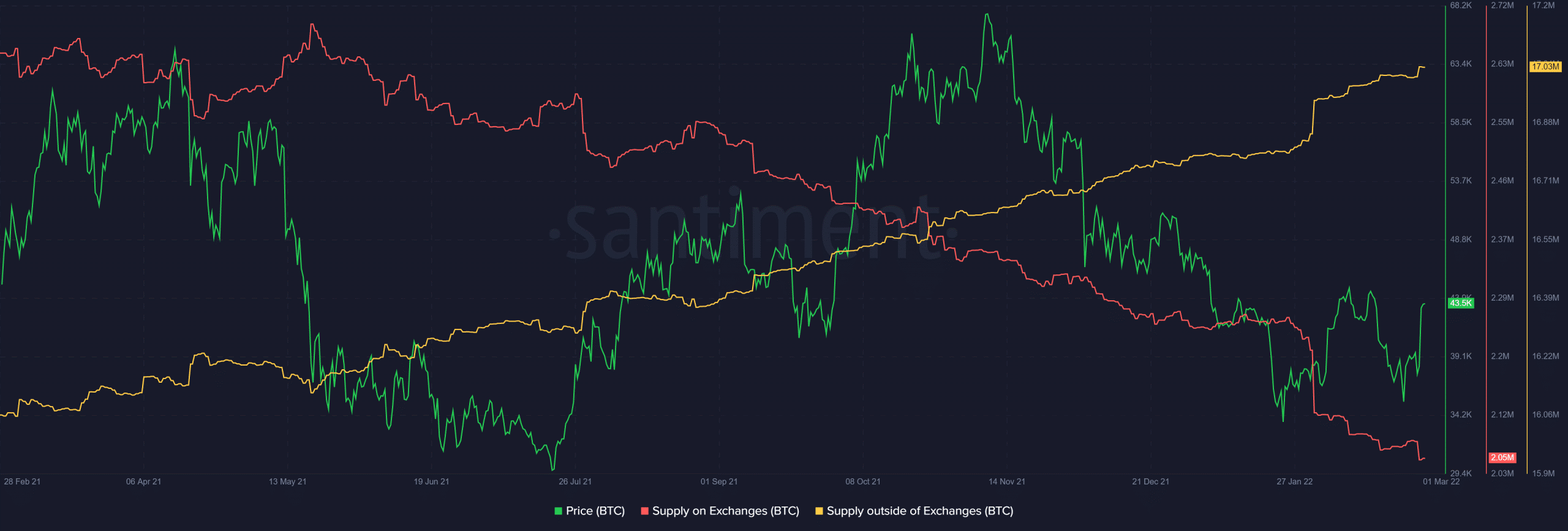
In 2021, XEM at BTC on-chain indicators clearly shows that investors are buying dips. According to the chart of Santiment, after November, when the price dropped sharply, the supply on the exchanges also decreased.
This happened while the supply of BTC outside of exchanges increased – a sign of a cumulative increase.
Source: Santiment
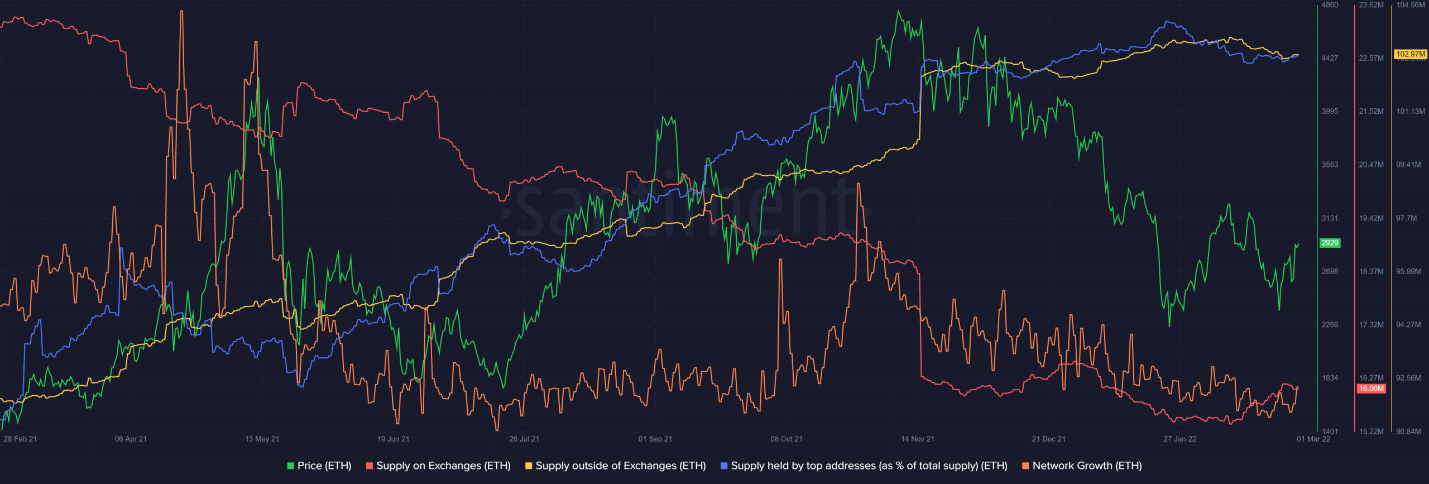
Not only BTC, but ETH metrics tell the same story.
The supply of ETH on exchanges decreased, along with an increase in the supply outside the exchange. Additionally, the chart also reveals that the supply held by the top addresses is increasing, reflecting investors' confidence in the token. However, the Ethereum network growth rate decreased during that time period, indicating that fewer new addresses were created for token transfers.
Source: Santiment
The string of mishaps isn't over yet in 2021. The next year isn't any better, but even worse, due to the demise of Terra LUNA. This disaster has severely affected the prices of all cryptocurrencies and the impact is evident so far.
However, it is interesting to see the "buy dip" trend also emerge during that period as investors remain confident in the market's ability to change the fate of the coming years.
While the first quarter of 2023 was better as the market gained momentum, the good things were short-lived.
Right now, BTC seems to be stabilizing below $28,000 – something that is worrisome for investors. However, this could be a good opportunity for them to accumulate or rather “buy the dip”, before BTC ’s price action once again turns bullish.
Bitcoin is expected to have its 4th halving in April 2024. If history repeats itself, the price could skyrocket after the halving.
For instance, during the 2020 Bitcoin halving, it was valued at $8,500, but it took several months to climb above $27,000. The same trend was seen during the first Bitcoin halving. The value of Bitcoin increased significantly in November 2013, following the first halving in November 2012. Therefore, this may be an appropriate opportunity for investors to accumulate.
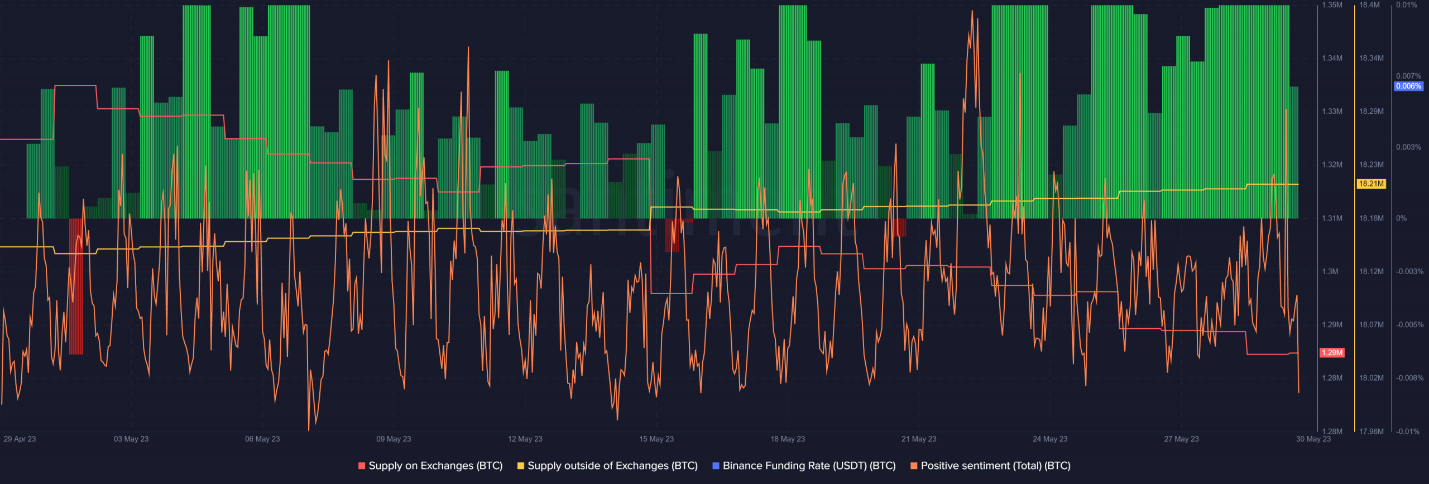
Supply outside exchanges increased similarly on last month's chart, indicating that investors are still buying. Not only that, the funding rate of BTC on Binance is also very high.
A high funding rate is a sign of demand in the Derivatives market. The positive sentiment surrounding Bitcoin is also high – an indication of investors' confidence in the king of the cryptocurrency.
Source: Santiment