How crypto market has changed in 2023-- 5 lessons from recent bull run:
A closer look at the January mini bull run and what you can learn from it as an investor/speculator—
1. Rotation no more
Liquidity rotation used to be structural feature of crypto mkt— at onset of a bull run, large caps (BTC, ETH) rose the most & once mkt participants made gains on those, liquidity shifted to smaller caps, prompting them to pump next.
The rotation game is so 2021.
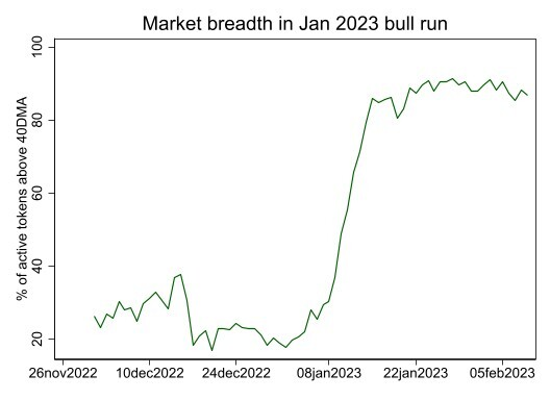
Most recent (mini) bull run in Jan 2023 showed different mkt progression. Once up cycle started in early Jan, it took mere 2 wks for 80%+ of tokens among top 1000 mkt caps to rise above their 40-day moving average.
In contrast, back in 2019 (similar stage of cycle) it took the mkt 3 mos & multiple small hype cycles for 80% of top tokens to rise over 40dma.
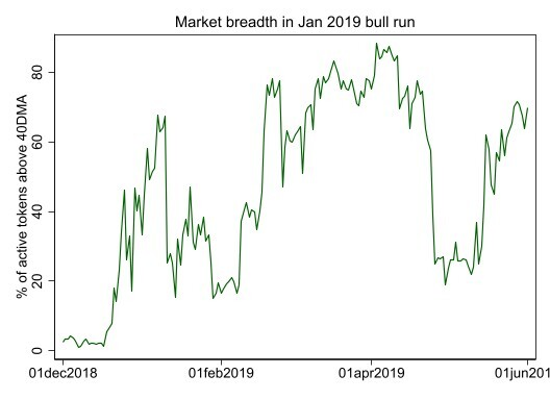
In other words, while there was distinctive liquidity rotation back in 2019, it doesn't work that way anymore. Once mkt up trend started everything that can go up goes up almost all at once.
Why the change?
Many reasons. For example—
Token listings on large exchanges have broadened. Mkt participant profiles have shifted & diversified. Rotation game has become public knowledge that everyone now wants to exploit & front run. Plus, a lot more liquidity on sideline now compared to a few yrs ago.
I'll talk abt what this means to you as individual investor in a min.
2. Underdogs lead recovery at market bottom
At mkt turning point coming out of long bear trend, downtrodden names that lead previous downturn also tend to lead subsequent recovery. This is a structural feature in other risk asset mkts as well not just crypto.
Chart below plots % gains in Jan 2023 against % gains in prior yr for mid-cap-and-above tokens (mkt cap > $250 mn). Study the chart & reach your own conclusion. Hopefully it's an obvious one.
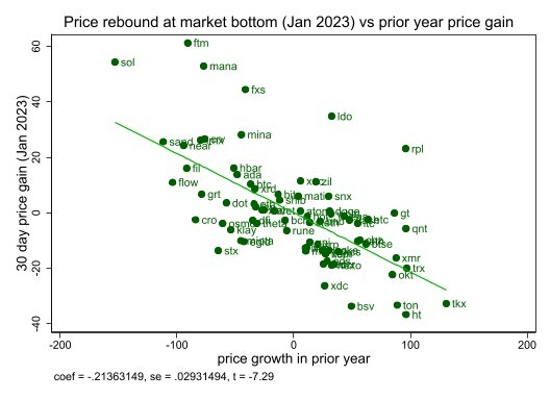
Does this relationship hold in other market conditions? No.
This underdog-to-growth-star phenom is unique feature for when mkt has strong reversal from deep bottom.
3. Market cap matters (sort of)
There's significant inverse correlation btw token mkt cap and price gain among smaller cap tokens (<$230 mn mkt cap) during recent up move, after controlling for prior year price gain & age of token.
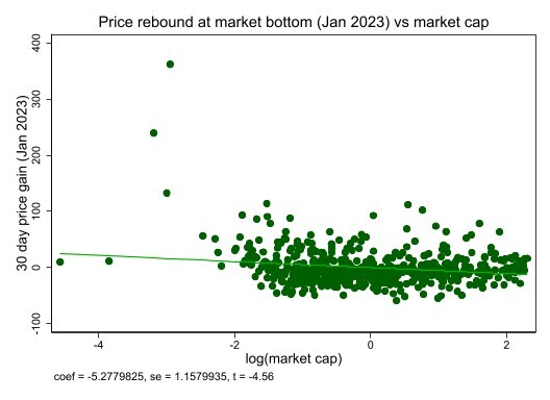
Among larger cap tokens this relationship does not exist esp in the $250 mn to $10 bn mkt cap range.
In other words conventional wisdom that smaller caps make bigger moves is true to some extent, but only if you're looking among small up-and-coming names, which is not practical for anyone w/ more than a few thousand $ to deploy since those are usually thinly traded.
4. Expect shorter cyclical moves in bear mkt
Bull runs in bear mks have shorter shelf life.
January mini bull run lasted in earnest for a month w/ majority of move done in 1st 2 wks of Jan. You can observe same pattern from previous run-up in July/August 2022.
These are distinctively shorter runs compared to up cycles in a bull mkt. The hostile macro environment means pumps are more fragile & prospect for continued buying demand after an up move is highly uncertain.
5. Rethink what the "fundamentals" mean
This is not a new pattern, but worth your attention b/c it'll persist.
Traditional metrics Wall St uses to evaluate company fundamentals—e.g. sales, earnings, margins— are mostly useless in crypto, at least at this stage.
I know it sounds politically incorrect but the biggest *fundamental* for any token is the amount of attention it can attract. Period.
What attracts attention?
For example:
· Over hyped themes— e.g. AI, zero knowledge, liquid staking.
· Big $ initiatives— e.g. $300 mn developer grants.
· Key personnel changes— e.g. famous so-and-so comes back as CTO.
Here's a list of top gaining tokens in Jan w/ $200 mn+ mkt cap (tokens w/ < 1 yr history excluded). Half have some attention driving narrative at play (aside from the fact, as discussed earlier, most of these are down horrendously bad, which is in itself an attention driver).
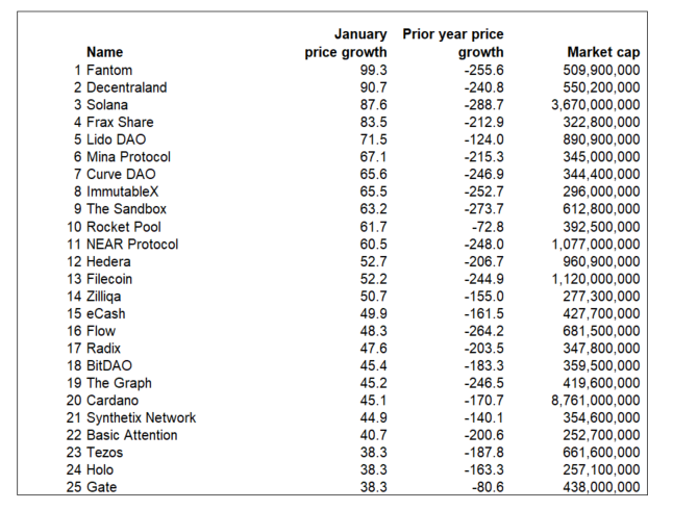
Do some research yourself. Can you identify what the driver is on each?
You may think a certain attention grabbing narrative is stupid or unjustified.
Well, first, tell that to the market & see if it cares.
Second, this is actually a rational behavior by the mkt despite appearing otherwise. Crypto projects at current stage are not steady money-making enterprises. They are experimental tech.
All that matters to the fate of experimental techs is whether they'll get mass-adopted. What would be a good predictor of that? The number of eyeballs they attract.
So the phenom of attention/narrative driving prices is really just mkt trying to deduce a project's growth prospect from however little information there is available. It's entirely rational if you ask me.
What all this means for you as an investor/speculator
What can you do to take advantage of evolving mkt features discussed above? A few ideas:
1. Be flexible & nimble when macro conditions are hostile. There'll be bull runs even in worst mkts but you need to act quickly & be vigilant on both entries & exists since these runs'll be more ephemeral than usual.
2. If you wait for rotation from large caps to the rest you'll be front run. There's hardly any rotation anymore. When mkt turns everything goes up together.
3. At mkt turning point out of major down trend, focus on beaten-down underdogs. If your capital size is small, focus on smaller caps as well.
4. Your time may be better spent researching the next attention-driving narratives & themes rather than studying technical analysis. Just sayin' ;)