Author: momo, ChainCatcher
On February 27, Binance Alpha and Binance Futures Market listed Fabric Protocol (ROBO), with its 24-hour trading volume exceeding 140 million in the first two days. Additionally, ROBO was subsequently listed on spot or futures markets of several major exchanges including OKX, Coinbase, Kraken, Bybit, Gate.io, HTX, etc., becoming one of the first batch of new projects to enter mainstream liquidity channels after the Spring Festival holiday resumption, sparking extensive attention and discussion.
In a phase where the overall crypto market is returning to rationality, few new tokens can sustain discussion热度. ROBO had already formed strong expectations before TGE, was oversubscribed on Kaito, and its热度 further amplified after listing. Clearly, it's not just a short-term effect of exchange listings.
The key lies more in its fundamentals. OpenMind, one of the core contributing teams of the Fabric Foundation, is a Silicon Valley company focused on robotics infrastructure. Unlike common projects that remain conceptual, it切入 a direction with greater industrial certainty: one end is the global tech主线 of embodied AI and robotics, the other end is the machine economy framework carried by on-chain identity, collaboration, and settlement networks.
It attempts to solve not a single-point application, but the more fundamental, harder-to-replace infrastructure problems that have long existed in the process of large-scale robot deployment: system fragmentation, inefficient collaboration, and lack of economic capabilities.
Furthermore, while many projects are still in the whitepaper and vision stage, OpenMind's products have already begun real-world deployment, installed in robotic devices around the world. It can be said that OpenMind is currently a rare, even unique, robotics infrastructure project in the related crypto market. Precisely because of this, ROBO更像 a fundamental industry sample that can be dissected, rather than a short-term sentiment-driven trading opportunity.
Next, let's look specifically at the team background, core products, and deployment progress: What exactly is OpenMind doing? Is its scaling path proven? And can this robotics × Crypto infrastructure logic truly open up new growth space?
I. The Composite Team from Stanford and Google DeepMind
Unlike most projects starting from the Crypto community and then adding hype narratives, OpenMind's team background更像 a typical Silicon Valley robotics/AI startup.
Founder Jan Liphardt is a professor of bioengineering at Stanford University, long engaged in AI, biocomputing, and distributed systems research, having received research grants from NIH, NSF, NCI, and the US Department of Energy.
CTO Boyuan Chen comes from MIT CSAIL and previously worked on cutting-edge AI and robotics research at Google DeepMind, with core capabilities focused on reinforcement learning and embodied AI systems.
The advisory layer also consists mainly of academic and industrial technical leaders, including former Willow Garage CEO and key promoter of the ROS ecosystem Steve Cousins, University of Oxford blockchain researcher Bill Roscoe, and Imperial College London safe AI professor Alessio Lomuscio.
Overall, this is a composite team from top academic institutions and the front lines of Silicon Valley tech—a "research派 + engineering派" blend. Their tech stack covers robotics, AI, and Crypto等多个前沿交叉领域, understanding both underlying algorithms and system architecture, and having truly worked with complex hardware and real-world deployment.
Precisely because of this明显偏 hard tech infrastructure capability structure, OpenMind from the start更像 building a long-term technical foundation, not a short-cycle project围绕 concepts讲故事. This is likely also a key reason for its continued support from top-tier capital.
According to RootData, in August 2025, OpenMind completed a $20 million funding round led by Pantera Capital, with participation from Ribbit Capital, Sequoia China, Coinbase Ventures, Digital Currency Group, Lightspeed Faction, Anagram, Primitive Ventures, Amber Group, and others. The investors span deep tech, fintech, and crypto infrastructure.
Why could OpenMind secure collective bets from头部 capital of both Web2 and Web3? When such a group from the forefront of research and engineering starts a company together, what structural pain points in the robotics industry did they see? And why use blockchain protocols to重构 the underlying infrastructure of this track?
II. Solving the 'Last Mile' Problem of the Machine Economy
Simply put, if we compare today's robotics industry to the smartphone era over a decade ago, what OpenMind wants to do is essentially build an "Android" system for robots.
In the past two years, robots have truly moved out of the lab. Tesla has sent humanoid robots into factories for production line testing, Unitree's quadruped robots have begun shipping at scale, and Boston Dynamics is also accelerating commercial deployment. Robots are moving from demonstration prototypes to warehousing, manufacturing, inspection, and even consumer scenarios, gradually becoming new productivity infrastructure.
But as deployment numbers scale, problems emerge, and the robotics industry begins to face issues similar to the "山寨机 era": system fragmentation, closed ecosystems, and lack of interoperability.
Founder Jan Liphardt mentioned in a previous ChainCatcher interview that, on one hand, there are over 150 robot hardware manufacturers globally, each building their own systems and ecosystems, almost every one wanting to be the iPhone of robots. The result is the same capabilities being repeatedly developed and adapted, applications难以复用, ecosystems remain fragmented,始终 lacking a universal base like Android. On the other hand, mainstream software systems still focus on motion control and navigation. Robots can work but have no identity, cannot automatically settle income, cannot establish credit, and更无法 participate in real-world collaboration and transactions.
In other words, they look like humans with hands and feet, but lack a unified brain and neural network like humans, making it difficult for them to become economic agents capable of independent decision-making, continuous learning, and mutual collaboration.
From OpenMind's perspective, what robots lack is never more hardware, but an infrastructure layer that simultaneously connects devices, applications, and the network, both unifying system capabilities like Android to carry the application ecosystem, and赋予 robots identity, collaboration, and settlement capabilities, allowing them to truly integrate into the real-world economic system. Only then can robots evolve from tools into participants that can perceive, learn, collaborate, and create value. This is precisely the starting point of OpenMind's venture.
After two years of refinement, OpenMind has built two core products: the open-source robot operating system OM1 + the decentralized collaboration network FABRIC. The former solves单体智能, the latter solves群体协作.
1. OM1: Giving Robots a Real "Brain"
If today's robots are still at the stage of being able to move, what OM1 does is make them start to understand and think.
OM1 is essentially an open-source, AI-native robot operating system. Unlike traditional ROS, which only handles motion control and navigation, it integrates perception, memory, reasoning, and action into a unified framework, giving robots a complete decision-making loop similar to humans.
Simply understood, it's four steps: See the world, Remember information, Think about tasks, Execute actions. The implementation is driven by large models and multimodal models. For example, cameras, lidar, voice, and other sensors handle perception; a long-term memory system saves environment and history; mainstream LLMs handle planning and reasoning; which are then converted into specific control commands to complete actions.
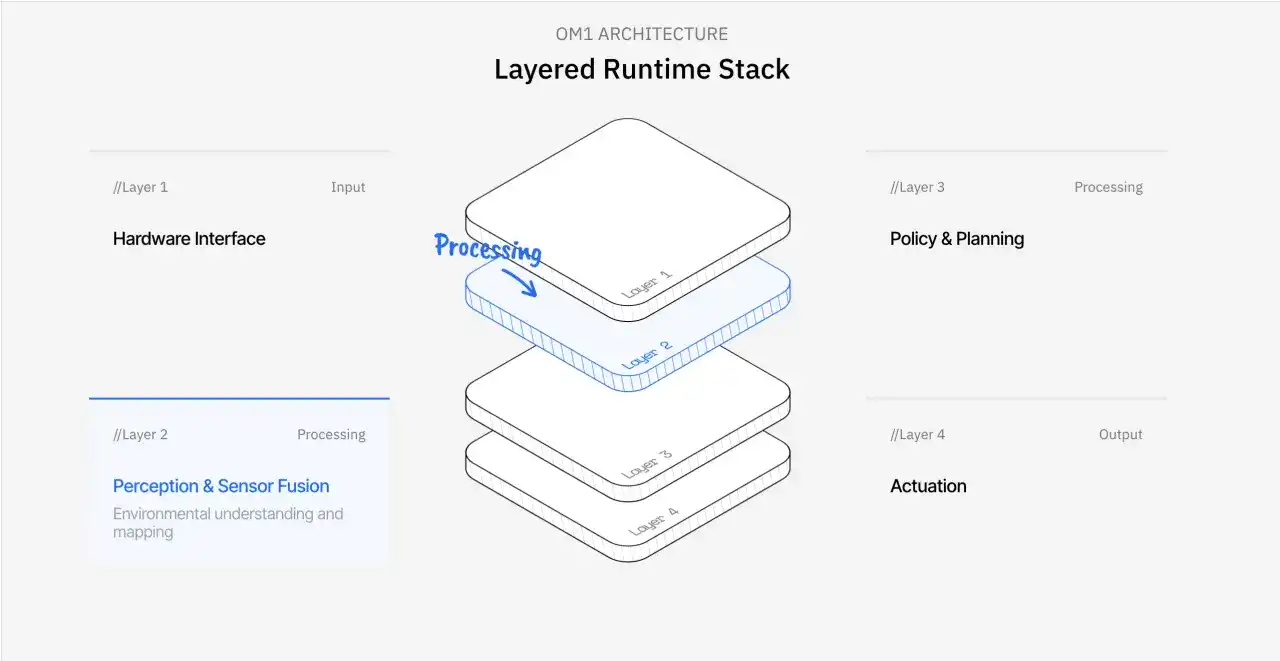
This gives robots真正的 "natural language interaction + autonomous decision-making" capabilities for the first time, rather than just being preset script executors.
The highlight of OM1 is its openness and generality. Its hardware-agnostic design allows developers don't need to rewrite code for each robot type. It currently supports various forms like the Unitree G1 humanoid robot, quadruped robots, etc. Software-wise, it integrates mainstream LLMs like GPT-4o, Gemini, equipped with functions like lidar, SLAM navigation, voice interaction, etc. The team will prioritize technical integration with Unitree, Agibot, UBTECH, Dobot, Cloudminds, Accelerated Evolution, Jueji Power, Zhongqing.
Furthermore, OM1's AI-native architecture supports plug-and-play integration of mainstream models, enabling natural interaction. Its modular structure, like an App Store, facilitates skill expansion.
OM1 released its Beta version in September 2025, is open-sourced on GitHub (MIT license), attracting thousands of global developers to contribute and test, and has been adapted to various robot forms including Unitree, DEEP Robotics, Dobot, and UBTECH, beginning the phase of real device deployment.
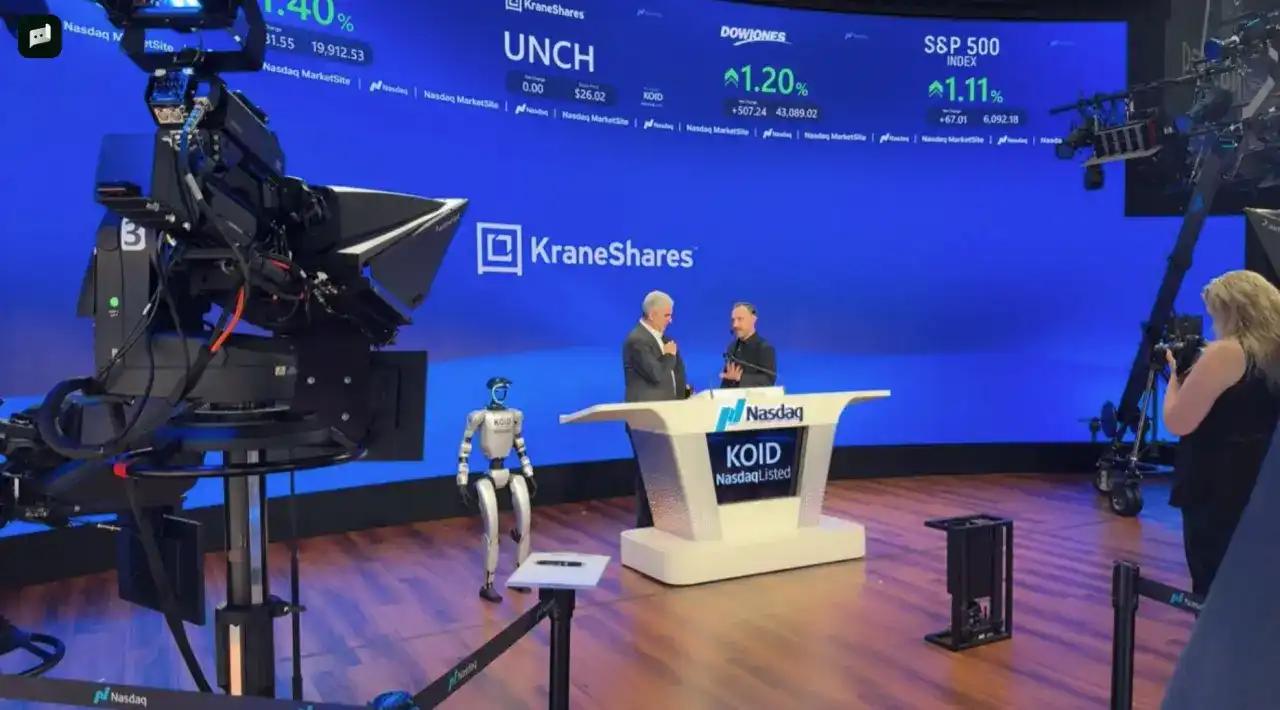
It is worth mentioning that at the ETF listing ceremony hosted by Nasdaq and launched by KraneShares, OpenMind's humanoid robot equipped with the OM1 operating system appeared on site and participated in the listing启动仪式.
Overall, OM1更像 a "universal brain + application platform" for robots. This model essentially replicates the successful path of Android当年: unify the base, reduce development costs to attract developers, and form an application ecosystem.
2. FABRIC: The Network Layer Letting Robots "Know" and "Collaborate" with Each Other
But a brain alone is not enough. In the real world, robots rarely operate alone. They need cross-manufacturer coordination, information sharing, task分配, and even automated settlement.
The problem is, traditional robot systems are mostly closed networks. Once跨品牌 or跨平台, collaboration almost has to start from scratch.
This is why, beyond OM1, OpenMind also built the Fabric Protocol (FABRIC).
If OM1 solves whether I am smart enough, FABRIC solves how I securely cooperate with other robots. FABRIC is essentially a decentralized collaboration and trust network. It assigns an on-chain identity to each robot, allowing devices to be identified, build credit, record behavior, and automatically complete task settlement.
In other words, robots are no longer just tools executing commands, but economic nodes with identity and accounts.
In this network, robots can share skills, synchronize experiences, call each other's capabilities, and even complete automated stablecoin micropayments and incentive distribution. From a Web3 perspective, it's closer to the identity layer + trust layer + collaboration layer between machines.
III. From Vision to Reality: OpenMind's Actual Deployment Progress
After talking so much about protocols, networks, and visions, the only真正关键 question is: Are these things actually running?
In the crypto industry, we've seen too many projects that issue coins first and then look for落地场景. Whitepapers are grand, demo videos are炫, but products remain in the testnet stage, with almost no real deployment in the real world.
The reason OpenMind has attracted so much attention this time is perhaps because its path is the opposite: it推进 TGE after OM1 and FABRIC were already running in real robots.
Currently, the two most representative pieces of落地成果 are: 1) the USDC automatic payment charging network launched in cooperation with Circle; 2) the BrainPack robot intelligence module sold to developers and hardware manufacturers.
1. Letting Robots Pay for Charging Themselves for the First Time
Last December, OpenMind announced a cooperation with Circle, deploying the world's first "USDC Robot Self-Charging Point" in Silicon Valley.
Simply put, robots can pay by themselves. When battery is low, it automatically navigates to the charging station, identifies the location, completes the USDC payment, then charges and continues working, all without human intervention.
It sounds small, but the significance is huge. This should be the first time robots possess autonomous consumption capability. They are no longer just managed devices, but begin to resemble economic agents.

2. Equipping Robots with a Universal Brain "BrainPack"
At the same time, OpenMind launched BrainPack and配套 robot solutions, aiming to help a larger scale of robots solve the problem of insufficient intelligence.
It is essentially a plug-and-play computing backpack, a module about the size of a backpack, integrating high-performance computing, sensors, and software. It can be directly installed on third-party robots. Once installed, ordinary robots immediately gain perception, mapping, planning, memory, and the complete autonomous capabilities like the aforementioned USDC payment-based self-charging management, edge inference, etc.
For example, it can help robots achieve real-time 3D mapping, object recognition/annotation, privacy-preserving vision (automatically blurring faces), and other operations.
Its core hardware is based on NVIDIA Jetson Thor and runs the self-developed OM1 system and FABRIC protocol, supporting ROS2, JetPack 7.05, etc. You can understand it as installing an Android system-level brain for the robot. No need to rebuild hardware or wait for the next generation of robots; old equipment is directly upgraded to AI-native robots.
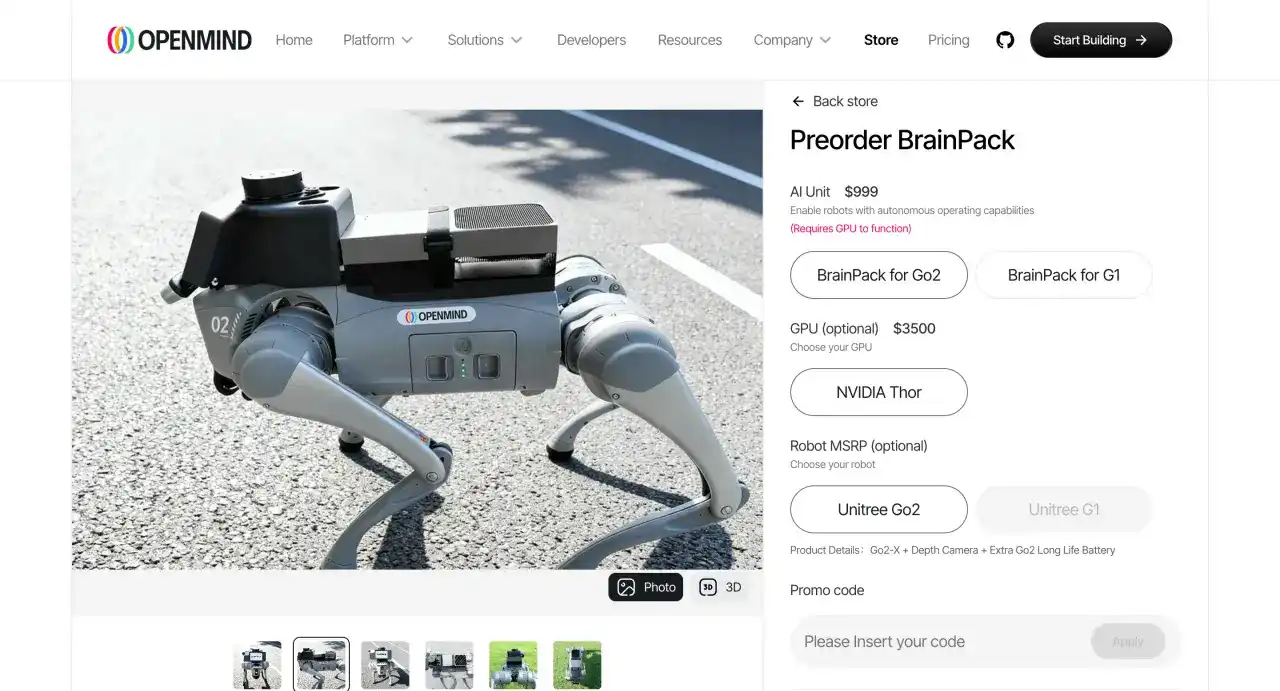
BrainPack announced specific robot dog products last November. According to the official pre-sale page, the deposit is $999. It supports bundled Unitree robot packages. The first batch of complete deliveries is expected around Q1 2026. Although currently in the pre-order stage, some developers and labs have received beta or early delivery versions.
3.配套 App Store: Beginning to Form an Ecosystem
While hardware is being delivered, OpenMind is also building another key piece of the puzzle—the application ecosystem—launching a robot version of the App Store.
The logic is simple, just like we download Apps on our phones, developers can develop skills and applications for robots, and users can install them on their devices with one click.
Currently, the first batch of applications for quadruped and humanoid robots has been launched. Although still in the early stages, the significance of this step is that OpenMind is not just selling hardware or systems, but attempting to establish a sustainably scalable developer platform.
As more and more robots connect to OM1 + FABRIC, coupled with application distribution capabilities, the entire network truly gains scale effects.
Conclusion: Will OpenMind Drive the "Robotics+Crypto" Concept Heat?
In recent years, the market has just experienced a wave of AI + Crypto热潮. But most projects are essentially "computing power narrative + token model", with a layer still separating the chain from the real world. The special thing about OpenMind is that it is the first to truly embed Crypto into robots, this kind of physical world productivity tool.
From the industry side, OpenMind is already doing something more long-term: education and ecosystem. They jointly with Unitree Robotics' largest distributor in the US, RobotShop (Robostore), launched complete humanoid robot education courses and solutions, currently serving over 100 research and education institutions, including Harvard University, Massachusetts Institute of Technology, Stanford University, and other top universities. This may lay a good foundation for the future ecosystem and network effects of its machine economy, as well as卡位 in the "robotics + Crypto" track.
Perhaps precisely because of this, many people started to seriously pay attention to the robotics+Crypto infrastructure track through OpenMind.
Of course, for OpenMind, deployment speed is more important than concept热度. If viewed more rationally, OpenMind's advantages are very clear:
First, the team: top academic background + robotics/AI/blockchain交叉 capabilities. This kind of composite team from various fields is not common in Crypto projects.
Second, track卡位. In the加密 field, there are almost no similar projects truly深耕 "robotics infrastructure". It is the leader and seed player in this direction. When the market starts talking about "embodied AI + Web3", capital and attention will naturally集中 on it first.
Third,落地 rhythm. OM1, FABRIC, USDC self-charging points, BrainPack, App Store—these are not roadmaps, but products that have already begun delivery. This makes it更像 a technology company building long-term infrastructure, rather than a narrative-driven token project.
Of course, challenges also exist. The robotics industry itself is a hard tech track with heavy assets and long cycles. Hardware deployment is slow, costs are high, and commercialization paths are complex. It cannot replicate the exponential expansion of pure software protocols. At the same time, whether跨厂商 standards can truly be unified, whether the developer ecosystem can take off, and whether the machine economy truly forms a closed loop all still need time to verify.
In other words, OpenMind faces a marathon requiring patience and sustained effort.