By Zhao Ying
SpaceX's stock continues to decline, having lost over $1 trillion in market value since its post-listing peak. The rocket and AI giant founded by Elon Musk is facing its most severe valuation test since going public.
On Friday, SpaceX shares fell 5.4% to close at $123.99 per share, bringing the total market capitalization down to $1.63 trillion. On June 16—the company's third trading day after going public—its market cap once reached as high as $2.64 trillion. The direct trigger for this decline was the forced abort of a launch mission for its flagship Starship rocket due to an engine failure.
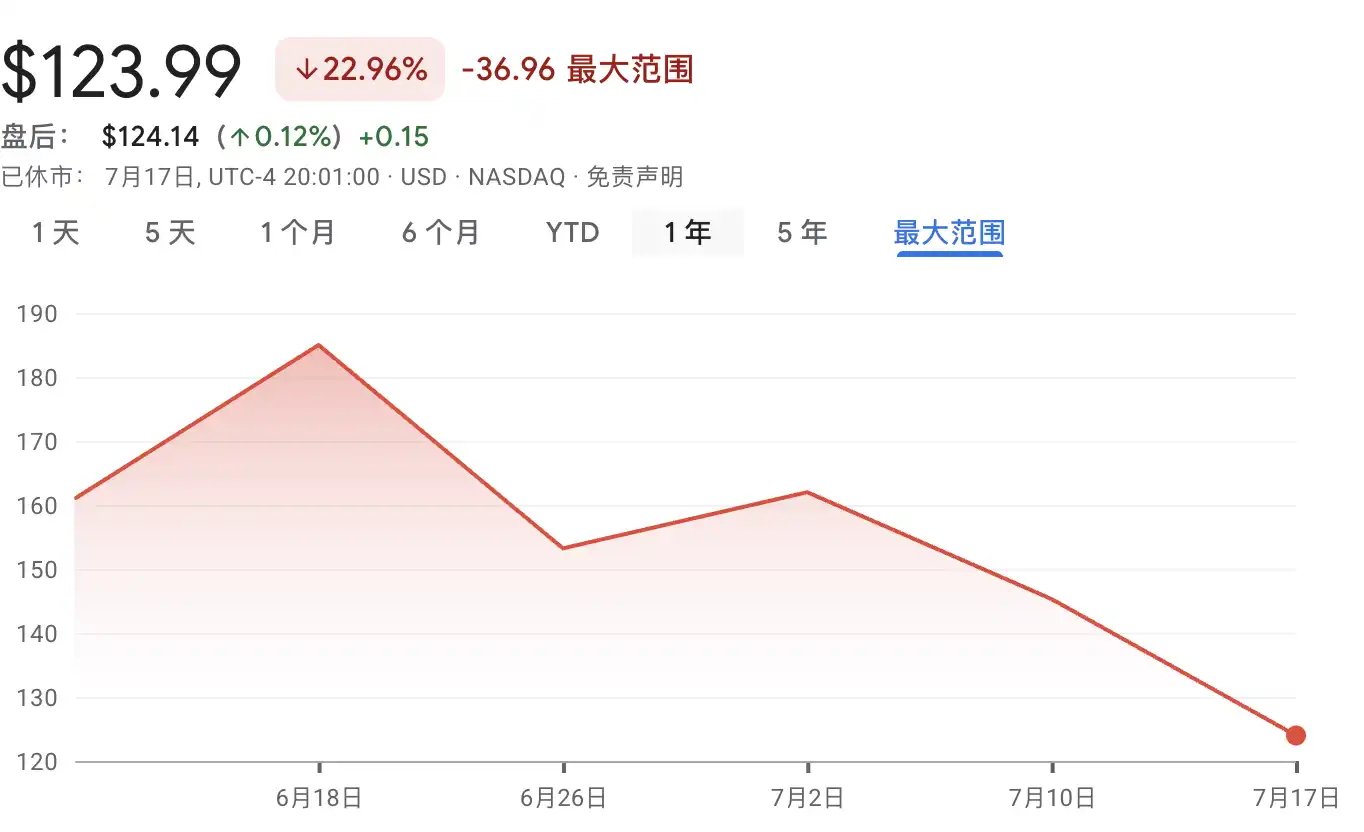
The sustained drop in stock price has dragged SpaceX below its $135 IPO price. Joe Gilbert, portfolio manager at Integrity Asset Management, stated, "The timing of the launch failure is not ideal for the company's narrative, but failure is an inherent risk in this narrative. Investors are reducing positions, re-evaluating the valuation; optimism is slowly fading while also compressing the previously high valuation multiples."
Starship Engine Failure Triggers Sell-Off
On Thursday, SpaceX aborted a launch mission after some engines on its Starship rocket failed to ignite. Musk later stated on platform X that the company would replace two Raptor engines, and the next launch attempt might be postponed to early next week.
SpaceX said it would attempt the launch again. In a report to clients on Friday, Raymond James analyst Brian Gesuale noted that even with delays, if a successful launch occurs next week, the interval between two Starship flights would be compressed to less than 60 days from the previous 221 days. Gesuale initiated coverage of SpaceX with a "Strong Buy" rating on July 7th, setting a target price of $800—the highest on Wall Street—representing a potential gain of about 545% from Friday's closing price.
Gesuale also emphasized, "Such anomalies will continue to accompany Starship's aggressive development process—this is an inevitable cost in pushing the boundaries of reusability, payload capacity, and accelerating deployment for Starlink V3 and future NASA Artemis missions."
Starship is a Core Pillar of SpaceX's Business Blueprint
The strategic importance of Starship to SpaceX cannot be underestimated. According to the company's IPO prospectus released in June, SpaceX has invested over $15 billion cumulatively in Starship development. This rocket is the core vehicle for advancing the company's space data center plans, expanding the Starlink satellite communication network, and ultimately achieving crewed lunar and Mars missions.
Clear Street analyst Greg Pendy pointed out, "Any substantial schedule slippage will directly impact the scale expansion of Starlink and the direct-to-cell phone service, as lower launch costs are crucial for accelerating satellite deployment."
RBC Capital Markets analysts Ken Herbert and Jonathan Atkin believe that the cost savings brought by Starship will be a key catalyst for unlocking SpaceX's ambitions—including the so-called 'orbital computing' business—but also warn that the pace of reusable launches is "critical." The analysts wrote in their report, "We understand the path to de-risking is non-linear, and believe investors may also be forced to accept this non-linear pace."
Wall Street Overall Maintains a Bullish Stance
Despite recent selling pressure, Wall Street's overall stance on SpaceX remains bullish. According to Bloomberg tracking, over 80% of analysts give the stock a Buy or equivalent rating, with an average price target of $235.34, implying approximately 90% upside from current levels.
However, there are structural pressures in the market. SpaceX joined the Nasdaq 100 index earlier this month, and lock-up periods for shares held by company insiders will gradually expire in the coming months, allowing shares to be released into the market. Mark Malek, Chief Investment Officer at Siebert Financial, said, "Given the upcoming lock-up expirations, many investors may have re-evaluated their initial investment thesis, while potential buyers who were previously on the sidelines are waiting for a better entry point—the probability of such opportunities arising is quite high as valuations gradually return to reasonable ranges."
According to The Wall Street Journal, SpaceX is in talks to sell computing power to the U.S. Department of Defense, news which caused a brief rebound in the stock price. The company already has similar agreements with Alphabet's Google and Anthropic PBC.
The continued decline in SpaceX's stock price poses a potential threat to the current wave of AI-related IPOs. Artificial intelligence is a significant part of the core narrative for SpaceX's IPO—the company positions its space data centers as a strategic pivot to capture a potential market estimated at around $26.5 trillion. This record-breaking IPO had brought substantial profits to major Wall Street investment banks, driving equity underwriting business revenue to its highest quarterly level since 2021. Now, with SpaceX's stock price falling below its IPO price, doubts are deepening in the market about whether highly-valued tech companies can maintain strong performance post-listing.