X Offers $1 Million Reward for Great Articles: What Kind of Content Actually Got Paid?

marsbitXuất bản vào 2026-02-04Cập nhật gần nhất vào 2026-02-04

Tóm tắt

X announced a $1 million prize for the best long-form Articles on its platform, with eligibility limited to U.S. users, requiring 1,000+ word original English content. The final prize pool doubled to $2.15 million. The winner, @beaverd (9k followers), received $1 million for an investigative piece on Deloitte's misuse of $74 billion in government contracts, supported by a self-built database. Second place ($500k) went to @KobeissiLetter (70k followers) for a tactical guide on trading during Trump-era tariff cycles. Dan Koe, whose earlier viral article inspired the contest, won a $250k "Creator Choice" award for a piece on focus and productivity, despite having the highest engagement but lower U.S. premium user exposure. Key insights: content scarcity outperformed follower count, all winners provided unique data or frameworks, and no traditional media won—highlighting X's push for native, in-depth content to retain users and train AI models like Grok.

Author: David, Deep Tide TechFlow
In mid-January, X announced a $1 million reward for the best-performing long-form Articles on its platform.

Elon Musk personally confirmed the announcement. The rules were simple: limited to US users, original English articles over 1000 words, ranked primarily based on exposure among US paid users.

You might recall that just a few days before this content incentive program was launched, personal growth blogger Dan Koe published an article titled "How to fix your entire life in 1 day," which garnered 170 million impressions, becoming the best-performing Article in X's history.

X clearly saw the traffic potential of long-form content and quickly followed up: lowering the threshold for the Articles feature, adjusting the algorithm to prioritize long-form content over short posts, and announcing the million-dollar征文大奖 (essay contest大奖).

A two-week competition period, with tens of thousands of participants.

Results were announced on February 4th. The total prize money was $2.15 million, more than double the initial promise. $1 million for the champion, $500,000 for the runner-up, plus a $250,000 "Creator Choice" award and four $100,000 honorable mentions.

The winning situation is roughly as follows:
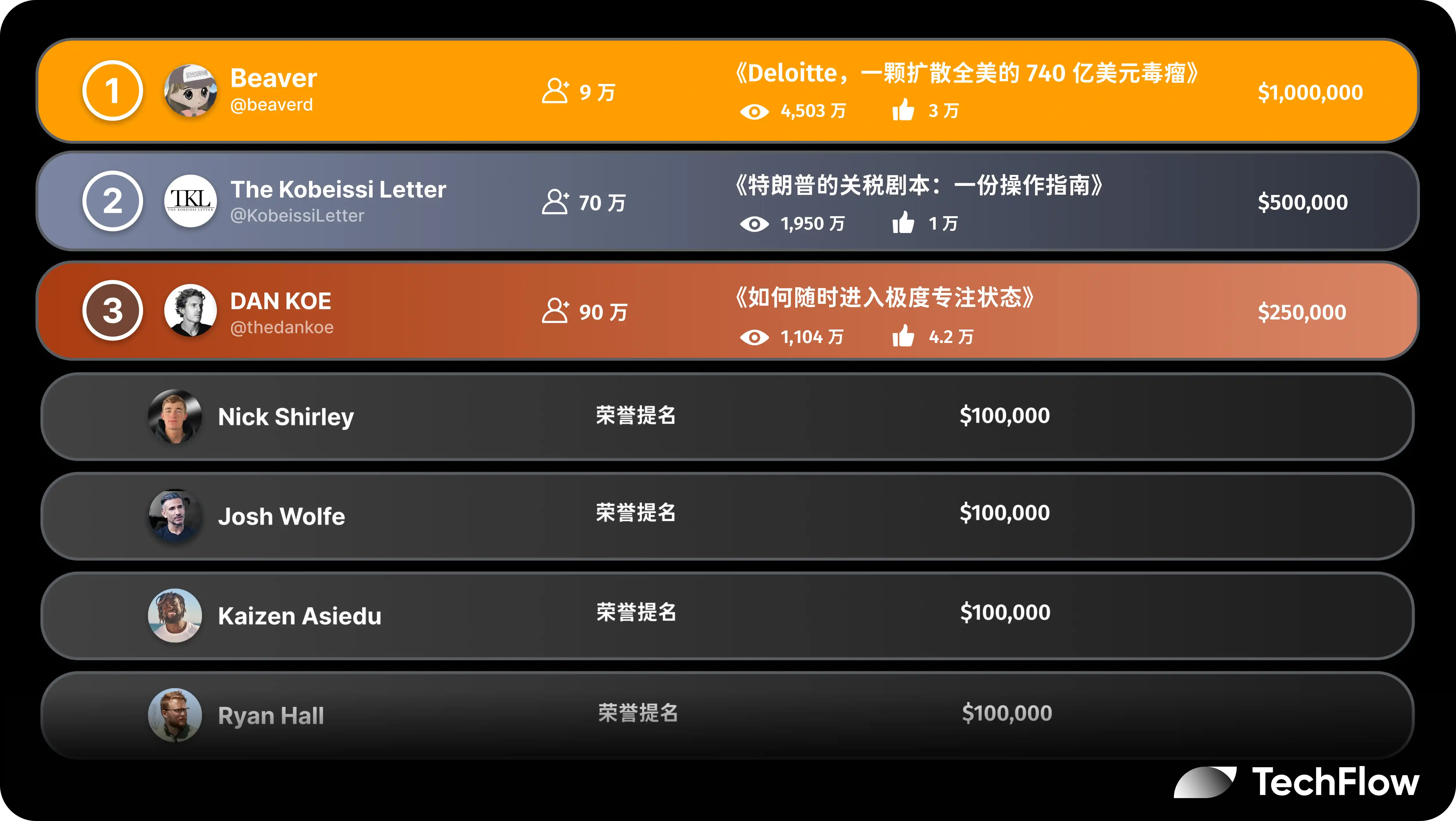
You can see Dan Koe is on the list again. However, his previous article on how to repair your life in one day had 170 million impressions, but the champion of this creation contest only had 45 million.

Viral hits are hard to come by, but the winning articles are still worth analyzing.

🏆 Champion: A 90k-follower "small account" takes $1 million with a self-built database

The champion @beaverd's article title translates to "Deloitte, a $74 Billion Cancer Spreading Across America." It's about the well-known consulting firm Deloitte.

This account currently has "only" 90,000 followers, which is relatively small compared to the other winners, and it has no media organization or any endorsement beyond the blue check verification.

The topic he wrote about doesn't touch on any trending buzzwords either, but it exposes a rather controversial issue: how Deloitte secured $74 billion in contracts from federal and state governments and then botched the projects.
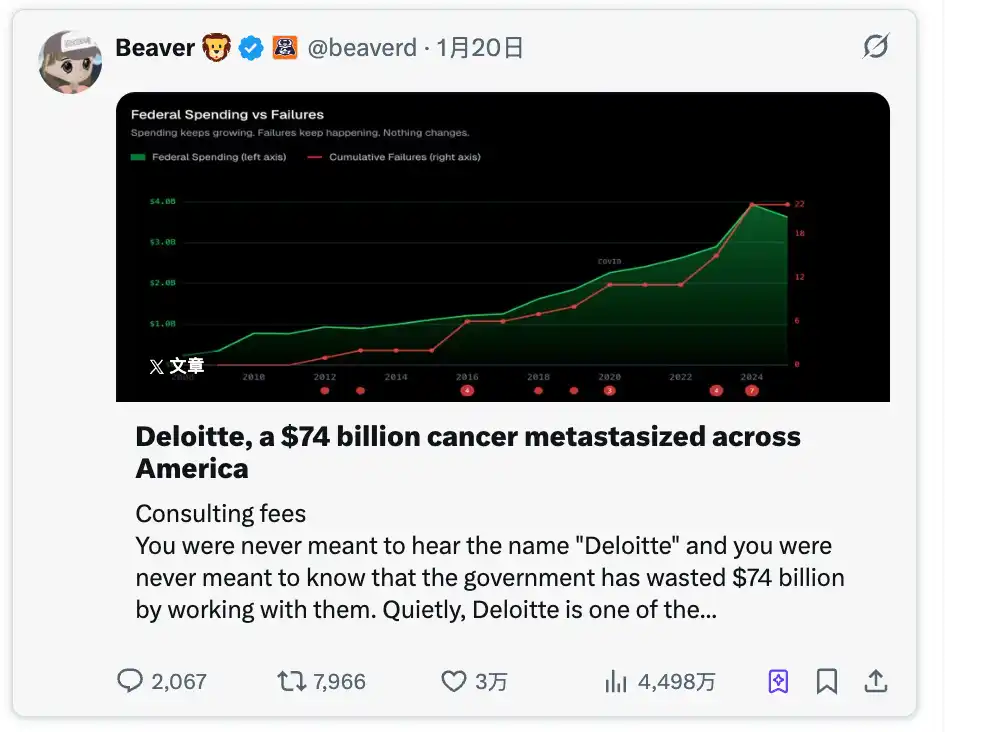
Portal is here

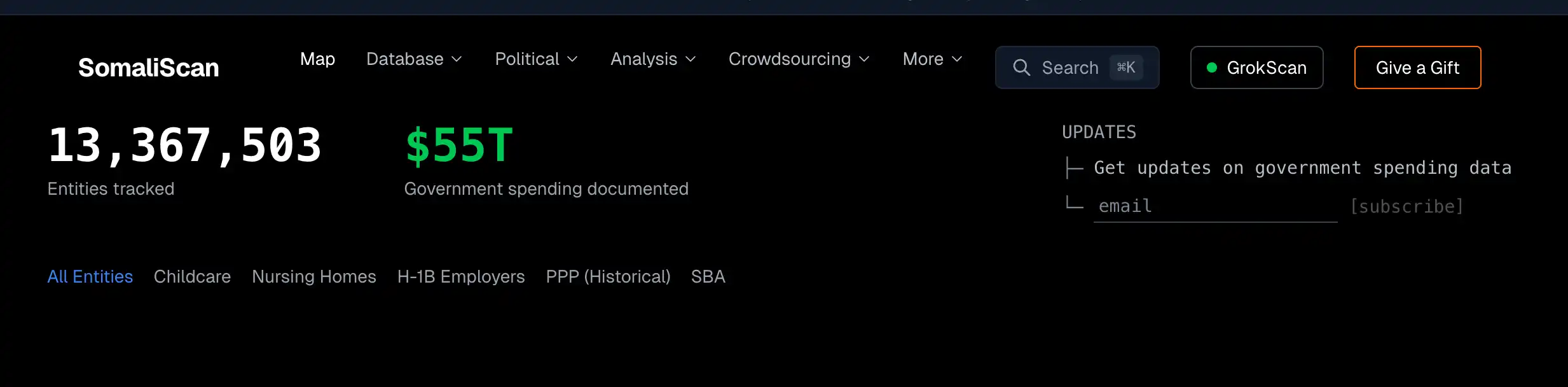
Clicking in, you'll find this person really put in the work.

He built his own website called somaliscan.com, scraping millions of government invoice data entries, cross-referencing audit reports and system failure records line by line.

Then, using this first-hand data, he told a series of shocking stories: California's unemployment benefits system defrauded of $32 billion, Tennessee's Medicaid system崩溃 (collapsed) leading to 250,000 children losing coverage, a court信息化改造 (IT modernization) project burning through $1.9 billion and ending up abandoned... covering 25 states in total.
He also dug up the revolving door between Deloitte executives and government officials, specifying who jumped from Deloitte to which department and then approved which contracts back to Deloitte, listing names and amounts clearly.

One person built his own database, did his own research, and earned $1 million.

🥈 Runner-up: A 700k-follower finance macro account teaches you how to profit from tariff panic

The runner-up @KobeissiLetter is a familiar face in the macro finance circle, with 700,000 followers, long focused on US economic policy and market volatility.

What he did in this article is also very direct: he拆解 (deconstructed) Trump's tariff playbook into a repeatable trading framework, titled "Trump's Tariff Playbook: An Operational Guide."

Since Trump often acts unpredictably, liking to announce extreme policies and threaten other countries but not always fully following through, Wall Street summarized this pattern as TACO, an acronym for Trump Always Chickens Out.

TACO describes a recurring pattern:

Trump announces aggressive tariffs → market plummets → a few days later he backs down or delays → market rebounds.
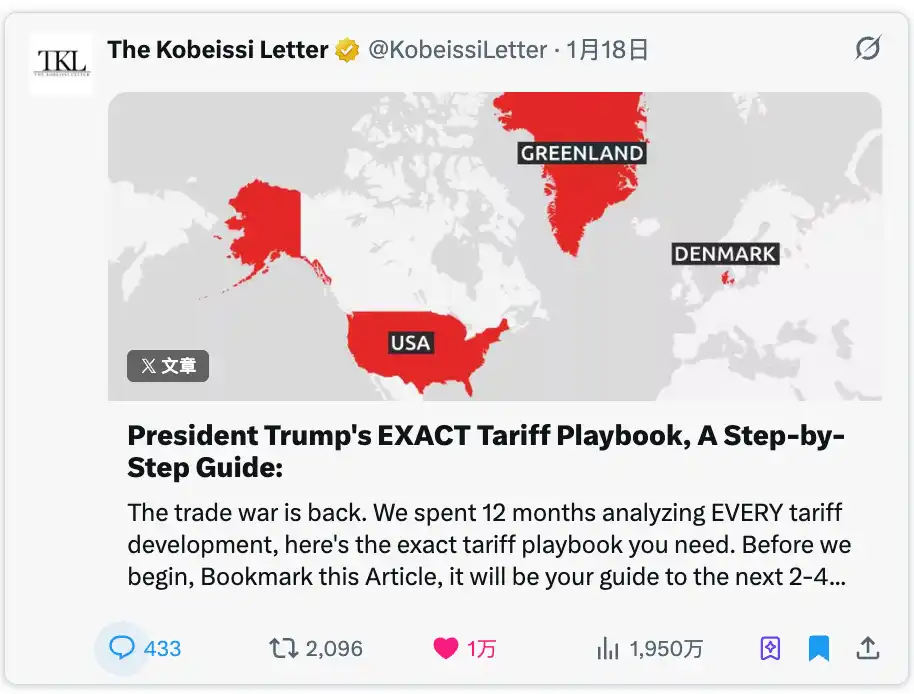
Portal

What KobeissiLetter's article did was turn TACO from a joke into an operational manual with timestamps. Using tariff events from the past 12 months as samples, he拆出 (deconstructed) a complete cycle template for you to follow and trade according to the time periods.

For example, the White House releases消息 (news)制造恐慌 (creating panic) on the weekend,抄底资金 (bargain-hunting funds) enter mid-week,缓和信号 (easing signals) are released the next weekend, some agreement is reached within 2 to 4 weeks. Simultaneously, he would follow up (持续跟帖) at each step, telling you which stage it's at now, making it more like a serialized pre-research post.

He also provided practical methods, such as watching the US 10-year Treasury yield. If this number breaks 4.60%, Trump will likely让步 (concede).

For the paid users on X who follow macro and trading, this stuff is right up their alley.

It doesn't discuss whether tariffs are good or bad, nor does it make moral judgments. It just tells you what actions to take at what point next time this playbook is used, to make money.

🥉 Third Place: DAN KOE with the most likes, familiar life methodology

Dan Koe's参赛文章 (contest entry) "How to Enter a State of Deep Focus Anytime" received 42,000 likes, 8,681 reposts, the highest interaction data among all entries. But the exposure was only 11.04 million, less than a quarter of the champion's.

What X gave him wasn't strictly third place; it was a separately established "Creator Choice" award worth $250,000.

This is understandable. Dan Koe is "the person who inspired this competition." His viral article with 170 million impressions in early January directly showed X how high the traffic ceiling for long-form content could be.
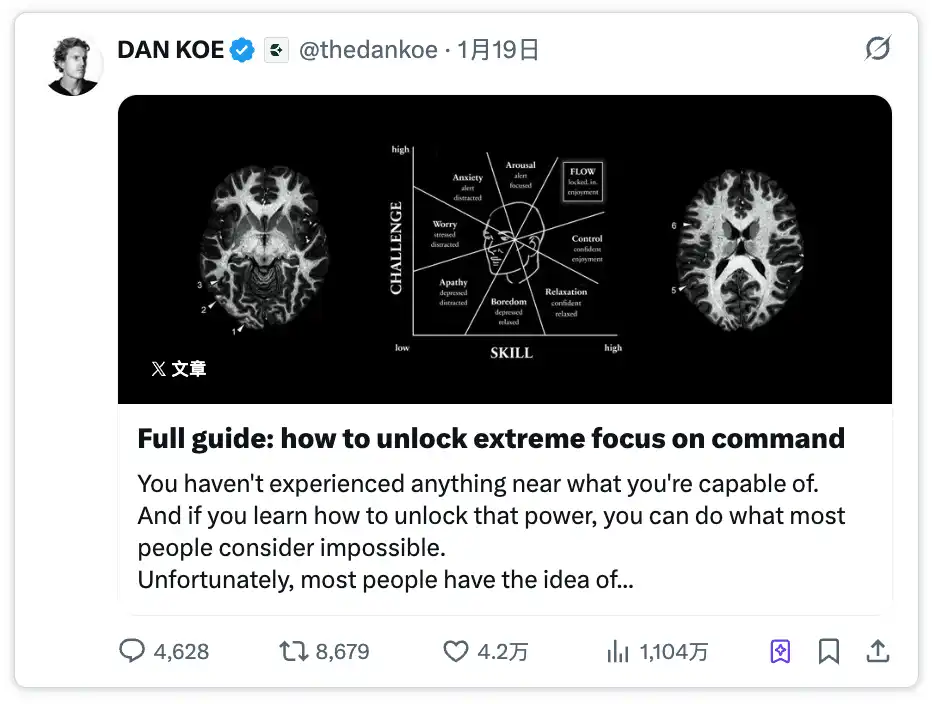
Portal

No need to introduce the article itself too much; it's still that set of life growth methodologies. It大致是讲 (roughly talks about) how to gain focus, citing neuroscience and flow state concepts for support and depth.

Actually, this piece had the best interaction data, but according to the core competition rule "exposure among US paid users," it didn't rank at the top.

Why did the article with the best interactions have lower exposure? This misalignment will be discussed later.

Honorable Mentions: $100k ×4

Nick Shirley, Josh Wolfe, Kaizen Asiedu, and Ryan Hall each received a $100,000 incentive. Their accounts cover public policy, geopolitics, history, and public safety, respectively.

Among them, Josh Wolfe is the co-founder of Lux Capital, a well-known venture capitalist, who also announced he would donate the prize money equally to four charities.

Since the original post did not list the specific articles by these four individuals, and due to time and energy constraints, we did not conduct further investigation. Everyone is welcome to supplement this information.

Some In-Depth Observations

Some patterns visible from these competition results:

  • The article with the most likes had only a quarter of the champion's exposure

The most counterintuitive data from this competition is definitely Dan Koe's.

42,000 likes, 8,681 reposts, 4,627 comments – the three interaction metrics were the highest overall. But the exposure was only 11.04 million, less than a quarter of champion @beaverd's. And @beaverd's likes were 30,000, fewer than Dan Koe's.

If you've done social media operations, this data feels别扭 (awkward). Generally, higher interaction should lead the algorithm to promote it more, resulting in greater exposure.

But X's competition calculation wasn't total exposure; it was "US paid user homepage timeline exposure." This metric excluded non-US users, non-paying users, and visits from search and personal profiles.

Dan Koe writes about personal growth, an audience naturally more global, with many non-US followers. @beaverd wrote about how US taxpayer money was wasted by Deloitte, an audience naturally concentrated in the US. Under the same algorithm recommendation mechanism, the "geographic concentration" of the content determined the level of this metric.

  • 90k followers beat 900k followers, content scarcity > follower base

Champion @beaverd had 90k followers before the competition. Runner-up @KobeissiLetter had 700k followers. Dan Koe had 900k followers.

If follower count determined exposure, the ranking should be reversed. But the actual results show that in X's Articles recommendation logic, the weight of follower base is far less than imagined.

@beaverd won because he had something others didn't; content scarcity played a key role.

This is completely different from traditional traffic logic. Big accounts rely on follower存量 (stock) and posting frequency, but in an algorithm-dominated distribution environment, "whether you have exclusive content" is more important than "how many followers you have."

  • You need to build your own content "hardware"

Stepping back, the topics of these three winning articles are completely unrelated: one investigates government contracts, one teaches you to trade tariff waves, one talks about how to focus.

In any content platform's categorization system, they wouldn't appear on the same list. But they share a common point: each has its own independent "hardware," meaning you need a narrative framework.

@beaverd's hardware is a self-built database scraping government data; KobeissiLetter's hardware is a trading framework backtested over 12 months; and Dan Koe's hardware is a six-chapter methodology blending neuroscience and psychology, although it might seem profound, it's actually common knowledge.

None of the winning articles were pure opinion pieces. They all required long篇幅 (length) to carry the information load, which is precisely the reason for the existence of the X Articles format.

Another noteworthy fact: Among the eight awardees, there wasn't a single traditional media outlet.

All are independent creators. This isn't to say traditional media didn't participate, but in this competition format, personal accounts反而更有优势 (actually had more advantage).

Institutional media content is usually published on their own websites, with only links and summaries on social media. But Articles require the full content to be published on X, which is an awkward move for media accustomed to off-site引流 (traffic diversion).

What is X really buying for $2.15 million

Returning to the platform itself.

X initially promised a $1 million incentive but ended up giving out $2.15 million. During the competition, it also made a series of supporting moves: expanding the Articles feature from creator accounts to all paid users, adjusting the algorithm to increase the recommendation weight of long-form content, changing the scoring method to "US paid user homepage exposure."

At such a high cost, the most direct reason is certainly that X needs original long-form content on its platform.

In the past, long content on X mostly relied on external links – Substack, Medium, personal blogs. Users click and jump away, leaving reading time and interaction data elsewhere. The goal of Articles is to keep this content on-site, allowing users to read from start to finish without leaving X.

Going deeper, X has Grok. Large language model training requires high-quality long-text data, and the vast majority of content on X is 280-character short tweets. If Articles can continuously attract creators to produce in-depth long-form content, this content becomes training material for Grok.

Finally, paid user value.

The competition rules limited the metric to "US paid user homepage exposure," directly telling creators that their content should serve paid users.

This is using creators' content to support the paid system, making paid users feel "the money I spent is worth it because I can see deep content on the homepage that I can't see elsewhere."

From a content creator's perspective, we feel the era of pure opinion might be turning a page.

This trend also applies to creators in the crypto circle. The crypto industry doesn't lack opinions; countless people on X every day喊单 (shill), predict prices, comment on regulation.

But few can自建 (build their own) on-chain data analysis tools like @beaverd, or拆解 (deconstruct) market cycles into repeatable trading playbooks like KobeissiLetter.

Maintaining scarcity and independence, producing consistently, is actually a very professional job, and also very rewarding and positive-feedback work.

We also hope to see more content from the Chinese circle appear on the list in the future.

Câu hỏi Liên quan

QWhat was the total prize money awarded in X's long-form article competition, and how did it compare to the initial announcement?

AThe total prize money awarded was $2.15 million, which was more than double the initially announced $1 million.

QWho won the $1 million grand prize, and what was the key factor that contributed to their article's success?

AThe grand prize was won by @beaverd. The key factor was the article's unique and scarce content, which was based on an original, self-built database analyzing millions of government invoices to expose how Deloitte mismanaged $74 billion in contracts.

QWhat specific metric did X use to rank the articles in the competition, and why did the article with the highest engagement (Dan Koe's) not have the highest exposure?

AX ranked articles based on 'exposure in the home timeline of US-based Premium subscribers.' Dan Koe's article had lower exposure by this metric because his audience is more global, while this metric excluded non-US and non-paying users, favoring content with a highly concentrated US audience.

QAccording to the article, what is one of the deeper reasons X is investing in its Articles feature and this competition?

AOne deeper reason is to generate high-quality, long-form text content to serve as training data for its large language model, Grok.

QWhat common characteristic did the winning articles share, according to the author's analysis?

AThe winning articles all had their own independent 'hardware' or narrative framework, such as a unique database, a tested trading model, or a multi-chapter methodology. None were purely opinion pieces.

Nội dung Liên quan

Chính phủ Mỹ bất ngờ yêu cầu dừng mô hình mạnh nhất của Anthropic, 'giá cổ phiếu IPO dự kiến' giảm mạnh 3,7% trong một đêm

Chính phủ Mỹ đột ngột yêu cầu Anthropic ngừng hoạt động hai mô hình AI mạnh nhất là Fable 5 và Mythos 5, viện dẫn lý do an ninh quốc gia liên quan đến một lỗ hổng "vượt ngục" hẹp. Lệnh này được đưa ra ngày 12/6, chỉ vài ngày sau khi các mô hình được công bố. Anthropic phản đối mạnh mẽ, cho rằng tiêu chuẩn này nếu áp dụng rộng rãi sẽ "về cơ bản đình chỉ việc triển khai tất cả mô hình tiên phong mới". Hành động của chính phủ đã gây tác động tức thì đến thị trường kỳ vọng IPO của công ty. Hợp đồng vĩnh viễn Anthropic trên Hyperliquid đã giảm khoảng 3.7% xuống mức khoảng 1.627 USD, giảm từ mức cao kỷ lục trên 1.800 USD trước đó. Các token hóa quyền sở hữu không được ủy quyền trên Solana cũng ghi nhận mức giảm đáng kể. Fable 5 và Mythos 5 được xem là bước nhảy vọt về năng lực, đặc biệt trong các lĩnh vực như kỹ thuật phần mềm và lý luận khoa học. Việc một công ty lấy "an toàn AI" làm nguyên tắc cốt lõi lại bị buộc phải đóng cửa sản phẩm hàng đầu của mình bởi chỉ thị an toàn của chính phủ tạo ra một tình huống trớ trêu. Sự việc xảy ra trong bối cảnh Anthropic đang chuẩn bị cho đợt IPO, làm dấy lên lo ngại về các tác động pháp lý và định giá. Công ty tuyên bố đang tích cực làm việc để giải quyết vấn đề và khôi phục dịch vụ, coi đây là "một sự hiểu lầm".

marsbit17 phút trước

Chính phủ Mỹ bất ngờ yêu cầu dừng mô hình mạnh nhất của Anthropic, 'giá cổ phiếu IPO dự kiến' giảm mạnh 3,7% trong một đêm

marsbit17 phút trước

SpaceX lên sàn tạo ra tỷ phú nghìn tỷ, tài sản của Elon Musk tương đương nửa thị trường tiền điện tử

Elon Musk đã trở thành người đầu tiên trong lịch sử hiện đại có khối tài sản ròng cá nhân vượt qua ngưỡng 1 nghìn tỷ USD, sau đợt IPO kỷ lục của SpaceX. Theo Chỉ số Bloomberg Billionaires, tổng tài sản của ông hiện ở mức 1,11 nghìn tỷ USD. Một so sánh nổi bật cho thấy khối tài sản này đã vượt qua tổng vốn hóa thị trường của toàn bộ tiền điện tử, nếu không tính Bitcoin. Ngay cả khi tính cả Bitcoin, tài sản của Musk cũng tương đương với một nửa toàn bộ thị trường tiền mã hóa, phản ánh sự tập trung của cải cao độ và sự thu hẹp đáng kể trong định giá của các altcoin. Vụ IPO của SpaceX trên Nasdaq đã gây chấn động, định giá công ty ở mức 2,2 nghìn tỷ USD. Giao dịch đạt khối lượng 85 tỷ USD trong ngày đầu tiên, phá kỷ lục và đưa vào top 10 giao dịch cổ phiếu lớn nhất mọi thời đại. Musk sở hữu 42% cổ phần của SpaceX. Bất chấp quy mô tài sản áp đảo thị trường altcoin, Musk vẫn gắn bó sâu sắc với hệ sinh thái tài sản số. Cá nhân ông đã công khai nắm giữ Bitcoin, Ethereum và Dogecoin. Hơn nữa, cả SpaceX và Tesla đều nắm giữ Bitcoin trong kho bạc công ty, với tổng cộng hơn 30.000 BTC, có thể xếp hạng thứ 5 trong số các công ty đại chúng.

Foresight News25 phút trước

SpaceX lên sàn tạo ra tỷ phú nghìn tỷ, tài sản của Elon Musk tương đương nửa thị trường tiền điện tử

Foresight News25 phút trước

Hard Ke phát hành độc quyền | Công ty trí tuệ cụ thể hóa đại dương 'World Sailing Intelligence' huy động được vốn kỷ lục 10 tỷ NDT, được Zhu Xiaohu, Temasek rót vốn

Tập đoàn thông minh thể thân đại dương "Shihang Intelligent" vừa hoàn thành vòng tài trợ Series A với số tiền kỷ lục hơn 10 tỷ nhân dân tệ, trở thành vòng tài trợ đơn lẻ lớn nhất trong lĩnh vực robot biển toàn cầu. Vòng tài trợ này có sự tham gia của các nhà đầu tư như Shanghe Momentum Fund, Vertex Growth của Singapore, công ty niêm yết Dayang Electric Motor, cùng với sự đầu tư tiếp tục từ các cổ đông cũ như Qiming Venture Capital, China Growth Capital và Changshi Capital. Người sáng lập kiêm CEO của Shihang Intelligent, Chen Xiaobo (sinh năm 1989), là cựu sinh viên Đại học Kỹ thuật Cáp Nhĩ Tân, có kinh nghiệm lâu năm trong lĩnh vực robot dưới nước và từng nhận Giải thưởng Tiến bộ Khoa học Công nghệ Quốc phòng khi mới 28 tuổi. Công ty cho biết, số tiền tài trợ sẽ được sử dụng để phát triển công nghệ cốt lõi, mở rộng thị trường toàn cầu và xây dựng hệ sinh thái chuỗi cung ứng, thúc đẩy ứng dụng quy mô lớn của robot biển trong các môi trường dưới nước phức tạp. Các robot của Shihang có khả năng hoạt động ở độ sâu từ 0 đến 10.000 mét và đã được ứng dụng trong các lĩnh vực như làm sạch tàu, an ninh dưới nước, điện gió biển, trang trại biển và kiểm tra đáy biển. Chỉ trong nửa đầu năm 2026, công ty đã nhận được đơn đặt hàng trị giá hơn 10 tỷ nhân dân tệ. Vào tháng 4 năm nay, Shihang Intelligent đã ra mắt mô hình lớn thể thân đại dương "Cangqiong CEORION". Mô hình này tích hợp nhận thức môi trường, hiểu nhiệm vụ và tạo hành động vào một kiến trúc duy nhất, được đào tạo dựa trên dữ liệu từ hàng triệu giờ hoạt động thương mại. Nó có thể bao phủ 12 loại nhiệm vụ dưới nước chính mà không cần chuyển đổi giữa các mô hình khác nhau. Trong các bài kiểm tra mô phỏng, tỷ lệ thành công nhiệm vụ của "Cangqiong CEORION" vượt quá 90%. Mô hình này cũng có khả năng thích ứng với các môi trường chưa từng gặp với tỷ lệ trên 70%, và đã giảm 80% tỷ lệ tai nạn va chạm nhờ mô-đun suy luận vật lý tích hợp. Gần đây, Shihang Intelligent cũng đã được chọn tham gia Kế hoạch Kiểm tra và Làm sạch Thân tàu Dưới nước Quốc gia của Cơ quan Hàng hải và Cảng biển Singapore, trở thành đối tác công nghệ cốt lõi của dự án cấp quốc gia này.

marsbit51 phút trước

Hard Ke phát hành độc quyền | Công ty trí tuệ cụ thể hóa đại dương 'World Sailing Intelligence' huy động được vốn kỷ lục 10 tỷ NDT, được Zhu Xiaohu, Temasek rót vốn

marsbit51 phút trước

3 tháng, 35 tỷ, các nhà đầu tư tranh giành OpenAI của thế giới vật lý

Một cảnh tượng quen thuộc lại xuất hiện. Công ty Công nghệ Giga Perspective (còn gọi là Cực Giai Thị Giới) mới đây đã công bố hoàn thành vòng gọi vốn B2 trị giá 10 tỷ nhân dân tệ, nâng tổng số vốn huy động được trong 3 tháng lên 35 tỷ nhân dân tệ. Điều này đánh dấu sự tin tưởng mạnh mẽ từ các nhà đầu tư vào lĩnh vực AGI vật lý (Trí tuệ nhân tạo phổ quát trong thế giới vật lý). Công ty do Tiến sĩ Hoàng Quan, một tiến sĩ 9x từ Đại học Thanh Hoa, dẫn dắt. Ông có kinh nghiệm nghiên cứu và công nghiệp phong phú. Đội ngũ lãnh đạo được coi là "đội hình mơ ước" trong lĩnh vực này. Chìa khóa công nghệ của Cực Giai Thị Giới là "Hệ thống Song Kim tự tháp" (Thuật toán và Dữ liệu) xoay quanh mô hình thế giới (World Model). Họ đã phát triển hai hệ thống mô hình cốt lõi: - **Mô hình Hành động Thế giới (World Action Model):** Chuyển đổi hiểu biết của mô hình thế giới thành chiến lược hành động cho robot. Các phiên bản như GigaBrain-0 và GigaBrain-0.5M đã đạt thành tích cao trong các đánh giá toàn cầu. - **Mô hình Sinh thành Thế giới (World Generation Model):** Hiểu, mô phỏng và tạo ra thế giới vật lý để cung cấp dữ liệu và tham số huấn luyện. GigaWorld-1 và DriveDreamer (mô hình thế giới cho xe tự hành) là những ví dụ nổi bật. Công ty tin rằng thời khắc "GPT-3" của AGI vật lý sắp đến. Họ dự kiến phát hành GigaBrain-1 trong quý III/2026, hướng tới các bước đột phá về hiểu biết thị giác nguyên bản, lập kế hoạch cấp cao bằng ngôn ngữ và căn chỉnh quy luật vật lý. Về mặt thương mại hóa, Cực Giai Thị Giới theo đuổi chiến lược song song: - **Thị trường Cá nhân (C-end):** Ra mắt thương hiệu con "Thập Quang SeeLight" và robot hình người đa năng "Thập Quang S1" cho gia đình, đã nhận được hàng trăm đơn đặt hàng thực tế. - **Thị trường Doanh nghiệp (B-end):** Giới thiệu robot đa năng Maker H01 cho sản xuất công nghiệp, hợp tác với các công ty như FAW Mold và Alibaba Cloud. Họ đã ký kết kế hoạch triển khai 1000 robot tại Vô Tích trong 3 năm tới, đánh dấu bước tiến vào giai đoạn sản xuất quy mô lớn. Mô hình thế giới DriveDreamer cho xe tự hành cũng đã hợp tác với hơn 30 OEM và công ty hàng đầu. Tầm nhìn cuối cùng của công ty là thời đại AGI vật lý phục vụ mọi người, bắt đầu từ từng hộ gia đình, thông qua việc nâng cao năng suất vật lý và định hình lại lối sống.

marsbit1 giờ trước

3 tháng, 35 tỷ, các nhà đầu tư tranh giành OpenAI của thế giới vật lý

marsbit1 giờ trước

Mối liên hệ giữa Hoàng Trinh làm Pinduoduo và blockchain là gì?

Tác giả phân tích mối liên hệ giữa người sáng lập Pinduoduo Hoàng Tranh và công nghệ blockchain thông qua bài viết "Đảo Ngược Chủ Nghĩa Tư Bản" của ông. Bài viết chỉ ra rằng logic cốt lõi của Pinduoduo thực chất là một mô hình kinh doanh dựa trên "sự không chắc chắn". Hoàng Tranh cho rằng người giàu tích lũy tài sản bằng cách gánh chịu rủi ro thay cho người khác. Pinduoduo, thông qua các hình thức như mua sắm nhóm và khuyến mãi thời gian giới hạn, tập hợp lượng lớn nhu cầu cá nhân để tạo ra một đơn hàng xác định, giúp nhà máy giảm thiểu rủi ro tồn kho. Đổi lại, nhà máy giảm giá, tạo thành cơ chế "bảo hiểm ngược" khiến dòng tiền chảy ngược về phía người tiêu dùng. Tuy nhiên, điểm then chốt là lời hứa của một cá nhân thiếu độ tin cậy. Gần cuối bài, Hoàng Tranh tự đặt câu hỏi: phải chăng blockchain được sinh ra cho mô hình "bảo hiểm ngược" này? Ông nhận thấy blockchain, với hợp đồng thông minh và cơ chế phi tập trung, có thể giải quyết vấn đề này: biến lời hứa mua hàng thành cam kết có chi phí răn đe nếu vi phạm, có thể định giá và đáng tin cậy, từ đó thay thế sự tin cậy dựa trên con người bằng sự tin cậy dựa trên quy tắc. Bài viết còn so sánh hai con đường tạo ra sự chắc chắn: Con đường của Pinduoduo dùng quy mô để san bằng rủi ro, trong khi con đường của Bitcoin (đại diện cho blockchain) dùng các quy tắc mã hóa bất biến để loại bỏ sự can thiệp chủ quan. Cả hai đều phải trả giá, một bên hy sinh một phần tự do cá nhân, một bên hy sinh tính linh hoạt của quy tắc.

链捕手2 giờ trước

Mối liên hệ giữa Hoàng Trinh làm Pinduoduo và blockchain là gì?

链捕手2 giờ trước

Giao dịch

Giao ngay
Hợp đồng Tương lai
活动图片





