On August 21, the domestic NAND giant Yangtze Memory Technologies Co., Ltd. (YMTC) submitted its IPO prospectus to the Shanghai Stock Exchange just after completing its IPO guidance.
With the disclosure of the prospectus, YMTC delivered an explosive performance. In the first quarter of 2026, the company achieved revenue of 47.042 billion yuan and net profit attributable to the parent company's shareholders of 33.379 billion yuan. Compared with ChangXin Memory Technologies (CXMT), which recently went public, YMTC's net profit attributable to the parent's shareholders actually exceeded CXMT's by 8.6 billion yuan despite having lower revenue.
How did this contrast arise? Does YMTC have higher gross margins, or is the difference due to the equity structures of the two companies? Why does YMTC, with higher net profit attributable to the parent, have a lower valuation than CXMT?
Revenue Lower Than CXMT, Net Profit Nearly 35% Higher
Unlike CXMT, which focuses on DRAM, YMTC targets the NAND Flash market.
According to TrendForce data calculations, from January to March 2026, YMTC ranked third globally and first in China among NAND Flash manufacturers based on both sales value and shipment volume.
Driven by AI demand pushing the memory industry into a new upward cycle, YMTC has also experienced an explosive performance.
In 2024, the company's revenue grew significantly to 45.203 billion yuan, with net profit attributable to the parent's shareholders turning from a loss to a profit of 6.771 billion yuan. In 2025, YMTC's revenue further increased to 63.185 billion yuan, a year-on-year increase of 39.78%; net profit attributable to the parent's shareholders was 14.211 billion yuan, a year-on-year increase of 109.88%.
The real explosion occurred in 2026.
In the first quarter of this year alone, YMTC achieved revenue of 47.042 billion yuan and net profit attributable to the parent's shareholders of 33.379 billion yuan. The revenue for a single quarter already exceeded that of the full year 2024, and net profit attributable to the parent's shareholders even surpassed the sum of 2024 and 2025.
However, when comparing YMTC with another domestic memory leader, CXMT, an anomaly emerges.
In the first quarter of 2026, CXMT's revenue was 50.800 billion yuan, with net profit attributable to the parent's shareholders of 24.762 billion yuan. This means CXMT's revenue was 3.758 billion yuan higher than YMTC's, but its net profit attributable to the parent's shareholders was 8.617 billion yuan less.
Why does YMTC, with a smaller revenue scale, have a net profit attributable to the parent's shareholders nearly 35% higher than CXMT?
The easiest explanation to think of is that the two companies have different products, with YMTC enjoying higher gross margins.
But the truth is quite the opposite.
In the first quarter of 2026, YMTC's comprehensive gross margin was 76.77%, lower than CXMT's 79.16%. Roughly calculated based on the two companies' operating revenue and comprehensive gross margins, YMTC's gross profit in the first quarter was approximately 36.116 billion yuan, while CXMT's was about 40.213 billion yuan.
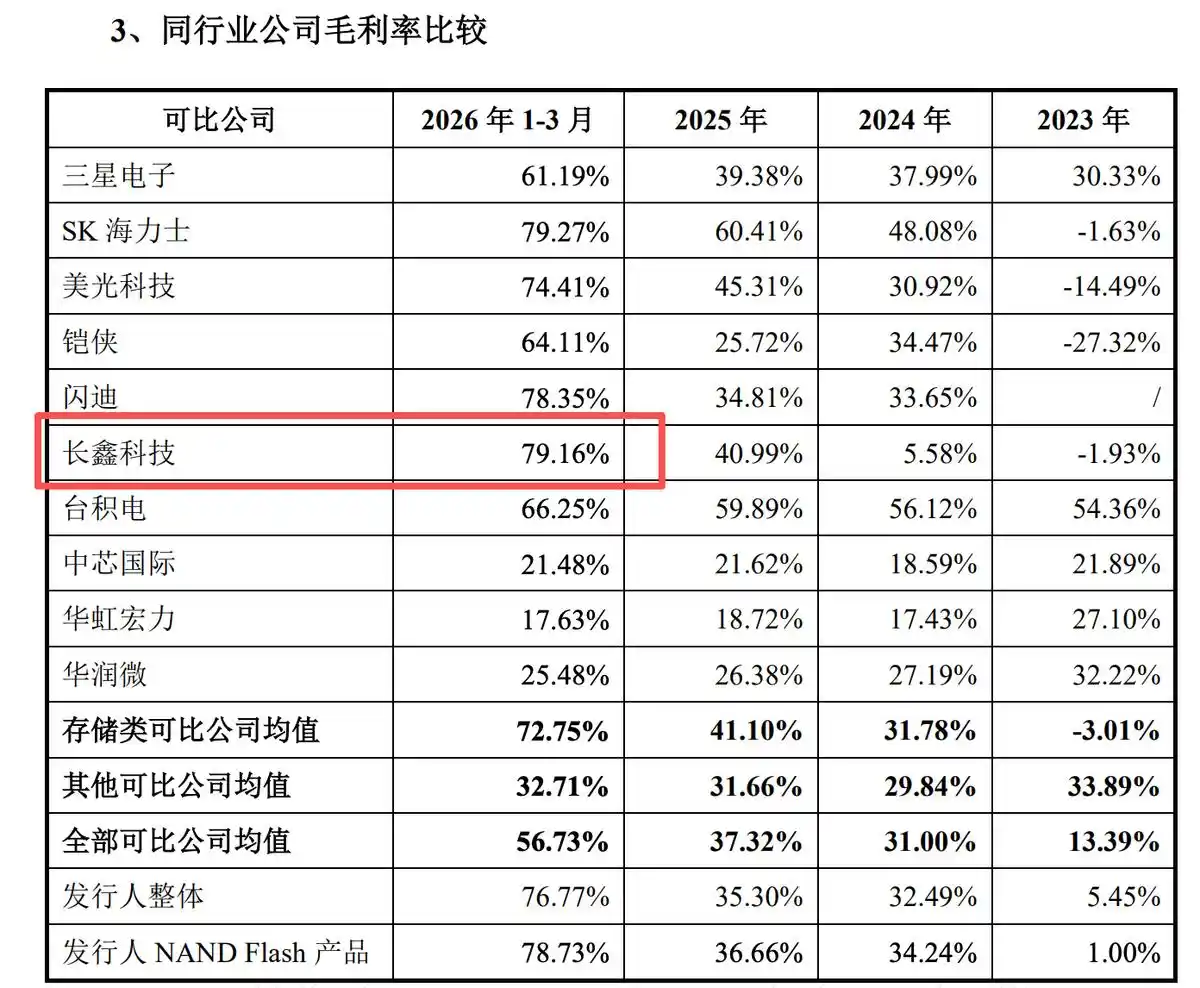
In other words, CXMT not only had higher revenue but also a higher gross margin, resulting in a gross profit approximately 4.1 billion yuan higher than YMTC's.
However, when it comes to net profit attributable to the parent's shareholders, YMTC instead leads CXMT by 8.6 billion yuan.
From being 4.1 billion yuan behind to leading by 8.6 billion yuan, a gap of approximately 12.7 billion yuan has appeared between the two companies from gross profit to net profit attributable to the parent's shareholders.
How exactly did this 12.7 billion yuan arise?
The Real Gap Comes from 8.2 Billion in Minority Shareholder Gains/Losses
Looking from gross profit downwards, YMTC did gradually close the gap.
In the first quarter of 2026, YMTC's sales, management, and R&D expenses were approximately 400 million yuan lower than CXMT's; CXMT also incurred about 1.579 billion yuan in non-recurring losses during the same period, while YMTC realized about 207 million yuan in non-recurring gains.
After adjusting for these items, YMTC's pre-tax profit was approximately 33.523 billion yuan, and CXMT's was about 35.434 billion yuan. The gap, which was about 4.1 billion yuan at the gross profit stage, has now narrowed to less than 2 billion yuan.
Income tax further leveled the playing field. YMTC's income tax expense in the first quarter was only 38 million yuan, while CXMT's reached 2.423 billion yuan.
Finally, YMTC achieved a consolidated net profit of 33.485 billion yuan, and CXMT achieved 33.012 billion yuan.
Seeing this, the previous "anomaly" has actually mostly disappeared.
Both companies earned over 33 billion yuan in a single quarter, with their consolidated net profits differing by only 474 million yuan. YMTC's overall group profitability is not 8.6 billion yuan higher than CXMT's.
The truly huge difference appears in the final step—how much of these profits actually belong to the parent company's shareholders.
Out of YMTC's 33.485 billion yuan consolidated net profit, 33.379 billion yuan was attributable to the parent company's shareholders, with minority shareholder gains/losses being only 106 million yuan.
CXMT is completely different. CXMT's first-quarter consolidated net profit was 33.012 billion yuan, almost the same as YMTC's, but only 24.762 billion yuan was attributable to the parent's shareholders, with the remaining 8.249 billion yuan belonging to minority shareholders.
Both earned over 33 billion yuan, but YMTC kept almost all of it for the parent company's shareholders, while a quarter of CXMT's profit did not belong to the parent company's shareholders.
The difference in minority shareholder gains/losses between the two companies is 8.143 billion yuan, which is the main reason why the net profit attributable to the parent's shareholders ultimately differs by 8.617 billion yuan.
Why does almost all the money YMTC makes belong to the parent company's shareholders, while a quarter of CXMT's belongs to minority shareholders?
The answer lies in the equity structure of the two companies' core production assets.
How Core Assets Are Packaged Determines Who Gets the Profits
The prospectus shows that Yangtze Memory Technologies Co., Ltd. is YMTC's most core operating entity, undertaking the group's main production, sales, procurement, and R&D functions. Its revenue in the most recent year accounted for over 90% of YMTC's consolidated revenue.
More importantly, YMTC directly holds 100% equity in Yangtze Memory Technologies Co., Ltd.
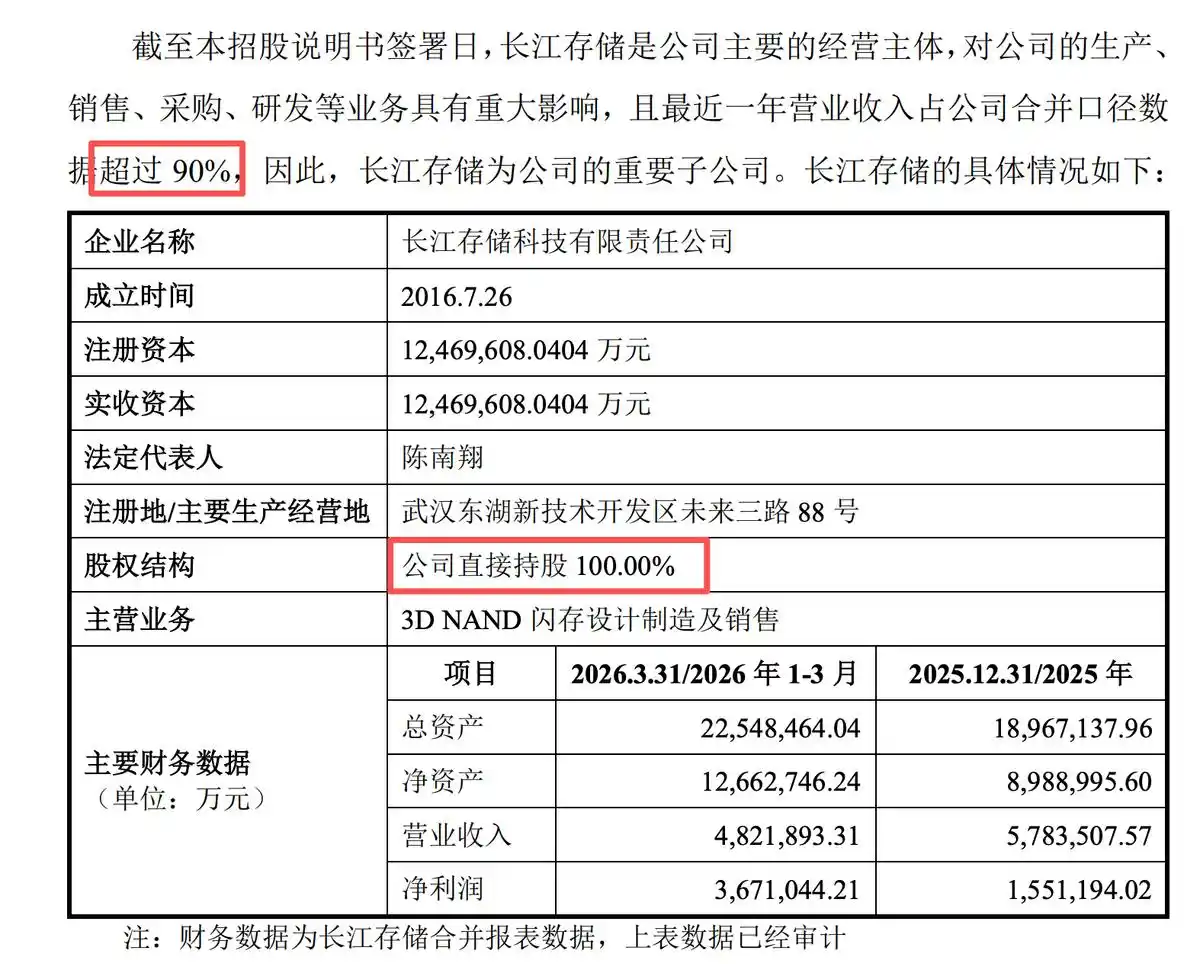
This means that YMTC's most core 3D NAND design, manufacturing, and sales assets are fully integrated under the proposed listed entity. The profits earned by the core subsidiaries can largely be attributed to YMTC's shareholders.
Subsidiaries under Yangtze Memory, such as YMTC Shanghai, YMTC Beijing, YMTC Hong Kong, YMTC USA, and YMTC Japan, which handle R&D, sales, and overseas business, also largely adopt a wholly-owned equity structure.
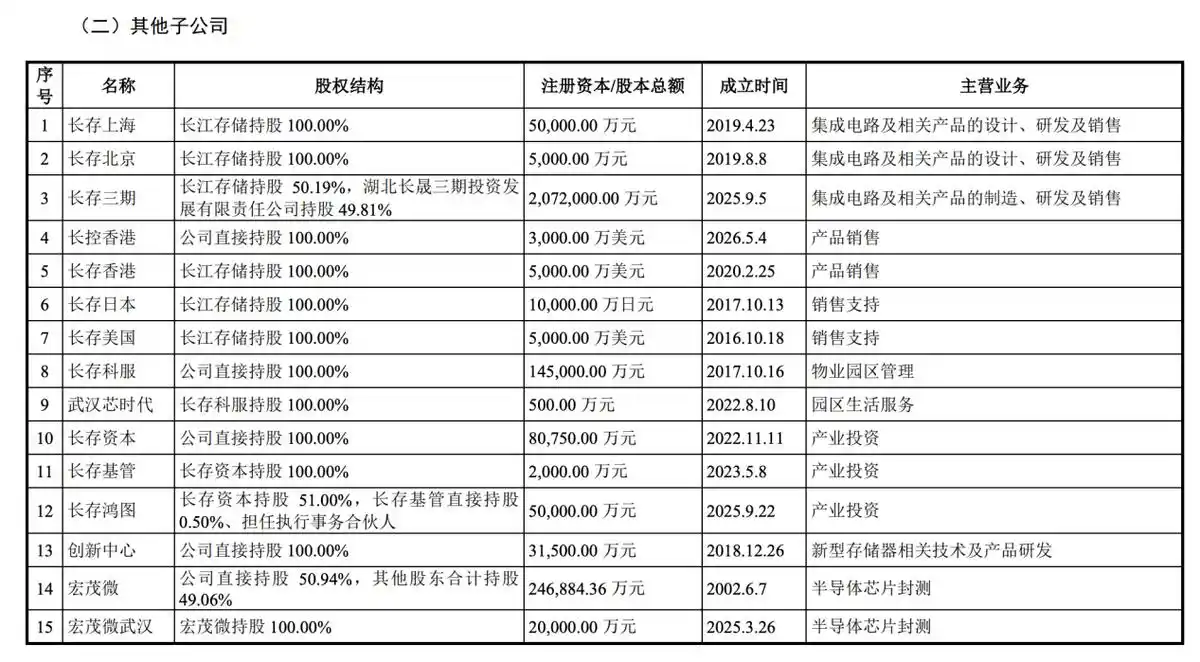
Although YMTC also has non-wholly-owned subsidiaries like YMTC Phase III and Hongmao Micro, they currently have a limited impact on overall profits. This is also why YMTC's minority shareholder gains/losses were only 106 million yuan in the first quarter of 2026.
CXMT, on the other hand, adopts a different model.
The CXMT system holds an economic interest of approximately 30.68% in CXIN Qiao but controls 73.01% of the voting rights through a concerted action arrangement; CXMT directly holds 31.72% equity in CXMT Jidian and controls 75.32% of the voting rights through a concerted action arrangement.
In simple terms, CXMT can control these core production entities, so it can include all their revenue and profits in its consolidated financial statements; however, CXMT does not own all the economic interests of these companies, so it cannot count all the money earned as its own net profit attributable to the parent's shareholders.
CXMT's model allows it to leverage external funds to share the enormous capital expenditures of wafer fabs, but the trade-off is that future profits from the projects also need to be shared with other shareholders; under YMTC's model, profits generated by core businesses can be more fully attributed to the listed company's shareholders.
This is precisely the root cause of the apparent "inversion of revenue and profit" between YMTC and CXMT.
From a group perspective, both companies actually earned over 33 billion yuan in the first quarter of 2026; but after allocation through different equity structures, YMTC retained 33.379 billion yuan in net profit attributable to the parent's shareholders, while CXMT retained only 24.762 billion yuan.
For investors after the IPO, this difference is not just a numbers game in accounting statements.
Net profit attributable to the parent's shareholders directly relates to the listed company's EPS, ROE, and the market's commonly used P/E valuation. For the same 10 billion yuan profit created, if nearly 10 billion yuan belongs to the listed company's shareholders versus only 7.5 billion yuan, the ultimate shareholder returns are obviously different.
Valuation Depends More on Industry Space, Not Just Profit
However, when further comparing the post-IPO valuation potential of YMTC and CXMT, merely comparing net profit attributable to the parent's shareholders is insufficient.
On June 25, the Hurun Research Institute released the "2026 Global Unicorn List" (Global Unicorn Index 2026), with the valuation calculation cutoff date being January 1, 2026. At that time, CXMT ranked 28th with a valuation of 197 billion yuan, while Yangtze Memory Technologies ranked 32nd with a valuation of 150 billion yuan.
A research report released by Guosheng Securities in May showed that the market predicted YMTC's IPO valuation to be around 300 billion yuan. Before CXMT's listing, the institutional consensus for a "reasonable market cap range" was 2 trillion to 3 trillion yuan.
Why does YMTC, with higher net profit attributable to the parent's shareholders, have a lower valuation than CXMT?
For CXMT, the DRAM market it focuses on inherently has a larger market size, and the rapid growth of AI servers has brought new incremental space for HBM. The market's judgment of its growth space depends not only on how much money its existing DRAM business can make but also on whether it can enter the faster-growing, higher-value HBM market.
YMTC faces a different set of questions.
The overall NAND market size is relatively limited. Under the constraint of the total market pie, the space that can be opened up solely by increasing market share ultimately has an upper limit. Therefore, aside from continuing to increase its NAND market share, whether YMTC's future valuation can further expand largely depends on whether it can improve its product mix through high-value products like enterprise-grade SSDs and enhance product value and profitability beyond single-chip values.
YMTC's first-quarter net profit attributable to the parent's shareholders of 33.379 billion yuan is undoubtedly impressive, but it is only the starting point.
The market ultimately needs to answer two different questions: Can CXMT fulfill the growth expectations brought by HBM, and can YMTC open up new growth space through product structure upgrades under the scale constraints of the NAND market?
This article is from the WeChat public account "Pai Cai Jing Guan Wei" (ID: paicj314), author: Wang Zheping