Author: Ba Xiaoling, Wu Xiaobo Channel
"Hoping to recreate the grand scene of WeChat red envelopes back in the day." With one sentence from Ma Huateng, the atmosphere in the entire domestic large model industry became tense and confrontational again.
The day before, Tencent Yuanbao announced that starting February 1st, it would distribute 1 billion CNY in Spring Festival cash red envelopes through the Yuanbao APP.
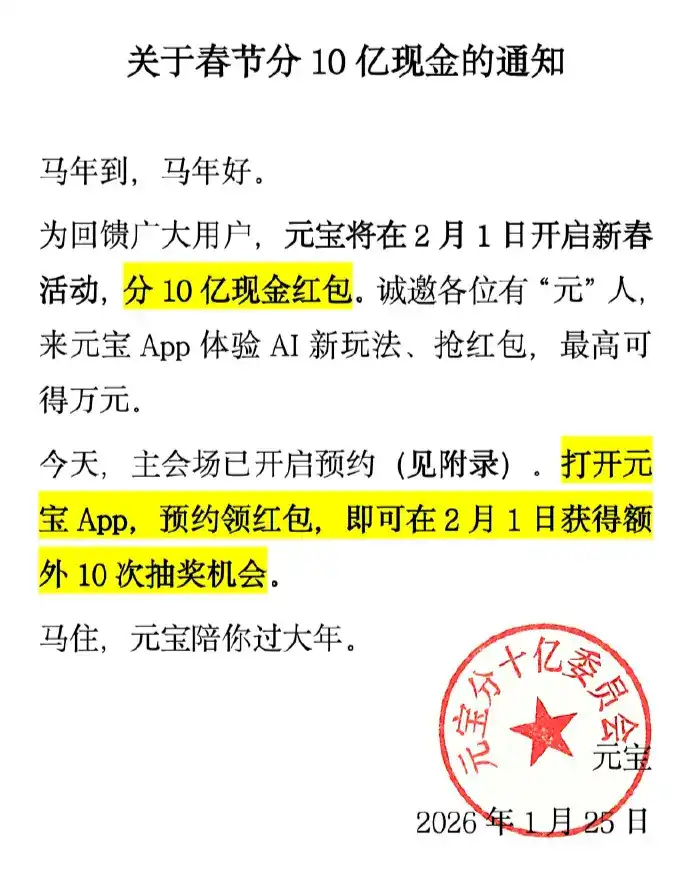
Image source: Internet
Competitors had to be on guard. That legendary red envelope shower from WeChat, which was recorded in the history of Chinese internet business wars, was described by Jack Ma as a "sneak attack on Pearl Harbor." In 2015, WeChat Pay partnered exclusively with the Spring Festival Gala, giving out 500 million CNY in WeChat red envelopes. That single night, WeChat garnered 11 billion "shake" interactions, bound over 100 million bank cards, and in just this one battle, forcefully seized half of the online payment market share from Alipay.
Also starting from this year, "Big Tech Red Envelope Wars" began to become part of the Chinese Spring Festival Gala memory. From Alipay to Douyin and Kuaishou, then to Taobao, JD.com, and Pinduoduo, it seems any internet giant worth its salt must have made an appearance at the Spring Festival Gala. The red envelope shower during the Gala also grew from the initial 500 million CNY to last year's 3 billion CNY.
Thus, this became the most anticipated segment of the Spring Festival Gala: which big tech company will give out red envelopes this year.
This year, the giants are once again standing at the same starting line, splashing cash and flying all sorts of marketing activities. When Ma Huateng steps up to "give red envelopes," can other big tech companies catch them?
Internet Giants Launch AI Red Envelope War
On the same day Yuanbao announced its lavish 1 billion CNY giveaway, Baidu also officially announced it would scatter 500 million CNY in Year of the Horse red envelopes and would cooperate with Beijing Television for the Spring Festival Gala.
ByteDance had already tied up with CCTV's Spring Festival Gala a month earlier, using its B2B AI cloud service platform, Volcano Engine, as the exclusive AI cloud partner for the 2026 Spring Festival Gala, while Doubao will配合上线各种互动玩法 (cooperate to launch various interactive features).
Although the official sponsorship amount was not disclosed, there are some reference figures: In 2020, Kuaishou's exclusive cooperation price with CCTV's Spring Festival Gala was 1.3-1.4 billion CNY, with an overall marketing package of about 2 billion CNY. In 2021, Douyin's exclusive cooperation price with CCTV's Spring Festival Gala was around 1 billion CNY, and additionally, on New Year's Eve, it distributed a total of 1.2 billion CNY in cash red envelopes.
Throughout 2025, compared to Tencent and Alibaba, ByteDance's marketing investment in Doubao could be considered "frugal." Some media analysis suggests this Spring Festival Gala sponsorship is likely ByteDance's largest AI brand marketing investment for the entire year.
Alibaba's response posture is to integrate the Alibaba ecosystem of applications, turning the Qianwen APP into a super traffic入口 (entry point) fully connected to shopping, navigation, travel, and a series of other functions, using incentives like food delivery red envelopes for user acquisition. Prior to this, Qianwen also secured the exclusive总冠名 (title sponsorship) of the Bilibili New Year's Eve Gala.
In the view of资深科技自媒体人 (veteran tech we-media personality) Zhuang Minghao, this year's red envelope war also sends an important signal: AI competition is expanding from pure model capability to application and入口 (entry point) competition.
And even before this, the smoke of battle had already filled手机屏幕 (mobile phone screens).
Throughout 2025, the big tech AI arms race was fought from every angle. For example, the talent war: Tencent high-profile hired 27-year-old former OpenAI researcher Yao Shunyu, concurrently serving as head of both the AI Infra department and the large language model department.
Another example is the hardware offense and defense war. Last December, ByteDance suddenly launched a "Doubao Phone," an action that directly切入 (cut into) the underlying mobile phone operating system, triggering joint boycotts from major software manufacturers. After the cold reception, ByteDance turned around and launched AI earphones and an AI "Recording Bean" equipped with Doubao.
On the other side, Alibaba launched the Quark AI glasses equipped with Qianwen, once承包 (monopolizing) the advertising space on the large screens in the passages of Hangzhou's highest traffic subway stations.
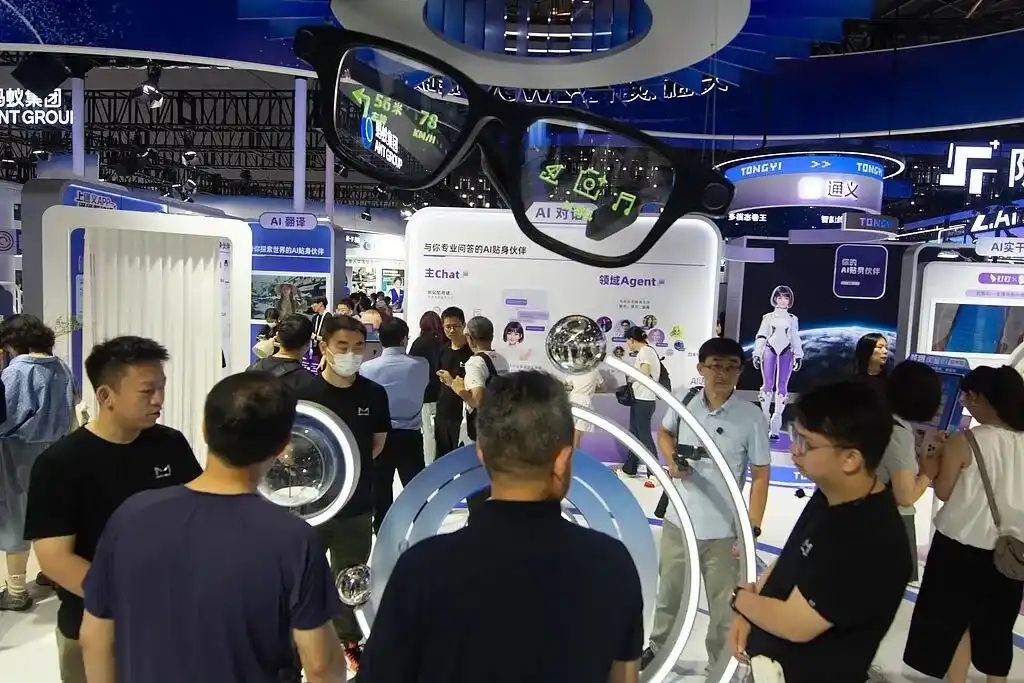
2025 World Artificial Intelligence Conference, Quark Smart AI Glasses
The most direct is the marketing war. According to a DataEye Research Institute report, in December 2025, in the native AI market, the top five in terms of投放素材量 (volume of advertising materials投放) were依次 (in order) Alibaba Qianwen, Yuanbao, Ant Afu, Doubao, and AI Douyin, accounting for 96% of the monthly投放素材量 in the mainland market.
Perhaps because the budgets were too large and the tasks too heavy, the最终出圈的姿态 (final姿态 that broke through the circle) were also varied and strange. For example, Yuanbao, wanting to conquer the下沉市场 (lower-tier market), went to rural areas to paint slogans on walls, "Difficult postpartum care for sows? Ask Tencent Yuanbao."
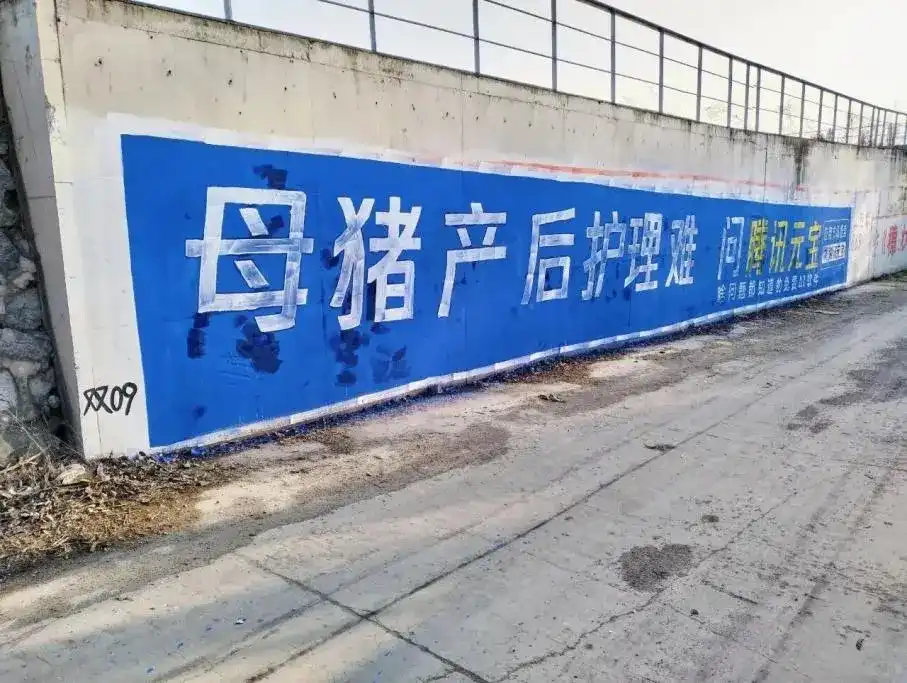
Image source: Internet
The most震撼 (stunning) is still the capital war. ByteDance's estimated capital expenditure for 2025 was nearly 160 billion CNY. Recently, overseas institutions reported that ByteDance has raised its 2026 capital expenditure target from 160-180 billion CNY to 300 billion CNY.
Alibaba announced at the beginning of 2025 a plan to invest 380 billion CNY in AI construction over the next three years,刷新 (refreshing) the AI spending record for domestic companies. At the end of the year, it又表示 (further stated), "this number might be conservative."
Ma Huateng, who did not disclose specific figures, also said at Tencent's annual meeting: "In 2025, Tencent played it safe and steady, the only area where we spent relatively more on investment was AI." According to institutional predictions, Tencent's AI capital expenditure in 2025 was close to 100 billion CNY.
"In a word, 2025 was a year of 'certainty.' The value and capability of AI were fully confirmed. Giants saw the situation clearly and went 'ALL IN' with full force; AI became usable, while疯狂基建 (frantic infrastructure building) occurred." Hu Yanping, a specially appointed professor at Shanghai University of Finance and Economics, summarized it this way.
And 2026 is the year of "decisiveness."
The Warring States Era of AI
AI industry investor Gao Zhendong compares the current landscape of large model competition to the Warring States era. Each company has its own strengths, and it's hard to distinguish superiority.
Hu Yanping believes that in terms of the overall commercialization picture, domestic AI currently presents a "(3+1)+5+N" pattern.
Among them, "3+1" refers to ByteDance, Alibaba, Tencent, plus Baidu; "5" refers to DeepSeek and the former "Six Little Tigers of Large Models" – Kimi, Zhipu, MiniMax, Step星辰 (Step Star), etc.; "N" refers to other AI enterprises focusing on vertical models and specialized markets.
But with the giants entering with heavy investments, under the spotlight, three "states" stand out in this Warring States struggle.
Gao Zhendong believes ByteDance is similar to the State of Chu:拥有最广的疆域 (having the vastest territory), the thickest foundation, vast land and abundant resources, a latecomer who arrived first, possessing流量母矿 (traffic motherlodes) like Douyin and TikTok.
Tencent is like the State of Qi:富甲天下 (the wealthiest under heaven), sitting on the profits of fishing and salt. It possesses the WeChat "social moat" and ample cash flow. It only needs to guard the social入口 (entry point) and can influence the entire situation with capital and traffic.
Alibaba is more like the State of Wei:率先变法 (the first to enact reforms), profound底蕴 (heritage), talent济济 (abundant talent), possessing强大的组织能力 (strong organizational capabilities). As the pioneer of Chinese cloud computing, Alibaba has打通 (opened up) the entire AI industry chain from chips to the cloud, from models to applications, top to bottom.
The three giants have thus extended their respective strategies.
Alibaba fights an生态战 (ecosystem war). Relying on its application ecosystem, the Qianwen APP is advancing towards becoming a "super app" covering all scenarios of eating, drinking, living, and traveling. It can now achieve ordering takeout, booking flights and hotels, and checking navigation in one stop.
ByteDance relies on short video scenarios, excelling more in AI creation and entertainment-oriented content. Besides the general product Doubao, ByteDance also has the AI creation tool Jimeng AI, which can generate videos, comic dramas, e-commerce pages, advertisements, etc.
Tencent continues to tightly grasp the social入口 (entry point). In the second half of 2025, Tencent Yuanbao successively integrated with Tencent Meeting and QQ, and recently launched the AI social-focused "Yuanbao Pai," which is essentially adding Yuanbao to group chats and supports inviting WeChat friends to join.
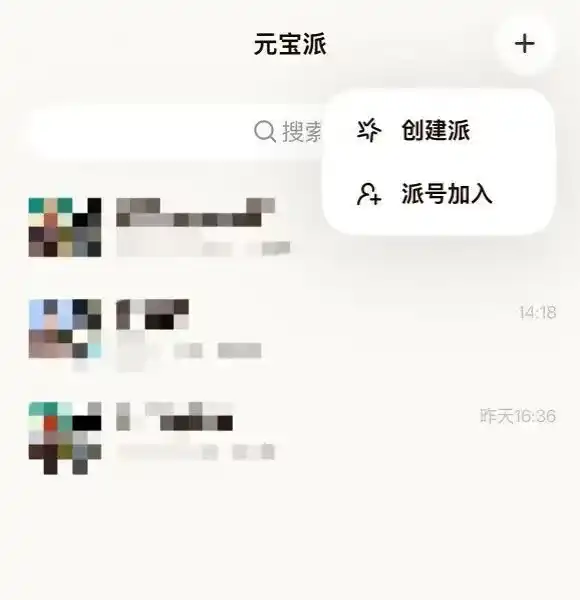
Image source: Internet
Beyond the giants displaying their prowess, the market cake left for other competitors seems to be getting smaller.
In Gao Zhendong's view, those that can still be called hegemons alongside the three giants are Baidu and DeepSeek. Baidu is like the State of Zhao in the Warring States, making massive investments in autonomous driving and base large models, with a solid technical foundation—a military power; DeepSeek, although its data and computing power scale cannot match the big factories, its computing efficiency is already on par with the latest models from Google and OpenAI, resembling the State of Han in the Warring States era, with sophisticated weaponry and good at "术"治 (governance by tactics/methods).
More small and medium-sized enterprises are seeking new paths of differentiation. For example, among the "Six Little Tigers of Large Models" that were hugely popular in 2024, Baichuan Intelligence, founded by Sogou founder Wang Xiaochuan, and 01.AI, founded by Kai-Fu Lee, have先后放弃 (successively abandoned) training base large models, turning to industry-level AI applications in healthcare and law; Zhipu AI and MiniMax landed on the Hong Kong stock market in early 2026, pinning their hopes on capital market funds to support subsequent R&D and market investment.
In the view of digital economy scholar Liu Xingliang, second and third-tier models still have space for deep application in细分场景 (segmented scenarios) like education, healthcare, and enterprises, but in the competition for mass入口 (entry points) and traffic, it may already be difficult to compete head-on with the giants.
Zhuang Minghao values "全栈能力" (full-stack capability): The AI competition at the current point is no longer单纯 (purely) model competition, but extends from the cloud to the model to the application, and even needs to expand to chips and hardware.
Hu Yanping uses four dimensions to observe the subsequent competitive situation:
◎ First, technical progress, where coding ability becomes an important central capability.
◎ Second, capital investment. Big factories are multiplying their AI capital expenditures, while slightly smaller leading startups, if they do not have cash reserves and investments of more than 5 billion CNY in 2026, will find it difficult to remain in the second tier.
◎ Third, user base. Either possess a traffic大盘 (large traffic pool) of billions of users, or form alliance cooperation with生态企业 (ecosystem companies) with hundreds of millions of users, otherwise market expansion costs (市场拓展成本) will be extremely high, affecting monetization capabilities.
◎ Fourth, expand monetization channels, quickly forming revenue sources of tens of billions of CNY from AI e-commerce, advertising marketing, enterprise application solutions, API Token, etc., because the Chinese market is an ecosystem where services are often free, and relying solely on subscriptions can hardly support sustainable development.
Therefore, also as Liu Xingliang's view, although the tripod鼎立 (tripod standing stable) seems stable in the short term, the competitive landscape is still full of variables in the future, influenced by technological innovation, outbreaks in vertical细分赛道 (segmented tracks), policy guidance, etc.

App download page in手机应用商店 (mobile app store)
Winner Undecided
The internet industry is no stranger to giant wars.
From the "Group Buying Wars," "Online Payment Wars," "Hundred-Model Wars" to the "Food Delivery Wars," every round of technological or business model innovation is a money-burning war, but these wars ultimately have more losses than wins, and the winners often change unpredictably.
The current battlefield is like the mid-Warring States period, with诸侯并起 (vassals rising together),霸权更替 (hegemony changing hands),改制与变法不断 (reforms and transformations constant), but a new order has yet to be established.
In other words, whether giants or small factories, although their tactics and situations differ, one point is格外一致 (particularly consistent): they have not yet found effective business models and are all operating at huge losses.
In Liu Xingliang's view, the current large model war still relies on the打法 (playbook) of "subsidies + traffic入口" to seize users, which helps educate the market in the early stages but is difficult to profit from in the long run. Real profitability still requires forming stable revenue sources such as paid subscriptions, AI solutions for enterprise customers, and industry定制服务 (customized services).
Also, as Zhuang Minghao said: "The current competition容不得 (does not allow for) consideration of the so-called sustainability of the money-burning model; it's a prisoner's dilemma."
However, the fact that the new order has not yet been established also means that the real winner is still悬念 (in suspense) and perhaps has not even appeared yet.
Hu Yanping believes that in the next stage, whether big factories, mid-stream enterprises, or "little dragons" and "little tigers," all have opportunities. In the short to medium term, having multiple enterprises participate in competition is a good thing, beneficial for industry development and able to provide consumers with diverse choices.
He also judges that the inflection point for AI monetization is即将到来 (approaching). From the close combat of technology and products to the stalemate of marketing competition, it all means that 2026 will become the "first year of AI value harvest." This year, domestic AI will welcome three major changes: big technical investment, big competitive differentiation, and big market分流 (diversion/shift).
It can be predicted that before the outcome of the battle is settled, red envelope showers will continue to fall in various forms. And the answer to this great war might be hidden in your hand: whose red envelope did you catch?