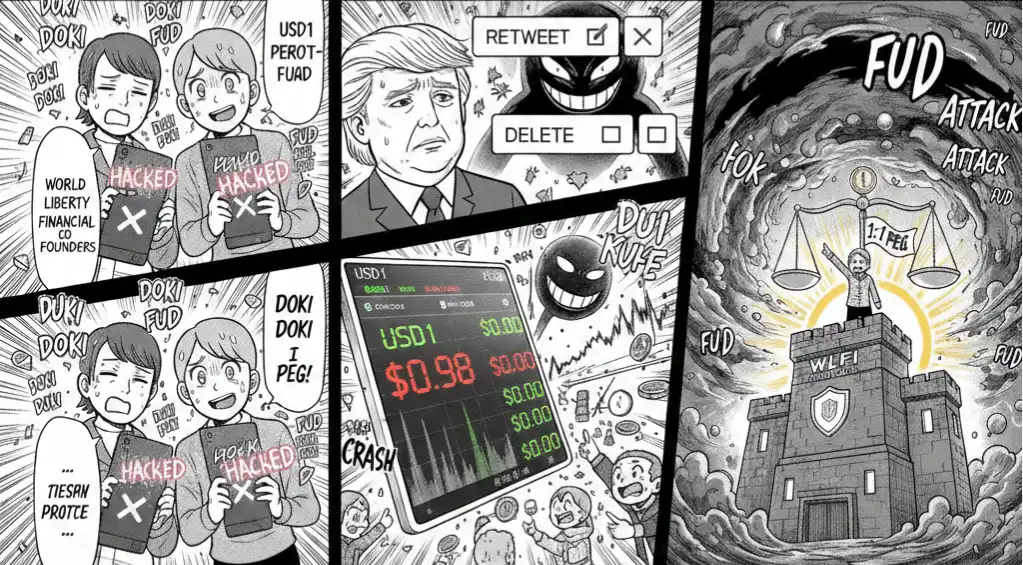
When 'Stability' Begins to Fluctuate: A Complete Review and Structural Analysis of the USD1 Depegging Incident

marsbitXuất bản vào 2026-02-25Cập nhật gần nhất vào 2026-02-25

Tóm tắt

USD1, a stablecoin issued by World Liberty Financial (WLFI), experienced a brief depegging event on February 23, with its secondary market price dropping to around $0.98. WLFI attributed the incident to a "coordinated attack," claiming reserves and redemption mechanisms remained unaffected, and the price quickly recovered. The event raised questions about whether the depegging was a liquidity issue or a solvency crisis. Unlike TerraUSD's algorithmic collapse in 2022, USD1’s price dip appeared more related to temporary market liquidity stress rather than fundamental reserve failures. However, the incident highlighted that stablecoin stability relies not only on assets but also on market trust. USD1 operates under a centralized reserve model, where risks involve reserve transparency, asset liquidity, and market depth. In a low-liquidity, risk-averse market environment, even minor instability can trigger concerns about collateral devaluation, liquidations, and broader financial contraction. While the rapid price recovery suggests no systemic solvency issue, the event underscores how stablecoin depegging—even if temporary—can amplify market anxiety, reduce leverage, and increase funding costs. Trust, once questioned, takes time to restore, and credit repricing often precedes price changes in stressed markets.

Author: 137Labs

On February 23, a stablecoin named USD1 suddenly showed a significant discount in the secondary market.

On-chain quotes once fell to around 0.98 USDT, and social media quickly amplified the news.
The project team, World Liberty Financial (WLFI), subsequently stated publicly that this was a "coordinated attack" and emphasized that the reserve and redemption mechanisms were unaffected.

The price then recovered.

But the problem had already emerged——

When a "stablecoin" begins to trade at a discount, is it merely a liquidity friction, or a precursor to a crack in the credit structure?

I. Timeline: From the Wicking to the "Attack" Narrative

Based on reports from CoinDesk, The Block, Decrypt, WuBlockchain, PANews, ChainCatcher, and others, the sequence of events is roughly as follows:

1️⃣ Abnormal Volatility in the Secondary Market

  • USD1 quickly fell to around 0.98 in some trading pairs

  • The discount lasted for a short time

  • The price subsequently recovered

Unlike the brief depegging of USD Coin in 2023 due to banking risks, no clear systemic banking shock occurred this time.

2️⃣ WLFI's Official Response

WLFI stated externally:

  • This was an organized short attack coupled with a public opinion coordination attack

  • Reserve assets showed no abnormalities

  • Redemption function is normal

  • The 1:1 peg structure remains unchanged

This explanation was subsequently reported by Chinese media including WuBlockchain and ChainCatcher.

3️⃣ Social Media Amplification Effect

The event spread rapidly on platform X.

Some related tweets were deleted, fueling further market speculation.
In the current emotionally charged market environment, "deletion behavior" is often interpreted as a signal, not a random operation.

Thus, the question shifted from "Is the price depegged?" to:

  • Is there a reserve risk?

  • Is there a concentrated bank run?

  • Is there insufficient information disclosure?

II. The Nature of Depegging: A Liquidity Problem or a Solvency Problem?

Judging a stablecoin depegging event hinges on distinguishing between two completely different risk structures.

The first is a liquidity shock.
In this case, reserves are still sufficient, the redemption mechanism remains unimpeded, but due to insufficient trading depth, market maker withdrawal, or concentrated selling pressure, the secondary market experiences a brief imbalance. Once the arbitrage mechanism kicks in, the price usually recovers quickly.

The second is a solvency crisis.
If the reserve assets themselves are problematic, or if the assets suffer from maturity mismatches and cannot be liquidated immediately, then the depegging is no longer a trading-level fluctuation but a repricing of the balance sheet. In this case, the discount often widens persistently, accompanied by redemption delays or a collapse in trust.

Based on the information disclosed so far, USD1 is closer to the former.

It is completely different from the algorithmic death spiral of TerraUSD (UST) in 2022. UST's collapse stemmed from mechanism failure, while USD1's wicking更像 (more like) a liquidity tilt within a short period.

But even so, this event still holds significance.

Because the true anchor of a stablecoin is not just the reserve assets, but market trust.

Once trust is questioned, the price reacts ahead of the fundamentals.

III. The Credit Structure of Stablecoins: Where Exactly is Their "Stability"?

Stablecoins are essentially the "base money" of the crypto market.

Their credit support generally comes from three models:

  1. Algorithmic

  2. Collateralized

  3. Centrally Custodied Reserve-backed

USD1 belongs to a more centralized reserve structure.

The risk of this model lies not in the algorithm, but in:

  • Reserve Transparency

  • Asset Liquidity

  • Maturity Structure

  • Market Making Depth

Once the market suspects that reserves are discounted or face liquidation risks, the price often falls first.
This is highly similar to a "shadow bank run" in traditional finance—as soon as depositors start to doubt, the act of withdrawal itself amplifies the risk.

IV. Why Was the Market Reaction Particularly Sensitive This Time?

The fear index was already at an extreme low that day.

In an environment where liquidity was already tight:

  • Leverage levels decreased

  • Risk appetite weakened

  • The market became highly sensitive to uncertainty

Stablecoins are not just trading tools; they are the cornerstone of lending and liquidity.

Once a discount appears, the chain reaction may include:

  • Decrease in collateral ratios

  • Triggering of liquidations

  • Further compression of leverage

  • Capital outflow from the market

Therefore, even though the price recovered quickly, the psychological shock did not disappear simultaneously.

V. Is the "Attack" Narrative Valid?

WLFI attributed this volatility to a "coordinated attack".

Short attacks and public opinion resonance are not uncommon in the crypto market.
When trading depth is insufficient and market sentiment is fragile, prices are easily subject to amplified volatility.

But whether an attack can be sustained depends on one core factor:

Does the market believe the reserves are real, redeemable, and sustainable?

If the reserve structure is transparent and redemptions remain smooth, attacks often find it difficult to be effective in the long term;
If reserve disclosure is insufficient, panic is more easily self-reinforcing.

VI. The Differences Between USD1, USDC, USDT, and the True Meaning of This Depegging

Historically, USDC fell to $0.88 in 2023 due to banking risks; its problem stemmed from exposure to custodian bank risks and limitations on the pace of reserve liquidation.

Meanwhile, Tether has experienced minor depegging multiple times, usually during extreme panic phases or under concentrated withdrawal pressure, but the key to its eventual recovery lies in the continuous availability of the redemption mechanism and the verification of reserve redemption capability.

USD1 currently seems to be in the midst of a "trust stress test".

This event is closer to a liquidity shock than a solvency crisis.
The rapid price recovery indicates that a systemic bank run has not yet formed.

But what is truly worth paying attention to is not that single price of 0.98, but whether the market has begun to reassess the risk premium of "stability".

Stablecoins are the monetary base of the crypto market.

When the market questions their safety, the impact transmits outward along the credit chain:

  • Leverage decreases

  • Lending contracts

  • Collateral assets are repriced

  • Capital flows back to mainstream assets or exits the market

Even if the event itself is just short-term volatility, it will increase the cost of future financing and liquidity.

Depegging is never just a price problem; it is a credit pricing problem.

The price can recover quickly,
but trust takes time to repair.

USD1's depegging may not necessarily evolve into a systemic risk,
but it reminds the market——

During periods of liquidity contraction,
credit always changes before the price.

And once credit begins to be revalued,
the entire risk structure也随之 (also随之 -也随之) changes accordingly.


Câu hỏi Liên quan

QWhat was the main event described in the article regarding the USD1 stablecoin?

AOn February 23rd, the USD1 stablecoin experienced a significant discount, with its price dropping to approximately 0.98 USDT on secondary markets.

QHow did the issuer, World Liberty Financial (WLFI), characterize the price drop of USD1?

AWLFI characterized the event as a 'coordinated attack,' stating that the reserve and redemption mechanisms were unaffected and the 1:1 peg structure remained intact.

QWhat is the fundamental difference between a liquidity shock and a solvency crisis for a stablecoin, as explained in the article?

AA liquidity shock involves sufficient reserves and a functioning redemption mechanism, with the price drop caused by temporary market imbalances like insufficient trading depth. A solvency crisis involves problems with the reserve assets themselves, where the de-pegging is a repricing of the balance sheet due to issues like asset quality or maturity mismatches.

QAccording to the article, what are the key risk factors for a centralized reserve-backed stablecoin like USD1?

AThe key risk factors are reserve transparency, asset liquidity, maturity structure, and market-making depth.

QWhat broader market implication does the article suggest from the USD1 de-pegging event, even if it was temporary?

AThe event suggests that market trust, the true anchor of a stablecoin, can be shaken. This can lead to a re-evaluation of risk premiums, resulting in decreased leverage, contracted lending, repricing of collateral assets, and potential capital outflows, thereby increasing future financing and liquidity costs.

Nội dung Liên quan

Đối thoại với Ray Dalio: Chúng ta đang ở trong bong bóng AI, 1% danh mục đầu tư của tôi là Bitcoin

Ray Dalio, người sáng lập Bridgewater Associates, trong một cuộc phỏng vấn đã chỉ ra rằng thế giới hiện tại đang trong một "AI bubble" (bong bóng AI) cổ điển, với giá tài sản tăng vọt và đầu cơ quá mức. Ông cảnh báo bong bóng có thể vỡ do lãi suất tăng, nguồn cung cổ phiếu dư thừa hoặc khi nhà đầu tư cần tiền mặt trả nợ, dẫn đến suy thoái kinh tế. Đồng thời, Dalio mô tả một "chu kỳ lớn" kéo dài khoảng 80 năm, bao gồm ba động lực chồng chéo: khoảng cách giàu nghèo và xung đột nội bộ, thâm hụt ngân sách chính phủ khổng lồ và thay đổi địa chính trị. Ông nhấn mạnh rằng Mỹ và Anh đang đối mặt với những thách thức trong giai đoạn suy yếu này. Để bảo vệ của cải, Dalio khuyến nghị đa dạng hóa danh mục đầu tư với cổ phiếu, vàng, trái phiếu, bất động sản thay vì chỉ giữ tiền mặt. Ông tiết lộ khoảng 1% danh mục của mình là Bitcoin, nhưng vẫn ưa chuộng vàng vật chất hơn do tính ổn định và vai trò tiền tệ dự trữ. Về tác động của AI, Dalio cho rằng nó không chỉ thay thế lao động chân tay mà còn cả tư duy, làm trầm trọng thêm bất bình đẳng thu nhập. Con người cần phát huy trí tuệ cảm xúc và trực giác - những thứ AI chưa có - và học cách hợp tác với AI. Cuối cùng, ông phân tích những rủi ro của thuế tài sản và xu hướng thế giới có thể trở nên "khu vực hóa" hơn, với các khối như châu Mỹ và châu Á - Thái Bình Dương, trong bối cảnh sự thống trị toàn cầu của Mỹ đang suy yếu.

marsbit1 giờ trước

Đối thoại với Ray Dalio: Chúng ta đang ở trong bong bóng AI, 1% danh mục đầu tư của tôi là Bitcoin

marsbit1 giờ trước

Hơn 7.2 nghìn tỷ won trong một ngày, ngoại hải nước ngoài mua ròng kỷ lục vào thứ Sáu! Phố Wall: Cơn gió ngược về mặt vốn của thị trường chứng khoán Hàn Quốc đã tan biến

Dòng vốn nước ngoài đổ mạnh vào thị trường chứng khoán Hàn Quốc (KOSPI) với mức mua ròng kỷ lục 7,2 nghìn tỷ won chỉ trong ngày 31/7, đánh dấu sự đảo chiều rõ rệt sau nhiều tháng bán ròng mạnh. Theo báo cáo từ Citigroup, áp lực bán từ dòng vốn nước ngoài đã giảm đáng kể, với mức bán ròng tháng 7 thu hẹp còn 9,8 nghìn tỷ won so với mức 48,4 và 44,5 nghìn tỷ won trong tháng 6 và tháng 5. Đồng thời, các quỹ hưu trí và quỹ đầu tư trong nước cũng chuyển sang vị thế mua ròng 1,0 nghìn tỷ won trong tháng 7. Một yếu tố hỗ trợ khác là quy định mới từ Ủy ban Dịch vụ Tài chính Hàn Quốc (FSC), có hiệu lực từ 31/7, siết chặt điều kiện đầu tư vào các ETF có đòn bẩy đối với nhà đầu tư cá nhân. Quy định này đã ngay lập tức làm giảm khoảng 50% khối lượng giao dịch của các ETF này, góp phần kỳ vọng giảm bớt biến động cho thị trường. Citigroup duy trì mục tiêu chỉ số KOSPI ở mức 10.000 điểm, dựa trên các yếu tố thuận lợi như ngành chip bán dẫn ổn định, định giá thị trường thấp, nền tảng kinh tế vững mạnh và các chính sách hỗ trợ. Họ nhận định áp lực dòng vốn ngược chiều đang giảm dần, tạo điều kiện cho các yếu tố cơ bản và chính sách tích cực phát huy tác dụng.

marsbit1 giờ trước

Hơn 7.2 nghìn tỷ won trong một ngày, ngoại hải nước ngoài mua ròng kỷ lục vào thứ Sáu! Phố Wall: Cơn gió ngược về mặt vốn của thị trường chứng khoán Hàn Quốc đã tan biến

marsbit1 giờ trước

Làm thế nào để khiến bản thân trở nên không thể bị thay thế bởi trí tuệ nhân tạo

**Tóm tắt: Làm thế nào để trở nên không thể bị thay thế bởi AI** Bài viết phản đối việc than vãn về AI và thay vào đó đề xuất một giải pháp căn cơ: trở thành một "siêu cá nhân" không thể bị thuê mướn. Mối đe dọa thực sự không phải là AI, mà là tình trạng "nô lệ lương thưởng" – phụ thuộc hoàn toàn vào người khác để sinh tồn, làm công việc nhàm chán mà không có mục đích. Để thoát khỏi vòng luẩn quẩn này và phát triển mạnh trong kỷ nguyên AI, bạn cần trau dồi 5 yếu tố then chốt: 1. **Tính tự chủ:** Khả năng hành động mà không cần chờ chỉ thị. 2. **Khiếu thẩm mỹ:** Khả năng nhận biết điều gì thực sự có giá trị. 3. **Khả năng thuyết phục:** Thu hút sự chú ý và sự công nhận. 4. **Sự kiên trì:** Không sợ thất bại, xem đó là bài học. 5. **Khả năng lặp:** Điều chỉnh dựa trên phản hồi để tiến tới mục tiêu. Giải pháp là đầu tư vào sự nghiệp của chính mình. Trong khi AI giỏi tạo ra "tài sản" (nội dung, code), nó không thể thay thế được khả năng phân biệt thứ gì đáng để tạo ra, làm cho mọi người quan tâm và kiên trì theo đuổi. Trong hai kỹ năng đòn bẩy mạnh mẽ là **Code (Lập trình)** và **Media (Nội dung)**, bài viết nhấn mạnh **Nội dung** quan trọng hơn. Giá trị của nội dung là chủ quan và đòi hỏi sự am hiểu, trải nghiệm mà AI khó có được, tạo không gian cho các cá nhân sáng tạo thực sự. **Cách bắt đầu (Bài tập 15 phút):** 1. **Khai thác nguyên liệu thô của bạn:** Xác định chủ đề bạn am hiểu sâu, vấn đề bạn tự giải quyết được, hay sở thích đặc biệt từ nhỏ. 2. **Xác định "trục phản biện" của bạn:** Tìm ra quan điểm độc đáo của bạn – những điều bạn tin là đúng nhưng số đông lại sai trong lĩnh vực của mình. 3. **Xuất bản ý tưởng đầu tiên:** Kết hợp câu trả lời từ bước 1 và 2, tạo ra một nội dung (bài đăng, video) và đăng nó lên. Hành động này mang lại phản hồi thực tế, bắt đầu quá trình học hỏi, lặp lại và phát triển kỹ năng thuyết phục. Bằng cách xây dựng một sự nghiệp xoay quanh con người thật, trải nghiệm thật và góc nhìn độc đáo của mình thông qua nội dung, bạn có thể tạo ra giá trị mà AI không thể sao chép, từ đó trở nên không thể thay thế.

marsbit3 giờ trước

Làm thế nào để khiến bản thân trở nên không thể bị thay thế bởi trí tuệ nhân tạo

marsbit3 giờ trước

Nhờ việc tung xúc xắc, chìa khóa Bitcoin được lưu trữ offline, nhưng không phải ai cũng muốn làm điều này

Cảm biến từ cuộc tranh cãi gần đây xung quanh lỗ hổng trong ví phần cứng Coldcard, bài viết thảo luận về phương pháp tạo seed (cụm từ khôi phục) cho ví Bitcoin bằng cách xúc xắc vật lý. Mỗi lần xúc xắc công bằng cung cấp khoảng 2,6 bit entropy (thước đo tính ngẫu nhiên). Để đạt mức entropy an toàn cho một seed 12 từ (128 bit), cần khoảng 50 lần xúc xắc; Coldcard khuyến nghị 99 lần để đạt mức bảo mật cao hơn. Lợi thế chính của phương pháp này là tách biệt hoàn toàn với bất kỳ lỗi phần cứng hoặc phần mềm nào trong trình tạo số ngẫu nhiên của thiết bị, từ đó bảo vệ seed chính của ví. Tuy nhiên, bài viết cảnh báo rằng trong sự cố Coldcard, các chức năng phụ khác của thiết bị (như tạo ví giấy, khóa đa chữ ký, mật mã phiên USB) vẫn có thể bị ảnh hưởng nếu chúng dựa vào trình tạo số lỗi, ngay cả khi seed chính được tạo an toàn bằng xúc xắc. Nhược điểm lớn của việc dùng xúc xắc là quá trình thủ công, dễ xảy ra sai sót, tốn thời gian và không thực tế cho đa số người dùng mới. Người dùng có thể ghi chép sai, sử dụng xúc xắc gian lận, hoặc để lộ chuỗi kết quả. Do đó, mặc dù có nền tảng toán học vững chắc, phương pháp này đòi hỏi sự tỉ mỉ cao và không phải là giải pháp khả thi cho việc áp dụng Bitcoin rộng rãi. Bài viết kết luận rằng mục tiêu dài hạn vẫn là phát triển phần cứng/phần mềm tạo số ngẫu nhiên mạnh mẽ và đáng tin cậy, trong khi vẫn giữ phương pháp thủ công như một tùy chọn cho người dùng có kinh nghiệm. Cuối cùng, bài viết đưa ra khuyến nghị cho chủ sở hữu Coldcard: cập nhật firmware, kiểm tra các chức năng phụ đã sử dụng và xem xét các biện pháp bảo mật bổ sung như ví đa chữ ký kết hợp nhiều nhà sản xuất để giảm thiểu rủi ro từ một điểm yếu đơn lẻ.

cryptonews.ru6 giờ trước

Nhờ việc tung xúc xắc, chìa khóa Bitcoin được lưu trữ offline, nhưng không phải ai cũng muốn làm điều này

cryptonews.ru6 giờ trước

Giao dịch

Giao ngay
活动图片




