When Curators Become a Risk Variable in DeFi Lending, How Can Algorithms Reshape the Market?

比推Xuất bản vào 2025-12-10Cập nhật gần nhất vào 2025-12-10

Tóm tắt

The article argues that the current "Curator" model in DeFi lending, as seen in protocols like Morpho and Euler, reintroduces human moral risk and inefficiency. It traces the evolution of lending markets, highlighting that early pooled models (e.g., Compound, Aave) sacrificed lender risk control for borrower convenience, while isolated markets (e.g., Morpho Blue) fragmented liquidity. Curator vaults attempted to bridge this gap but reintroduced trust assumptions and discretionary decision-making. The author proposes a new paradigm inspired by traditional order books: a two-tier architecture separating risk definition from order matching. In this model (exemplified by Avon), lenders deposit into isolated, parameter-defined "strategies" (retaining full risk control), while a shared order book algorithmically aggregates and routes borrower requests across compatible strategies atomically. This eliminates the need for human curators, enhances transparency, and improves liquidity utilization. The approach also benefits RWA by allowing compliance at the strategy level while pooling global liquidity. Built on high-performance chains like MegaETH, this CLOB-based system aims to automate lending coordination without sacrificing lender autonomy or borrower experience.

Original Author: @0xJaehaerys, Gelora Research

Original Compilation: EeeVee, SpecialistXBT, BlockBeats

Original Title: Lending Markets Do Not Need the Curator Model


Editor's Note: After the successive blowups of Stream Finance and USDX, the DeFi community is undergoing a painful disenchantment. The "Curator" model introduced by protocols like Morpho and Euler was originally intended to solve liquidity fragmentation but inadvertently reintroduced the moral hazard of "human" factors on-chain. The author of this article points out that current lending protocols mistakenly bundle "risk definition" with "order matching." By drawing on the order book model from traditional finance, this article constructs a new paradigm that eliminates the need for curators and relies on algorithmic automatic routing.

The Evolutionary Logic of Lending Markets

Reviewing the evolution of on-chain trading provides a reference for understanding lending market.

AMMs based on constant functions (like Uniswap) solved a fundamental problem: how to create a market without active market makers? The answer was to use an invariant function to preset the "shape" of liquidity. Liquidity providers pre-agree to a set of strategies, and the protocol handles execution automatically.

This works well in trading because trading is relatively simple: buyers and sellers meet at a price. But lending is much more complex. A loan involves multiple dimensions:

Interest rate

Collateral type

Loan-to-Value ratio (LTV)

Term (fixed vs. demand)

Liquidation mechanism

Matching a loan requires satisfying constraints across all these dimensions simultaneously.

Early DeFi lending directly adopted solutions similar to AMMs. Protocols like Compound and Aave preset interest rate curves, with lenders joining a shared pool. This allowed lending markets to function without active lenders.

But this analogy has a fatal flaw. In DEX trading, the shape of the constant function curve affects execution quality (slippage, depth); in lending, the shape of the interest rate curve directly determines risk. When all lenders share a single pool, they also share the risk of all collateral accepted by the pool. Lenders cannot express their desire to bear only specific types of risk.

In the trading space, order books solved this problem: they allow market makers to define their own "curve shape." Each market maker quotes at their preferred price, the order book aggregates these quotes into a unified market, but each market maker still controls their own risk exposure.

Can lending adopt the same approach? A project named Avon attempts to answer this question.

The Liquidity Fragmentation Problem

To give lenders control, DeFi's first attempt was market isolation.

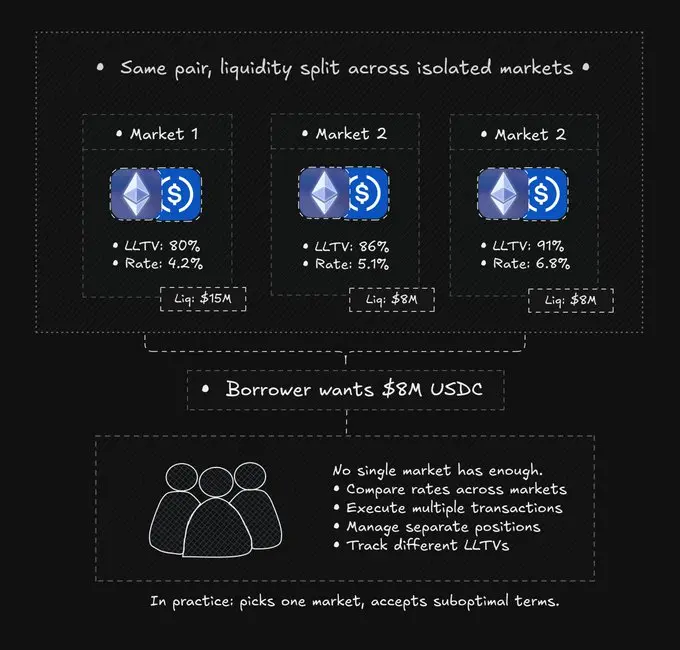
Protocols like Morpho Blue and Euler allow anyone to create lending markets with specific parameters: designated collateral, borrowed asset, fixed liquidation LTV, and interest rate curve. Lenders deposit into markets that match their risk preferences. Bad debt in one market never spills over to another.
This is perfect for lenders; they get the risk isolation they want.

But for borrowers, this creates fragmentation.

Take ETH-USDC lending as an example. There might be a dozen different markets:

Market B: $3M liquidity, 86% LTV, 5.1% interest rate

Market C: $2M liquidity, 91% LTV, 6.8% interest rate

... and 9 other markets with lower liquidity

A user wanting to borrow $8 million cannot be satisfied from a single market. They must manually compare prices, execute multiple transactions, manage分散的头寸, and track different liquidation thresholds. The theoretical optimal solution requires splitting the loan across four or more markets.

In practice, no one does this. Borrowers typically just pick one market. Capital utilization is low in fragmented pools.

Market risk isolation solved the lender's problem but created a borrower's problem.

The Limitations of Curator Vaults

The curator vault model attempts to bridge this gap.
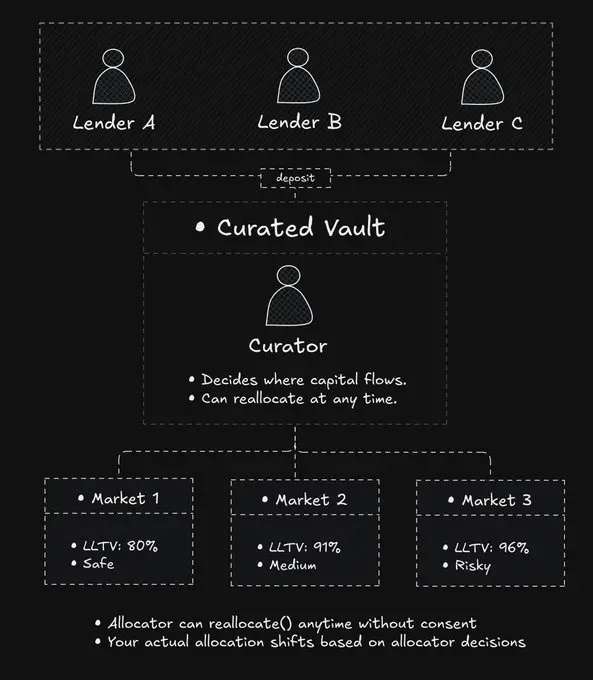
The idea is: professional curators manage capital allocation. Lenders deposit into vaults, and curators allocate funds to underlying markets, optimizing yield and managing risk. Borrowers still face fragmented markets, but at least lenders don't have to manually rebalance.

This helps lenders who want to "set and forget," but it introduces something DeFi aimed to eliminate: discretionary power.
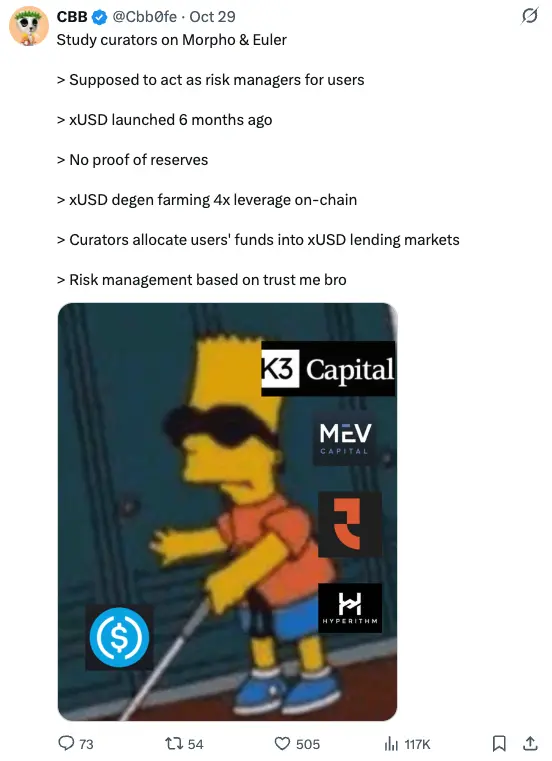
Curators decide which markets get capital and can reallocate at any time. The lender's risk exposure changes with the curator's decisions, unpredictably and uncontrollably. As one Twitter user put it: "The curator is PvPing the borrower, but the borrower doesn't even know they are being farmed."

This asymmetry is not only in strategy but also in the accuracy of the basic interface. Morpho's UI sometimes shows "$3 million available liquidity," but in practice, funds at low interest rates are scarce, with most capital located in higher rate tiers.

When liquidity coordination relies on human decisions, transparency suffers.

Capital allocators adjust market liquidity on their schedule, not based on the market's immediate needs. Vaults try to solve borrower fragmentation through "rebalancing," but rebalancing requires gas fees, depends on the curator's willingness, and often lags. Borrowers still face suboptimal rates.

Separating Risk from Matching

Lending protocols conflate two distinct modules.

User definition of risk: Different lenders have different views on collateral quality, leverage ratios.

The protocol's method of matching loans: This is mechanical. It doesn't require user subjectivity, just efficient routing.

The pooled model bundles these two, lenders lose control.

The isolated pool model separates risk definition but abandons matching, forcing borrowers to manually find the optimal path.

The curator vault model adds matching back through the curator role but introduces a trust assumption in the curator.

Can matching be automated without introducing discretion (human intervention)?

Order books in trading did this. Market makers define quotes, the order book aggregates depth, matching is deterministic (best price first). No one decides where orders go, the mechanism decides everything.

CLOB lending applies the same principle to credit markets:

Lenders define risk through isolated strategies.

Strategies post quotes to a shared order book.

Borrowers interact with unified liquidity.

Matching happens automatically, without curator intervention.

Risk stays with the lender, coordination becomes mechanical. No trust in a third party is needed at any point.

Two-Tier Architecture

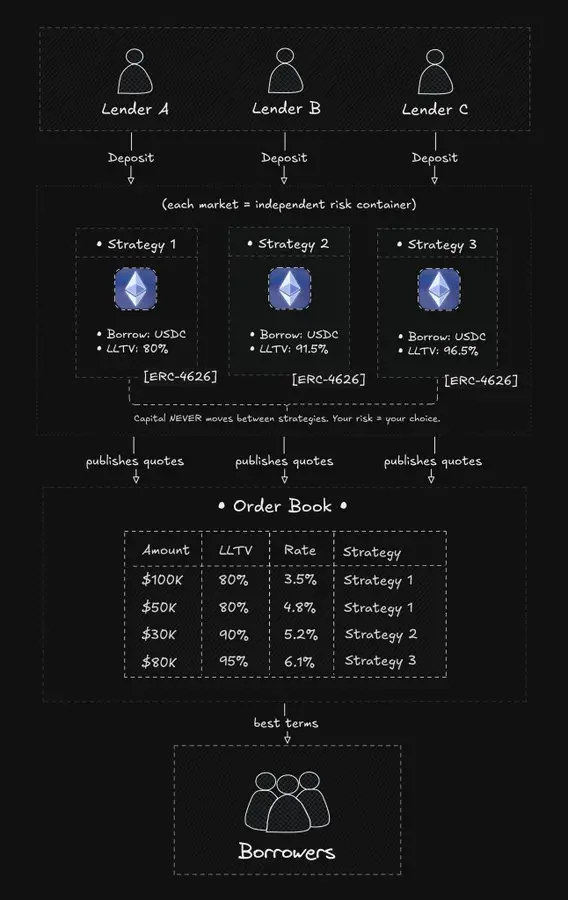
Avon implements order book lending through two unique tiers.
Strategy Layer

A "Strategy" is an isolated lending market with fixed parameters.

The strategy creator defines the following parameters: Collateral/Borrowed Asset, Liquidation LTV, Interest Rate Curve, Oracle, Liquidation Mechanism.

Once deployed, the shape of the interest rate curve cannot be changed. Lenders know the rules exactly before depositing.

Funds never move between strategies.

If you deposit into Strategy A, your money stays in Strategy A until you withdraw. No curators, no rebalancing, no sudden changes in risk exposure.

Although someone (the strategy manager) sets the parameters, they are fundamentally different from a curator: Curators are capital allocators (deciding where money goes), strategy managers are true risk managers (defining rules but not moving money), analogous to Aave DAO. The decision-making power for capital allocation always remains with the lender.

How does the system adapt to market changes? Through competition, not parameter modification. If the risk-free rate soars, this forces old strategies to become obsolete (funds flow out), and new strategies are created (funds flow in). "Discretion" shifts from "where should capital go?" (curator's decision) to "which strategy should I choose?" (lender's decision).

Matching Layer

Strategies do not serve borrowers directly; instead, they post quotes to a shared order book.

The order book aggregates quotes from all strategies into a unified view. Borrowers see the combined depth of all strategies that accept their collateral.

When a borrower places an order, the matching engine:

Filters quotes by compatibility (collateral type, LTV requirements).

Sorts by interest rate.

Executes starting from the cheapest.

Settles within an atomic transaction.

If one strategy can fulfill the entire order, it takes it all; if not, the order is automatically split across multiple strategies. The borrower only perceives one transaction.

Important note: The order book only reads strategy states; it cannot modify them. It is only responsible for coordinating access, not allocating capital.

A Boon for RWA

DeFi has always faced a structural contradiction in institutional adoption: compliance requires isolation, but isolation kills liquidity.
Aave Arc tried the "walled garden" model, where compliant participants have their own pool. The result was shallow liquidity and poor rates. Aave Horizon tried a "semi-open" model (RWA issuers require KYC, but lending is permissionless). This is progress, but institutional borrowers still cannot access the $32 billion liquidity in Aave's main pool. Some projects explored permissioned rollups. The KYC process is completed at the infrastructure level. This approach works for some use cases but fragments liquidity at the network layer. Compliant users on Chain A cannot access liquidity on Chain B.

The order book model offers a third way.

The strategy layer can enforce any access control (KYC, geographic restrictions, accredited investor checks). The matching engine is only responsible for matching.

If a compliant strategy and a permissionless strategy both offer compatible terms, they can simultaneously fill the same loan.

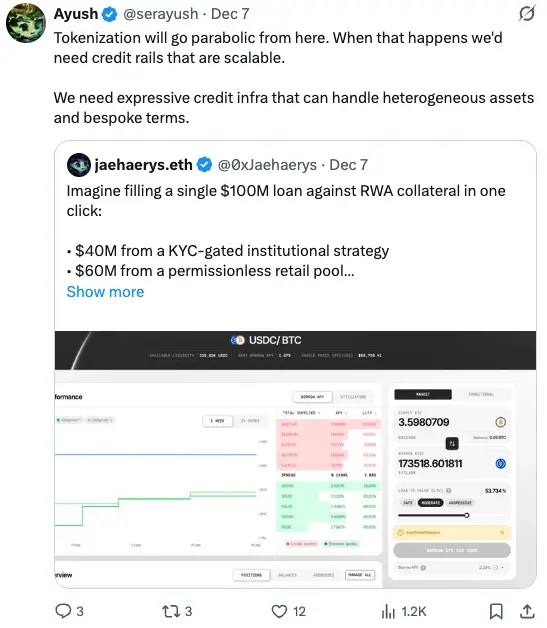
Imagine a corporate treasury抵押代币化国债 borrowing $100 million:

$30 million from a strategy requiring institutional KYC (pension fund LPs)

$20 million from a strategy requiring accredited investor certification (family office LPs)

$50 million from a completely permissionless strategy (retail LPs)

Funds are never mixed at the source, institutions remain compliant, but liquidity is unified globally. This breaks the deadlock of "compliance equals isolation."

Mechanisms for Multi-Dimensional Matching

Order books match on only one dimension: price. The highest bid and lowest ask match.
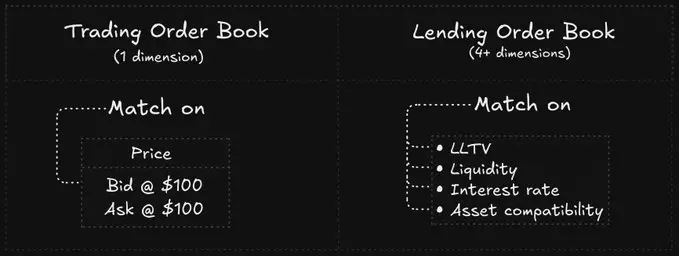
Lending order books must match across multiple dimensions simultaneously:

Interest Rate: Must be below the borrower's acceptable上限.

LTV: The borrower's collateral ratio must meet the strategy's requirements.

Asset Compatibility: Currency match.

Liquidity: Sufficient market liquidity.

Borrowers who provide more collateral (lower LTV) or accept higher interest rates can match with more strategies. The engine finds the cheapest path within this constraint space.

A note for large borrowers. In Aave, $10 billion in liquidity is a monolithic pool. In order book lending, $10 billion might be分散在数百种策略中. A $100 million loan would quickly consume the entire order book, filling from the cheapest strategies first, progressively moving to the most expensive ones. Slippage is visible.

Pool-based systems also have slippage, just manifested differently: a surge in utilization pushes up interest rates. The difference is transparency. In the order book, slippage is visible upfront. In the pool, slippage only becomes apparent after the trade executes.

Floating Rates and Re-quoting

DeFi lending uses floating rates. As utilization changes, so does the interest rate.

This creates a synchronization challenge: if the strategy utilization changes but the quote on the order book isn't updated, the borrower executes at the wrong price.

Solution: Continuous re-quoting.

As soon as the strategy state changes, immediately post a new quote to the order book. This requires extremely high infrastructure performance:

Very fast block times.

Extremely cheap transaction costs.

Atomic state reads.

This is why Avon chose to build on MegaETH. On Ethereum Mainnet, this architecture is prohibitively expensive due to gas fees.

Existing friction:

If market rates move but the strategy's fixed curve doesn't adapt, a "Dead Zone" appears – borrowers find it too expensive to borrow, and lenders earn no yield. In Aave, the curve adjusts automatically, whereas in CLOB mode, this requires lenders to manually withdraw and migrate to new strategies. This is the price paid for control.

Multi-Strategy Position Management

When a loan is filled by multiple strategies, the borrower effectively holds a multi-strategy position.

Although it looks like one loan on the interface, the underlying components are independent:

Independent Interest Rates: Component A's rate might rise due to increased utilization in Strategy A, while Component B remains unchanged.

Independent Health Ratios: When the token price drops, components with stricter LTV limits are liquidated first locally. You don't get liquidated all at once but experience a series of partial liquidations, like being "nibbled away."

To simplify the experience, Avon provides unified position management (one-click add collateral, automatically distributed by weight) and one-click refinancing功能 (automatically borrow new to repay old via flash loans, always locking in the market's best rate).

Conclusion

DeFi lending has gone through several stages:

Pooled Protocols: Gave borrowers depth but剥夺了放贷人的控制权.

Isolated Markets: Gave lenders control but fragmented the borrower experience.

Curator Vaults: Attempted to bridge the two but introduced human decision-making risk.

Order Book Lending (CLOB): Decouples the above models. Risk definition rights return to lenders; matching is achieved through an order book engine.

The design principle is clear: when matching can be achieved through code, human intervention is no longer needed. Markets can self-regulate.


Twitter:https://twitter.com/BitpushNewsCN

Bitpush TG Discussion Group:https://t.me/BitPushCommunity

Bitpush TG Subscription: https://t.me/bitpush

Original Link:https://www.bitpush.news/articles/7594633

Câu hỏi Liên quan

QWhat is the core problem with the 'Curator' model in DeFi lending protocols like Morpho and Euler?

AThe Curator model reintroduces human discretion and moral risk into the system. Curators decide where capital is allocated, which can change lenders' risk exposure unpredictably and create information asymmetry, undermining the trustless and transparent ideals of DeFi.

QHow does the proposed CLOB (Central Limit Order Book) model for lending separate risk from matching?

AThe CLOB model separates risk definition and order matching into two distinct layers. The Strategy Layer allows lenders to define risk in isolated, fixed-parameter markets. The Matching Layer is a shared order book that automatically and deterministically routes borrower orders to the best available strategies without any human intervention.

QWhat advantage does the order book model offer for Real-World Assets (RWA) in DeFi?

AIt allows for compliance at the strategy level (e.g., KYC, accreditation checks) while aggregating liquidity at the matching layer. This enables compliant and permissionless strategies to simultaneously serve the same borrower, unifying global capital without mixing it at the source and breaking the 'compliance equals isolation' dilemma.

QWhat is a key infrastructural requirement for a CLOB lending system to function effectively?

AIt requires extremely high-performance infrastructure with fast block times, very low transaction costs, and atomic state reads. This is necessary for strategies to continuously re-quote their rates on the order book in response to market changes, ensuring borrowers get accurate, up-to-date pricing.

QHow does the CLOB model change the experience for a large borrower compared to a pooled model like Aave?

AIn a pooled model, a large borrower interacts with a single pool, and slippage manifests as a sharp increase in the interest rate due to higher utilization. In a CLOB model, liquidity is fragmented across many pools (strategies). Slippage for a large loan is visible upfront as the order is filled progressively from the cheapest to the most expensive strategies, offering more predictable execution.

Nội dung Liên quan

Có nên mua cổ phiếu SpaceX trị giá 1,7 nghìn tỷ đô la? Bạn cần biết thị trường đang lo lắng điều gì

SpaceX đang chuẩn bị cho một đợt IPO với mức định giá khoảng 1,75 nghìn tỷ USD, một trong những đợt phát hành lớn nhất trong lịch sử. Tuy nhiên, thị trường đang có nhiều lo ngại. Định giá cao gấp 94 lần doanh thu năm 2025, dù SpaceX sở hữu mạng lưới vệ tinh Starlink sinh lời và công nghệ tên lửa tái sử dụng độc đáo, khiến nhiều nhà đầu tư cho rằng giá trị này đã tính trước phần lớn lợi nhuận từ các dự án tương lai như cơ sở hạ tầng AI, trung tâm dữ liệu quỹ đạo và tàu Starship. Cơ cấu tài chính cho thấy Starlink là nguồn lợi nhuận chính, trong khi bộ phận AI đang thua lỗ nặng và tiêu tốn phần lớn chi tiêu vốn. Việc mua lại xAI càng làm dấy lên lo ngại về các giao dịch liên kết và rủi ro tài chính tiềm ẩn được chuyển vào bảng cân đối của công ty. Cơ cấu quản trị với cổ phiếu đa quyền biểu quyết cho phép Elon Musk duy trì quyền kiểm soát tuyệt đối, hạn chế khả năng ảnh hưởng của cổ đông phổ thông đối với các quyết định rủi ro cao và dài hạn. Tóm lại, thị trường không nghi ngờ thành công trong quá khứ của SpaceX, mà đang cân nhắc mức độ sẵn sàng trả giá cao cho những câu chuyện tăng trưởng tương lai đầy tham vọng, đồng thời phải chiết khấu hợp lý cho các rủi ro về khả năng sinh lời, cấu trúc tài chính và quản trị doanh nghiệp.

marsbit16 phút trước

Có nên mua cổ phiếu SpaceX trị giá 1,7 nghìn tỷ đô la? Bạn cần biết thị trường đang lo lắng điều gì

marsbit16 phút trước

Phá Vỡ Lời Nguyền Thanh Lý Tuần Hoàn Trong DeFi, Vitalik Đề Xuất Giải Pháp Mới

**Tóm tắt: Đề xuất của Vitalik Buterin về một giải pháp thay thế cho cơ chế thanh lý DeFi** Vitalik Buterin đã đề xuất một phương pháp cách mạng để loại bỏ cơ chế thanh lý tự động – vốn là nguyên nhân gây ra hiệu ứng bán tháo dây chuyền trong thị trường DeFi. Thay vì sử dụng cấu trúc cho vay thế chấp truyền thống, phương án mới xây dựng tài sản tổng hợp dựa trên hợp đồng quyền chọn (options). **Vấn đề với cơ chế thanh lý hiện tại:** Khi giá tài sản thế chấp giảm mạnh, hàng loạt vị thế bị buộc thanh lý đồng loạt, tạo ra áp lực bán lớn và làm trầm trọng thêm đà giảm giá ngắn hạn, như đã thấy trong đợt sụt giảm thị trường gần đây. **Giải pháp mới dựa trên quyền chọn:** Một tài sản (ví dụ: ETH) được chia thành hai loại tài sản giống quyền chọn: P (put) và N (call). Giá trị của chúng luôn bằng một ETH. Thay vì thanh lý đột ngột khi vượt ngưỡng, giá trị vị thế của người dùng sẽ "lệch" dần so với mức mục tiêu nếu họ không chủ động tái cân bằng (rebalance) vị thế. Điều này chuyển quyền kiểm soát rủi ro từ hệ thống sang người dùng. **Lợi ích chính:** * **Giảm bán tháo dây chuyền:** Loại bỏ sự kiện thanh lý tập trung và ép buộc. * **Giảm áp lực lên oracle:** Oracle chỉ cần xác định giá khi hợp đồng đáo hạn, thay vì cung cấp giá thời gian thực để kích hoạt thanh lý, giúp tăng cường an toàn và cho phép sử dụng các cơ chế định giá chịu lỗi cao hơn. * **Trao quyền kiểm soát cho người dùng:** Người dùng có thể lựa chọn thời điểm tái cân bằng vị thế phù hợp với chiến lược của họ. **Thách thức và hạn chế:** * **Chi phí giao dịch (trượt giá):** Việc tái cân bằng thường xuyên trên các AMM thông thường có thể tạo ra chi phí giao dịch đáng kể, đặc biệt trong thị trường biến động. * **Giá trị lệch dần:** Không phù hợp cho các stablecoin cần gắn chặt 1:1 với USD để thanh toán hoặc kế toán. * **Phức tạp về trải nghiệm người dùng:** Cần có các công cụ tự động hoá hoặc giao diện được đóng gói sẵn để đơn giản hóa việc quản lý vị thế. * **Cần thanh khoản mới:** Thị trường điều chỉnh cần một loại hình tạo lập thị trường mới, tập trung vào các lệnh chờ một chiều, thụ động. **Kết luận:** Đề xuất này thách thức quan điểm cho rằng thanh lý tự động là một phần không thể tránh khỏi của DeFi. Mặc dù còn nhiều vấn đề cần giải quyết trước khi áp dụng thực tế, nó mở ra một hướng đi mới để thiết kế các hệ thống tài chính phi tập trung linh hoạt và ổn định hơn, giảm thiểu rủi ro hệ thống trong các đợt biến động thị trường.

marsbit20 phút trước

Phá Vỡ Lời Nguyền Thanh Lý Tuần Hoàn Trong DeFi, Vitalik Đề Xuất Giải Pháp Mới

marsbit20 phút trước

Sự Kết Thúc Của Tiền Mã Hóa Yếu Tố Đơn Lẻ

Bài viết thảo luận về sự chuyển dịch trong thế giới tiền mã hóa, từ trạng thái phụ thuộc đơn nhất vào giá Bitcoin sang một giai đoạn mới được thúc đẩy bởi các yếu tố bên ngoài. Nền kinh tế tiền mã hóa đang phân hóa thành hai nhóm: nội sinh (giá trị gắn liền với chu kỳ tiền mã hóa) và ngoại sinh (giá trị độc lập với giá tiền mã hóa, ví dụ như các công ty fintech sử dụng blockchain làm cơ sở hạ tầng). Các tài sản ngoại sinh, như Venice (dịch vụ AI trả phí) hay các công ty stablecoin, có mô hình kinh doanh dựa trên nhu cầu thực tế và cơ sở người dùng ổn định, không bị ảnh hưởng nhiều bởi biến động giá Bitcoin. Sự tăng trưởng của chúng được minh chứng qua các thương vụ M&A lớn (ví dụ: Mastercard mua BVNK). Bài viết chỉ ra rằng việc phân tích các dự án ngoại sinh cần tập trung vào cơ bản doanh nghiệp như khách hàng, kinh tế đơn vị và lợi thế cạnh tranh, thay vì chỉ theo dõi biểu đồ giá Bitcoin. Một số lĩnh vực ngoại sinh đáng chú ý bao gồm: sàn giao dịch trên chuỗi, tín dụng/tài sản thế chấp, AI riêng tư, ngân hàng mới, cho vay, stablecoin, kênh thanh toán, và các sản phẩm tiêu dùng phi tài chính. Tóm lại, ngành công nghiệp đang thoát khỏi trạng thái phụ thuộc vào một yếu tố duy nhất, hướng tới một tương lai đa dạng với các động lực tăng trưởng độc lập.

marsbit21 phút trước

Sự Kết Thúc Của Tiền Mã Hóa Yếu Tố Đơn Lẻ

marsbit21 phút trước

‘Cổ Phiếu Lão Làng’ Biến Thành ‘Quý Tộc Mới’: Từ Dell Đến Nokia, AI Định Giá Lại Cơ Sở Hạ Tầng Cũ Như Thế Nào?

**Tóm tắt: "Cổ phiếu 'lão làng' thành 'quý tộc mới': AI định giá lại cơ sở hạ tầng cũ từ Dell đến Nokia như thế nào?"** Chỉ một năm trước, những công ty công nghệ lâu đời như Dell, Nokia, Cisco, Corning, Western Data dường như đứng ngoài cuộc chơi AI. Thị trường chú trọng vào những cái tên "nóng" như NVIDIA hay các mảng chip, lưu trữ, quang học. Tuy nhiên, gần đây, các "lão làng" này lại thể hiện sức hút mạnh mẽ. Nguyên nhân? AI đang chuyển từ giai đoạn phát triển mô hình sang giai đoạn triển khai thực tế, đòi hỏi xây dựng cơ sở hạ tầng vật lý quy mô lớn. Đây là thời điểm các công ty có năng lực tích hợp hệ thống, kinh nghiệm giao hàng và mạng lưới khách hàng doanh nghiệp vững chắc được định giá lại. Họ sở hữu những "tài sản cũ" nhưng lại đáp ứng "nhu cầu mới" của kỷ nguyên AI. Có ba nhóm chính được định giá lại: 1. **Máy chủ & Tích hợp hệ thống:** Dell và HPE không sản xuất GPU, nhưng họ là những "nhà thầu chính" quan trọng, cung cấp năng lực thiết kế server, chuỗi cung ứng và triển khai trọn gói các cụm AI cho khách hàng. 2. **Mạng & Kết nối:** Cơ sở hạ tầng AI cần mạng lưới siêu tốc. Corning (cáp quang), Nokia (mạng không dây AI-RAN, 6G) và Cisco (thiết bị chuyển mạch trung tâm dữ liệu) trở nên quan trọng khi quy mô tính toán mở rộng và AI di chuyển ra biên mạng. 3. **Lưu trữ & Quản lý dữ liệu:** Ngoài bộ nhớ tốc độ cao (HBM), sự bùng nổ dữ liệu AI (dữ liệu huấn luyện, nhật ký, video, lưu trữ lạnh) làm tăng nhu cầu về ổ cứng dung lượng lớn, giúp các công ty như Western Digital và Seagate được chú ý trở lại. Tuy nhiên, không phải mọi công ty cũ đều được hưởng lợi đồng đều. Một sự "định giá lại thực sự" cần đáp ứng ba tiêu chí: (1) Có đơn hàng và doanh thu AI cụ thể được công bố; (2) Ban lãnh đạo điều chỉnh kỳ vọng tăng trưởng (hướng dẫn) tăng lên; (3) Chất lượng lợi nhuận được cải thiện, không chỉ tăng trưởng doanh thu đơn thuần. Tóm lại, đợt định giá lại này không phải là cơn sốt ngắn hạn hay câu chuyện mơ hồ. Nó phản ánh thực tế rằng khi AI bước vào giai đoạn xây dựng hạ tầng thực tế, các công ty có năng lực triển khai và cung cấp các thành phần cơ sở hạ tầng thiết yếu sẽ tìm thấy vị thế mới. Họ không trở nên trẻ trung hơn, mà những gì họ có lại trở nên cần thiết trong kỷ nguyên mới.

marsbit1 giờ trước

‘Cổ Phiếu Lão Làng’ Biến Thành ‘Quý Tộc Mới’: Từ Dell Đến Nokia, AI Định Giá Lại Cơ Sở Hạ Tầng Cũ Như Thế Nào?

marsbit1 giờ trước

Giao dịch

Giao ngay
Hợp đồng Tương lai

Bài viết Nổi bật

Làm thế nào để Mua BILL

Chào mừng bạn đến với HTX.com! Chúng tôi đã làm cho mua Billions Network (BILL) trở nên đơn giản và thuận tiện. Làm theo hướng dẫn từng bước của chúng tôi để bắt đầu hành trình tiền kỹ thuật số của bạn.Bước 1: Tạo Tài khoản HTX của BạnSử dụng email hoặc số điện thoại của bạn để đăng ký tài khoản miễn phí trên HTX. Trải nghiệm hành trình đăng ký không rắc rối và mở khóa tất cả tính năng. Nhận Tài khoản của tôiBước 2: Truy cập Mua Crypto và Chọn Phương thức Thanh toán của BạnThẻ Tín dụng/Ghi nợ: Sử dụng Visa hoặc Mastercard của bạn để mua Billions Network (BILL) ngay lập tức.Số dư: Sử dụng tiền từ số dư tài khoản HTX của bạn để giao dịch liền mạch.Bên thứ ba: Chúng tôi đã thêm những phương thức thanh toán phổ biến như Google Pay và Apple Pay để nâng cao sự tiện lợi.P2P: Giao dịch trực tiếp với người dùng khác trên HTX.Thị trường mua bán phi tập trung (OTC): Chúng tôi cung cấp những dịch vụ được thiết kế riêng và tỷ giá hối đoái cạnh tranh cho nhà giao dịch.Bước 3: Lưu trữ Billions Network (BILL) của BạnSau khi mua Billions Network (BILL), lưu trữ trong tài khoản HTX của bạn. Ngoài ra, bạn có thể gửi đi nơi khác qua chuyển khoản blockchain hoặc sử dụng để giao dịch những tiền kỹ thuật số khác.Bước 4: Giao dịch Billions Network (BILL)Giao dịch Billions Network (BILL) dễ dàng trên thị trường giao ngay của HTX. Chỉ cần truy cập vào tài khoản của bạn, chọn cặp giao dịch, thực hiện giao dịch và theo dõi trong thời gian thực. Chúng tôi cung cấp trải nghiệm thân thiện với người dùng cho cả người mới bắt đầu và người giao dịch dày dạn kinh nghiệm.

Tổng lượt xem 291Xuất bản vào 2026.05.07Cập nhật vào 2026.06.02

Làm thế nào để Mua BILL

ATWO là gì

I. Giới thiệu Dự ánArena Two là một nền tảng tương tác phi tập trung cho phép người hâm mộ đóng vai trò tích cực, có thể mã hóa trong kết quả sự kiện theo thời gian thực. Khác với các mô hình phát sóng truyền thống khiến người hâm mộ trở thành người xem thụ động, Arena Two tận dụng công nghệ blockchain để cho phép người hâm mộ trực tiếp bỏ phiếu theo thời gian thực và ảnh hưởng đến kết quả trên sân.II. Thông tin TokenTên token: ATWO(Arena Two)III. Liên kết liên quanWebsite:https://arenatwo.com/Explorers:https://basescan.org/token/0x499D35eBE6cEe9B2Ac35Fd003fcBbeeB9CFc7B32Twitter:https://x.com/arenatwoXGhi chú: Giới thiệu dự án đến từ các tài liệu được công bố hoặc cung cấp bởi đội ngũ dự án chính thức, chỉ mang tính tham khảo và không cấu thành lời khuyên đầu tư. HTX không chịu trách nhiệm cho bất kỳ tổn thất trực tiếp hoặc gián tiếp nào phát sinh.

Tổng lượt xem 247Xuất bản vào 2026.05.18Cập nhật vào 2026.06.02

ATWO là gì

Làm thế nào để Mua ATWO

Chào mừng bạn đến với HTX.com! Chúng tôi đã làm cho mua Arena Two (ATWO) trở nên đơn giản và thuận tiện. Làm theo hướng dẫn từng bước của chúng tôi để bắt đầu hành trình tiền kỹ thuật số của bạn.Bước 1: Tạo Tài khoản HTX của BạnSử dụng email hoặc số điện thoại của bạn để đăng ký tài khoản miễn phí trên HTX. Trải nghiệm hành trình đăng ký không rắc rối và mở khóa tất cả tính năng. Nhận Tài khoản của tôiBước 2: Truy cập Mua Crypto và Chọn Phương thức Thanh toán của BạnThẻ Tín dụng/Ghi nợ: Sử dụng Visa hoặc Mastercard của bạn để mua Arena Two (ATWO) ngay lập tức.Số dư: Sử dụng tiền từ số dư tài khoản HTX của bạn để giao dịch liền mạch.Bên thứ ba: Chúng tôi đã thêm những phương thức thanh toán phổ biến như Google Pay và Apple Pay để nâng cao sự tiện lợi.P2P: Giao dịch trực tiếp với người dùng khác trên HTX.Thị trường mua bán phi tập trung (OTC): Chúng tôi cung cấp những dịch vụ được thiết kế riêng và tỷ giá hối đoái cạnh tranh cho nhà giao dịch.Bước 3: Lưu trữ Arena Two (ATWO) của BạnSau khi mua Arena Two (ATWO), lưu trữ trong tài khoản HTX của bạn. Ngoài ra, bạn có thể gửi đi nơi khác qua chuyển khoản blockchain hoặc sử dụng để giao dịch những tiền kỹ thuật số khác.Bước 4: Giao dịch Arena Two (ATWO)Giao dịch Arena Two (ATWO) dễ dàng trên thị trường giao ngay của HTX. Chỉ cần truy cập vào tài khoản của bạn, chọn cặp giao dịch, thực hiện giao dịch và theo dõi trong thời gian thực. Chúng tôi cung cấp trải nghiệm thân thiện với người dùng cho cả người mới bắt đầu và người giao dịch dày dạn kinh nghiệm.

Tổng lượt xem 147Xuất bản vào 2026.05.18Cập nhật vào 2026.06.02

Làm thế nào để Mua ATWO

Thảo luận

Chào mừng đến với Cộng đồng HTX. Tại đây, bạn có thể được thông báo về những phát triển nền tảng mới nhất và có quyền truy cập vào thông tin chuyên sâu về thị trường. Ý kiến ​​của người dùng về giá của A (A) được trình bày dưới đây.

活动图片