War, Weekends, and Locked Liquidity: How RWA is Reshaping Global Trading Hours, as Seen from the Iran Airstrike Incident

marsbitXuất bản vào 2026-03-03Cập nhật gần nhất vào 2026-03-03

Tóm tắt

This article analyzes the 2026 Iran airstrike as a pivotal moment demonstrating how Real World Asset (RWA) tokenization is reshaping global finance by eliminating traditional market hours. The attack, deliberately timed on a weekend when traditional markets (stocks, forex) were closed, created a 48-hour "trading vacuum." This exposed a critical vulnerability: traditional T+1/T+2 settlement systems and reliance on banking hours leave investors as "liquidity prisoners" during off-hours crises, unable to hedge and forced to absorb massive gap risk upon Monday's open. In stark contrast, tokenized gold assets like XAUT and PAXG on blockchain networks experienced a surge in trading, providing continuous, 24/7 price discovery and a crucial hedging mechanism. This event marked a historic shift: for the first time, pricing power for a major commodity like gold temporarily transferred to the digital asset market during a geopolitical crisis. The chain's "settlement equals清算" T+0 logic and atomic swaps allowed instant, global capital movement without counterparty risk. The conclusion is that RWA's core value is the temporal expansion of liquidity. This event will drive traditional institutions, quant funds, and market makers to integrate blockchain-based RWA trading pools to capture alpha and manage risk in a truly 24/365 global market, ultimately rendering obsolete the traditional financial infrastructure bound by working hours.

Author: Max.s

On February 28, 2026 (Saturday), air raid sirens in the Middle East pierced the quiet of global geopolitics. The United States and Israel launched a meticulously planned large-scale airstrike on targets within Iran.

The timing of this military operation was like an extremely precise surgical strike, evident not only in the physical coordinates of the tactical attack but also in the grasp of the global financial market's "time coordinates." Choosing to launch the surprise attack on a weekend, during the traditional Western financial market closure, was deeply significant: it maximally prevented the immediate spread of panic in stock and foreign exchange markets, and also gave various governments and central banks a full 48-hour buffer period to intervene and guide market expectations.

However, global capital did not sit idly by during this deliberately created "trading vacuum." While the CME (Chicago Mercantile Exchange) gold and crude oil futures screens froze at Friday's closing prices, and the buy/sell buttons for various ETFs were forcibly grayed out by the system, real undercurrents were surging fiercely in another, never-sleeping network. Cryptocurrency gold tokens, represented by XAUT (Tether Gold) and PAXG (PAX Gold), experienced a trading peak on blockchain networks like Ethereum.
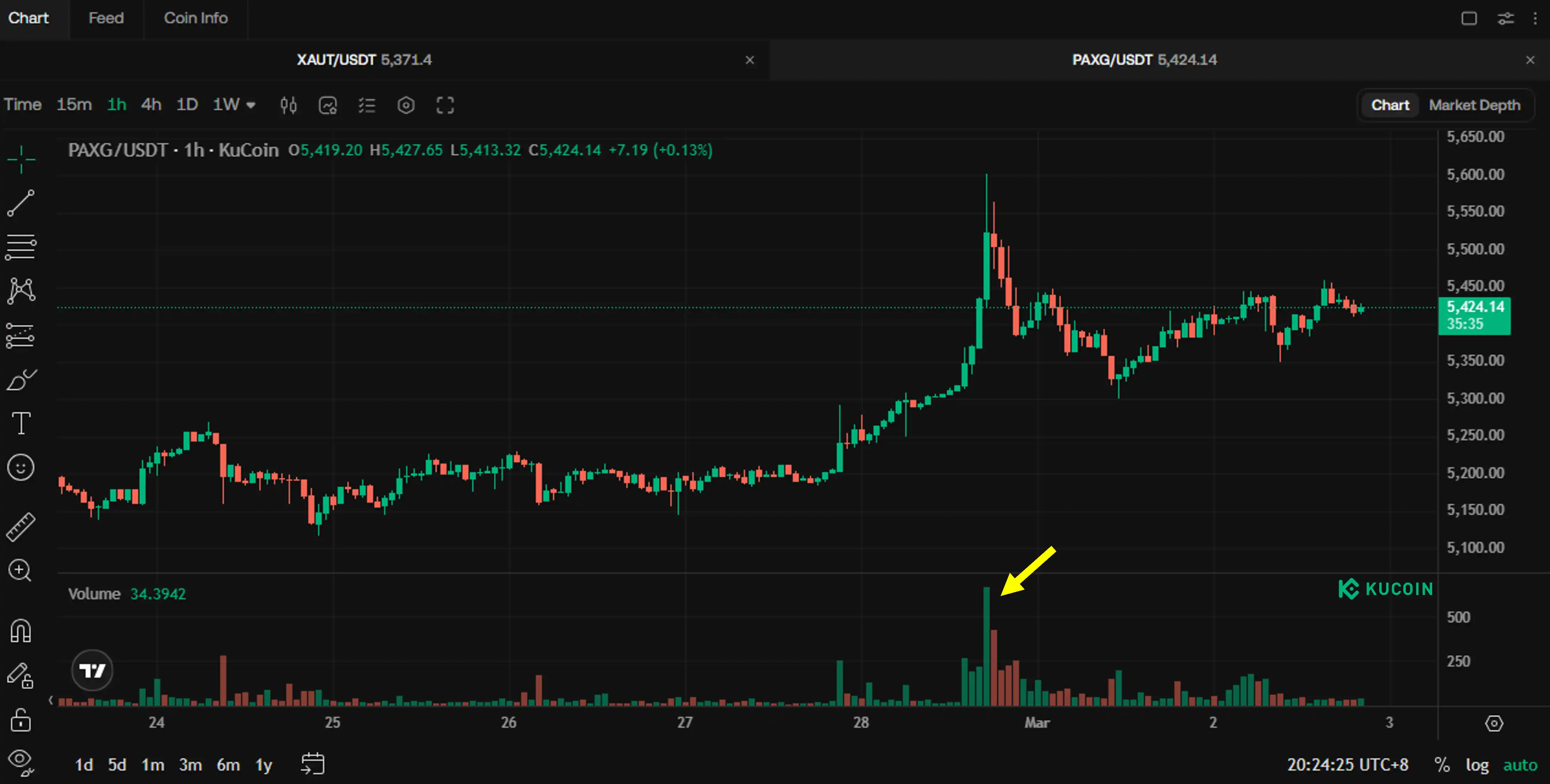
This was not just a game of geopolitical chess, but also a stress test on "liquidity privilege." The airstrike incident, in an extremely stark manner, declared to all traditional finance professionals: the traditional financial infrastructure, based on T+1 or T+2 settlement and constrained by workdays and fixed trading hours, is being left behind by the times. The tokenization of real-world assets (RWA), and the completion of round-the-clock trading and settlement through digital assets, is no longer a social experiment by geeks, but an inevitable trend in the global capital's fight for pricing power and trading Alpha.

From the perspective of quantitative trading and hedge funds, the core of risk management lies in the accessibility of hedging instruments. Following the airstrike on February 28th, the risk exposure of macro hedge funds spiked instantly. Conventionally, crude oil and gold are the preferred safe-haven hedging instruments. But on that Saturday morning, tens of thousands of financial institutions and professional traders became "liquidity prisoners."

Traditional financial market infrastructure is built upon the industrial era's timetable. Although electronic trading has been widespread for decades, the underlying clearing and settlement systems (such as DTCC, Euroclear systems, and the SWIFT network) still heavily rely on the batch processing of centralized institutions and banking hours. When a black swan event occurs outside trading hours, the reaction mechanism of traditional markets is completely frozen. Investors can only watch as information spreads at the speed of light, while the flow of funds is like an insect trapped in amber, immobile.

This type of strike, "deliberately avoiding trading days," essentially compresses all market volatility and gap risk into the few short minutes of Monday's market open. For quantitative market makers and high-frequency trading institutions, this kind of discontinuous hedging gap risk is fatal. During the highly information-asymmetric and liquidity-starved Monday opening phase, it is extremely easy to trigger chain reactions of long squeezes or short blow-ups.

In contrast, the cryptocurrency market demonstrated a dimensionality-reducing resilience. Within minutes of the attack news breaking on February 28th, capital rapidly flowed into crypto liquidity pools. XAUT and PAXG trading pairs on major centralized crypto exchanges absorbed避险需求 (hedging demand) on a massive scale. As shown in the chart, the funding rate (longs pay shorts) reached 0.5% on February 28th.
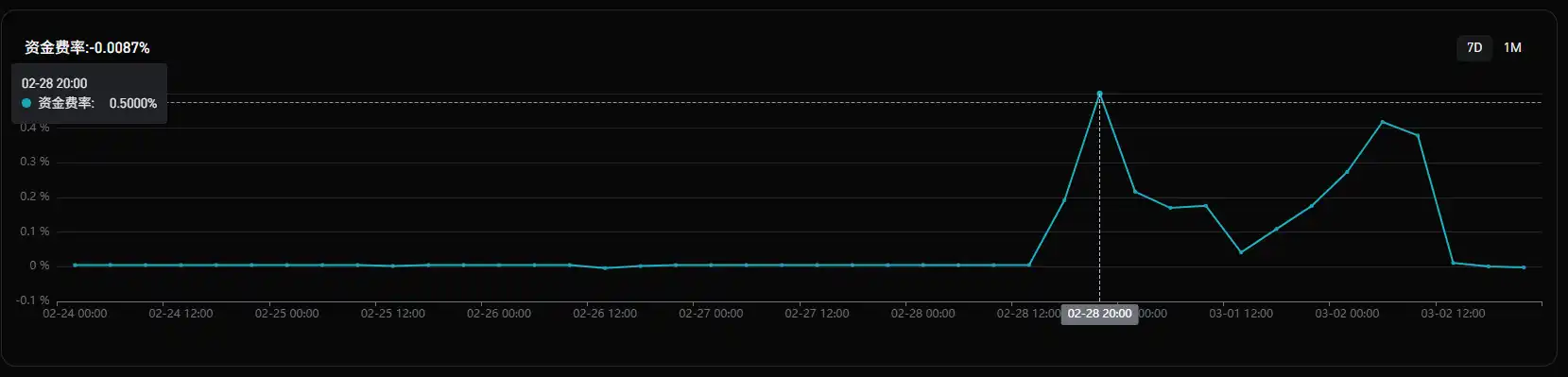
We can clearly see this smooth yet steep value appreciation curve from the on-chain data: no market halt, no trading curbs, no opening gap uncertainty. The price of on-chain gold tokens followed every update from the front lines, continuously pricing in milliseconds. Before the CME opened on Monday, the price of on-chain XAUT had already completed sufficient price discovery.

This led to a highly disruptive financial phenomenon: for the first time in history during a major geopolitical crisis, the pricing power of traditional commodities temporarily shifted to the digital asset market.

When the Asian early trading session opened on March 2nd (Monday), the traditional gold spot and futures markets surged at the open. Over that weekend, XAUT was no longer a shadow asset of GLD (SPDR Gold ETF) or COMEX futures. Instead, on-chain tokens, in a sense, became the "price oracle" for Wall Street's Monday open. Astute arbitrageurs used this 48-hour time difference to build substantial positions on-chain and, at the moment the traditional market opened on Monday, arbitraged away the basis spread, equalizing prices across the two worlds.
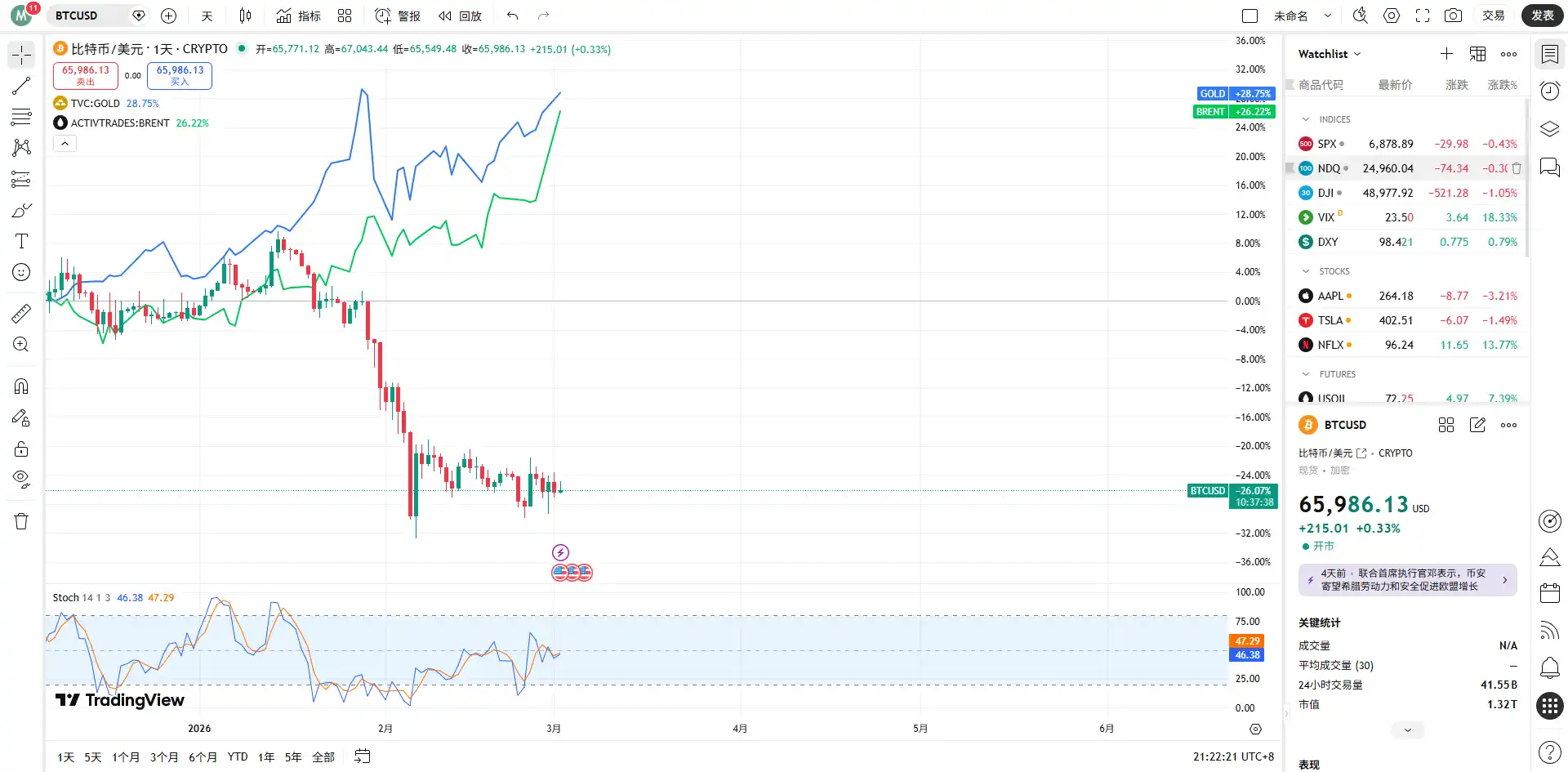
The weekend's gold token trading frenzy revealed the most core value proposition of RWA assets: the expansion of the time dimension of liquidity.

In previous narratives, the advantages of RWA were often focused on lowering barriers, fractionalizing ownership, or increasing transparency. But for professional financial practitioners, the greatest appeal of RWA lies in the T+0 underlying logic of "settlement equals clearing," and the 7x24x365 round-the-clock operational mechanism.

Imagine if, instead of a Middle East airstrike, a sovereign debt default, a major bank collapse, or an unexpected emergency central bank rate cut had occurred over the weekend. Traditional institutions would be forced to passively bear enormous exposure risk until Monday's open. But if government bonds, foreign exchange, and even core stock indices were deeply tokenized and had established sufficient liquidity pools on the blockchain, institutional investors could immediately execute risk hedging and asset swaps via smart contracts the moment the risk materializes.

In this event, not only gold but also the exchange network between stablecoins and crypto-native assets acted as a superhighway for safe-haven capital flows. In the traditional financial system, cross-border, cross-institution fund transfers require complex correspondent bank confirmations and multiple compliance checks, taking days to complete. On-chain, hedging positions worth hundreds of millions of dollars can be atomically swapped within one block time (12 seconds on Ethereum), with no counterparty default risk.

For Wall Street, the weekend at the end of February 2026 was a profound lesson in investment research. Previously, many traditional institutions took a wait-and-see attitude towards BlackRock's launch of BUIDL (a tokenized treasury fund) and the rise of RWA protocols like Ondo Finance, considering it a gimmick to attract existing crypto capital. But the airstrike incident proved that in the face of extreme black swan events, the liquidity premium provided by tokenized assets is a hardcore Alpha that no excellent quantitative model can replace.

Quantitative funds will no longer be satisfied with the trading interfaces provided by CME or Nasdaq; they will massively connect APIs to on-chain DEXs and RWA trading pools with institutional-grade compliance systems. To capture "non-synchronous trading opportunities" during weekends and holidays, building cross-border arbitrage models spanning TradFi and DeFi will become standard configuration for top hedge funds.

When brokers and market-making institutions realize that significant trading demand and commission profits are bleeding into blockchain networks on weekends, profit motives will force them to actively become liquidity providers for on-chain assets. In the future, large market makers like Jane Street and Jump Trading will not only make markets for ETFs on weekdays but will also inject liquidity into round-the-clock RWA asset pools on weekends.

Starting with highly standardized commodities like gold and crude oil, this will gradually spread to short-term treasury bonds, high-quality corporate bonds, and even US stock indices. The载体 (carrier) of financial assets will migrate completely from the ledgers of trust companies and clearinghouses to distributed ledgers. No more T+2 fund settlement periods, no more Friday afternoon sell-offs due to weekend anxiety; global capital will truly achieve seamless circulation across physical time and space.

"Money never sleeps" was once one of Wall Street's most famous slogans, but the reality is that traditional Wall Street not only sleeps but also takes weekends and public holidays. The artillery fire on February 28, 2026, proved in a cruel way that in the face of an increasingly complex and unpredictable global macro environment, fragmented trading times and locked liquidity are themselves the greatest systemic risks.

The price discovery process led by digital assets like XAUT over that weekend sounded the death knell for the traditional clearing system. RWA is not just about moving real-world assets onto the blockchain; it is about using code to reconstruct the temporal laws of financial operation. For quantitative analysts, traders, and financial engineers, the future battlefield will no longer be confined to the screens for 5 days a week, 8 hours a day. Whoever masters the trading and settlement infrastructure for round-the-clock digital assets first will hold the throat of the global market on the next unexpected black swan night.


Câu hỏi Liên quan

QWhat was the strategic significance of the timing of the U.S. and Israeli airstrike on Iran, as described in the article?

AThe airstrike was strategically timed to occur on a weekend when traditional Western financial markets were closed. This timing maximally blocked the immediate spread of panic in stock and forex markets and provided governments and central banks with a 48-hour buffer period to intervene and guide market expectations.

QHow did the cryptocurrency market, specifically gold tokens like XAUT and PAXG, react during the 'trading vacuum' created by the weekend airstrike?

ADuring the weekend trading vacuum, capital rapidly flowed into cryptocurrency markets. Gold tokens like XAUT and PAXG on Ethereum and other blockchain networks experienced a significant surge in trading volume, acting as a crucial hedging tool and providing continuous price discovery while traditional markets were frozen.

QAccording to the article, what is the most significant value proposition of Real World Asset (RWA) tokenization for professional financial practitioners?

AFor professional financial practitioners, the most significant value proposition of RWA tokenization is the expansion of the time dimension of liquidity. Its core appeal lies in the T+0 'settlement equals clearing' logic and its 7x24x365 non-stop operational mechanism, allowing for immediate risk hedging and asset swaps at the moment a risk event occurs.

QWhat new financial phenomenon did the event demonstrate regarding the pricing power of traditional commodities?

AThe event demonstrated that, for the first time in history during a major geopolitical crisis, the pricing power of traditional commodities (like gold) temporarily shifted to the digital asset market. The price of on-chain tokens like XAUT completed full price discovery over the weekend and effectively acted as a 'price oracle' for the opening of traditional markets on Monday.

QWhat long-term shift in the financial infrastructure does the article predict as a result of this event and the rise of RWA?

AThe article predicts a fundamental migration of financial asset carriers from the ledgers of trust companies and clearinghouses to distributed ledgers (blockchain). This will eliminate T+2 settlement delays and weekend liquidity anxiety, enabling global capital to achieve seamless circulation across physical time and space, with major market makers providing liquidity for 24/7 RWA asset pools.

Nội dung Liên quan

Antarctic Thông Báo Chương Trình Điểm Mùa 1 Bắt Đầu Vào Ngày 8 Tháng 6

Antarctic đã công bố Chương trình Điểm Mùa 1 sẽ chính thức bắt đầu vào ngày 8 tháng 6 năm 2026. Chương trình này nhằm ghi nhận hoạt động của nhà giao dịch trên nền tảng, với khối lượng giao dịch là nguồn tích lũy điểm cơ bản chính. Cứ mỗi 1.000 đô la khối lượng giao dịch đủ điều kiện, người dùng sẽ nhận được 1 Điểm AX. Điểm tổng cuối cùng được tính theo công thức: Điểm Cơ Bản x Điểm Đóng Góp. Trong đó, Điểm Đóng Góp là hệ số nhân dựa trên thứ hạng nền tảng và tính nhất quán của hoạt động, chi tiết cụ thể sẽ không được công khai. Các phương thức kiếm điểm hợp lệ bao gồm: giao dịch, staking trong nhóm thanh khoản, giới thiệu người dùng, thực hiện nhiệm vụ trên nền tảng, tham gia cộng đồng và các hoạt động khác có thể được bổ sung. Antarctic cũng dự kiến ra mắt tính năng "Tài khoản Phục hồi" sau khi chương trình điểm bắt đầu, giúp các nhà giao dịch bị thanh lý có cơ hội khôi phục một phần thua lỗ. Hoạt động từ tài khoản này cũng đủ điều kiện tích lũy điểm. Thông tin chi tiết đầy đủ về Chương trình Mùa 1 sẽ được cập nhật qua các kênh chính thức của Antarctic.

TheNewsCrypto1 giờ trước

Antarctic Thông Báo Chương Trình Điểm Mùa 1 Bắt Đầu Vào Ngày 8 Tháng 6

TheNewsCrypto1 giờ trước

JPMorgan Cảnh Báo Vụ Bán Bitcoin Của Strategy Đã Làm Rung Chuyển Thị Trường

Các nhà phân tích JPMorgan cảnh báo việc Strategy (trước đây là MicroStrategy) bán 32 Bitcoin vào tuần trước đã làm rối loạn thị trường tiền mã hóa và có thể buộc công ty của Michael Saylor phải tái xây dựng dự trữ đô la để khôi phục niềm tin từ các nhà đầu tư. Dù được mô tả là "mang tính biểu tượng và tự nguyện", động thái này đã đặt ra câu hỏi lớn về khả năng công ty đáp ứng nghĩa vụ cổ tức mà không phải bán thêm Bitcoin từ kho dự trữ khổng lồ của mình. JPMorgan cho biết dự trữ đô la hiện tại của Strategy chỉ đủ chi trả cổ tức trong khoảng 6,3 tháng, một mức có thể quá mỏng. Công ty cần làm rõ kế hoạch đáp ứng khoản thanh toán cổ tức hàng năm khoảng 1,7 tỷ đô la, đặc biệt nếu Bitcoin vẫn chịu áp lực. Trong bối cảnh rộng hơn, ngân hàng này cũng trở nên thận trọng hơn với thị trường tiền mã hóa do dòng vốn suy yếu, giá Bitcoin giảm xuống dưới chi phí sản xuất ước tính và niềm tin giảm sút về khả năng thông qua luật pháp tiền mã hóa tại Mỹ trong năm nay (dưới 50% cơ hội). Mặc dù vậy, JPMorgan vẫn kỳ vọng Strategy tiếp tục mua Bitcoin, với dự báo mua khoảng 32 tỷ đô la vào năm 2026. Michael Saylor cũng bày tỏ quan điểm tích cực. Tuy nhiên, các nhà phân tích nhận định một nửa cuối năm tăng trưởng sẽ phụ thuộc vào việc Strategy làm rõ chiến lược cổ tức và sự phê chuẩn của luật pháp Mỹ. Giá Bitcoin tại thời điểm báo cáo giao dịch quanh mốc 63.071 đô la.

bitcoinist1 giờ trước

JPMorgan Cảnh Báo Vụ Bán Bitcoin Của Strategy Đã Làm Rung Chuyển Thị Trường

bitcoinist1 giờ trước

Khi AI Bắt đầu Kiểm toán Thế giới: Từ Claude Phát hiện Lỗ hổng ZEC, Nhìn về Ngành Mã hóa đang Bước vào "Thời đại An ninh Đệ quy"

AI đang bước vào "Kỷ nguyên Bảo mật Đệ quy" trong ngành công nghiệp tiền mã hóa, một xu hướng được minh họa qua việc Claude Opus 4.8 phát hiện lỗ hổng trong hệ thống bằng chứng không kiến thức (zero-knowledge proof) của Zcash (ZEC). Sự kiện này không chỉ đơn thuần là một phát hiện lỗ hổng mà còn báo hiệu sự thay đổi cơ bản: AI bắt đầu tham gia sâu vào việc hiểu, phân tích và xác minh các hệ thống phức tạp. Trước đây, bảo mật blockchain chủ yếu dựa vào chuyên gia và kiểm toán thủ công. Ngày nay, với khả năng xử lý ngữ cảnh rộng và nhận diện mẫu phức tạp, AI có thể giảm đáng kể chi phí và thời gian phát hiện rủi ro, chuyển đổi bảo mật từ một quy trình kiểm tra định kỳ sang một khả năng giám sát liên tục. Điều này tạo ra một vòng phản hồi tương tự "Tự cải thiện Đệ quy" mà Anthropic mô tả trong nghiên cứu AI - nhưng áp dụng cho bảo mật. WEEX Labs gọi đây là "Bảo mật Đệ quy" (Recursive Security), nơi hệ thống liên tục tham gia vào việc tối ưu hóa và củng cố chính nó. Tuy nhiên, AI cũng trang bị công cụ tương tự cho cả kẻ tấn công, làm tăng tốc độ toàn bộ chu kỳ tấn công-phòng thủ. Thách thức trong tương lai không phải là loại bỏ mọi lỗ hổng, mà là rút ngắn vòng đời của chúng thông qua khả năng phát hiện, phản hồi và khắc phục nhanh chóng hơn. Do đó, giao thức dẫn đầu sẽ là giao thức có khả năng phục hồi mạnh mẽ và hiệu quả xử lý rủi ro cao, đánh dấu sự chuyển dịch từ trạng thái "an toàn tĩnh" sang một hệ thống bảo mật động, tiến hóa không ngừng.

marsbit1 giờ trước

Khi AI Bắt đầu Kiểm toán Thế giới: Từ Claude Phát hiện Lỗ hổng ZEC, Nhìn về Ngành Mã hóa đang Bước vào "Thời đại An ninh Đệ quy"

marsbit1 giờ trước

Nhịp Điểm Thị Trường BTC: Tuần 24

Thị trường Bitcoin vẫn chịu áp lực khi phe bán tiếp tục chi phối. Động lực thị trường giao ngay suy giảm mạnh, với khối lượng giao dịch tăng lên do bán chủ động, phản ánh tâm lý phòng thủ khi nhà đầu tư giảm tiếp xúc rủi ro. Trên thị trường phái sinh, lãi suất mở hợp đồng tương lai giảm do giảm đòn bẩy, trong khi vị thế hợp đồng vĩnh viễn cho thấy áp lực bán liên tục. Nhu cầu bảo vệ khỏi rủi ro giảm giá trong thị trường quyền chọn tăng, với các chỉ báo skew và chênh lệch biến động tăng, cho thấy sự thận trọng gia tăng. Dòng vốn ròng từ các ETF giao ngay tại Mỹ vẫn âm, dù khối lượng giao dịch tăng, cho thấy các tổ chức đang tái đánh giá mức độ tiếp xúc, góp phần vào bầu không khí bất ổn chung. Tuy nhiên, các chỉ số cơ bản của mạng lưới cho thấy sự tham gia mở rộng với số lượng địa chỉ và khối lượng chuyển tiền tăng. Mặc dù tổng phí giảm, những người nắm giữ dài hạn vẫn chi phối nguồn cung, duy trì cấu trúc thị trường kiên cường. Giai đoạn hiện tại cho thấy dấu hiệu đầu hàng, với thị trường cân bằng giữa áp lực thanh lý ngắn hạn và cơ sở nắm giữ dài hạn ổn định.

insights.glassnode1 giờ trước

Nhịp Điểm Thị Trường BTC: Tuần 24

insights.glassnode1 giờ trước

Từ MSTR đến STRC+: Vũ Trụ Strategy Đi Về Đâu

Từ MSTR đến STRC+: Vũ trụ của Strategy sẽ đi về đâu? Strategy không chỉ là công ty sở hữu Bitcoin (BTC) lớn (843,706 BTC), mà đang chuyển hóa thành một công ty kỹ thuật tài chính, xây dựng hệ thống tín dụng và cơ sở hạ tầng thu nhập trên chuỗi xung quanh BTC. Bài viết phân tích quá trình chuyển đổi của Strategy từ một công ty phần mềm thành "kho bạc Bitcoin" công khai thông qua việc phát hành cổ phiếu, trái phiếu chuyển đổi để mua BTC. Động lực tăng trưởng ban đầu dựa vào mNAV (tỷ lệ định giá so với tài sản BTC ròng). Tuy nhiên, Strategy đã mở rộng bằng cách phát hành hàng loạt sản phẩm ưu tiên như STRC (cổ phiếu ưu tiên vĩnh viễn, cổ tức thả nổi ~11.5%), STRD, STRK, STRF, nhằm phân tách rủi ro từ cùng một bảng cân đối BTC thành các lớp với hồ sơ rủi ro và lợi nhuận khác nhau cho nhiều nhà đầu tư. STRC, với cổ tức cao và thanh toán hàng tháng, thu hút vốn từ các nhà đầu tư thu nhập cố định. Tuy nhiên, rủi ro của nó gắn liền với hiệu suất của BTC, khả năng thanh toán của Strategy và trạng thái mNAV. Nếu BTC giảm mạnh hoặc mNAV suy giảm, STRC có thể mất giá so với mệnh giá và áp lực cổ tức tăng lên. Bước tiếp theo là STRC+, với các giao thức như Saturn và Apyx, nhằm đưa dòng tiền cổ tức từ các công cụ ưu tiên off-chain này lên hệ sinh thái DeFi, cung cấp một nguồn thu nhập mới cho stablecoin trên chuỗi (ví dụ: sUSDat, apyUSD). Điều này biến BTC từ tài sản trữ giá thành cơ sở thế chấp cho một đường cong tín dụng. Tương lai của Strategy không phải là mua BTC vô hạn, mà là việc thị trường có chấp nhận lâu dài hay không một hệ thống tín dụng mới lấy BTC làm tài sản cơ bản, công ty đại chúng làm trung gian và dòng tiền cổ phiếu ưu tiên làm nguồn thu nhập, được đóng gói lại trên chuỗi. Đây chính là ranh giới thực sự của "vũ trụ Strategy".

marsbit2 giờ trước

Từ MSTR đến STRC+: Vũ Trụ Strategy Đi Về Đâu

marsbit2 giờ trước

Giao dịch

Giao ngay
Hợp đồng Tương lai
活动图片




