Wall Street Collectively Pessimistic About 2026: Could an Oil Crisis Trigger an Economic Recession?

marsbitXuất bản vào 2026-03-26Cập nhật gần nhất vào 2026-03-26

Tóm tắt

In late March, multiple major financial institutions—Moody's Analytics, Goldman Sachs, J.P. Morgan, and EY-Parthenon—raised their 12-month recession probability forecasts for the U.S. to over 30%. Moody’s gave the highest estimate at 48.6%, followed by EY-Parthenon at 40%, J.P. Morgan at 35%, and Goldman Sachs at 30%. A key common factor is the sharp rise in oil prices, with Brent crude surpassing $100 per barrel in early March—the first time in four years—due to supply disruptions in the Strait of Hormuz, a critical global oil transit route. Historical data indicates that four out of the five major oil price shocks since the 1970s led to economic recessions. Although the current price increase of around 80% is the smallest among them, the scale of supply disruption is described by the IEA as the largest since the 1970s energy crises. J.P. Morgan estimates that every sustained 10% increase in oil prices reduces U.S. GDP growth by 15–20 basis points. Larry Fink, CEO of BlackRock, outlined two extreme outcomes: either geopolitical resolution leads to oil prices falling to $40 and global growth, or prolonged conflict keeps prices above $100—possibly near $150—triggering a global recession. He ruled out a 2008-style systemic financial meltdown, citing stronger bank buffers. Beyond oil, declining consumer confidence and weak employment data are amplifying concerns. The convergence of pessimistic forecasts from different methodological approaches may itself influence economic be...

During the week of March 25, four institutions—Moody's Analytics, Goldman Sachs, J.P. Morgan, and EY-Parthenon—using different methodologies, simultaneously raised their probabilities of a U.S. recession within the next 12 months to over 30%. Moody's gave 48.6%, EY-Parthenon 40%, J.P. Morgan 35%, and Goldman Sachs 30%.

This fact itself is more significant than any specific number.

Four Lines Rising Simultaneously

Moody's Analytics' machine learning model provided the highest reading. According to a Fortune report on March 25, Mark Zandi, Chief Economist at Moody's, stated that this figure was only 15% in December 2024, rose to 42% by the end of 2025, jumped to 49% in February this year, and the latest calculation result is 48.6%. Zandi expects that the next round of data will likely push this number above 50%. The baseline recession probability is usually between 15% and 20%; the current reading is nearly three times the normal level.
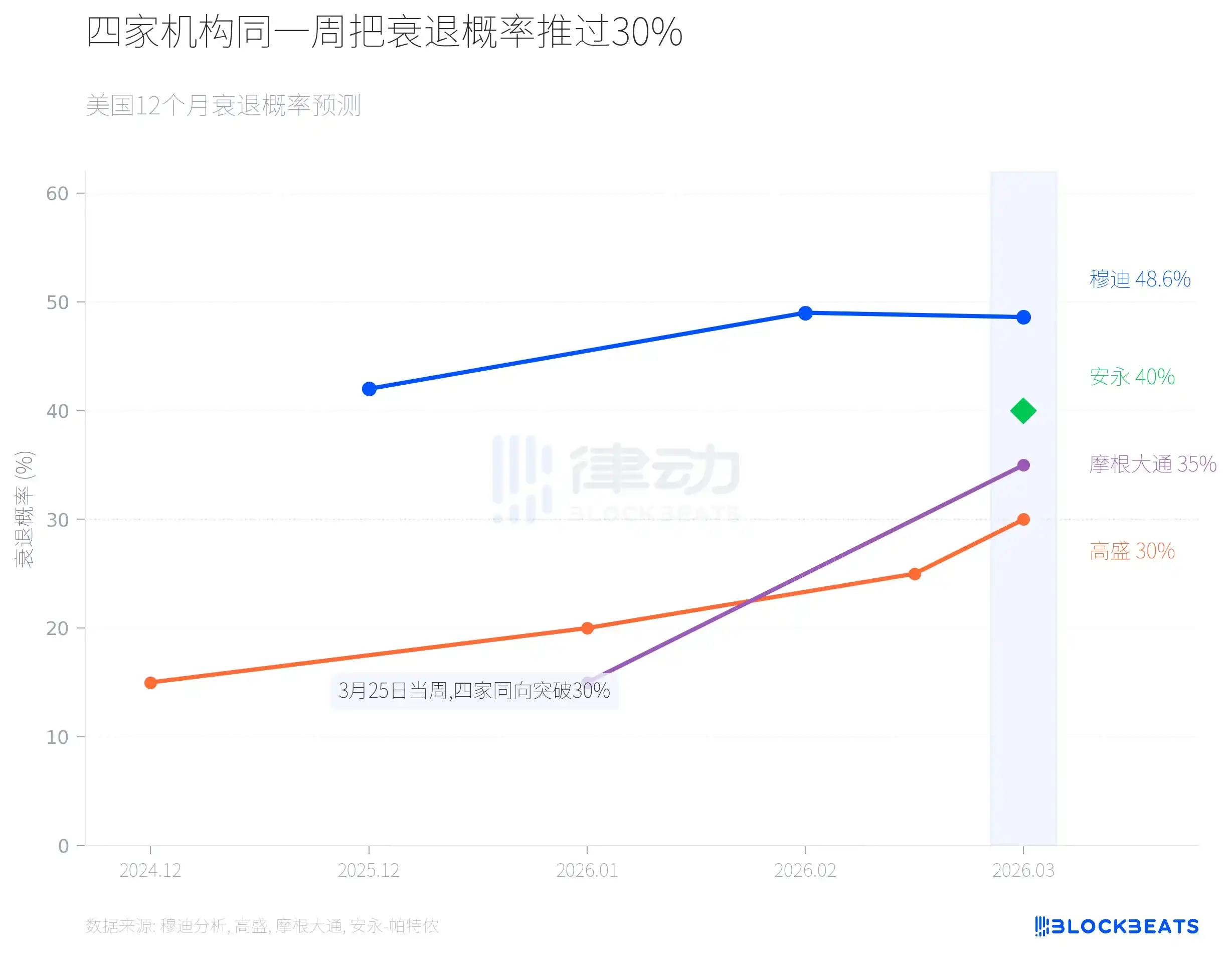
Goldman Sachs' trajectory is equally steep. According to the Fortune report, Goldman Sachs' prediction in December 2024 was 15%, slightly adjusted to 20% in January this year, raised to 25% on March 12, and reached 30% by March 25. A pace of doubling every two weeks is rare in Goldman Sachs' historical forecasts. Goldman Sachs also raised its PCE inflation forecast by 0.2 percentage points to 3.1%, lowered its full-year GDP growth forecast to 2.1%, and postponed its expectation for the first interest rate cut from June to September.

J.P. Morgan Global Research gave 35%. According to a CNBC report on March 19, J.P. Morgan economists simultaneously lowered their year-end target for the S&P 500 from 7500 points to 7200 points, with an extreme scenario possibly dropping to 6000 points.

EY-Parthenon was the last of the four to speak, but its 40% probability came with an interesting qualifier. According to a World Oil report on March 24, Gregory Daco, Chief Economist at EY-Parthenon, defined the current situation as a "multi-dimensional disturbance," reasoning that the impact is not limited to crude oil supply but also affects the refining system, LNG infrastructure, and fertilizer supply chains. This means that even if oil prices fall, inflationary pressures will not subside simultaneously.

Historical Win Rate of Oil Price Shocks

The core assumptions of the four institutions share a common variable: oil prices. Since the U.S.-Israel strike on Iran on February 28, Brent crude has climbed from about $70 per barrel, breaking through $100 on March 8 (the first time in four years), and touching $115 last week. As of March 25, it closed at $102.22.

According to the IEA's March report, the Strait of Hormuz previously saw about 20 million barrels of crude oil passing through daily, accounting for approximately 20% of global seaborne oil trade. After the conflict erupted, Gulf countries' crude oil production was cut by at least 10 million barrels per day. Zandi estimated in an interview with Fortune that about one-third of the global fertilizer supply also passes through this route.

Energy shocks of this magnitude have occurred four times in history.
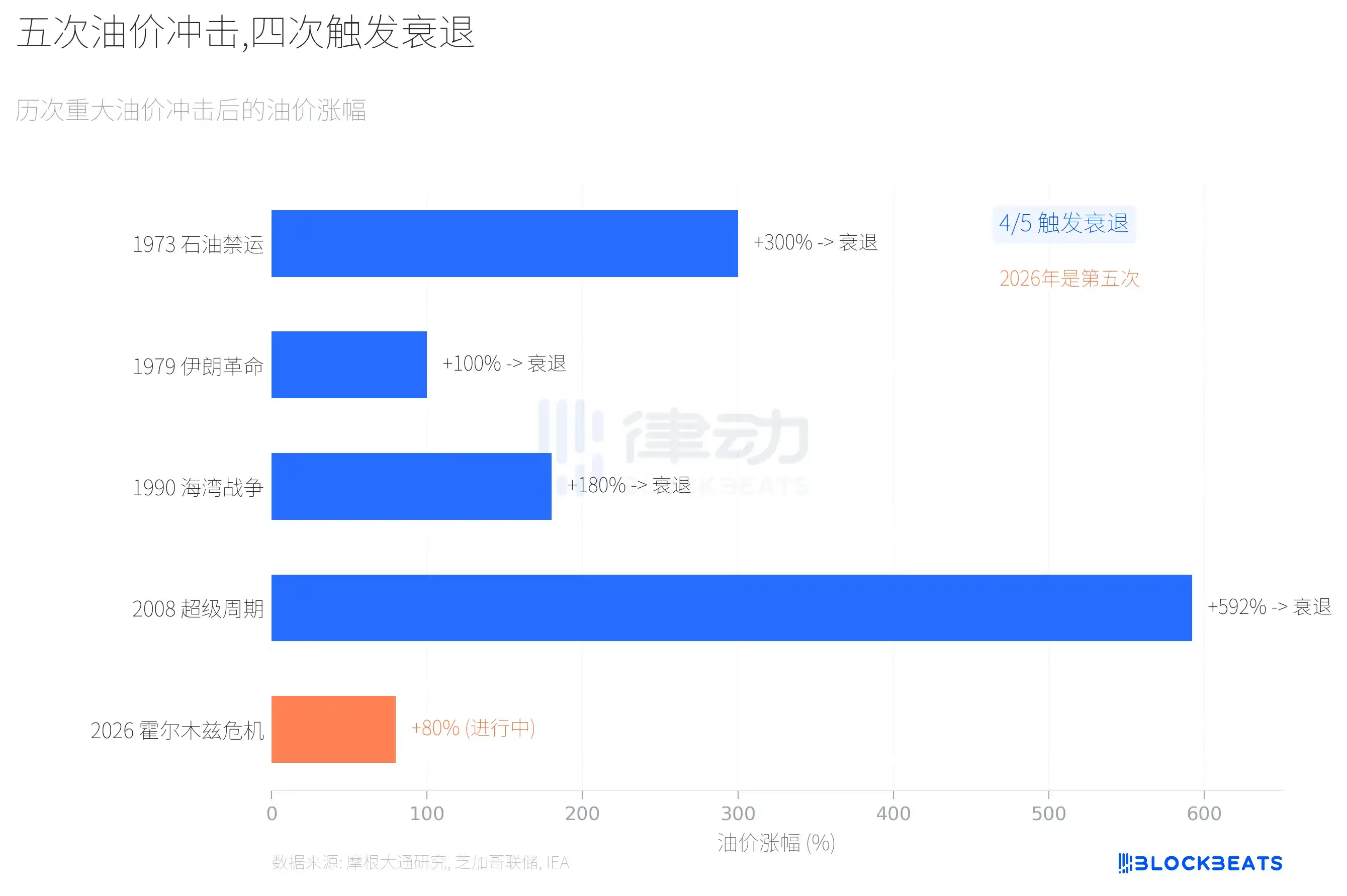
According to J.P. Morgan research, among the five major oil price shocks since the 1970s, four triggered recessions afterward. The 1973 Yom Kippur War caused oil prices to surge by 300%, and the U.S. entered a recession in November that year. The 1979 Iranian Revolution doubled oil prices, and a recession began in January 1980. The 1990 Gulf War pushed oil prices up by 180%, and the recession started almost simultaneously. The supercycle from 2002 to 2008 saw a cumulative oil price increase of 592%, ultimately ending with the global financial crisis.

The current increase from the 2026 Strait of Hormuz crisis is about 80%, the smallest among the five. But there is a key difference: the scale of this supply disruption is larger than any previous one. The IEA describes it as "the largest disturbance to energy supply since the 1970s energy crisis."

J.P. Morgan economists provided a quantitative estimate: every sustained 10% increase in oil prices drags U.S. GDP down by about 15 to 20 basis points.

Fink's Dichotomy

On March 25, Larry Fink, CEO of BlackRock, which manages over $10 trillion in assets, provided a more direct framework than numbers in an interview with the BBC.

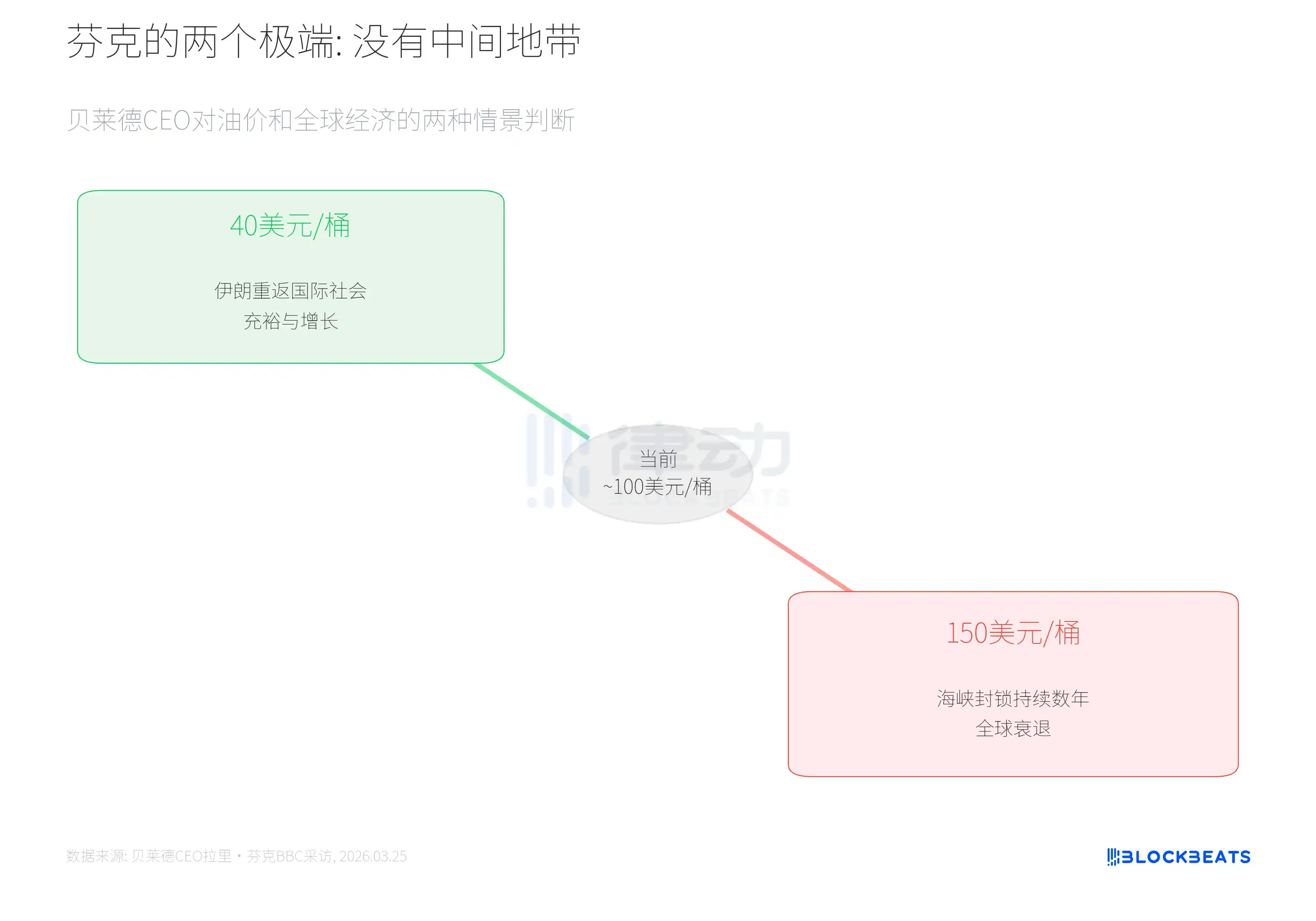
According to the Fortune report, Fink said: "There will be no middle ground; the outcome will definitely be one of two extremes."

The first scenario: Iran is accepted by the international community, re-engages in global trade, oil supply recovers, oil prices fall to $40 per barrel, and the world welcomes growth. The second scenario: the conflict continues, the strait remains blocked for years, oil prices stay above $100 or even approach $150, and the world enters a recession. Fink specifically pointed out that the ripple effects of high oil prices would extend to agricultural products and fertilizers, as these are byproducts of natural gas.
However, Fink also ruled out one possibility, clearly stating that there would not be a systemic financial crisis like 2008, as financial institutions' capital adequacy ratios are much higher now than back then.

Consensus Itself Is a Variable

Returning to the initial question. Moody's uses a machine learning model, Goldman Sachs uses a macroeconomic forecasting framework, J.P. Morgan tracks a five-factor indicator, and EY-Parthenon approaches from the supply chain dimension. Four different methodologies converged in the same direction in the same week.

According to the University of Michigan's March survey, the Consumer Confidence Index fell to 55.5, at the 2nd historical percentile. According to BLS data, U.S. nonfarm payrolls decreased by 92,000 in February, the opposite of the market expectation of an increase of 60,000. Leisure and hospitality lost 27,000, healthcare lost 28,000, manufacturing lost 12,000, and the federal government lost 10,000. According to BLS statistics, since the peak in October 2024, federal government employment has cumulatively shrunk by 330,000, a drop of 11%.

Zandi said in the interview that if oil prices average around $125 per barrel in the second quarter, "that would push us into a recession." At Brent's current level of about $102, it is $23 away from that line.

These four institutions' predictions may not be accurate. But when four institutions arrive at similar conclusions using different methods in the same week, its impact is more than just a probability number. Businesses may delay investment plans because of it, consumers may tighten their spending, and these behaviors themselves will, in turn, depress economic data, causing the numbers in the next round of predictions to continue rising.


Câu hỏi Liên quan

QWhat are the recession probability forecasts for the next 12 months from Moody's Analytics, Goldman Sachs, J.P. Morgan, and EY-Parthenon, as mentioned in the article?

AMoody's Analytics forecasts a 48.6% probability, EY-Parthenon 40%, J.P. Morgan 35%, and Goldman Sachs 30%.

QAccording to the article, what is the key common variable in the core assumptions of the four institutions that is driving the increased recession risk?

AThe key common variable is the price of oil, which has surged due to disruptions in the Strait of Hormuz.

QWhat historical precedent does the J.P. Morgan research cite regarding oil price shocks and recessions?

AJ.P. Morgan research states that out of five major oil price shocks since the 1970s, four triggered recessions: following the 1973 Yom Kippur War, the 1979 Iranian Revolution, the 1990 Gulf War, and the 2002-2008 supercycle that ended with the global financial crisis.

QWhat are the two extreme scenarios for the global economy outlined by BlackRock CEO Larry Fink in his interview?

AThe first scenario is Iran being reintegrated into global trade, oil supply recovering, and oil prices falling to $40/barrel, leading to global growth. The second scenario is a prolonged conflict and blockade of the Strait of Hormuz, with oil prices staying above $100 or even nearing $150/barrel, triggering a global recession.

QWhat specific level of oil prices does Moody's chief economist, Mark Zandi, say would 'push us into a recession'?

AMark Zandi stated that if oil prices average around $125 per barrel in the second quarter, it would push the economy into a recession.

Nội dung Liên quan

Ngân hàng Ý không nhìn thấy lợi thế hệ thống của stablecoin trong chuyển tiền

Một nghiên cứu của Ngân hàng Ý kết luận rằng stablecoin không mang lại lợi thế hệ thống bền vững về chi phí và tốc độ trong chuyển tiền quốc tế so với các dịch vụ tiêu chuẩn. Các ưu điểm tiềm năng bị mất đi bởi phí chuyển đổi sang/và từ tiền pháp định và hiệu quả của cơ sở hạ tầng thanh toán địa phương. Nghiên cứu so sánh việc chuyển 200 USDC qua 10 hành lang giữa Ý và các nước như Brazil, Argentina, Nhật Bản, UAE và Nam Phi. Tổng chi phí chuyển stablecoin dao động từ 0,3% đến gần 9%, tùy tuyến. Thời gian giải quyết giao dịch dưới 20 phút ở những nơi có hệ thống thanh toán tức thời, nhưng có thể kéo dài 1-2 ngày làm việc ở khu vực không có. Chi phí và độ trễ chủ yếu đến từ việc trao đổi, chuyển đổi tiền tệ và chất lượng hạ tầng địa phương, không phải từ phí blockchain. Dù stablecoin rẻ hơn mức trung bình toàn cầu là 6,65%, chúng chỉ rẻ hơn dịch vụ Wise ở 3/7 tuyến so sánh được. Các tác giả cho rằng lợi ích sẽ rõ ràng hơn nếu stablecoin có thể được chi tiêu trực tiếp mà không cần đổi sang tiền địa phương. Họ cũng lưu ý rằng các quy định cấm đoán không làm giảm nhu cầu với stablecoin, trong khi quy định quá chặt chẽ lại gây khó khăn cho người dùng phổ thông.

cryptonews.ru2 giờ trước

Ngân hàng Ý không nhìn thấy lợi thế hệ thống của stablecoin trong chuyển tiền

cryptonews.ru2 giờ trước

Cơn sốt Bitcoin đang bùng nổ: Tuyên bố mới của Saylor gây nên những đồn đoán về việc mua vào

Giám đốc điều hành của Strategy Inc. (Nasdaq: MSTR), Michael Saylor, một lần nữa khơi dậy những đồn đoán về việc công ty sẽ thông báo mua Bitcoin mới vào thứ Hai, sau khi đăng thông điệp "Bitcoin Drive engaged" vào ngày 2 tháng 8. Thông báo này đi kèm với biểu đồ mua hàng quen thuộc của công ty, phù hợp với thói quen báo hiệu thay đổi kho bạc trước các báo cáo hàng tuần của Saylor. Báo cáo kèm theo cho thấy dự trữ Bitcoin của Strategy là 843.775 BTC, trị giá khoảng 53,25 tỷ USD. Giá mua trung bình được ghi nhận là 75.653 USD/BTC, với lỗ chưa thực hiện là 10,58 tỷ USD (-16,58%). Một tín hiệu tương tự vào Chủ nhật tuần trước đã dẫn đến thông báo vào ngày 27/7 về việc công ty gia tăng dự trữ tiền mặt. Sổ cái thời gian thực của Strategy hiển thị 116 giao dịch đã đăng ký với tổng số 843.775 BTC được mua, đồng thời ghi nhận hai đợt bán Bitcoin gần đây tổng cộng 3.588 BTC (giảm từ 847.363 BTC), nhằm mục đích tài trợ cho cổ tức ưu đãi và bổ sung dự trữ USD. Công ty được báo cáo là đã không mua BTC trong tuần kết thúc ngày 26/7, đồng thời tăng dự trữ USD lên khoảng 3,75 tỷ USD. Bối cảnh tài chính đầy thách thức khi Strategy báo lỗ hoạt động 8,33 tỷ USD trong quý II/2026, chủ yếu do lỗ chưa thực hiện trên tài sản kỹ thuật số. Ban lãnh đạo có thể bán thêm tới 1,25 tỷ USD Bitcoin để củng cố dự trữ USD. Thông báo cập nhật dự kiến vào thứ Hai sẽ cho thấy liệu "Bitcoin Drive" có đánh dấu việc tái tích lũy hay không, khi Strategy cân bằng giữa kho dự trữ Bitcoin khổng lồ và các nghĩa vụ tiền mặt ngày càng tăng.

cryptonews.ru2 giờ trước

Cơn sốt Bitcoin đang bùng nổ: Tuyên bố mới của Saylor gây nên những đồn đoán về việc mua vào

cryptonews.ru2 giờ trước

Cổ phiếu các công ty trí tuệ nhân tạo được giao dịch như 'meme coin', trong khi Bitcoin hầu như không thay đổi giá - Tổng quan tuần

**Tóm tắt:** Bài viết phân tích các diễn biến chính trên thị trường tài chính và tiền điện tử trong tuần, với trọng tâm là sự biến động mạnh ở lĩnh vực AI và sự trầm lặng tương đối của Bitcoin. **Thị trường chứng khoán & AI:** * Cổ phiếu AI được giao dịch như "meme coin" với biến động cực đoan. Thị trường Hàn Quốc lao dốc 8% trong một phiên, chịu ảnh hưởng từ đợt bán tháo chip toàn cầu. * Quỹ "Situational Awareness" của Leopold Aschenbrenner bị thua lỗ nặng, dẫn đến thanh lý tài sản lớn, góp phần gây ra biến động. Citadel được cho là đã mua lại phần lớn danh mục của quỹ này. * Các chuyên gia như Ram Ahluwalia và Flood khuyên nên kiên nhẫn, trong khi Jim Bianco lưu ý thị trường thường tìm đáy sau khi một sự kiện lớn (như sự sụp đổ của một quỹ) xảy ra. **Macro & Tiền tệ:** * Các phát biểu của Chủ tịch Fed Kevin Warsh được cho là đã góp phần gây ra biến động, với một số ý kiến cho rằng ông thiếu năng lực. * Bộ Tài chính Nhật Bản can thiệp để hỗ trợ đồng Yên, nhưng hiệu quả hạn chế. * Có dấu hiệu về việc giảm thanh khoản toàn cầu và đà tăng trưởng sản xuất Mỹ chậm hơn kỳ vọng. **Thị trường Tiền điện tử:** * Bitcoin ít biến động, dao động quanh mức 64,000 USD, trong khi sự chú ý đổ dồn sang thị trường truyền thống. * Nhiều công ty tiền điện tử gặp khó khăn: BitMart và Storj Labs tuyên bố đóng cửa/phá sản; Coinbase (COIN) lao dốc sau báo cáo tài chính yếu; Uphold và các sàn khác cắt giảm nhân sự. * MicroStrategy tiếp tục tích lũy Bitcoin và mua lại cổ phiếu của chính mình, một chiến lược bị chỉ trích là "vòng xoáy Ponzi". * Cảnh báo bảo mật nghiêm trọng về lỗ hổng trên ví phần cứng Coldcard có thể làm lộ khóa riêng tư, đòi hỏi người dùng hành động ngay. **Các chủ đề khác:** * **DeFi/Blockchain:** Trade.xyz trên Hyperliquid và Pump.fun trên Solana cực kỳ thành công, đặt ra câu hỏi liệu họ có tự khởi chạy blockchain riêng hay không. Nghi ngờ giao dịch nội gián trên Hyperliquid. * **AI & Crypto:** Jason Calacanis và Barry Silbert nhiệt tình ủng hộ dự án Bittensor (TAO), coi đó là mô hình AI phi tập trung. Tác giả cảnh báo nên thận trọng trước sự cổ xúy của các nhà đầu tư mạo hiểm. * Các tranh cãi trong ngành: Kyle Samani chỉ trích Multicoin Capital; Charles Hoskinson khó chịu vì câu hỏi về quá khứ đồng sáng lập Ethereum. **Thông điệp chính:** Thị trường đang trải qua giai đoạn biến động mạnh, đặc biệt ở mảng AI, trong khi tiền điện tử chịu áp lực. Tính kỷ luật, sự kiên nhẫn và cảnh giác cao độ (đặc biệt về bảo mật) là cần thiết trong bối cảnh hiện tại.

cryptonews.ru2 giờ trước

Cổ phiếu các công ty trí tuệ nhân tạo được giao dịch như 'meme coin', trong khi Bitcoin hầu như không thay đổi giá - Tổng quan tuần

cryptonews.ru2 giờ trước

Giao dịch

Giao ngay
活动图片




