US-Iran War: Why Did Turkey Sell Off 58.4 Tons of Gold in Two Weeks?

marsbitXuất bản vào 2026-03-30Cập nhật gần nhất vào 2026-03-30

Tóm tắt

Turkish Central Bank sold approximately 58.4 tons of gold, worth over $8 billion, within two weeks in March 2026, as a response to a severe financial crisis triggered by the U.S.-Israel military operation against Iran. The conflict led to Iran blocking the Strait of Hormuz, causing oil prices to surge over 40% and cutting off natural gas supplies to Turkey, which relies heavily on energy imports. This resulted in a plunging Turkish lira, massive foreign capital flight, and rapid depletion of foreign reserves. To defend the currency and meet urgent dollar demands, Turkey utilized gold swaps—temporarily exchanging gold for dollars with agreements to repurchase later—rather than outright sales, to avoid market panic and preserve long-term reserves. The move highlights Turkey's vulnerability to energy shocks and its strategic use of gold reserves for liquidity during crises. If the conflict persists, further gold sales may be necessary, adding downward pressure on global gold prices.

Author: Le Ming

A recent figure that has stunned global financial markets has emerged: the Turkish central bank sold off approximately 58.4 tons of gold in just two weeks, worth over $8 billion. Of this, 6 tons were reduced in the week of March 13, and 52.4 tons were sharply cut in the week of March 20.

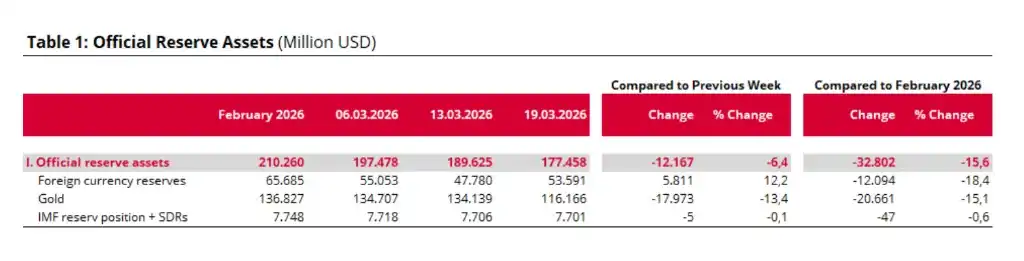
The weekly data from the Turkish central bank clearly outlines this picture: from March 13 to 19, the market value of gold reserves plummeted from $134.1 billion to $116.2 billion, evaporating nearly $18 billion in a single week; meanwhile, foreign exchange reserves (excluding gold) actually increased by $5.8 billion.

Between the decline and the rise, the traces of a "gold for foreign exchange" operation are unmistakable.

Over the past decade, Turkey has been one of the world's most aggressive gold buyers, with gold reserves rising from 116 tons in 2011 to over 820 tons.

Why suddenly sell off such hard-earned assets on a large scale within two weeks?

The answer is three words: to survive.

Trigger: A War That Pushed Turkey into a "Perfect Storm"

On February 28, the United States and Israel jointly launched a military operation codenamed "Epic Fury," launching airstrikes on Iranian nuclear facilities, military bases, and government buildings.

Iran retaliated and effectively blockaded the Strait of Hormuz—a passage for 20% of the world's seaborne oil and 20% of LNG trade.

Brent crude surged from $73 per barrel before the war to over $106, a rise of more than 40%. The International Energy Agency defined it as the "most severe global energy security challenge in history."

For most countries, this was a shock; but for Turkey, it was a survival crisis.

Turkey relies on imports for 90% of its oil and 98% of its natural gas. Every $10 increase in oil prices adds $4.5 to $7 billion to the current account deficit. Based on post-war oil prices, the annual energy import cost could surge by about $15 billion.

An even more fatal blow came on March 24—when Israel airstriked Iran's South Pars gas field, Iran subsequently halted natural gas exports to Turkey. Iran is Turkey's second-largest pipeline natural gas supplier, accounting for about 13% to 14% of its natural gas imports. The 25-year contract for this pipeline is set to expire in July 2026, and the war directly dashed prospects for renewal.

Simply put, Turkey's situation is: its energy bill suddenly doubled, a key gas source was cut off, and no equivalent replacement could be found in the short term.

Transmission Chain: Foreign Exchange Reserves Buckled First

Energy imports require settlement in US dollars, so importers scrambled for dollars, and the lira plummeted.

In the 16 trading days since the conflict began, the lira hit a record low against the dollar 11 times, reaching about 44.35 lira per dollar on March 25.

Behind this was the accelerated withdrawal of foreign investors: in three weeks, foreign capital outflows from Turkish bonds reached $4.7 billion, with $1.2 billion flowing out of the stock market, while carry trade positions shrank from a record $61.2 billion in January to below $45 billion.

The Turkish central bank was thus forced to launch a "lira defense battle." In just the first week of March, it sold over $8 billion in foreign exchange. In the three weeks ending March 19, the central bank cumulatively consumed about $25 to $30 billion in foreign exchange reserves. Net reserves, after deducting swaps, plummeted from $54.3 billion before the war to $43 billion.

Turkey's weekly data fully records this process: foreign exchange reserves (excluding gold) fell from $55 billion on March 6 to $47.8 billion on March 13—first using foreign exchange ammunition. By March 19, foreign exchange reserves rebounded to $53.6 billion, but gold reserves simultaneously plummeted from $134.1 billion to $116.2 billion—foreign exchange ammunition was nearly exhausted, and gold began to be used.

This is a textbook example of an emergency defense sequence: "first use foreign exchange, then use gold."

Figure: Foreign exchange data released by the Turkish central bank
Gold Swaps: Why "Sell" Instead of "Pawn"?

The key to understanding this operation is: more than half of Turkey's gold reduction was done through swaps, not direct sales.

The essence of a gold swap is "exchanging gold for foreign exchange, with redemption upon maturity." The central bank transfers gold to the counterparty (usually a primary investment bank) in exchange for an equivalent amount of US dollars, while signing a forward contract to repurchase the gold at a slightly higher price in the future. It is a short-term financing behavior, not a permanent liquidation.

The central bank chose swaps over outright sales for at least three reasons.

First, to retain long-term positions. If the oil price surge is judged to be a temporary shock, swaps can address the urgent need, and the gold can be redeemed later, avoiding the destruction of a decade of accumulation.

Second, to reduce the impact on gold prices. Directly dumping 60 tons of gold could trigger a cliff-like plunge in the market, in turn causing a significant devaluation of its remaining over $100 billion in gold reserves. Swaps are conducted quietly in the over-the-counter market, with much less impact.

Third, a buffer at the domestic political level. Gold is an "anti-inflation totem" in the hearts of the Turkish people. Announcing large-scale gold sales could easily trigger panic, while swaps can maintain a certain degree of ambiguity technically.

This operation was completed quickly within two weeks thanks to a key pre-arrangement: Turkey stored about 111 tons of gold, worth about $30 billion, at the Bank of England. This gold could be used for foreign exchange intervention without logistical constraints—no need for cross-border physical transport, directly pledged and liquidated in the City of London.

Pressure on Gold Prices

Turkey has a historical pattern: selling gold during crises and buying back after crises.

The 2018 lira crisis, the 2020 pandemic shock, the 2023 earthquake—each time the central bank reduced gold to provide liquidity but resumed accumulation afterward. Analysts generally believe that the operation in March 2026 continues this pattern.

But this judgment has a core premise: the war cannot be prolonged.

Swap agreements come with holding costs and interest. If the war continues, energy prices remain anchored at over $100 for the long term, and Turkey's foreign exchange earning capacity cannot cover the soaring energy bill, then these "temporary swaps" will never be redeemed, effectively becoming "permanent fire sales."

Therefore, in the coming weeks, if the war continues, Turkey will need to continue turning its $135 billion in gold reserves into a lifeline.

Although Turkey prefers to "pledge" gold to obtain foreign exchange liquidity, these transactions still substantially increase the downward pressure on the gold market. In the London over-the-counter market, when the Turkish central bank transfers tens of tons of gold as collateral to international counterparties (such as investment banks) in exchange for US dollars, these financial institutions, to hedge their own position risks, typically conduct corresponding short-selling or selling operations in the spot or futures derivative markets.

Therefore, the liquidity of this batch of gold will eventually be transmitted to the market, indirectly increasing supply and depressing prices.

Conclusion

The Turkish central bank's sale of 60 tons of gold in two weeks is not panic, not speculation, but a rational self-rescue by a country highly dependent on energy imports after its ally bombed its largest energy supplier, facing the triple blow of depleted foreign exchange, a plummeting lira, and a cut-off of natural gas supply.

Figure: The market is frantically shorting the lira, partly betting that the war will not end soon and partly betting that Turkey will ultimately not hold out.
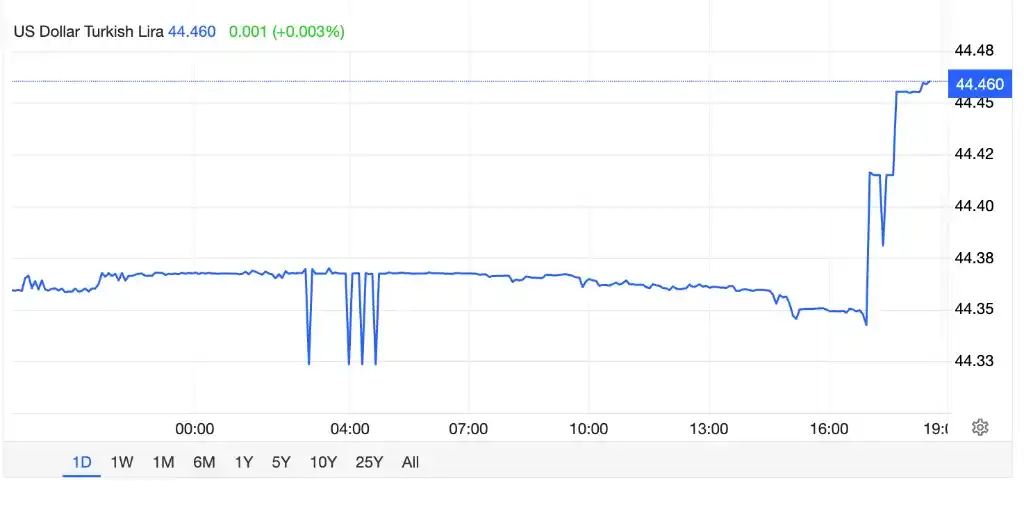
As the war prospects worsen, Turkey still needs to continue to withstand the pressure.


Tiền kỹ thuật số thịnh hành

Câu hỏi Liên quan

QWhy did Turkey's central bank sell 58.4 tons of gold in just two weeks?

ATo survive a severe financial crisis triggered by the US-Israel war with Iran, which caused a surge in energy import costs, a collapse of the Turkish lira, and a critical depletion of foreign exchange reserves.

QWhat was the immediate trigger for Turkey's financial crisis in March 2026?

AThe US-Israel military operation 'Epic Rage' against Iran, which led to Iran blocking the Strait of Hormuz and cutting off natural gas exports to Turkey, causing oil prices to soar over 40%.

QHow did the Turkish central bank's gold sales operation work, and why was it done through swaps?

AOver half of the gold was减持 via swaps, not direct sales. This 'pawned' the gold to international banks for immediate USD liquidity, with an agreement to buy it back later. This was done to preserve long-term reserves, minimize market impact, and avoid domestic political panic.

QWhat impact did the energy crisis have on Turkey's currency and foreign reserves?

AThe lira hit record lows against the dollar 11 times in 16 trading sessions. The central bank burned through $250-300 billion in foreign reserves in three weeks defending it, forcing it to then use its gold reserves as a last resort.

QHow could the ongoing war turn Turkey's temporary gold swaps into a permanent loss?

AIf the war continues and energy prices remain high, Turkey may be unable to generate enough foreign exchange to redeem the gold from the swap agreements, effectively forcing a permanent sale.

Nội dung Liên quan

Sự cố Coldcard kích hoạt làn sóng Bitcoin, củng cố tiền điện tử 'tăng giá': Hodler's Digest, 2 tháng 8

Sự kiện khai thác lỗ hổng trên ví cứng Coldcard đã dẫn đến việc mất khoảng 90 triệu USD Bitcoin, khiến nhiều nhà đầu tư nhỏ chuyển tiền gấp sang các sàn tập trung. Dữ liệu cho thấy khối lượng giao dịch Bitcoin dưới 1 BTC đạt mức cao nhất hàng ngày kể từ năm 2022. Trong bối cảnh đó, ngành công nghiệp tiền mã hóa được cho là đang bước vào giai đoạn củng cố lớn nhất, với doanh thu ngày càng tập trung vào một số ít giao thức hàng đầu như Hyperliquid và Pump.fun. Nhà phân tích Lorenzo Valente của ARK Invest nhận định xu hướng này là "cực kỳ tích cực" cho không gian crypto, dù nó có thể đi kèm với nhiều vụ sáp nhập, phá sản và đóng cửa dự án. Mặt khác, báo cáo thu nhập quý II của các công ty lớn như Coinbase và MicroStrategy cho thấy kết quả ảm đạm, với thua lỗ gia tăng. Đồng thời, những bất ổn về mặt pháp lý vẫn tiếp diễn, như sự bế tắc của Dự luật Clarity Act tại Mỹ hay các cáo buộc nhắm vào nhà sáng lập Telegram Pavel Durov từ Nga và Australia. Cuối tuần, thị trường chung đi xuống, với Bitcoin giảm 3%. Grayscale đưa ra dự báo lạc quan rằng Bitcoin có thể đã chạm đáy sớm hơn chu kỳ truyền thống, mặc dù nhiều tín hiệu tương tự trước đó vẫn chưa ứng nghiệm.

cointelegraph17 phút trước

Sự cố Coldcard kích hoạt làn sóng Bitcoin, củng cố tiền điện tử 'tăng giá': Hodler's Digest, 2 tháng 8

cointelegraph17 phút trước

Ngân hàng Ý không nhìn thấy lợi thế hệ thống của stablecoin trong chuyển tiền

Một nghiên cứu của Ngân hàng Ý kết luận rằng stablecoin không mang lại lợi thế hệ thống bền vững về chi phí và tốc độ trong chuyển tiền quốc tế so với các dịch vụ tiêu chuẩn. Các ưu điểm tiềm năng bị mất đi bởi phí chuyển đổi sang/và từ tiền pháp định và hiệu quả của cơ sở hạ tầng thanh toán địa phương. Nghiên cứu so sánh việc chuyển 200 USDC qua 10 hành lang giữa Ý và các nước như Brazil, Argentina, Nhật Bản, UAE và Nam Phi. Tổng chi phí chuyển stablecoin dao động từ 0,3% đến gần 9%, tùy tuyến. Thời gian giải quyết giao dịch dưới 20 phút ở những nơi có hệ thống thanh toán tức thời, nhưng có thể kéo dài 1-2 ngày làm việc ở khu vực không có. Chi phí và độ trễ chủ yếu đến từ việc trao đổi, chuyển đổi tiền tệ và chất lượng hạ tầng địa phương, không phải từ phí blockchain. Dù stablecoin rẻ hơn mức trung bình toàn cầu là 6,65%, chúng chỉ rẻ hơn dịch vụ Wise ở 3/7 tuyến so sánh được. Các tác giả cho rằng lợi ích sẽ rõ ràng hơn nếu stablecoin có thể được chi tiêu trực tiếp mà không cần đổi sang tiền địa phương. Họ cũng lưu ý rằng các quy định cấm đoán không làm giảm nhu cầu với stablecoin, trong khi quy định quá chặt chẽ lại gây khó khăn cho người dùng phổ thông.

cryptonews.ru2 giờ trước

Ngân hàng Ý không nhìn thấy lợi thế hệ thống của stablecoin trong chuyển tiền

cryptonews.ru2 giờ trước

Cơn sốt Bitcoin đang bùng nổ: Tuyên bố mới của Saylor gây nên những đồn đoán về việc mua vào

Giám đốc điều hành của Strategy Inc. (Nasdaq: MSTR), Michael Saylor, một lần nữa khơi dậy những đồn đoán về việc công ty sẽ thông báo mua Bitcoin mới vào thứ Hai, sau khi đăng thông điệp "Bitcoin Drive engaged" vào ngày 2 tháng 8. Thông báo này đi kèm với biểu đồ mua hàng quen thuộc của công ty, phù hợp với thói quen báo hiệu thay đổi kho bạc trước các báo cáo hàng tuần của Saylor. Báo cáo kèm theo cho thấy dự trữ Bitcoin của Strategy là 843.775 BTC, trị giá khoảng 53,25 tỷ USD. Giá mua trung bình được ghi nhận là 75.653 USD/BTC, với lỗ chưa thực hiện là 10,58 tỷ USD (-16,58%). Một tín hiệu tương tự vào Chủ nhật tuần trước đã dẫn đến thông báo vào ngày 27/7 về việc công ty gia tăng dự trữ tiền mặt. Sổ cái thời gian thực của Strategy hiển thị 116 giao dịch đã đăng ký với tổng số 843.775 BTC được mua, đồng thời ghi nhận hai đợt bán Bitcoin gần đây tổng cộng 3.588 BTC (giảm từ 847.363 BTC), nhằm mục đích tài trợ cho cổ tức ưu đãi và bổ sung dự trữ USD. Công ty được báo cáo là đã không mua BTC trong tuần kết thúc ngày 26/7, đồng thời tăng dự trữ USD lên khoảng 3,75 tỷ USD. Bối cảnh tài chính đầy thách thức khi Strategy báo lỗ hoạt động 8,33 tỷ USD trong quý II/2026, chủ yếu do lỗ chưa thực hiện trên tài sản kỹ thuật số. Ban lãnh đạo có thể bán thêm tới 1,25 tỷ USD Bitcoin để củng cố dự trữ USD. Thông báo cập nhật dự kiến vào thứ Hai sẽ cho thấy liệu "Bitcoin Drive" có đánh dấu việc tái tích lũy hay không, khi Strategy cân bằng giữa kho dự trữ Bitcoin khổng lồ và các nghĩa vụ tiền mặt ngày càng tăng.

cryptonews.ru2 giờ trước

Cơn sốt Bitcoin đang bùng nổ: Tuyên bố mới của Saylor gây nên những đồn đoán về việc mua vào

cryptonews.ru2 giờ trước

Giao dịch

Giao ngay

Bài viết Nổi bật

Làm thế nào để Mua WAR

Chào mừng bạn đến với HTX.com! Chúng tôi đã làm cho mua WAR (WAR) trở nên đơn giản và thuận tiện. Làm theo hướng dẫn từng bước của chúng tôi để bắt đầu hành trình tiền kỹ thuật số của bạn.Bước 1: Tạo Tài khoản HTX của BạnSử dụng email hoặc số điện thoại của bạn để đăng ký tài khoản miễn phí trên HTX. Trải nghiệm hành trình đăng ký không rắc rối và mở khóa tất cả tính năng. Nhận Tài khoản của tôiBước 2: Truy cập Mua Crypto và Chọn Phương thức Thanh toán của BạnThẻ Tín dụng/Ghi nợ: Sử dụng Visa hoặc Mastercard của bạn để mua WAR (WAR) ngay lập tức.Số dư: Sử dụng tiền từ số dư tài khoản HTX của bạn để giao dịch liền mạch.Bên thứ ba: Chúng tôi đã thêm những phương thức thanh toán phổ biến như Google Pay và Apple Pay để nâng cao sự tiện lợi.P2P: Giao dịch trực tiếp với người dùng khác trên HTX.Thị trường mua bán phi tập trung (OTC): Chúng tôi cung cấp những dịch vụ được thiết kế riêng và tỷ giá hối đoái cạnh tranh cho nhà giao dịch.Bước 3: Lưu trữ WAR (WAR) của BạnSau khi mua WAR (WAR), lưu trữ trong tài khoản HTX của bạn. Ngoài ra, bạn có thể gửi đi nơi khác qua chuyển khoản blockchain hoặc sử dụng để giao dịch những tiền kỹ thuật số khác.Bước 4: Giao dịch WAR (WAR)Giao dịch WAR (WAR) dễ dàng trên thị trường giao ngay của HTX. Chỉ cần truy cập vào tài khoản của bạn, chọn cặp giao dịch, thực hiện giao dịch và theo dõi trong thời gian thực. Chúng tôi cung cấp trải nghiệm thân thiện với người dùng cho cả người mới bắt đầu và người giao dịch dày dạn kinh nghiệm.

Tổng lượt xem 1.1kXuất bản vào 2024.12.11Cập nhật vào 2026.06.02

Làm thế nào để Mua WAR

Thảo luận

Chào mừng đến với Cộng đồng HTX. Tại đây, bạn có thể được thông báo về những phát triển nền tảng mới nhất và có quyền truy cập vào thông tin chuyên sâu về thị trường. Ý kiến ​​của người dùng về giá của WAR (WAR) được trình bày dưới đây.

活动图片












