Author: Liu Kaiwen
Original Title: U.S. Captures Another Country's President, Trump-Linked Platform Says This Doesn't Count as "Invasion"
CARACAS, Venezuela – In the early hours of January 3rd local time, U.S. forces entered Venezuelan territory simultaneously by air and ground, secured several key military facilities, and escorted President Nicolás Maduro to the United States.
Precision airstrikes, armed ground troops taking control, abducting a head of state... According to common definitions under international law, this constitutes a military invasion of a sovereign nation.
Meanwhile, on Polymarket, the world's hottest prediction market, a group of traders had already begun celebrating their own victory triggered by this attack.
They had bet that the U.S. would invade Venezuela before the event, and the smoke and artillery fire reported in the news seemed like an early celebration of their high-odds, massive profits.
At that moment, no one who had placed a bet thought they were already destined to lose the moment they entered the trade.
News Reported Globally Never Happened on Polymarket
The market "Will the U.S. invade Venezuela before January 31, 2026?" had a straightforward definition of invasion before the attack: "a military offensive by U.S. armed forces with the purpose of establishing control."
After the attack, the probability (which translates to odds) in this market surged from 2% to 80%. This probability-as-odds trading model meant traders who bet "Yes" before the attack saw massive floating profits.
Then, just as mainstream media globally were reporting on the "U.S. attack on Venezuela," the market suddenly saw multiple large trades betting "No," asserting that "the U.S. did not invade Venezuela." This caused the probability to drop to a low of 7%.
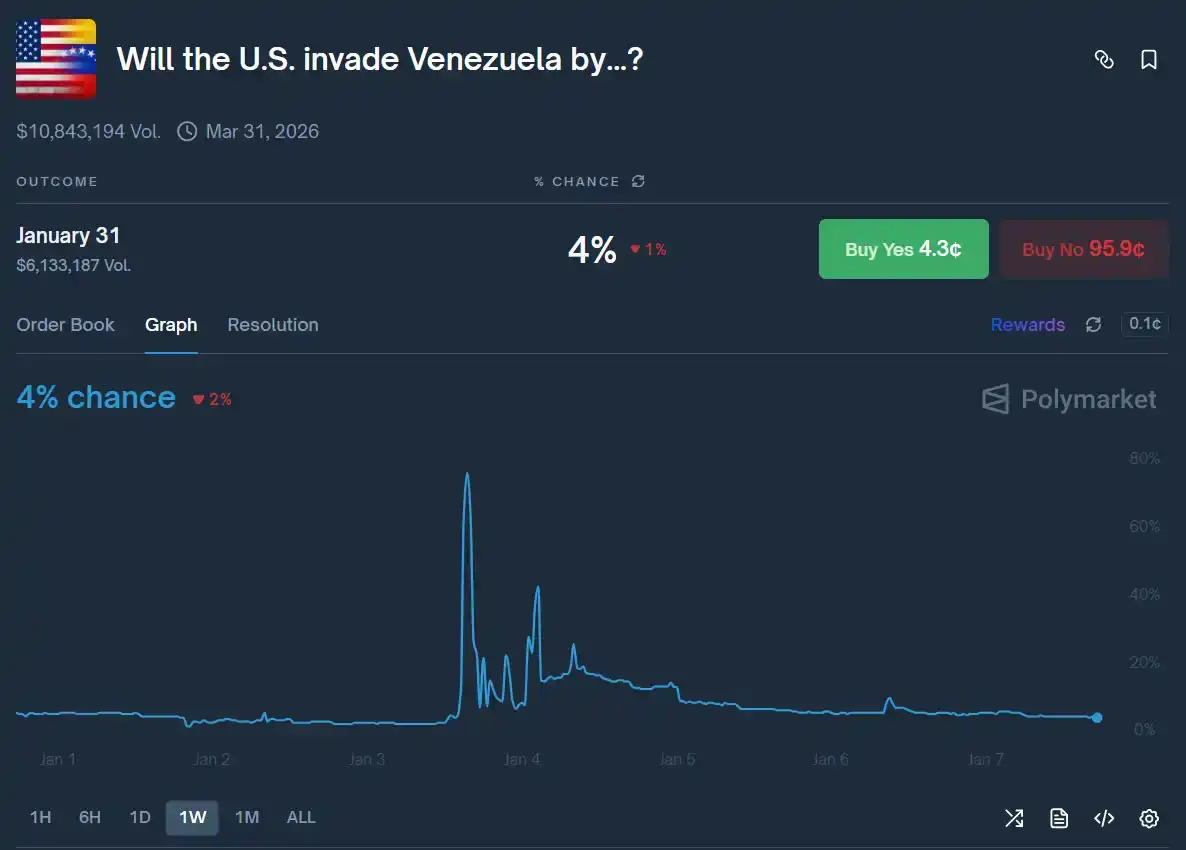
Even after Trump brazenly stated "run Venezuela" following the attack, as of the time of this writing, the market has still not been resolved, and the probability has fallen back to 4%.
This earth-shattering military invasion seems to have never happened on Polymarket.
"Tailor-Made" Rule Updates: Using Wordplay to Deny an Invasion
If you were to look for proof of the invasion happening on Polymarket, it does exist: hours after the attack, the platform officially published a rule supplement:
This market refers to U.S. military operations intended to establish control. President Trump’s statement that they will「run」Venezuela while referencing ongoing talks with the Venezuelan government does not alone qualify the snatch-and-extract mission to capture Maduro as an invasion.
In simple terms: U.S. troops entering the country and bombing don't count as an invasion. Trump talking about invading, occupying, and running the country doesn't count as an invasion. Capturing the president doesn't count as an invasion.
But they stick to their line: "military action with the purpose of establishing control counts as invasion."
Writing job description requirements based on a family register probably wasn't this rigorous. Traders who bet earlier didn't need to consider these hidden clauses, which didn't exist at the time, when analyzing the military situation.
Meanwhile, traders (mostly whales) who bet "No" during the period when its odds surged, relying on these tailor-made rule updates, again achieved substantial profits.
The same script played out in another market: "Will the U.S. and Venezuela engage in military conflict within 2025?" On December 26, 2025, Trump stated publicly in an interview that U.S. forces had destroyed an important facility inside Venezuela.
Multiple mainstream media outlets subsequently reported on the incident, with CNN noting the operation was "planned and executed by the Central Intelligence Agency (CIA)."
Shortly after the event, the platform issued a rule supplement stating that "operations executed by non-military intelligence agencies do not qualify."
As luck would have it, the CIA falls precisely into the category of a non-military intelligence agency.
Without the U.S. government ever formally clarifying which branch was responsible for the action, Polymarket, based on CNN's reporting citing "anonymous sources," precisely excluded a military strike from the settlement criteria.
Why Change the Rules? Digging into the Trump Family's Prediction Market Ties
As losing traders gathered on forums to protest, a more fundamental question emerged: Why would Polymarket risk its reputation being destroyed to modify the rules in plain sight?
Clues point to unusual names at the top of the platform.
Despite its decentralized facade, Polymarket is a实实在在 (shí shí zài zài - real, actual) private company regulated by the U.S. Commodity Futures Trading Commission (CFTC). A pivotal investment that changed its fate occurred last August:
Donald Trump Jr. – the eldest son of the sitting U.S. President – his private investment company formally took a stake in Polymarket, and he himself subsequently joined the company's "Advisory Board."
The timing is intriguing: after Trump Jr.'s investment, Polymarket, which had long operated in a regulatory gray area, quickly obtained an operating license from the CFTC, legalizing its operations in the U.S.
And the CFTC's five highest-ranking commissioners are all appointed directly by the President.
"This is just normal business investment," some commentators tried to downplay the connection. "The Trump administration supports cryptocurrency innovation anyway."
The next step would be to verify whether people close to Trump are using information asymmetry to profit on Polymarket.
From On-Chain Data to White House Inner Circle: When 'Coincidences' Are Too Many to Be Coincidences
Let's turn our attention to three hours before the raid occurred.
In another related market, "Will Maduro leave office before January 31, 2026?", a previously inactive new wallet address suddenly injected $30,000 into the market, all betting "Yes." As Maduro was put on a plane, this $30,000 turned into over $400,000 within hours.
The account's behavior pattern was highly suspicious: newly created, single deposit, betting on only one market within a specific time window, immediate withdrawal after profit. This is the操作 (cāozuò - operation, modus operandi) of treating the prediction market as a private ATM.
Who was this "insider"?
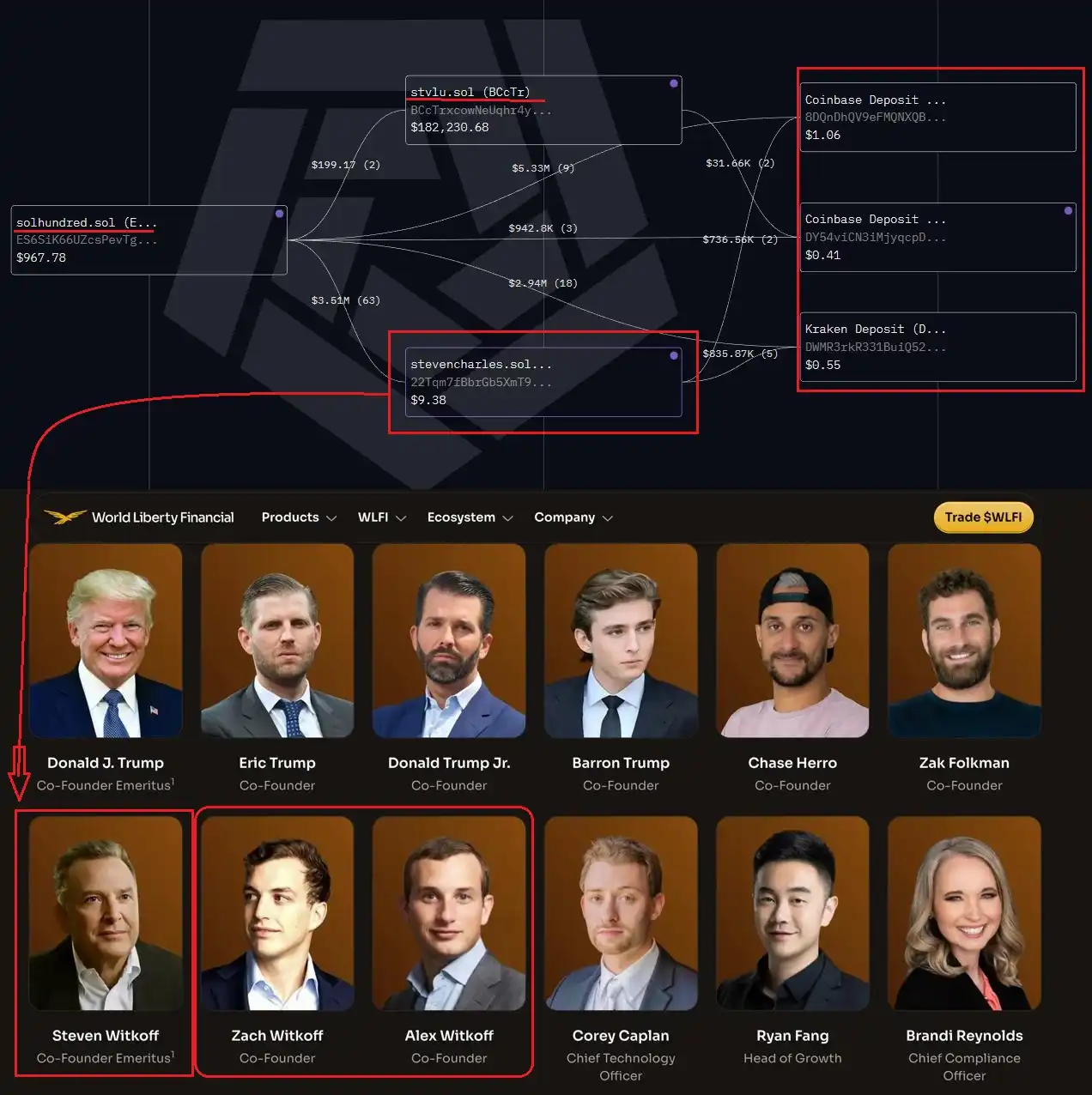
On-chain analysis blogger @Andrey_10gwei found, by comparing deposit/withdrawal amounts on exchanges, that the funds for this insider account could be traced back to an account with the domain "stevencharles.sol".
Steven Charles?
Opening the website for core members of WLFI, orchestrated by Donald Trump Jr., reveals that the second person from the left in the front row is a co-founder of the company, also a New York real estate developer, provided campaign funds to Trump, and the two have a friendship spanning nearly 40 years.
(cr: https://x.com/Andrey_10gwei/status/2007904168791454011?s=20)
His full name? Steven Charles Witkoff. A perfect match for the "stevencharles" on-chain domain.
A mysterious account turning $30k into $400k in 3 hours, an on-chain funding source named "stevencharles", a business magnate inextricably linked to the President's family who can directly influence Polymarket.
Three events with probabilities近乎于零 (jìn hū yú líng - approaching zero)串联在一起 (chuàn lián zài yīqǐ - strung together) can no longer be explained away as coincidence.
Conclusion
Polymarket, touted as a decentralized fair trading platform, might seem to ordinary person as just a financial tool to profit by betting on outcomes.
But perhaps in corners unseen by the common person, it has long become a white glove for those who can arbitrarily修改对错定义本身 (xiūgǎi duì cuò dìngyì běnshēn - modify the very definition of right and wrong), frequently using market-intervening rule updates and asymmetric information差 (chā - gap, asymmetry) to repeatedly empty people's assets.
How long the common person can survive here depends entirely on the desires and moral boundaries of the elite group.
Twitter:https://twitter.com/BitpushNewsCN
Bitpush TG Discussion Group:https://t.me/BitPushCommunity
Bitpush TG Subscription: https://t.me/bitpush