U.S. Establishes 'Five-Category Law' for Crypto Assets: A Guide to the New Regulatory Framework (Essential Edition)

marsbitXuất bản vào 2026-03-18Cập nhật gần nhất vào 2026-03-18

Tóm tắt

The U.S. SEC and CFTC jointly issued a landmark 68-page regulatory framework on March 17, 2026, establishing a clear classification system for crypto assets. The new rules categorize assets into five types: Digital Commodities (e.g., BTC, ETH), Digital Securities, Regulated Payment Stablecoins, Digital Tools, and Digital Collectibles. A key innovation is the "separation" mechanism, allowing assets to transition from securities to commodities once they become sufficiently decentralized and no longer rely on managerial efforts. The framework also clarifies that activities like mining, staking, wrapping, and airdrops (under certain conditions) are not securities transactions. This guidance aims to reduce regulatory uncertainty, lower compliance costs, and reinforce U.S. leadership in crypto innovation by providing legal clarity and encouraging market transparency.

On March 17, 2026, the U.S. Securities and Exchange Commission (SEC) and the Commodity Futures Trading Commission (CFTC) jointly released an interpretive document numbered 33-11412. This 68-page regulatory framework officially declares: U.S. crypto regulation has ended a decade-long era of "regulation by enforcement" and entered a new era of clarity and harmonization driven by "Project Crypto".
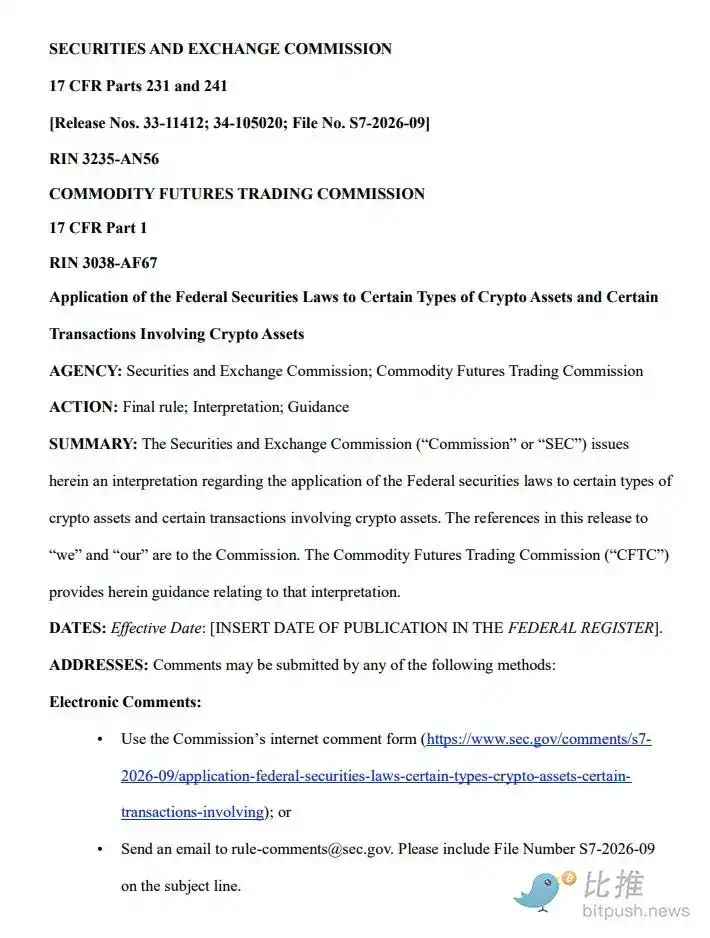
This document is not only a rare achievement of regulatory collaboration between the SEC and CFTC but also the most landmark guidance in the history of U.S. crypto regulation. The following is the full interpretation of the essential edition:

I. Background: "Project Crypto" from Conflict to Collaboration

In 2017, the SEC first applied the Howey test to crypto assets through "The DAO Report." For the next decade, regulation primarily relied on enforcement actions to define asset attributes, leaving the market in a state of uncertainty and controversy.

In early 2025, the SEC established the "Crypto Task Force," subsequently launching the "Project Crypto" initiative led by SEC Chairman Paul S. Atkins and CFTC Chairman Michael S. Selig. The initiative aimed to coordinate the authority of the two major regulatory agencies, establish a unified asset classification method, and provide a clear path for crypto innovation to remain in the U.S. In January 2026, the project was officially upgraded to a joint SEC and CFTC action.

II. Asset Classification: The Logic of the "Five-Category Law" for Crypto Assets

Based on asset characteristics,用途, and functionality, the document divides crypto assets into five major categories, providing the market with a clear classification standard for the first time:

  1. Digital Commodities

    Definition: Refers to those assets whose value stems from the programmatic operation and supply-demand dynamics of a "functionalized" crypto system, rather than relying on the managerial efforts of others.

    Core List: The document explicitly names mainstream tokens such as BTC, ETH, SOL, XRP, ADA, DOT, AVAX, LINK, etc., as digital commodities. These assets are not controlled by any single centralized entity and do not possess inherent economic rights that generate passive income.

  2. Digital Securities

    Definition:即"Tokenized Securities," referring to traditional securities represented in the form of crypto assets, or digital assets possessing the economic substance of securities (e.g., representing enterprise ownership, dividend rights).

    Regulation: Whether on-chain or off-chain, as long as they符合 economic substance, they fall under the SEC's regulatory purview.

  3. Regulated Payment Stablecoins

    Definition: Stablecoins that meet the definition of the 2025 "GENIUS Act" and are issued by authorized institutions.

    Qualification: These stablecoins are explicitly excluded from the definition of "securities" and are primarily受 specific legal constraints as payment instruments.

  4. Digital Tools

    Purpose: Tokens that only have utility functions within specific crypto systems (e.g., access rights or service payments) and are generally not considered securities.

  5. Digital Collectibles

    Definition: Assets intended to be collected and/or used, representing artworks, music, videos, in-game items, or internet memes, etc.

    Examples: CryptoPunks, Chromie Squiggles, WIF, VCOIN, etc.

    Qualification: Not securities themselves; their value stems from supply and demand relationships rather than the managerial efforts of others. However, if fragmented and sold, they may constitute securities.

III. Innovation: "Separation" and "Dynamic Conversion" of Security Attributes

This is the most groundbreaking legal innovation in the document—the SEC首次承认: The "security attribute" of a crypto asset is not permanent.

"Separation" Mechanism

  • Principle: A project may be considered a security (investment contract) during its initial financing phase if it meets the Howey test. But when the project completes its roadmap, achieves autonomous operation of open-source code, and decentralizes network power, the asset can be "separated" from the investment contract.

  • Judgment Standard: When investors no longer reasonably rely on the issuer's "essential managerial efforts" to obtain profits, but instead rely on the system's own operation and market supply and demand, the asset transforms from a "security" to a "digital commodity."

  • Separation Timing: Can occur immediately upon delivery of the asset to the purchaser, or at a future date.

Three Scenarios for Separation

  1. Issuer Fulfills Promises: After completing the essential managerial efforts, even if non-essential maintenance continues, the asset is no longer bound by the investment contract.

  2. Issuer Abandons Project: If publicly宣布放弃 development and no longer fulfills promises, the asset脱离 securities law jurisdiction (but the issuer may still bear legal liability for fraud).

  3. Secondary Market Trading: If subsequent purchasers no longer reasonably expect to rely on the issuer's efforts for profit, the transaction does not constitute a securities transaction.

Transparency Recommendation

The SEC encourages project parties to publicly disclose roadmap progress and milestone achievements to facilitate market identification of the "separation point."

IV. Qualification of On-Chain Activities: "Demining" for Decentralization

Regarding long-disputed activities such as staking, mining, wrapping, and airdrops, the document provides extremely detailed and favorable explanations:

Protocol Mining

  • Qualification: PoW mining is an "administrative or ministerial" activity that ensures network security and verifies transactions.

  • Conclusion: Whether solo mining or joining a mining pool, it does not involve securities issuance.

  • Mining Pool Operation: The activities of mining pool operators are administrative and ministerial, not constituting essential managerial efforts.

Protocol Staking

  • Qualification: Staking is an administrative activity for maintaining network operation.

  • Coverage: Includes solo staking, delegated third-party staking, custodial staking, and liquid staking.

  • Custodial Staking: If a custodian stakes on behalf of users, as long as it does not involve re-lending of assets, leverage, or discretionary trading, it does not constitute a securities activity.

  • Ancillary Services: Slash insurance, early unstaking, flexible reward distribution, asset aggregation, and other auxiliary services are all administrative and ministerial.

Staking Receipt Tokens

  • Qualification: If the underlying asset is a non-security commodity and not subject to an investment contract, the receipt itself is not a security.

  • Principle: The receipt merely exists as a "receipt," does not generate income; income stems from the underlying staking activity.

Wrapping Tokens (Wrapping)

  • Definition: Users deposit crypto assets with a custodian or跨链桥, obtaining 1:1锚定的 redeemable wrapped tokens.

  • Qualification: If the underlying asset is a non-security commodity and not subject to an investment contract, wrapping tokens are considered an "administrative function" aimed at enhancing interoperability and do not constitute a securities transaction.

  • Key Restriction: The custodian must lock the assets and cannot lend,抵押, or re-stake them.

Airdrops

  • Qualification Breakthrough: As long as the recipient does not provide money, goods, services, or other consideration, it does not meet the "investment of money" element of the Howey test.

  • Applicable Scenarios:

    Airdropping to wallets holding specific tokens, without prior announcement

    Rewarding early testnet users

    Airdropping to eligible users based on application usage

  • Red Line: If recipients need to provide services (e.g., social media promotion) in exchange for the airdrop, it may constitute securities issuance.

V. Consolidation of U.S. Leadership

The document analyzes its economic significance in detail at the end:

  1. Eliminate "Chilling Effect": By providing legal clarity, reduce business stagnation caused by compliance opacity and encourage crypto innovation to return to the U.S.

  2. Reduce Compliance Costs: Clear classification and separation paths significantly reduce corporate legal consulting and regulatory应对 costs.

  3. <极速赛车开奖直播历史记录p style="text-align: justify; font-size: 16px; font-weight: inherit; word-break: break-all; line-height: 2; font-family: PingFang SC,Helvetica Neue,Helvetica,Arial,Hiragino Sans GB,Heiti SC,Microsoft YaHei,WenQuanYi Micro He极速赛车开奖直播历史记录i,sans-serif;">Enhance Market Transparency: The new framework requires more detailed disclosure during the "investment contract" phase, better protecting investors.

  4. Promote Competition and Innovation: Clear rules will attract more issuers and entrepreneurs to enter the market.

  5. Improve Pricing Efficiency: Reduce price distortions caused by uncertainty.

VI. Historic Breakthrough in Regulatory Collaboration

Structurally, the document establishes a clear analytical path: first classify the asset, then judge the transaction structure, and finally analyze whether the investment relationship持续存在.

More importantly, this is a rare result of coordination between the SEC and CFTC on crypto regulatory issues. Previously, the two agencies had long-standing differences in defining "securities vs. commodities," and this joint framework实质上 divides the归属 of major asset categories, marking a shift in U.S. crypto regulation from the stage of "inter-agency jurisdictional competition" to a "division of labor system based on unified rules."

This 68-page document not only ends a decade of regulatory chaos but also establishes the U.S.'s leadership position in the global crypto regulatory field. For practitioners, it is a must-read "industry constitution"; for investors, it is a clear "rights protection guide"; for entrepreneurs, it is a clear "compliance roadmap".

The "Wild West" era of crypto assets has officially ended.

Original Link

Câu hỏi Liên quan

QWhat is the 'Five-Category Method' for crypto assets established by the SEC and CFTC in the new regulatory framework?

AThe 'Five-Category Method' classifies crypto assets into: 1. Digital Commodities (e.g., BTC, ETH, SOL, XRP, ADA, DOT, AVAX, LINK), 2. Digital Securities (tokenized traditional securities or assets with securities economic substance), 3. Regulated Payment Stablecoins (as defined by the 2025 GENIUS Act), 4. Digital Tools (tokens with utility functions within specific crypto systems), and 5. Digital Collectibles (e.g., CryptoPunks, Chromie Squiggles, WIF, VCOIN).

QWhat is the 'Separation' mechanism introduced in the SEC and CFTC's new framework, and why is it significant?

AThe 'Separation' mechanism allows a crypto asset initially classified as a security (e.g., during fundraising via an investment contract) to transition to a non-security status (e.g., a digital commodity) once the project completes its roadmap, becomes decentralized, and no longer relies on the issuer's 'essential managerial efforts.' This is significant because it acknowledges that an asset's security status is not permanent and provides a clear path for projects to achieve regulatory clarity.

QHow do the SEC and CFTC classify activities like protocol mining, staking, and airdrops under the new framework?

AProtocol mining (PoW) and protocol staking (including solo, delegated, custodial, and liquid staking) are classified as 'administrative or ministerial' activities that maintain network operations and do not constitute securities offerings. Airdrops are generally not considered securities offerings if recipients provide no consideration (money, goods, services); however, if recipients must perform services (e.g., social media promotion) to receive the airdrop, it may be deemed a securities offering.

QWhat are the economic benefits highlighted in the framework for the U.S. crypto industry?

AThe framework aims to: 1. Eliminate the 'chilling effect' of regulatory uncertainty, encouraging crypto innovation to return to the U.S.; 2. Reduce compliance costs through clear classification and separation paths; 3. Enhance market transparency with better disclosure requirements during the 'investment contract' phase; 4. Promote competition and innovation by attracting more issuers and entrepreneurs; and 5. Improve pricing efficiency by reducing price distortions caused by uncertainty.

QWhat does the joint SEC-CFTC framework signify for U.S. crypto regulatory coordination?

AThe framework marks a historic shift from a decade of regulatory ambiguity and inter-agency competition (e.g., over 'security vs. commodity' definitions) to a unified, collaborative approach. It establishes a clear analytical path: classify assets, then evaluate transaction structures, and finally assess whether an investment relationship persists. This coordination positions the U.S. as a leader in global crypto regulation and ends the 'Wild West' era of crypto assets.

Nội dung Liên quan

94 tỷ, khoản đầu tư lớn nhất của người máy năm nay đã xuất hiện

Ngành robot hình người vừa chứng kiến khoản đầu tư lớn nhất trong năm khi Neura, công ty robot hình người có trụ sở tại Munich, Đức, hoàn thành vòng gọi vốn Series C với 1.4 tỷ USD (khoảng 94.9 tỷ NDT). Điều đáng chú ý là sự tham gia của các nhà đầu tư chiến lược từ ngành công nghiệp như Schaeffler và Bosch - những tập đoàn linh kiện công nghiệp lâu đời của Đức. Sự tham gia này cho thấy sự chuyển dịch trong logic của lĩnh vực này: từ những màn trình diễn công nghệ sang triển khai thực tế trong nhà máy, và từ câu chuyện vốn đầu tư sang hệ thống thương mại thực sự. Sau vòng gọi vốn, định giá của Neura đạt khoảng 7 tỷ USD, đưa công ty vào nhóm dẫn đầu toàn cầu. Khác với các công ty như Figure AI tập trung vào robot hình người đa năng với câu chuyện về AI thể hiện (embodied AI) được hậu thuẫn bởi OpenAI hay Microsoft, Neura theo đuổi con đường ứng dụng theo ngành dọc trong công nghiệp. Công ty đã có khách hàng thực tế là BMW và sản phẩm của họ đã được kiểm chứng trên dây chuyền sản xuất. Có hai lý do chính cho làn sóng đầu tư mạnh mẽ này. Thứ nhất là sự tiến bộ vượt bậc của các mô hình lớn (AI), phá vỡ giới hạn về khả năng nhận thức và ra quyết định của robot. Thứ hai là áp lực từ phía nhu cầu: tình trạng thiếu hụt lao động và chi phí nhân công ngày càng tăng trên toàn cầu, đặc biệt ở các nền công nghiệp như Nhật Bản, Đức, buộc các nhà sản xuất phải tìm giải pháp thay thế. Mặt trận chính của robot hình người giờ đây không còn là các buổi ra mắt sản phẩm mà là mặt bằng nhà máy. Hai lĩnh vực được kỳ vọng sẽ triển khai quy mô sớm nhất là sản xuất công nghiệp (vì môi trường có cấu trúc, nhiệm vụ lặp lại) và các môi trường làm việc nguy hiểm (hóa chất, hạt nhân). Tuy nhiên, thách thức lớn nhất cho việc triển khai hàng loạt không còn là công nghệ lõi mà là các vấn đề kỹ thuật và thương mại như chi phí thích ứng với từng dây chuyền cụ thể và xây dựng hệ thống bảo trì, dịch vụ địa phương đáng tin cậy. Việc các gã khổng lồ công nghiệp lâu đời bắt đầu "bỏ phiếu" bằng tiền thật cho thấy ngành công nghiệp này đã chuyển từ câu hỏi "Liệu có làm được không?" sang "Làm thế nào để làm tốt hơn, nhanh hơn và ổn định hơn". Đây mới là tín hiệu quan trọng nhất từ khoản đầu tư kỷ lục này.

marsbit4 giờ trước

94 tỷ, khoản đầu tư lớn nhất của người máy năm nay đã xuất hiện

marsbit4 giờ trước

Thị Trường Trước Niêm Yết của Anthropic Sụt Giảm Sau Lệnh Hoa Kỳ Buộc Ngừng Hoạt Động Mô Hình

Công ty trí tuệ nhân tạo Anthropic thông báo đã nhận chỉ thị từ chính phủ Mỹ vào ngày 12/6, yêu cầu ngừng cung cấp quyền truy cập hai mô hình Claude Fable 5 và Claude Mythos 5 cho người nước ngoài, kể cả nhân viên nước ngoài trong công ty. Để tuân thủ, Anthropic đã vô hiệu hóa cả hai mô hình trên toàn cầu. Lệnh này được mô tả là một biện pháp kiểm soát xuất khẩu khẩn cấp liên quan đến an ninh quốc gia. Các mô hình khác như Claude Opus 4.8 không bị ảnh hưởng. Anthropic phản đối quyết định này, cho biết chính phủ chỉ cung cấp bằng chứng bằng lời nói về một lỗ hổng "jailbreak" hẹp và không phổ biến, liên quan đến việc yêu cầu mô hình xem xét một mã nguồn cụ thể. Công ty lập luận lỗ hổng này nhỏ, đã biết trước và có thể được tìm thấy bởi các mô hình công khai khác, không cần thiết phải đóng cửa toàn bộ mô hình thương mại. Họ cảnh báo tiêu chuẩn này nếu áp dụng rộng rãi có thể đình chỉ mọi triển khai mô hình mới của các nhà cung cấp AI tiên phong. Thị trường tiền điện tử đang theo dõi sự việc do các hợp đồng phái sinh liên kết pre-IPO của Anthropic, cho phép giao dịch phản ánh tâm lý về lĩnh vực AI. Ngay sau chỉ thị, hợp đồng vĩnh viễn Anthropic trên Hyperliquid đã giảm 3.7%. Sự kiện này cho thấy quy định AI đang trở thành yếu tố có thể giao dịch được, và cơ sở hạ tầng AI đang hòa vào bản đồ thị trường đầu cơ cùng với crypto. Tuy nhiên, rủi ro là các thị trường này có thể biến động mạnh dựa trên thông tin không đầy đủ, trong khi báo cáo kỹ thuật của chính phủ chưa được công khai.

bitcoinist10 giờ trước

Thị Trường Trước Niêm Yết của Anthropic Sụt Giảm Sau Lệnh Hoa Kỳ Buộc Ngừng Hoạt Động Mô Hình

bitcoinist10 giờ trước

Ví Khai Thác Chuyển Đổi Token Bị Đánh Cắp Thành 18,510 ETH Và 1,548 BNB

Ví tiền liên quan đến một vụ khai thác lỗ hổng bảo mật đã chuyển đổi tài sản bị đánh cắp thành 18,510 ETH (khoảng 30,83 triệu USD) và 1.548 BNB (khoảng 924.000 USD), theo cảnh báo theo dõi trên chuỗi được WuBlockchain chia sẻ, trích dẫn dữ liệu từ Lookonchain. Việc chuyển đổi này đáng chú ý vì sau khi khai thác, các ví thường chuyển từ các token kém thanh khoản hoặc dễ bị truy vết sang các tài sản có tính thanh khoản cao hơn như ETH và BNB trước khi cố gắng rút tiền. Kẻ tấn công được cho là liên quan đến token "H" bị xâm phạm và vẫn đang nắm giữ số token trị giá khoảng 14 triệu USD. Các giao dịch hoán đổi lớn sau khai thác quan trọng vì chúng có thể gây áp lực bán lên tài sản, hé lộ bước di chuyển tiếp theo của kẻ tấn công và cung cấp manh mối cho các nhà điều tra. Trong khi theo dõi trên chuỗi (on-chain) giúp hiển thị các chuyển động này, việc xác định danh tính thực tế của người kiểm soát ví vẫn là thách thức. Các ví có thể nhanh chóng chia nhỏ hoặc chuyển tài sản xuyên chuỗi, làm phức tạp công tác truy vết. Báo cáo nhấn mạnh tầm quan trọng của việc theo dõi dữ liệu để hiểu cách quỹ bị đánh cắp được hợp nhất, đồng thời lưu ý rằng thông tin từ các nguồn như Lookonchain và WuBlockchain cung cấp cái nhìn nhanh chóng, nhưng không thay thế cho báo cáo điều tra chính thức. Việc chuyển đổi sang các tài sản có tính thanh khoản cao như ETH và BNB thường là giai đoạn phổ biến, làm phức tạp thêm các lựa chọn thu hồi tài sản sau đó.

bitcoinist12 giờ trước

Ví Khai Thác Chuyển Đổi Token Bị Đánh Cắp Thành 18,510 ETH Và 1,548 BNB

bitcoinist12 giờ trước

Từ 119 đến 176 USD: Phía sau vụ IPO của SpaceX, MSX một lần nữa chứng minh vòng khép kín Pre-IPO

Tiếp nối thành công từ Cerebras với lợi nhuận 300% vào tháng 5, MSX một lần nữa chứng minh mô hình Pre-IPO của mình qua vụ IPO lịch sử của SpaceX. Ngày 12 tháng 6, SpaceX (SPCX) chính thức lên sàn Nasdaq với mức vốn hóa đỉnh điểm đạt 2,3 nghìn tỷ USD. Đối với người dùng MSX, đây là thời điểm then chốt để hiện thực hóa lợi nhuận từ dự án Pre-IPO SpaceX được mở bán từ tháng 3 với giá 119 USD. Tính theo giá đóng cửa phiên đầu tiên (166,85 USD), lợi nhuận đạt khoảng 40%. Thành công này đánh dấu lần thứ hai MSX hoàn tất một cách trọn vẹn vòng khép kín Pre-IPO, từ đăng ký mua, nắm giữ, đến niêm yết, giao dịch và chốt lời. Quy trình 6 bước này đã được kiểm chứng trong đợt IPO SpaceX, khi một số nền tảng khác gặp sự cố về hạn ngạch và phải hoàn tiền cho người dùng. Trước đó, vào tháng 5, MSX đã giao dịch thành công cổ phiếu Cerebras (CBRS) ngay sau khi công ty này lên sàn, mang về lợi nhuận lên tới 300% cho những người tham gia từ giai đoạn Pre-IPO. Hai trường hợp liên tiếp này cho thấy giá trị thực sự của sản phẩm Pre-IPO không chỉ nằm ở việc cung cấp cổ phần sớm, mà quan trọng hơn là khả năng tạo ra một lộ trình rõ ràng và khả thi để chuyển đổi tài sản và thoát vốn sau khi công ty niêm yết. MSX tiếp tục mở rộng danh mục dự án Pre-IPO tiềm năng, tập trung vào các lĩnh vực như AI và công nghệ tiên phong, nhằm mang đến cho người dùng Web3 cơ hội tham gia vào các tài săng tăng trưởng toàn cầu trước khi chúng lên sàn chính thức.

Odaily星球日报16 giờ trước

Từ 119 đến 176 USD: Phía sau vụ IPO của SpaceX, MSX một lần nữa chứng minh vòng khép kín Pre-IPO

Odaily星球日报16 giờ trước

Giao dịch

Giao ngay
Hợp đồng Tương lai
活动图片