Theft Is Just the Beginning: The Slow Collapse Behind Cyber Attacks

比推Xuất bản vào 2026-03-23Cập nhật gần nhất vào 2026-03-23

Tóm tắt

The article "Theft Is Just the Beginning: The Slow Collapse Behind Hacker Attacks" discusses the long-term impacts of cryptocurrency hacks beyond the initial financial loss. Based on Immunefi’s "2026 On-Chain Security Report," the analysis reveals that while attacks themselves are swift, the aftermath unfolds over months, causing prolonged damage such as declining token prices, reduced funding, halted hiring, and delayed development. Key findings include: - The median direct loss per attack is around $25 million, but tokens experience a median drop of 61% within six months, with 16% recovering to pre-attack levels. - Although the number of attacks remains steady (94 in 2024, 97 in 2025), the concentration of losses is alarming: the top five attacks accounted for 62% of total stolen funds. - Centralized platforms, though fewer in attack frequency, represent over half of the financial losses, highlighting persistent vulnerabilities in trusted intermediaries. The report emphasizes that the true crisis begins after the theft—projects face extended recovery periods, reputational harm, and operational disruption, making survival particularly challenging for less-resourced teams. The interconnected nature of DeFi ecosystems further amplifies risks, as single incidents can trigger broader market repercussions. Ultimately, the article underscores that resilience is not just about preventing hacks but enduring their prolonged secondary effects.

Author: Andjela Radmilac

Compiled by: Saoirse, Foresight News

Original title: Under the Shadow of Hackers, More Than Just the Demise of Funds


Cryptocurrency exploits can drain a wallet in minutes, but the full extent of the losses often takes months to fully materialize. Token prices continue to fall, project treasuries shrink, hiring freezes, and even projects that survive the theft may completely lose their future in the subsequent turmoil.

Cryptocurrency hacks never end the moment the wallet is emptied. The theft is swift and direct, followed by a slower collapse that begins to spread within the project.

Tokens continue to decline, funding pools shrink accordingly, hiring plans are cut, product development is delayed, and partners withdraw one after another. Projects that should be focusing on recovery end up spending months rebuilding credibility instead of building.

This is precisely the scene depicted in Immunefi's latest "2026 On-Chain Security Status Report." Its core argument applies to any market—whether in the crypto industry or traditional sectors: the initial loss is only part of the damage.

The more serious issue lies in the devastating impact of the exploit on the project's future. Immunefi data shows that the average direct amount stolen per attack in their sample was approximately $25 million, while the median drop in stolen tokens within six months was as high as 61%. During this period, 84% of the tokens failed to return to their pre-attack prices, and project teams spent at least three months on post-incident recovery, delaying normal development.

However, this data comes with a caveat: token declines have multiple causes, and many projects were already vulnerable before the attack—suffering from poor liquidity, overvaluation, or having already lost momentum.

Immunefi acknowledges that they cannot completely separate the impact of hacks from broader market weakness or the projects' own issues. Even so, the patterns revealed in the report are still noteworthy: hacker attacks are no longer isolated theft events but more like a long-tail corporate crisis.

The value of this report lies in its proof that, after the热点 news fades, the后续 effects of hacker attacks continue to cause long-term harm.

Median Attack Losses Are Decreasing, but Extreme Attacks Are Becoming More Dangerous

According to Immunefi's statistics, 191 crypto attacks occurred in 2024-2025, with total losses of $4.67 billion; over five years, 425 attacks累计 occurred, with total losses reaching $11.9 billion.

The number of attacks per year has hardly changed: 94 in 2024, 97 in 2025, roughly flat with 2023. This indicates that the overall security of the market has not significantly improved. Hacker attacks have become the norm in the crypto industry, and a few giant attacks are enough to define the industry's risk for an entire year.

The report reveals a core contradiction:

The median loss from attacks in 2024-2025 was $2.2 million, lower than the $4.5 million in 2021-2023. On the surface, this seems like progress. However, the average loss was still about $24.5 million, more than 11 times the median; previously, this gap was only 6.8 times. The top five attacks accounted for 62% of all stolen funds; the top ten accounted for 73%.

This is an extremely dangerous distribution pattern: the market appears stable and safe until a giant event tears it apart. The scale of ordinary attacks has become smaller, but the real致命 risk lies in the tail—a few特大 incidents absorb the vast majority of losses and冲击 the entire market in a single day.

The most typical case is Bybit. The exchange's $1.5 billion exploit became the most iconic hack of 2025, with this single incident accounting for 44% of all funds stolen that year.

It's easy to view such events as news spectacles, but they expose a deeper problem of risk concentration: a single failure at a core platform is enough to distort the annual loss structure of the entire industry, revealing that huge risks are still piled up on a few critical nodes.

The Protracted Decline Is Where the Project Truly Begins to Collapse

The data on stolen funds in the report is certainly noteworthy, but the most alarming part is the section on price impact.

In Immunefi's sample of 82 hacked tokens:

  • Within two days of the hack, the median drop was about 10%, roughly flat with the previous cycle;

  • But the real冲击 emerged later: the median drop expanded to 61% after six months, higher than the 53% in 2021-2023.

Six months later:

  • 56.5% of the hacked tokens had fallen more than 50%;

  • 14.5% had fallen more than 90%;

  • Only about 16% of tokens returned to or exceeded their pre-attack price levels.
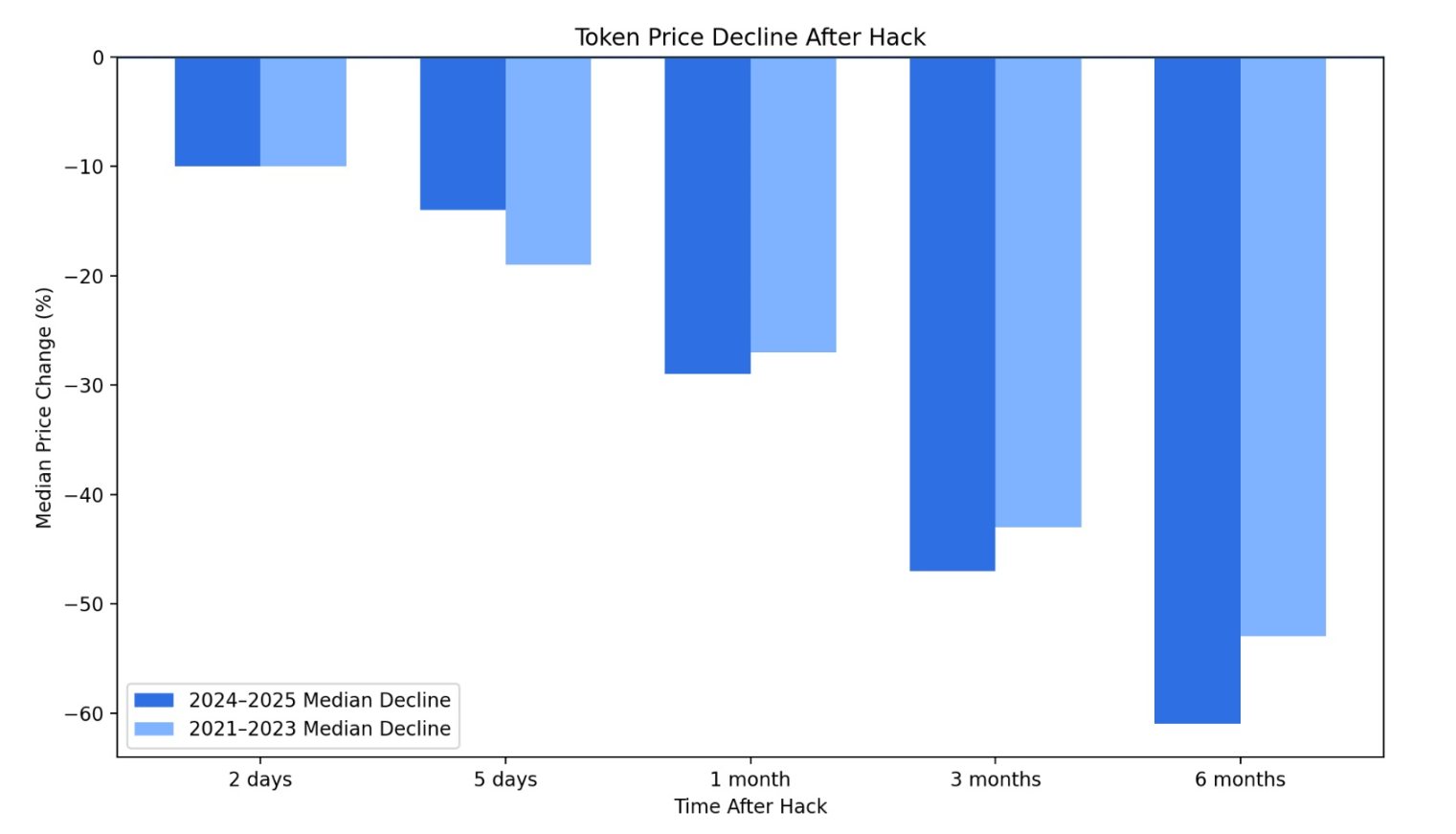
Chart shows the median token price decline for 82 hacked tokens in Immunefi's sample from 2024 and 2025 (Source: Immunefi)

To understand the full impact of a hack, we can no longer view token price as an isolated market indicator. For the vast majority of crypto projects, the token is the treasury, the foundation for fundraising, and the public report card of credibility. A prolonged暴跌 directly cripples the project's operational cycle, hiring ability, bargaining power in partnerships, and internal morale.

The report points out that projects that suffer attacks often lose their security lead within weeks and enter a recovery period of at least three months. Even if the timeline varies by project, the consequences are clear: projects with crashed tokens and damaged brands have almost no breathing room or chance for a turnaround.

Many markets can withstand a theft, a bad quarter, or even a reputation crisis. But the crypto industry often compresses all three into the same event: the attack empties the treasury → the token暴跌 publicly revalues the project → partners withdraw before the internal cleanup is even finished.

Recovery in this environment is extremely difficult, and致命 for teams that were not well-funded to begin with.

Interdependency makes the situation worse. Immunefi believes the DeFi ecosystem has become increasingly interconnected, forming longer, more fragile risk chains between cross-chain bridges, stablecoins, liquid staking, restaking, and lending markets.

Although some cases in the report require external verification, the overall trend is undeniable: today's crypto systems have more complex layers, meaning the impact of a single attack will extend far beyond the affected protocol itself.

Centralized platforms remain at the epicenter of explosions.

The report shows that out of the 191 attacks in 2024-2025, only 20 targeted centralized exchanges, but these 20 caused losses of $2.55 billion, accounting for 54.6% of the total losses.

This shifts the problem from smart contract vulnerabilities back to asset custody, key management, and over-concentrated infrastructure. For an industry that often sells itself on "decentralized risk resistance," most of the huge losses still occur on highly trusted, centralized nodes.

But this does not mean all hacked projects are doomed to fail. The industry has entered a new phase: a project's survival no longer depends on whether it can withstand an attack, but on whether it can withstand the six months *after* the attack.

Theft is just the beginning of the crisis. What truly determines whether a project has a future is the long, slow,持续的 secondary damage that follows the attack.


Twitter:https://twitter.com/BitpushNewsCN

Bitpush TG Discussion Group:https://t.me/BitPushCommunity

Bitpush TG Subscription: https://t.me/bitpush

Original link:https://www.bitpush.news/articles/7622471

Câu hỏi Liên quan

QWhat is the main finding of Immunefi's '2026 On-Chain Security Status Report' regarding the impact of crypto hacks?

AThe main finding is that the initial theft is only part of the damage; the more severe problem is the devastating impact on a project's future, including prolonged token price declines, drained treasuries, halted hiring, and delayed development, which can lead to a slow, long-term collapse.

QAccording to the report, what was the median percentage drop in the price of hacked tokens after six months?

AThe median percentage drop in the price of hacked tokens after six months was 61%.

QWhat does the report reveal about the distribution of losses from crypto hacks between 2024 and 2025?

AThe report reveals a highly dangerous distribution: while the median attack loss decreased, the average loss was high, and a small number of extreme attacks accounted for the majority of the losses. The top 5 attacks represented 62% of all stolen funds, and the top 10 represented 73%.

QWhich type of platform was responsible for the majority of the financial losses from hacks in 2024-2025, despite having fewer incidents?

ACentralized exchanges were responsible for the majority of financial losses. Although only 20 attacks targeted CEXs, they resulted in losses of $2.55 billion, accounting for 54.6% of the total losses during that period.

QWhat key factor does the report suggest ultimately determines whether a project can survive a hack?

AThe report suggests that a project's survival is no longer determined by its ability to withstand the initial attack, but rather by its ability to withstand the subsequent six months of slow, prolonged secondary damage, including price collapse and reputational harm.

Nội dung Liên quan

MicroStrategy Sẽ Không Chết Trong Đợt Sụt Giảm Này: Tính Phản Chiếu, MSTR Hồi Neo Và Logic Tự Cứu 'Bán Cổ Phiếu Không Bán Coin'

**Tóm tắt bài viết "MicroStrategy Không Chết Vì Đợt Giảm Giá Này: Tính Phản Chiếu, STRC Hồi Neo Mệnh Giá và Logic Tự Cứu 'Bán Cổ Phiếu, Không Bán Bitcoin'"** Đợt sụt giảm nhanh chóng của Bitcoin (BTC) gần đây có thể là một cuộc tấn công có chủ đích nhắm vào MicroStrategy (MSTR), khai thác lo ngại về khủng hoảng thanh khoản. Điều này minh họa **tính phản chiếu (reflexivity)**: kỳ vọng thị trường có thể tự biến thành hiện thực. Kịch bản tấn công: dự trữ tiền mặt giảm → kỳ vọng MSTR buộc phải bán BTC → bán tháo gây áp lực giảm giá BTC → giá BTC giảm làm xấu đi bảng cân đối kế toán và giá trị tài sản ròng điều chỉnh theo BTC (mNAV) → kỳ vọng "không thể chống đỡ" càng được củng cố. Cổ phiếu ưu đãi STRC của MSTR (thực chất là trái phiếu lãi suất thả nổi) cũng giảm theo do thị trường định giá lại rủi ro và yêu cầu tỷ suất sinh lợi cao hơn lãi suất danh nghĩa hiện tại. Tuy nhiên, với bản chất là công cụ **lãi suất thả nổi**, giá STRC về lâu dài sẽ có xu hướng quay trở lại neo tại mệnh giá 100. Đây là điều kiện tiên quyết để MSTR có thể tiếp tục sử dụng STRC như một công cụ gây vốn hiệu quả. Để phá vỡ vòng xoáy phản chiếu và củng cố dự trữ tiền mặt, MSTR có hai lựa chọn: **bán BTC** hoặc **phát hành thêm cổ phiếu phổ thông**. * **Bán BTC** có thể giải quyết khủng hoảng ngắn hạn nhưng là hành động "uống thuốc độc giải cơn khát". Nó phá vỡ câu chuyện "không bao giờ bán BTC" – nguồn gốc tạo ra **mNAV premium** (khi mNAV > 1). Việc này khiến cổ phiếu phổ thông bị định giá lại, làm thu hẹp hoặc xóa sổ khoản premium, hủy hoại "bánh đà" tăng trưởng dựa trên việc phát hành cổ phiếu để mua thêm BTC. Hơn nữa, bán BTC làm giảm lượng BTC trên mỗi cổ phiếu và có thể làm xấu hơn tỷ lệ nợ. * **Phát hành thêm cổ phiếu phổ thông** (khi mNAV > 1) là giải pháp ưu việt. MSTR có thể sử dụng một phần số tiền huy động được để tăng dự trữ tiền mặt (làm dịu lo ngại của trái chủ STRC), trong khi phần còn lại mua BTC vẫn tạo ra giá trị cho cổ đông nhờ vào premium. Cách này bảo vệ được lượng BTC trên mỗi cổ phiếu, không làm tổn hại đến câu chuyện đầu tư, và còn cải thiện tỷ lệ nợ. Tóm lại, MSTR khó có thể chết trong đợt sụt giảm này vì có các công cụ để ứng phó. Tuy nhiên, lựa chọn giữa **bán cổ phiếu** và **bán BTC** sẽ quyết định tính bền vững lâu dài của mô hình và câu chuyện đầu tư mà công ty đã xây dựng. Việc bán BTC, dù có thể giải cứu ngắn hạn, sẽ đặt ra câu hỏi về kết cục trong tương lai khi vòng xoáy phản chiếu tiếp diễn.

marsbit36 phút trước

MicroStrategy Sẽ Không Chết Trong Đợt Sụt Giảm Này: Tính Phản Chiếu, MSTR Hồi Neo Và Logic Tự Cứu 'Bán Cổ Phiếu Không Bán Coin'

marsbit36 phút trước

Humanity bị đánh cắp 31 triệu USD, một khóa riêng tư khiến giá token giảm 90%

Ngày 9/6, dự án danh tính số Humanity Protocol đã bị tấn công an ninh nghiêm trọng do rò rỉ khóa cá nhân của một thành viên quỹ, dẫn đến thiệt hại ước tính hơn 31 triệu USD. Hàng trăm ví chứa token H đã bị xâm phạm. Kẻ tấn công đã đúc thêm 100 triệu token H và bán tháo, khiến giá token H giảm hơn 90%, từ khoảng 0,7 USDT xuống mức thấp nhất là 0,052 USDT. Vốn hóa thị trường của dự án sụt giảm từ 2 tỷ USD xuống còn khoảng 35,7 triệu USD. Người sáng lập Terence Kwok đã xác nhận sự cố và khuyến cáo người dùng tạm thời không tương tác với cầu nối cross-chain hoặc các pool thanh khoản của Humanity. Đội ngũ đang hợp tác với các chuyên gia bảo mật và sàn giao dịch để xử lý. Humanity Protocol, được thành lập năm 2024, hướng tới xây dựng mạng lưới danh tính số phi tập trung sử dụng sinh trắc học lòng bàn tay và zk-proof. Dự án đã huy động được 50 triệu USD từ các quỹ như Pantera Capital và Animoca Brands, đạt định giá kỳ lân. Tuy nhiên, dự án từng vấp phải tranh cãi khi bị phát hiện có tới 88% trong số 9 triệu ID người dùng có thể là robot, và bị nghi ngờ là "dự án Trung Quốc đội lốt" với mã nguồn chứa hình ảnh từ một nhà cung cấp thiết bị kiểm soát ra vào. Đây không phải là thất bại đầu tiên của Kwok. Trước đó, startup Tink Labs của ông đã tiêu tan 170 triệu USD vốn đầu tư và phá sản vào năm 2020. Vụ việc này một lần nữa làm nổi bật vấn đề quản lý khóa cá nhân trong ngành công nghiệp tiền mã hóa, một lỗi bảo mật cơ bản nhưng có thể gây hậu quả thảm khốc, đặc biệt đối với một dự án vốn đã lung lay niềm tin từ cộng đồng.

Foresight News59 phút trước

Humanity bị đánh cắp 31 triệu USD, một khóa riêng tư khiến giá token giảm 90%

Foresight News59 phút trước

Cách thực hiện nghiên cứu sâu với Dynamic Workflows của Claude

Công việc nghiên cứu kỹ thuật chứa đầy cạm bẫy, dễ bị chìm trong biển thông tin và mất tập trung vào mục tiêu ban đầu. Claude mới giới thiệu tính năng **Dynamic Workflows** (Quy trình làm việc động), một bước tiến vượt bậc so với các phương pháp AI truyền thống bằng cách tự động thiết kế và điều phối quy trình tối ưu cho từng nhiệm vụ cụ thể, đặc biệt hiệu quả cho nghiên cứu sâu (**deep-research**). Dynamic Workflows hoạt động dựa trên sáu mẫu điều phối lõi, giải quyết hai vấn đề cốt lõi: **cách chia nhỏ nhiệm vụ** và **cách hợp nhất kết quả**: 1. **Định tuyến (Classify-And-Act)**: Phân loại nhiệm vụ và định tuyến đến chuyên gia phù hợp nhất. 2. **Chia tách & Hợp nhất (Fan-out & Merge)**: Chia thành các nhiệm vụ con chạy song song, sau đó tổng hợp kết quả. 3. **Xác minh đối kháng (Adversarial Verification)**: Sử dụng nhiều agent độc lập để thách thức và biểu quyết cho một kết luận, chống lại thiên kiến xác nhận. 4. **Tạo & Lọc (Generate & Filter)**: Tạo ra nhiều phương án, sau đó lọc để giữ lại những phương án tốt nhất. 5. **Giải đấu (Tournament)**: Các agent cạnh tranh từng cặp qua nhiều vòng để chọn ra giải pháp tối ưu. 6. **Vòng lặp (Loop)**: Lặp lại nhiệm vụ một cách thích ứng cho đến khi đạt tiêu chí hoàn thành. So sánh với hệ thống deep-research tự xây dựng trước đây, Dynamic Workflows của Claude bổ sung các cơ chế then chốt giúp nghiên cứu **định hướng mục tiêu** và **chắc chắn** hơn: * **Phân tách vấn đề**: Phân tích câu hỏi ban đầu thành các khía cạnh phụ trước khi hành động. * **Đánh giá độ tin cậy**: Xếp hạng độ tin cậy của từng nguồn thông tin. * **Hợp nhất chọn lọc**: Sử dụng biểu quyết đa agent để loại bỏ thông tin không đủ ủng hộ, thay vì gộp chung mọi thứ. * **Đầu ra tập trung vào quyết định**: Báo cáo cuối cùng đưa ra đánh giá và khuyến nghị hành động rõ ràng, phục vụ cho việc ra quyết định. Những cải tiến này giải quyết hiệu quả các vấn đề phổ biến của AI trong các nhiệm vụ dài như: **trôi dạt mục tiêu**, **dừng sớm**, **nhiễm ngữ cảnh** và **thiên kiến đầu ra**. Dynamic Workflows không chỉ là một cuộc đối thoại thông minh hơn, mà là **cơ cấu hóa chính quy trình nghiên cứu**, giúp rút ngắn đáng kể số lần tương tác cần thiết (từ hơn chục lần xuống còn 3-4 lần), dù tiêu tốn token nhiều hơn. Tuy vẫn còn một số thách thức như cơ chế xác minh cần khắt khe hơn với dữ kiện thực tế (ví dụ trong blockchain), khả năng tư duy liên ngành sâu cho các lĩnh vực mới, và việc thiết kế-xác thực giải pháp dựa trên ràng buộc thực tế, Dynamic Workflows đã đánh dấu một bước nhảy vọt về **tính linh hoạt và khả năng thích ứng** của AI, chuyển từ việc giải quyết các vấn đề tĩnh sang xử lý các nhiệm vụ mở với quy trình được tối ưu hóa tự động.

marsbit1 giờ trước

Cách thực hiện nghiên cứu sâu với Dynamic Workflows của Claude

marsbit1 giờ trước

Khi LP dùng Đậu Bếp dạy tôi đầu tư: Lời tự thuật chuyển nghề của một GP quỹ đầu tư tư nhân

Trước sự phổ biến của AI, mối quan hệ giữa các đối tác đầu tư (LP) và các đối tác quản lý quỹ (GP) trong lĩnh vực quỹ đầu tư tư nhân quy mô nhỏ đang thay đổi. Câu chuyện của "Er Gou" - một cựu GP của một quỹ đô la Mỹ nhỏ chuyên về cổ phiếu Mỹ, nay chuyển sang làm việc cho một công ty khởi nghiệp AI - minh họa rõ nét áp lực này. Ông cho biết, các quỹ nhỏ như của ông vốn đã gặp khó khăn trong huy động vốn do cơ cấu quỹ (thường dùng SPC Cayman) kém hấp dẫn hơn so với các cấu trúc tại Hong Kong hay Singapore, và do chiến lược đầu tư chủ quan (subjective strategy) khó thuyết phục hơn so với chiến lược định lượng (quantitative strategy) được AI hỗ trợ. Sự nổi lên của các công cụ AI như Doubao (của Trung Quốc) hay ChatGPT đã trao cho nhiều LP khả năng phân tích và tiếp cận thông tin chưa từng có. Điều này làm xói mòn lợi thế thông tin truyền thống của GP. LP giờ đây có thể tự nghiên cứu, đặt câu hỏi sâu hơn và thậm chí chất vấn các quyết định của GP dựa trên phân tích từ AI. Điều này thường dẫn đến mâu thuẫn, đặc biệt khi LP sử dụng AI để tìm kiếm sự đồng thuận thay vì phân tích khách quan, hoặc trong thị trường bùng nổ khi lợi nhuận cá nhân có thể vượt trội. Tuy nhiên, AI khó có thể thay thế hoàn toàn GP. Bản chất của quản lý tài sản vẫn dựa trên sự tin tưởng và dịch vụ tư vấn. Sự khác biệt nằm ở chỗ AI đang buộc các GP phải thích nghi: nâng cao giá trị bằng cách sử dụng AI như một đòn bẩy để cải thiện chiến lược, đồng thời củng cố vai trò tư vấn và cung cấp giá trị cảm xúc cho LP trong một môi trường đầu tư ngày càng được số hóa.

Odaily星球日报1 giờ trước

Khi LP dùng Đậu Bếp dạy tôi đầu tư: Lời tự thuật chuyển nghề của một GP quỹ đầu tư tư nhân

Odaily星球日报1 giờ trước

Giao dịch

Giao ngay
Hợp đồng Tương lai
活动图片