The Unbundling of the Stock Market

marsbitXuất bản vào 2026-04-06Cập nhật gần nhất vào 2026-04-06

Tóm tắt

The article "The Unbundling of Stock Markets" by Prathik Desai argues that traditional financial markets, built on outdated structures like fixed trading hours and centralized exchanges, are being disrupted. Recent developments, such as S&P licensing its 500 index to a new crypto exchange (Hyperliquid), Nasdaq's SEC-approved tokenized stock trading, and Cboe's proposal for near 24/5 US equity trading, signal a shift towards unbundled, efficient, and accessible markets. Capital seeks the fastest path to price information, and new platforms like Hyperliquid's HIP-3, which offers 24/7 trading of traditional assets (e.g., commodities, indices) via perpetual contracts, are gaining traction due to their liquidity, lower friction, and ability to react to global events in real-time. The author concludes that market participants will adopt any structure that reduces the delay between events and price discovery, regardless of whether it originates from traditional institutions or permissionless blockchain platforms.

Author: Prathik Desai

Compiled by: Block unicorn

Preface

Clocks are not a good way to cover up delays. For decades, financial markets have been built around the speed of information transmission. They introduced closing bells, batch settlements, and regional exchanges, which made sense in an era of slow information flow. But all that has changed. Capital does not wait. Just as water always finds a crack, so does capital. Financial gravity pulls it towards the fastest path to obtain price information. This is the law of the market. Market participants will not tolerate inefficiency forever.

This is what I have observed from a macro perspective over the past few weeks as financial markets have evolved.

In today's article, I will help you understand what has broken the old bundled structure of financial markets, transforming it into a more efficient, unbundled structure that spans different venues, wrappers, and times.

Changing of the Guard

I have been studying finance for over a decade. In the early stages of my learning, I always viewed traditional stock exchanges as synonymous with the market. For most of their development, stock exchanges were the place where everyone and everything converged: buyers, sellers, regulators, and the technology that drives the market. It had indices tracking its components, and it had clocks indicating trading hours, telling everyone when they could trade and when they could not.

But this has changed in the past few years. In fact, just in the past few weeks, we have seen several developments that confirm this shift.

On March 18, S&P Dow Jones Indices licensed the S&P 500 index to Trade[XYZ], allowing HIP-3 market deployers to launch the first and only S&P 500 perpetual derivatives contract on the Hyperliquid exchange. The S&P 500 is the world's most followed large-cap U.S. equity index, tracking 500 leading U.S. companies, covering about 80% of the total U.S. market capitalization, with a total market cap of over $61 trillion. The index covers at least half of the global equity market's capitalization.

This is an index with nearly 70 years of history, listed on a market that is only 6 months old.

The day after S&P's announcement, the U.S. Securities and Exchange Commission (SEC) approved Nasdaq's application to trade and settle some stocks in tokenized form. Nasdaq is one of the world's most active trading venues, often exceeding the nominal trading volume of the New York Stock Exchange (NYSE), the world's largest exchange by market capitalization.
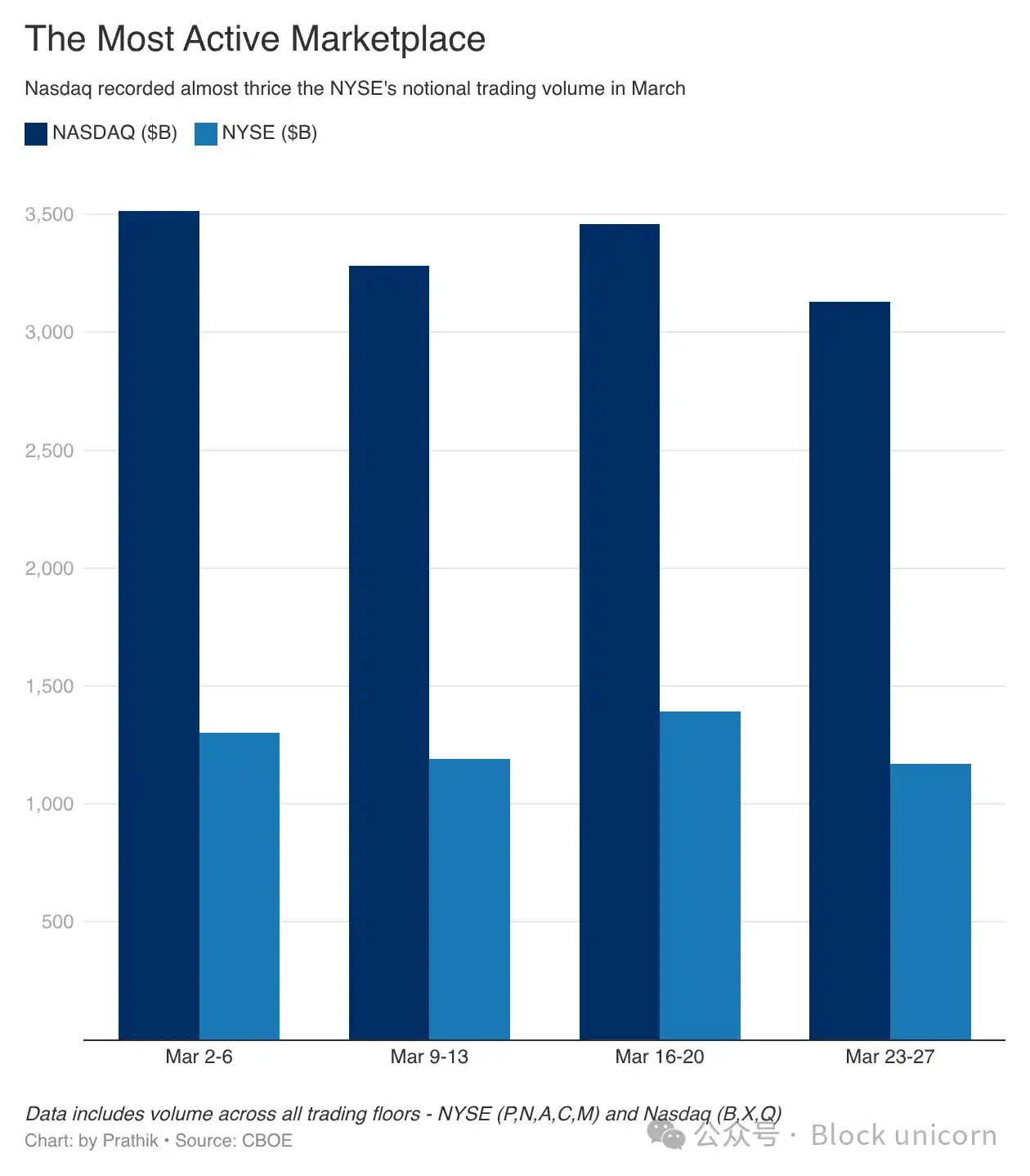
On March 16, Cboe Global Markets (Cboe Global Markets) filed a proposal with the U.S. Securities and Exchange Commission (SEC) to launch "near 24x5 U.S. equity trading." The largest operating body behind this U.S. financial exchange stated that it is ready to provide 24/5 equity trading services as early as December 2026.

But why? There is growing demand for extended U.S. equity trading hours.

These three initiatives collectively target the outdated bundled trading structure. Hyperliquid's launch of an S&P 500 futures trading market challenges the decades-old convention where investors could only trade traditional indices through traditional markets. It also enables 24/7 global trading of one of the most tracked large-cap indices.

Nasdaq's tokenized stock trading initiative targets infrastructure. It introduces a new form of wrapping, allowing the same stock to be traded in different ways. Previous attempts at tokenizing stocks have been criticized by the industry.

Investors questioned whether these tokens享有 the same rights as the original shares.

But, if I provide the same equity exposure through a token on the blockchain, without losing the voting rights and legal protections attached to the original dematerialized shares, wouldn't you accept it?

Why would you do this? What's in it for you?

Well, if you are an investor outside the U.S. who wants easier access to the stock market of the world's largest economy? What if this tokenized stock makes it easier for you to integrate it with collateral and lending systems?

When you consider 24/7 trading, these advantages multiply.

This is what Cboe is attacking. Its near 24x5 (24 hours a day, 5 days a week) trading proposal aims to acknowledge that capital does not wait for office hours. Traders always want to express their views immediately after receiving information. If Cboe does not provide them with a market to express their views, then traders will flock to other platforms that do.

Nothing I'm talking about is hypothetical, nor is it something that "might happen in the near future." They are happening, right now, as we speak.

An Unbundled Future

The adoption of financial product unbundling is most evident in Hyperliquid's HIP-3 market, which only officially launched in late October 2025.

In the past month alone, the cumulative trading volume on the HIP-3 market increased by $72 billion. The cumulative volume for the previous four months was $78 billion.
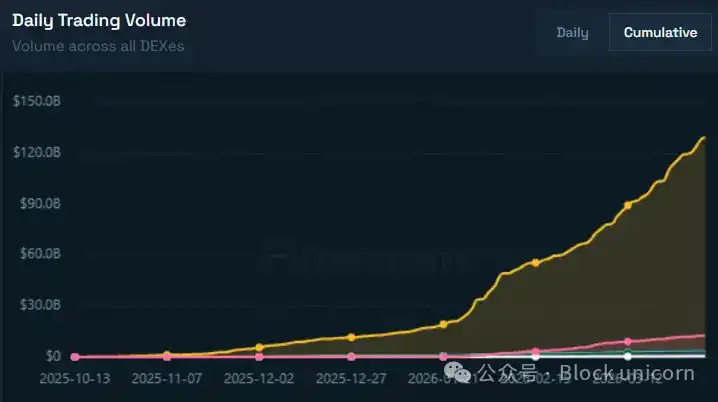
In March, Trade[XYZ] perpetual markets on traditional financial commodities and equities continued to account for 90% of HIP-3's daily trading volume. But this is not the most interesting aspect.

More than half of Trade[XYZ]'s trading volume comes from perpetual contract markets for silver, crude oil, Brent crude, and gold.

Hyperliquid provides a unified trading platform for spot cryptocurrencies as well as perpetual contracts for both cryptocurrencies and traditional assets. This not only simplifies the trading process on a unified platform but also brings higher liquidity, a unified user interface, and tighter bid-ask spreads.

Traders still want to trade some of the largest, hottest assets, spanning commodities, publicly listed companies, large private companies, and indices. You might want to trade silver, gold, crude oil, Tesla, Apple, Amazon, Google, an index tracking the top 100 U.S. non-financial companies, and the S&P 500 index—all of which can be done on the Hyperliquid platform.

HIP-3 unbundles the function of investing in these assets from the existing exchange infrastructure, while still tracking the underlying assets of their original benchmarks. So when you go long on a silver futures contract on HIP-3, the underlying asset it tracks is still pegged to the value of one ounce of silver in the Pyth data feed.

Traders have switched from previous platforms to trading silver on HIP-3 because HIP-3 does not distinguish between U.S. and non-U.S. traders, nor does it follow any specific time. Whenever an event occurs that traders want to express a view on through asset pricing, HIP-3 provides them with a market, regardless of the trader's geographic location or time zone.

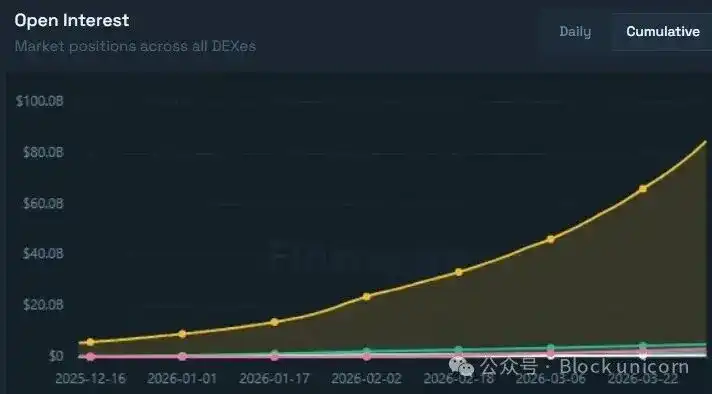
The significant growth in open interest (OI) on the Hyperliquid platform over the past few weeks fully demonstrates the above results. OI measures the total value of outstanding derivative positions. Unlike volume, which reflects trading activity, OI reflects trading commitment.
极

Open interest was $1.13 billion on March 1 and doubled to $2.2 billion on April 1. This shows that traders are confident in Hyperliquid's perpetual contracts and are locking in funds.

These metrics indicate that when market access is easier and there is less friction, traders will not be loyal to a particular platform or asset class. They will choose any platform that offers volatility, convenience, and liquidity.

This is why traditional institutions like S&P, Nasdaq, and Cboe are taking steps to acknowledge this behavior.

At least two recent events have demonstrated the importance of 24/7 trading and market volatility to traders.

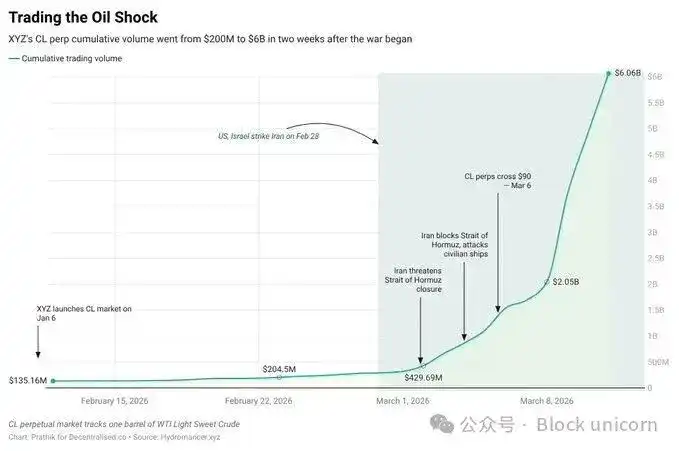
Saurabh wrote in a tweet on Decentralised.Co: "On February 28, the U.S. and Israel attacked Iran during traditional market hours. Within hours, the price of oil-linked perpetual contracts on the Hyperliquid platform surged 5% as traders digested the shock in real time."

Just two weeks after the outbreak of war, the trading volume of oil-linked perpetual contracts surged from $200 million to a cumulative $6 billion.
A major隐患 of emerging platforms is liquidity. If liquidity is insufficient, bid-ask spreads may widen, causing traders to face a pricing disadvantage worse than on other platforms.

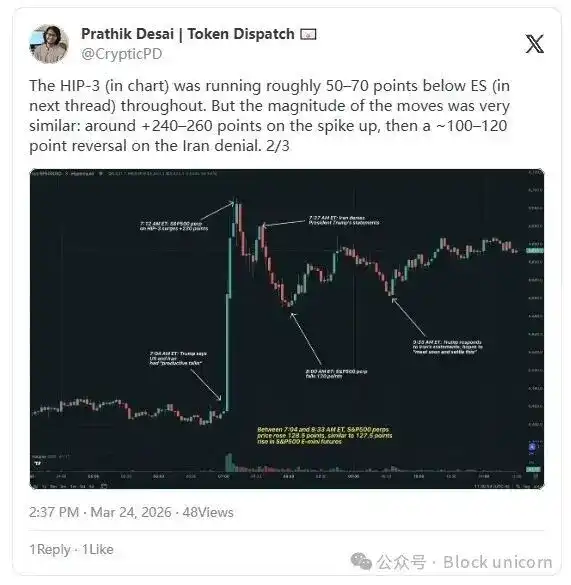
Last week, as U.S. President Trump consulted with Iranian officials on holding "productive talks," the Hyperliquid platform demonstrated its strong liquidity. The newly launched S&P 500 index futures based on the HIP-3 platform were able to accurately track the movement of the CME E-mini S&P 500 futures, down to the minute.

Although the on-chain perpetual contract was about 50–70 points lower than the ES, the magnitude of the price movement was similar.
What This Means

For decades, traditional markets have been bundled and controlled venues (exchanges), time (trading sessions), and products (indices/contracts).

They chose to maintain the status quo because they failed to establish mechanisms to address inefficiencies such as time delays, trading hour restrictions, and regulatory constraints on non-U.S. investors. Instead, they掩盖了 these inefficiencies and packaged them into procedural systems designed to build trusted institutions to attract investors.

People still trade and invest. This is not because they are stupid, or because they believe the rhetoric peddled by traditional financial markets. They do it because they have no choice. This began to change with the advent of blockchain, which provided the world with on-chain markets, making trading and investing easier than ever before.

People saw this choice and seized it.

They didn't care in the past, and they won't care in the future about changes in market structure. They also don't care whether the new structure is bundled or unbundled. As long as traders and investors can more easily express their opinions through financial instruments, they will embrace the new market structure, whether existing institutions like it or not. It doesn't matter if this structure comes from traditional giants like Nasdaq, Cboe, or S&P 500, or from a permissionless platform running on a blockchain.

The financial industry continues to evolve as it always has, and will adopt any structure that narrows the gap between the occurrence of an event and the expression of price opinion.

Important events are happening all over the world, every hour of the day. So why should prices have to wait until a clock starts ticking on a Monday morning in a glass-walled building in New York before they are determined?


Câu hỏi Liên quan

QWhat is the main argument presented in the article about the traditional structure of financial markets?

AThe article argues that the traditional, bundled structure of financial markets—which includes fixed trading hours, centralized exchanges, and specific product offerings—is becoming obsolete. It posits that capital seeks the fastest path to price information and that market participants will not tolerate inefficiencies, leading to an unbundled future with 24/7 trading across various venues and asset wrappers.

QWhat recent developments does the author cite as evidence of the shift towards an unbundled market structure?

AThe author cites three key developments: 1) S&P Dow Jones Indices licensing the S&P 500 to Trade[XYZ] for a perpetual derivatives contract on the Hyperliquid exchange. 2) The SEC approving Nasdaq's application to trade and settle some stocks in a tokenized form. 3) Cboe Global Markets submitting a proposal to the SEC for near 24x5 trading of U.S. stocks.

QHow does the article use the performance of Hyperliquid's HIP-3 market to support its thesis?

AThe article points to the massive growth of Hyperliquid's HIP-3 market, which saw a cumulative trading volume increase of $72 billion in just one month. It highlights that a majority of this volume is in perpetual contracts for traditional assets like silver, oil, and stock indices, demonstrating that traders are rapidly adopting new, unbundled platforms that offer 24/7 access, lower friction, and unified trading for both crypto and traditional assets.

QAccording to the article, what is a major historical reason traditional markets maintained their bundled structure?

AThe article suggests that traditional markets maintained their bundled structure not because it was the most efficient, but because they failed to build mechanisms to solve inherent inefficiencies like time delays, trading hour restrictions, and regulatory limits for non-U.S. investors. Instead, they masked these inefficiencies by packaging them as procedural rituals designed to create an aura of trust and institutional reliability.

QWhat fundamental force does the author identify as the driver behind the move to unbundle markets?

AThe author identifies 'financial gravity' as the fundamental force. This is the idea that capital, like water, will always find the path of least resistance and fastest access to price information. Market participants will naturally migrate to any structure that minimizes the gap between when an event occurs and when a price opinion can be expressed, regardless of whether it comes from a legacy institution or a new, permissionless platform.

Nội dung Liên quan

Cuộc Đối Đầu Bàn Cãi Nảy Lửa Trước IPO Lớn Nhất Lịch Sử: SpaceX Có Đáng Giá 1,77 Nghìn Tỷ USD Không?

SpaceX đang chuẩn bị cho đợt IPO lịch sử với định giá mục tiêu khoảng 1,77 nghìn tỷ USD, huy động 75 tỷ USD. Mức định giá này làm dấy lên cuộc tranh luận gay gắt trên thị trường vốn. **Phe lạc quan** (dẫn đầu bởi các ngân hàng bảo lãnh như Goldman Sachs và Morgan Stanley) cho rằng định giá dựa trên câu chuyện tăng trưởng dài hạn. Họ nhìn thấy tiềm năng to lớn từ mạng lưới vệ tinh Starlink, khả năng phóng tên lửa chi phí thấp và cả hoạt động AI trong tương lai, có thể đưa doanh thu lên hàng nghìn tỷ USD vào năm 2030 hoặc 2040. **Phe bi quan** (gồm các tổ chức nghiên cứu độc lập như Morningstar, New Constructs) thừa nhận SpaceX là tài sản vũ trụ thương mại hiếm có. Tuy nhiên, họ cho rằng mức định giá 1,77 nghìn tỷ USD đã phản ánh quá nhiều kỳ vọng tăng trưởng tương lai, đặc biệt là từ các lĩnh vực AI còn nhiều rủi ro. Các mô hình định giá của họ (như DCF) chỉ ra giá trị hợp lý thấp hơn nhiều, trong khoảng 780 tỷ đến 1,7 nghìn tỷ USD. Họ cảnh báo về rủi ro định giá quá cao, kiểm soát nội bộ và áp lực bán ra sau IPO. Tóm lại, cả hai bên đều đồng ý về chất lượng công ty, nhưng bất đồng sâu sắc về mức giá 135 USD/cổ phiếu. IPO hiện được ghi nhận mức độ tham gia cao, phản ánh sự khan hiếm và sức hút của SpaceX, bất chấp những tranh cãi về định giá.

marsbit42 phút trước

Cuộc Đối Đầu Bàn Cãi Nảy Lửa Trước IPO Lớn Nhất Lịch Sử: SpaceX Có Đáng Giá 1,77 Nghìn Tỷ USD Không?

marsbit42 phút trước

Các Ngân hàng Lớn nhất Nhật Bản Hướng tới Mục tiêu Triển khai Stablecoin vào Năm Tài chính 2026 Giữa Lúc Chính quyền Thúc đẩy

Trong bối cảnh cơ quan quản lý Nhật Bản thúc đẩy thị trường tài sản số dựa trên đồng yên, ba ngân hàng lớn nhất nước này - MUFG, Sumitomo Mitsui và Mizuho - đã tiến thêm một bước trong kế hoạch phát hành stablecoin chung. Họ đã thành lập một hội đồng tự nguyện để phát triển khung phát hành token trong năm tài chính này, nhằm mục tiêu triển khai giao dịch thương mại ổn định vào cuối năm tài chính 2026 (trước ngày 31/3/2027). Các ngân hàng này, phục vụ hơn 300.000 công ty, sẽ đóng vai trò là người thiết lập ủy thác chung, trong khi một ngân hàng ủy thác sẽ là người được ủy thác. Hội đồng sẽ xem xét các khung hoạt động, quản trị và xây dựng cơ sở hạ tầng phát hành, đồng thời mở rộng hợp tác với các tổ chức tài chính khác. Động thái này diễn ra trong bối cảnh Nhật Bản đã sửa đổi Đạo luật Dịch vụ Thanh toán vào năm 2022, chỉ cho phép các công ty chuyển tiền, công ty ủy thác và ngân hàng được cấp phép phát hành stablecoin bằng yên. Gần đây, đảng cầm quyền LDP cũng kêu gọi chính phủ thúc đẩy việc sử dụng stablecoin yên để thanh toán ở châu Á, tận dụng cơ hội Nhật Bản đăng cai hội nghị thường niên của Ngân hàng Phát triển châu Á vào năm tới.

bitcoinist1 giờ trước

Các Ngân hàng Lớn nhất Nhật Bản Hướng tới Mục tiêu Triển khai Stablecoin vào Năm Tài chính 2026 Giữa Lúc Chính quyền Thúc đẩy

bitcoinist1 giờ trước

Sau khi các đạo luật GENIUS và CLARITY được thông qua, kiến trúc đúng đắn cho lợi suất trên chuỗi là gì?

Bài viết thảo luận về cấu trúc tín dụng trên chuỗi phù hợp sau khi các đạo luật GENIUS và CLARITY được thông qua. Tác giả phân biệt ba thị trường tín dụng trên chuỗi: cho vay thế chấp vượt mức (như Aave, Compound), cho vay không thế chấp (thất bại lịch sử), và tín dụng có tài sản bảo đảm (Asset-Backed Credit - ABC). ABC, với tài sản thế chấp ngoài chuỗi có thể định danh, quyền đòi nợ hợp pháp và cơ chế thu hồi, được xem là loại hình duy nhất giải quyết được vấn đề lựa chọn ngược (adverse selection) – khi những người vay rủi ro nhất lại tích cực tìm kiếm vốn nhất. Bài viết chỉ ra rằng thị trường Tài sản Thế giới Thực (RWA) trên chuỗi, đặc biệt là tín dụng tư nhân được mã hóa, đang tăng trưởng mạnh mẽ (259.6 tỷ USD vào 06/2026). Tuy nhiên, phần lớn hiện tại chỉ là "bao bì quỹ được mã hóa", kế thừa rủi ro từ nhà quản lý quỹ ngoài chuỗi mà không giải quyết triệt để vấn đề lựa chọn ngược ở cấp độ giao thức. Đạo luật GENIUS (cấm nhà phát hành stablecoin trả lãi) và CLARITY (dự kiến cấm các nền tảng trả lãi trên số dư stablecoin) đang thay đổi cục diện. Chúng thu hẹp các cách hợp pháp để tạo ra lợi nhuận từ đồng USD trên chuỗi, đẩy mạnh vai trò của "kho tiền" (vault) theo tiêu chuẩn như ERC-4626 như là sản phẩm đầu tư riêng biệt để phân phối lợi nhuận. Tác giả nhấn mạnh rằng thiết kế kho tiền, nơi mã hóa công tác thẩm định tín dụng, cấu trúc và cơ chế thu hồi, là lựa chọn kiến trúc quan trọng nhất. Trong tương lai, kho tiền được thiết kế tốt, tuân thủ quy định và tập trung vào ABC sẽ là chìa khóa để cung cấp lợi nhuận minh bạch, hợp pháp trong môi trường hậu GENIUS/CLARITY, tận dụng nhu cầu vốn khổng lồ từ thị trường stablecoin (khoảng 3230 tỷ USD).

Foresight News1 giờ trước

Sau khi các đạo luật GENIUS và CLARITY được thông qua, kiến trúc đúng đắn cho lợi suất trên chuỗi là gì?

Foresight News1 giờ trước

TechFlow Tình Báo Cục: Mô hình mới Fable của Anthropic giới hạn nghiên cứu an toàn sinh học gây tranh cãi, Chỉ số CPI Mỹ tăng lên 4.2%, cao nhất trong ba năm

Anthropic gặp tranh cãi khi các mô hình Fable và Mythos bị phát hiện hạn chế ngầm nghiên cứu sinh học và giữ dữ liệu 30 ngày, sau đó buộc phải điều chỉnh chính sách. Người đồng sáng lập Dario Amodei tiết lộ lý do rời OpenAI là do Sam Altman không trung thực. OpenAI có thể giảm giá mạnh để cạnh tranh, trong khi Microsoft mở rộng Copilot. Trong lĩnh vực crypto, BlackRock đẩy mạnh ETF Bitcoin, còn CEO Bank of America cảnh báo stablecoin có thể rút hụt lớn tiền gửi ngân hàng. Bitcoin giảm bất chấp CPI Mỹ tăng 4.2% và khủng hoảng địa chính trị khi Iran đóng cửa eo biển Hormuz. Về chip, Nvidia và AMD cạnh tranh với các mô hình và kiến trúc mới. Tòa án Đức phán quyết Google phải chịu trách nhiệm pháp lý cho câu trả lời sai từ AI Overviews. Thị trường tài chính biến động: vàng và cổ phiếu Mỹ lao dốc, Hàn Quốc chứng kiến ba ngày ngưng giao dịch. Nghiên cứu cho thấy cộng đồng Reddit WSB có thể chọn cổ phiếu tốt hơn Phố Wall. Các xu hướng đáng chú ý: công nghệ giao diện não tại Trung Quốc giúp bệnh nhân khiếm thị, và máy bay không người lái tự động lần đầu tiên sát hại binh lính, làm dấy lên lo ngại về vũ khí AI. Chủ đề xuyên suốt: ranh giới và trách nhiệm của AI đang được định hình giữa lúc thế giới thực đối mặt với lạm phát và xung đột, đánh dấu sự giằng co giữa lạc quan công nghệ và lo ngại thực tế.

marsbit1 giờ trước

TechFlow Tình Báo Cục: Mô hình mới Fable của Anthropic giới hạn nghiên cứu an toàn sinh học gây tranh cãi, Chỉ số CPI Mỹ tăng lên 4.2%, cao nhất trong ba năm

marsbit1 giờ trước

Alibaba lại có một đơn vị kinh doanh mới, tín hiệu gì đây?

Vào tháng 6, Tập đoàn Alibaba công bố đợt điều chỉnh tổ chức AI lớn thứ ba kể từ năm 2026: sáp nhập Nhóm Nghiên cứu Mô hình Lớn Thông Nghĩa và Phòng Thí nghiệm Cuộc sống Tương lai để thành lập Bộ phận Kinh doanh mới - Token Foundry. Bộ phận này do CEO Đỗ Vũ Minh trực tiếp phụ trách, với mục tiêu trở thành "nhà máy sản xuất" token AI, đẩy nhanh việc nghiên cứu và thương mại hóa mô hình. Đồng thời, Chu Tĩnh Nhân, người đặt nền móng cho hệ thống Thiên Vấn, chuyển sang vai trò Nhà khoa học trưởng tập đoàn, dẫn dắt Viện Nghiên cứu Tương lai AI Alibaba, tập trung vào nghiên cứu công nghệ tiên phong. Động thái này đánh dấu chiến lược AI của Alibaba đã chuyển từ giai đoạn "tích hợp tài nguyên" sang "tăng tốc triển khai". Token Foundry sẽ chịu trách nhiệm phát triển mô hình và thương mại hóa, trong khi Viện Nghiên cứu Tương lai AI tập trung vào khám phá dài hạn. Cấu trúc tổ chức bốn tầng "Viện nghiên cứu - Mô hình cơ sở - Nền tảng dịch vụ - Sản phẩm ứng dụng" nhằm đảm bảo cả đổi mới công nghệ và nhu cầu thương mại hóa ngắn hạn. Bối cảnh của sự điều chỉnh là ngành công nghiệp AI toàn cầu đang trải qua quá trình tái cấu trúc tổ chức tương tự, với xu hướng hợp nhất các nhóm AI riêng lẻ vào một đơn vị chỉ huy thống nhất dưới sự quản lý trực tiếp của CEO, nhằm giảm chi phí phối hợp và tăng tốc độ ra quyết định. Về mặt thương mại, AI của Alibaba đã bước vào chu kỳ thu hồi vốn. Doanh thu từ các sản phẩm và dịch vụ liên quan đến AI của Alibaba Cloud đã tăng ba con số trong 11 quý liên tiếp. Mục tiêu là đạt Doanh thu thường xuyên hàng năm (ARR) 100 tỷ nhân dân tệ cho nền tảng MaaS (Model-as-a-Service) vào quý 6 và 300 tỷ vào cuối năm. Tuy nhiên, áp lực cạnh tranh trong lĩnh vực MaaS vẫn rất lớn, với các đối thủ như ByteDance và Tencent cũng đang tăng tốc thương mại hóa. Việc thành lập Token Foundry là một nước đi then chốt của Alibaba trong cuộc đua công nghệ, sản phẩm và thương mại hóa ba tuyến này.

marsbit2 giờ trước

Alibaba lại có một đơn vị kinh doanh mới, tín hiệu gì đây?

marsbit2 giờ trước

Giao dịch

Giao ngay
Hợp đồng Tương lai
活动图片




