The Other Side of XMR's Surge: Regulation, Black Market, and Real Demand

比推Xuất bản vào 2026-01-14Cập nhật gần nhất vào 2026-01-14

Tóm tắt

Monero (XMR), a leading privacy-focused cryptocurrency, reached a new all-time high of over $690 on January 13, 2025, marking a 262% surge from around $200 a year prior. This rally occurred amid a broader market downturn and increasing global regulatory pressure, including its delisting from major exchanges like Binance and a recent ban on privacy coins in Dubai. Analysis reveals that the price surge was not primarily driven by trading on centralized exchanges, as spot and derivatives trading volumes remained relatively modest. Instead, key factors include significant capital deployment in mining, with network difficulty rising sharply throughout 2025 despite temporary volatility, indicating strong interest from large-scale miners. On-chain data shows a substantial increase in average transaction fees—tripling since mid-2025—suggesting growing real demand for private transactions. Users are willing to pay higher fees for Monero’s privacy features, especially as regulatory crackdowns intensify. This has created a counterintuitive effect where bans may have strengthened demand among users seeking censorship-resistant transactions. The rally reflects both “white” (legitimate privacy needs) and “black” (asymmetric information and potential market manipulation) factors. The opaque nature of Monero’s ecosystem means retail investors face significant risks, as evidenced by high volatility and the potential for sharp corrections, similar to those seen with other privacy coins like...

Author: Frank, PANews

Original Title: The More It's Banned, The More It Rises? Unpacking the Black and White Truth Behind XMR's Surge


XMR (Monero), one of the leading players in the privacy sector, hit a new all-time high on January 13, with its price peaking at over $690, reigniting discussions about privacy coins.

From January 2025 to now, over the past year, XMR has surged from around $200, achieving a maximum gain of 262%. Amid widespread weakness in mainstream altcoins, such a rise is exceptionally rare. More intriguingly, this rally occurred against a backdrop of unprecedented global regulatory tightening.

Due to compliance pressures, major centralized exchanges like Binance had already delisted XMR spot trading. Then, on January 12, the Dubai Virtual Assets Regulatory Authority (VARA) officially announced a ban on the trading and custody of privacy tokens throughout Dubai and its free zones. However, far from casting a shadow over XMR, this ban was met with defiance as the coin hit a new high, almost mocking the Dubai government.

So, who is the real driving force behind XMR's rise, caught between dwindling exchange liquidity and regulatory crackdowns? PANews peels back the surface to find the real demand behind this market movement.

Exchanges Are Not the Core Pricing Venue

Despite the hot market, it is not primarily driven by funds within exchanges.

In terms of spot trading, while XMR's recent trading volume has increased with the price rise, it has generally remained in the range of tens of millions to $200 million, without any particularly dramatic spikes. Looking back, the significant peak in spot trading volume was actually on November 10, reaching $410 million. This means that during this recent doubling rally, spot trading (or buying pressure on centralized exchanges) was not the main driver.

The situation is similar for futures. The volume peak also occurred on November 10. Until about a week ago, futures trading volume did not show a significant surge and even showed some signs of decline. Observing the open interest data, the change curve in USD terms almost perfectly overlaps with the price movement. The number of XMR positions in the market did not abnormally spike; the increase in open interest value was solely due to the rising coin price, not a large influx of new capital opening positions.
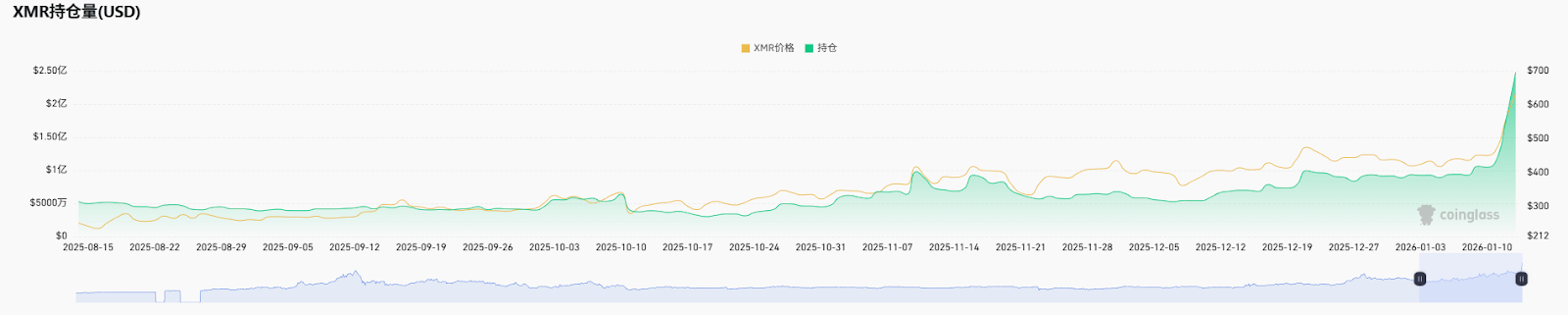
Clearly, mainstream exchanges are not the core pricing venue for XMR currently.

Undercurrents on the Supply Side: Miner Shake-up and Early Positioning

Since the "visible" funds are unremarkable, we need to turn to the "invisible" on-chain world. As the network with the strongest privacy, XMR offers very little information to mine, but changes in mining difficulty and mining rewards allow us to glimpse the capital布局 (layout) on the supply side.

Historical mining difficulty typically represents capital's enthusiasm for participating in the network ecosystem. Data shows that XMR's mining difficulty began to climb rapidly at the end of 2024 and was in a state of rapid growth throughout the first half of 2025. Although it fluctuated between September and November, it recently began a new round of difficulty increase.
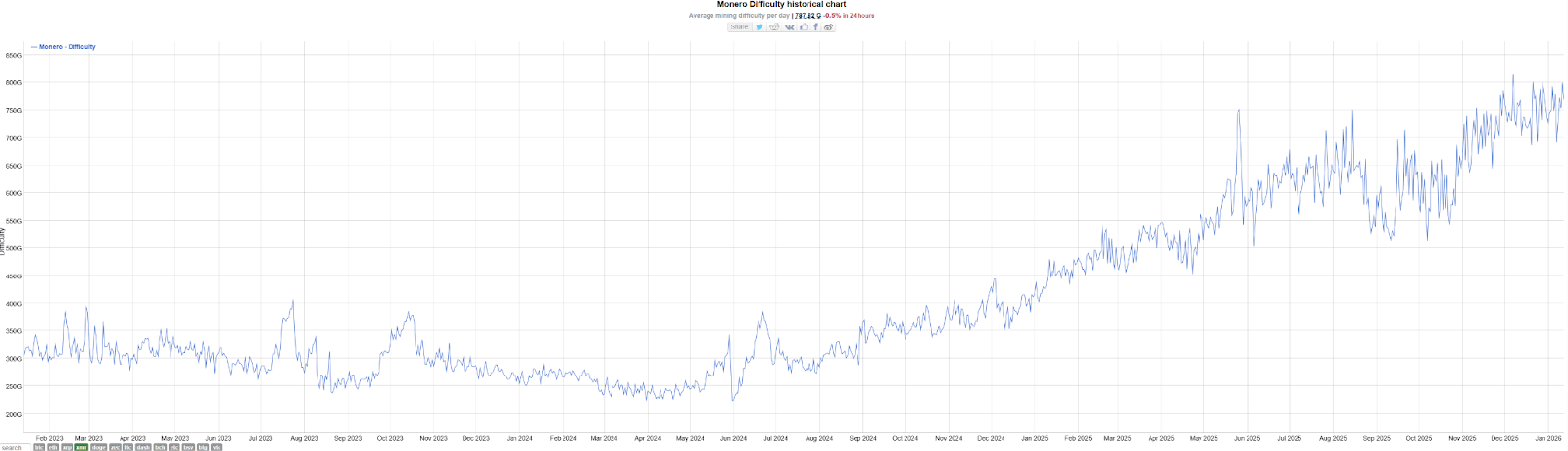
An interlude must be mentioned here: In September, the Qubic project claimed it controlled over 51% of XMR's total network hash rate and performed a "demonstration attack," causing a chain reorganization spanning 18 blocks on the XMR network. This event served as a wake-up call for the community, after which a large number of miners migrated their hash rate to the established mining pool SupportXMR. This incident was the main reason for the剧烈波动 (violent fluctuations) in mining difficulty around the end of 2025, but it also侧面印证了 (serves as side evidence of) the activity and resilience of the hash rate market.

More noteworthy is the联动 (linkage) between the mining reward curve and the difficulty.

Before April 2025, the mining rewards on the Monero network experienced a significant drop. Correlating with the difficulty chart from that time, the hash rate rose sharply while the price remained震荡 (volatile). This divergence led to diluted rewards, likely forcing some smaller miners with higher costs out of the market. Data showing a回调 (pullback) in mining difficulty in April supports this猜想 (conjecture).
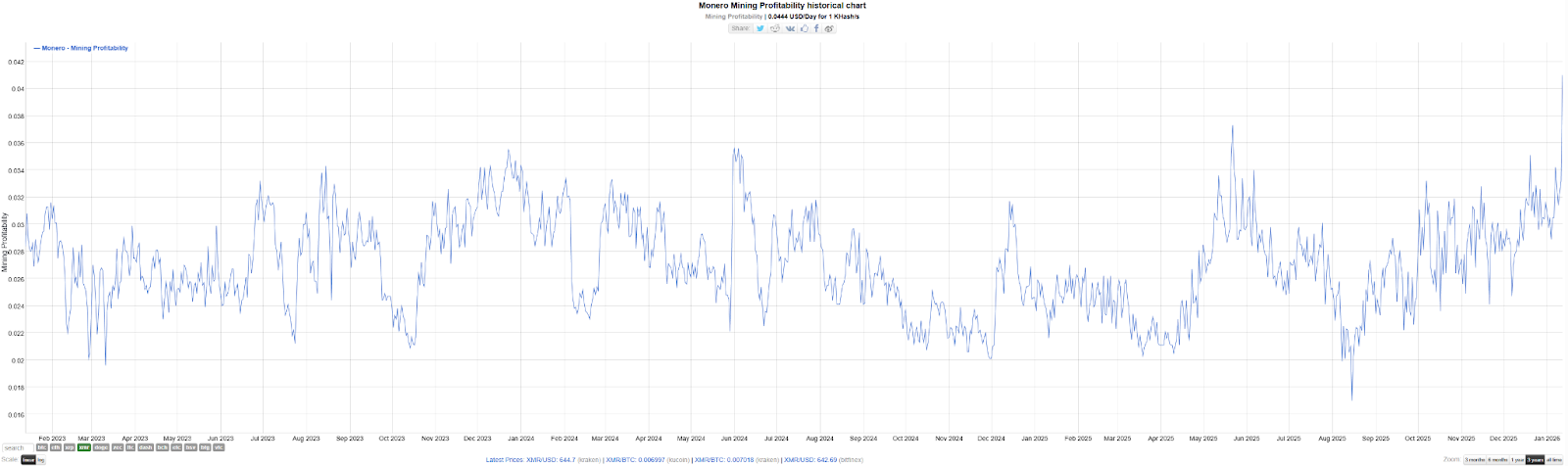
This was a classic case of "miner capitulation" and "筹码交换 (chips exchange/churn)." After this, as prices rose significantly, mining rewards and difficulty resumed同步上涨 (synchronous growth). Judging from the data changes in this phase, as early as the beginning of 2025, some large mining enterprises or capital with strong risk resistance might have started positioning early in Monero token mining despite the low rewards.

Demand-Side Verification: Paying a High Premium for Privacy

If miners represent confidence on the supply side, then the average transaction fee most accurately reflects demand on the user side.

Looking at the chart, Monero's average transaction fee was relatively stable before the first half of 2025, basically staying below $0.1. But starting in June, a growth trend emerged; by December 11, the highest average fee一度达到 (once reached) over $0.3, more than triple the level from six months prior.
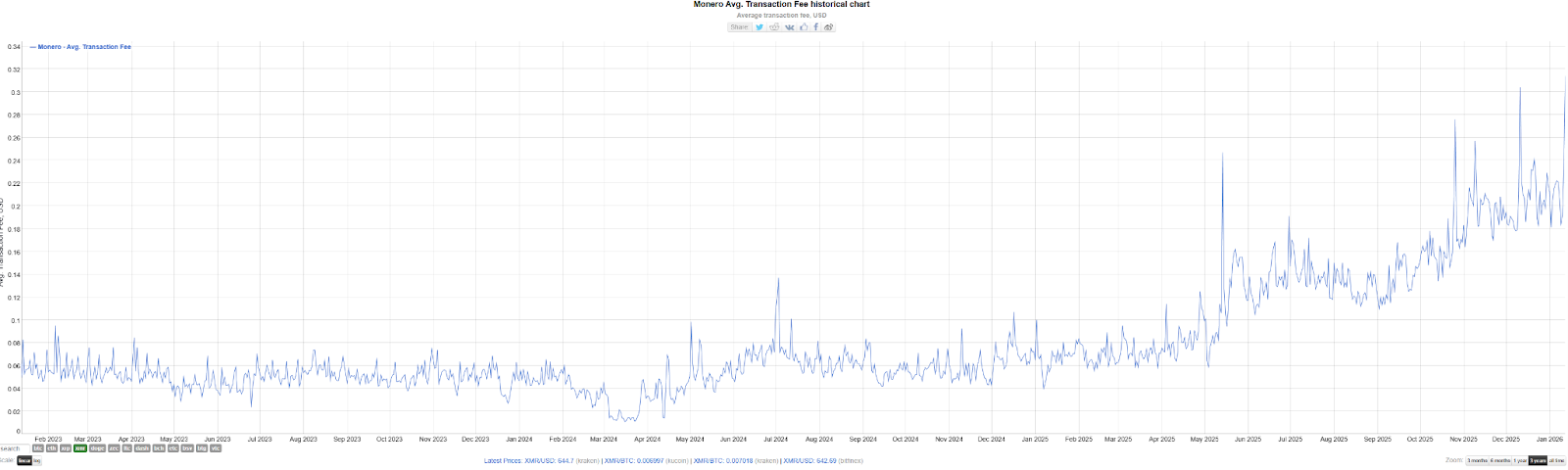
Because Monero has a dynamic block size adjustment mechanism, a surge in fees means a large number of users are trying to send transactions quickly and are willing to pay high fees to compensate miners for the cost of block expansion. This侧面证明 (serves as indirect proof) that starting from the second half of 2025, the real on-chain transaction demand for Monero began to increase significantly.

However, we also discovered an interesting pattern: spikes in on-chain fees often coincide with sharp price increases.

For example, on April 28, XMR suddenly rose 14%, and the average transaction fee that day surged to $0.125; during the subsequent period of slow price爬升 (climb), fees fell back to a trough (lowest at $0.058 on May 4). This indicates that while market volatility can drive on-chain demand in the short term, when the volatility subsides, on-chain demand also returns to calm. Although sometimes they are not synchronized (e.g., fees rose on May 14 but the price didn't move), overall, during these more than six months, price increases briefly drove on-chain demand, and the growth in real on-chain demand in turn triggered market optimism about XMR, with the two互为因果 (being mutually causal).

The Truth in Black and White

Combining the above data, the truth behind XMR's surge likely has "black and white" aspects.

The so-called "white" truth is the "antifragile" rebound of privacy demand under high regulatory pressure.

The反向推动 (reverse driving effect) of regulation is becoming increasingly apparent. The VARA ban not only failed to crush XMR but made market participants realize: regulatory agencies can ban exchanges, but they cannot ban the protocol itself. As major exchanges退出 (exit) the XMR trading环节 (segment), the logic of pricing reliant on market makers and derivative contracts was rewritten. XMR returned to a model controlled by real users or certain heavyweight players. After脱离 (detaching from) the exchange system, privacy coins have developed an independent rhythm completely different from the mainstream market.

The so-called "black" truth is the capital game under information asymmetry.

Behind this opacity, there might be an "iceberg" of whales. The "unimpressive" trading data (even on January 13, when it hit a new high, futures open interest was only $240 million, and liquidation volume was just over $1 million) indicates that mainstream institutions almost failed to predict and participate in this rally in advance, only following along.

This information asymmetry, held by a few, leads to extreme price volatility. Especially when the market starts paying attention to such a rise, it often signals short-term emotional overheating. Referring to the privacy coin ZEC in November, it experienced a retracement of over 50% after its surge. Ultimately, in the privacy coin market, there is a large amount of "information asymmetry," which puts ordinary retail investors at an absolute disadvantage.

Amid the剧烈波动 (violent fluctuations) of privacy coins, on-chain data is perhaps our only reliable guide. But in the depths without transparency, the high premium of freedom always comes with unknown risks.


Twitter:https://twitter.com/BitpushNewsCN

Bitpush TG Discussion Group:https://t.me/BitPushCommunity

Bitpush TG Subscription: https://t.me/bitpush

Original Link:https://www.bitpush.news/articles/7602643

Tiền kỹ thuật số thịnh hành

Câu hỏi Liên quan

QWhat was the peak price of XMR (Monero) on January 13th, and what was its maximum percentage increase from its price at the beginning of 2025?

AXMR reached a peak price of over $690 on January 13th. Its maximum percentage increase from its price of around $200 at the beginning of 2025 was 262%.

QDespite the price surge, why were mainstream centralized exchanges like Binance not considered the core pricing venues for XMR?

ABecause the spot trading volume on these exchanges did not see a significant, exaggerated increase during the rally, and the open interest in futures contracts only rose in dollar value due to the price increase, not from a large influx of new capital opening positions.

QWhat event in September 2025 caused significant volatility in XMR's mining difficulty, and what was the community's response?

AThe Qubic project claimed to control over 51% of XMR's network hashrate and performed a 'demonstrative attack,' causing an 18-block chain reorganization. In response, a large number of miners migrated their hashrate to the established mining pool, SupportXMR.

QWhat on-chain metric is cited as the most authentic reflection of user-side demand for Monero, and what was its trend in the latter half of 2025?

AThe average transaction fee is cited as the most authentic reflection of user-side demand. It began to show a growth trend starting in June 2025, with the highest average fee reaching over $0.30 by December 11th, a more than 3x increase from six months prior.

QAccording to the article, what are the 'white' and 'black' truths behind XMR's price surge?

AThe 'white' truth is the 'anti-fragile'反弹反弹 of privacy demand under high regulatory pressure, where the asset became less dependent on exchanges. The 'black' truth is capital博弈博弈 in an environment of information asymmetry, where a few major players ('whales') with an information advantage could be driving the volatile price action, putting retail investors at a significant disadvantage.

Nội dung Liên quan

Lãi Mở XRP Chạm Mốc 2,6 Tỷ USD Khi Nhu Cầu Phái Sinh Tăng

Dữ liệu từ CoinGlass cho thấy lãi mở (open interest) của hợp đồng tương lai XRP đã tăng hơn 10% trong 24 giờ, đạt mốc 2,6 tỷ USD, đưa XRP trở thành một trong những tài sản tiền điện tử có lãi mở phái sinh lớn nhất. Mức tăng này phản ánh nhu cầu giao dịch phái sinh quanh XRP đang gia tăng đáng kể. Tuy nhiên, lãi mở tăng cho thấy nhiều vị thế đang được mở ra, nhưng không tự động chỉ ra rằng dòng tiền này lạc quan hay bi quan về giá. Nó có thể đến từ các vị thế mua, bán khống, phòng ngừa rủi ro hoặc giao dịch đòn bẩy. Do đó, sự tích tụ này có thể hỗ trợ một đợt biến động mạnh hơn, nhưng cũng làm tăng rủi ro biến động và thanh lý. Các nhà giao dịch cần xem xét thêm các chỉ số khác như phí funding, khối lượng giao dịch spot, hướng giá và dữ liệu thanh lý để có bức tranh đầy đủ. Sự gia tăng lãi mở cho thấy XRP đang thu hút sự chú ý nghiêm túc từ thị trường phái sinh, nhưng sự bền vững của xu hướng sẽ phụ thuộc vào việc liệu hoạt động spot có tăng theo để xác nhận hay không. Kết quả cuối cùng có thể là một xu hướng mạnh hơn hoặc đơn giản là thêm biến động cho một thị trường vốn đã sôi động.

bitcoinist43 phút trước

Lãi Mở XRP Chạm Mốc 2,6 Tỷ USD Khi Nhu Cầu Phái Sinh Tăng

bitcoinist43 phút trước

Nhịp Đập Thị Trường BTC: Tuần 30

Bitcoin (BTC) đã hồi phục từ dưới 58.000 USD để thử nghiệm mức 65.000 USD trước khi đi vào giai đoạn củng cố quanh 64.500 USD. Động lượng tăng đã chậm lại và khối lượng giao dịch spot vẫn ở mức thấp. Mặc dù vậy, sự phục hồi được duy trì trong bối cảnh thị trường đang tìm kiếm điểm cân bằng vững chắc hơn. Chênh lệch biến động (volatility spreads) thu hẹp cho thấy thị trường phái sinh không còn định giá phí bảo hiểm rủi ro cao, phản ánh tâm lý phòng thủ giảm bớt. Dù sự tham gia của thị trường giao ngay còn yếu, khẩu vị đầu cơ đang dần quay trở lại. Lãi suất mở (open interest) cho hợp đồng tương lai và quyền chọn tăng lên, dòng tiền của nhà giao dịch vĩnh viễn (perpetual taker flow) chuyển sang mua ròng và nhu cầu bảo vệ trước rủi ro giảm xuống. Hoạt động on-chain cũng đang ổn định, được hỗ trợ bởi sự cải thiện vừa phải về thông lượng kinh tế và sự tham gia của người dùng. Dòng vốn vẫn thận trọng, nhưng dòng tiền ETF spot tại Mỹ đang phục hồi và các nhóm ETF đang trở lại gần mức hòa vốn, cho thấy áp lực bán từ tổ chức đang giảm dần. Nhìn chung, thị trường Bitcoin dường như ngày càng cân bằng hơn, với niềm tin dài hạn tạo đà hỗ trợ trong khi sự tham gia đầu cơ vẫn được kiểm soát. Tuy nhiên, tỷ trọng ngày càng tăng của vốn ngắn hạn nhạy cảm với giá cả làm tăng khả năng biến động mạnh hơn, khiến thị trường vẫn kiên cường nhưng ngày càng nhạy cảm với sự thay đổi trong động lượng và áp lực bán.

insights.glassnode2 giờ trước

Nhịp Đập Thị Trường BTC: Tuần 30

insights.glassnode2 giờ trước

Nhu cầu Bitcoin tại thị trường giao ngay suy yếu khi vốn mới do dự bất chấp dòng tiền vào ETF

Mặc dù dòng tiền vào các quỹ ETF Bitcoin đã chuyển sang tích cực kể từ giữa tháng 7, nhưng điều này vẫn chưa đủ để đưa giá Bitcoin vượt lên vùng cung địa phương quanh mốc 65.000 USD. Theo phân tích từ CryptoQuant, nhu cầu mua Bitcoin trên thị trường giao ngay (spot) trong 30 ngày đã suy yếu đáng kể, giảm từ -80.000 BTC xuống -170.000 BTC. Sự ổn định tương đối của giá hiện tại chủ yếu được hỗ trợ bởi các lệnh mua để đóng vị thế bán (short-covering) trên thị trường phái sinh và áp lực bán từ các nhà đầu tư ngắn hạn đã giảm bớt. Chỉ số "Nhà đầu tư mới vào Bitcoin", đo lường tỷ trọng vốn hóa nắm giữ bởi các đồng coin non trẻ (dưới 1 tháng tuổi), vẫn ở gần mức thấp nhất trong năm, cho thấy sự tham gia của dòng vốn mới còn yếu. Tỷ lệ lợi nhuận trên đầu ra đã chi tiêu của nhà đầu tư ngắn hạn (STH SOPR) cũng duy trì dưới mức 1.0, có nghĩa là họ vẫn đang chốt lỗ trung bình. Những chỉ báo này cùng củng cố quan điểm rằng thị trường hiện đang trong giai đoạn ổn định cục bộ, chứ chưa có dấu hiệu đảo chiều tăng mạnh. Các nhà phân tích nhấn mạnh rằng, cần theo dõi việc giá có thể vượt qua đỉnh dao động địa phương 67.300 USD hay không để xác nhận một sự đảo chiều thực sự.

ambcrypto4 giờ trước

Nhu cầu Bitcoin tại thị trường giao ngay suy yếu khi vốn mới do dự bất chấp dòng tiền vào ETF

ambcrypto4 giờ trước

Vì sao giao dịch "cá voi" 32,6 triệu USD của Chainlink có thể định hình đà tăng của LINK về phía 9 USD

Một giao dịch chuyển 3,89 triệu LINK (trị giá 32,58 triệu USD) từ ví Coinbase Institutional sang một ví ẩn danh đã thu hút sự chú ý đến Chainlink. Chuyển động này làm dấy lên suy đoán về việc các tổ chức lớn đang tích lũy thay vì bán ra ngay lập tức. Dòng tiền ròng trên sàn giao dịch đã chuyển sang dương với lượng vào khoảng 620,18 nghìn USD, đánh dấu sự thay đổi sau một thời gian dài dòng tiền ra chiếm ưu thế. Tuy nhiên, tâm lý trên thị trường phái sinh vẫn thận trọng, với chỉ số CVD 90 ngày cho thấy lệnh bán vẫn chiếm ưu thế. Về mặt kỹ thuật, LINK đang giao dịch quanh mức 8,35 USD, thử thách vùng kháng cự gần đó. Chỉ số RSI ở mức 57,71 cho thấy áp lực mua đang tăng lên. Để duy trì đà hồi phục, giá cần vượt qua được ngưỡng 8,35 USD, từ đó mở đường hướng tới mục tiêu 9,00 USD. Ngược lại, nếu bị từ chối tại đây, giá có thể quay lại kiểm tra vùng hỗ trợ 8,18 USD. Tóm lại, hoạt động của ví tổ chức và dòng tiền ròng trên sàn là tín hiệu tích cực, nhưng tâm lý bán trên thị trường phái sinh vẫn tạo ra sự thận trọng, khiến triển vọng ngắn hạn của LINK chưa thực sự rõ ràng.

ambcrypto5 giờ trước

Vì sao giao dịch "cá voi" 32,6 triệu USD của Chainlink có thể định hình đà tăng của LINK về phía 9 USD

ambcrypto5 giờ trước

Giao dịch

Giao ngay

Bài viết Nổi bật

Làm thế nào để Mua XMR

Chào mừng bạn đến với HTX.com! Chúng tôi đã làm cho mua Monero (XMR) trở nên đơn giản và thuận tiện. Làm theo hướng dẫn từng bước của chúng tôi để bắt đầu hành trình tiền kỹ thuật số của bạn.Bước 1: Tạo Tài khoản HTX của BạnSử dụng email hoặc số điện thoại của bạn để đăng ký tài khoản miễn phí trên HTX. Trải nghiệm hành trình đăng ký không rắc rối và mở khóa tất cả tính năng. Nhận Tài khoản của tôiBước 2: Truy cập Mua Crypto và Chọn Phương thức Thanh toán của BạnThẻ Tín dụng/Ghi nợ: Sử dụng Visa hoặc Mastercard của bạn để mua Monero (XMR) ngay lập tức.Số dư: Sử dụng tiền từ số dư tài khoản HTX của bạn để giao dịch liền mạch.Bên thứ ba: Chúng tôi đã thêm những phương thức thanh toán phổ biến như Google Pay và Apple Pay để nâng cao sự tiện lợi.P2P: Giao dịch trực tiếp với người dùng khác trên HTX.Thị trường mua bán phi tập trung (OTC): Chúng tôi cung cấp những dịch vụ được thiết kế riêng và tỷ giá hối đoái cạnh tranh cho nhà giao dịch.Bước 3: Lưu trữ Monero (XMR) của BạnSau khi mua Monero (XMR), lưu trữ trong tài khoản HTX của bạn. Ngoài ra, bạn có thể gửi đi nơi khác qua chuyển khoản blockchain hoặc sử dụng để giao dịch những tiền kỹ thuật số khác.Bước 4: Giao dịch Monero (XMR)Giao dịch Monero (XMR) dễ dàng trên thị trường giao ngay của HTX. Chỉ cần truy cập vào tài khoản của bạn, chọn cặp giao dịch, thực hiện giao dịch và theo dõi trong thời gian thực. Chúng tôi cung cấp trải nghiệm thân thiện với người dùng cho cả người mới bắt đầu và người giao dịch dày dạn kinh nghiệm.

Tổng lượt xem 428Xuất bản vào 2024.12.10Cập nhật vào 2026.06.02

Làm thế nào để Mua XMR

Thảo luận

Chào mừng đến với Cộng đồng HTX. Tại đây, bạn có thể được thông báo về những phát triển nền tảng mới nhất và có quyền truy cập vào thông tin chuyên sâu về thị trường. Ý kiến ​​của người dùng về giá của XMR (XMR) được trình bày dưới đây.

活动图片