The Next Memecoin Script: The Era of Flash in the Pan

marsbitXuất bản vào 2025-12-15Cập nhật gần nhất vào 2025-12-15

Tóm tắt

The memecoin market is evolving from a period of frenzy to a more mature, fast-paced "flash in the pan" era. While activity has cooled since the 2024 peak, it remains a key arena for attention-based speculation. Key shifts are defining this new phase: dominance has moved beyond Solana (now holding 57% of new token launches) to chains like Base and BNB Chain; the market cap ceiling for successful memes has lowered, with mid-to-small cap coins like BRETT and TOSHI becoming the norm; and the lifecycle of new coins has drastically accelerated. Driven by AI and social media algorithms, tokens can peak within 24-48 hours of launch before rapidly fading. Recent trending memecoins like $Franklin (inspired by a political meme), $DOYR (a typo-driven coin), and $Horse_Success (a Chinese community meme) exemplify this trend—all saw rapid, short-lived pumps. The market is maturing from pure jokes into a "cultural index" of social trends. While established memes like DOGE and SHIB are building utility, new launches are purely driven by social hype and data, offering high-risk, granular opportunities. This structural shift demands faster reflexes and deeper research (DYOR) from participants.

Against a backdrop of a somewhat fatigued market, Memecoins, though no longer frenzied, remain a battleground in the attention economy.

Memecoins Haven't Reached the End, They've Changed Direction

Compared to the scene in 2024 where Memecoins stole the show, they have indeed quieted down a lot after $TRUMP this year. However, this is not the end, but rather the market evolving to the next stage.

From Solana to Base, BNB Chain: Initially, Solana monopolized 90% of the new token issuance share with its low fees and high speed. The launch of Pump.fun, in particular, significantly decentralized the power to issue tokens, catalyzing a year-long Meme frenzy in 2024. However, with multi-chain expansion and the continued efforts of other public chains, Solana's share has now dropped to 57%, with BNB Chain, Base Chain, and others continuously grabbing on-chain market share.
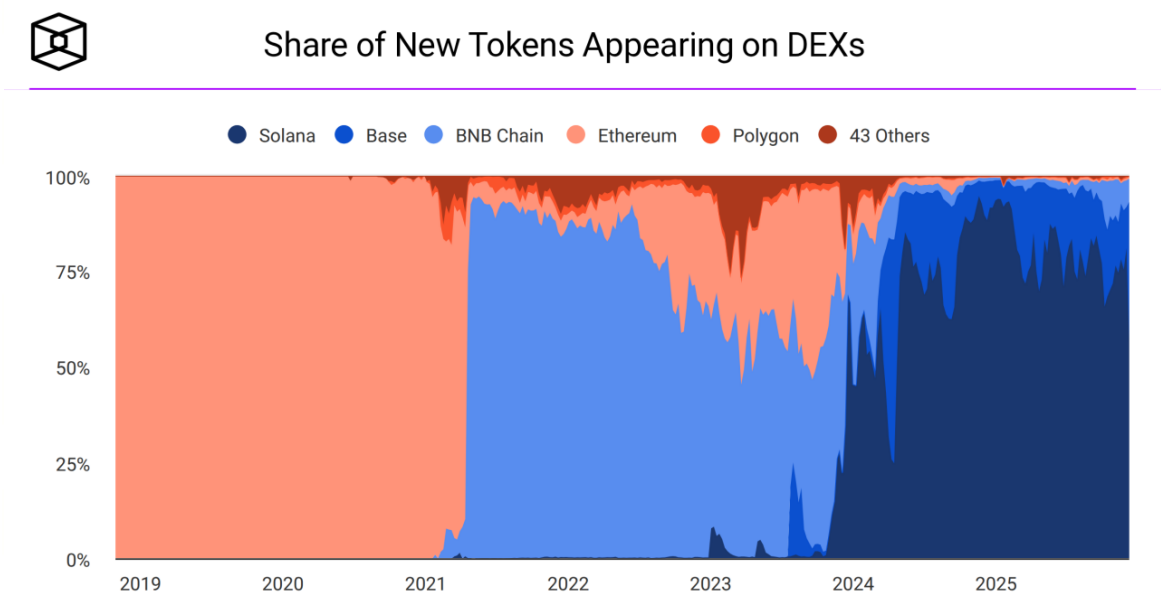
Source : https://www.theblock.co/data/decentralized-finance/dex-non-custodial/share-of-new-tokens-appearing-on-dexs

Small and Medium-Sized Memes Become Mainstream: The Memecoin market narrative has shifted from being dominated by Ethereum chain tokens with multi-billion dollar market caps like DOGE, SHIB, and PEPE, to Solana chain birthing large Memecoins with multi-billion dollar market caps like BONK, WIF, FARTCOIN, and TRUMP, and now to small and medium-sized Memecoins with tens of millions in market cap born on various chains, such as BRETT and TOSHI on Base chain, and Binance Life, BROCCOLI on BNB Chain. This indicates the market cap ceiling for Memecoins is continuously lowering, and the market is maturing.

Accelerated Rotation Pace: With limited liquidity growth and an accelerating trend in the number of Memecoins, the market rotation pace has shifted from "weekly" to "hourly." Particularly thanks to the proliferation of AI tools and upgrades in social media algorithms, the speed of viral spread and decay has increased dramatically. This results in a large number of new coins reaching their peak within just 24-48 hours of launch, with a lifecycle far shorter than the previous weekly cycles.

Recent Hot Memecoins: Social Media Hype + Small/Mid Cap

Browsing recent popular Memecoins undoubtedly confirms the above changes.

$Franklin: Franklin The Turtle was originally a classic children's character from a series of books and TV shows in Canada in the 1980s and 1990s. The current U.S. Secretary of Defense recently posted a politically satirical image on X, expressing a tough stance on U.S. cross-border military anti-drug operations. Subsequently, the同名 Memecoin portrayed Franklin the Turtle as a satirical, militarized anti-drug warrior. The coin launched on December 1st, reached a peak FDV of $24.36M by the 10th, and has currently retraced to $5.4M.

$DOYR: The起因 (cause) was that DYOR was misspelled as DOYR. Then, spurred by a reply post saying "DOYR = DO YouR meme?", the BNB Chain community quickly launched a同名 Memecoin. The coin launched on December 6th, reached a peak FDV of $31.34M the next day, and has currently retraced to $3.4M.

$马到成功 (Horse Success): Originating from the Chinese community's blessing phrase "马到成功" (meaning immediate success), it is a popular Chinese Memecoin following others like "Binance Life" and "Vulgar Penguin". The coin launched on November 15th, reached a peak FDV of $5.03M on December 2nd, and has currently retraced to $2.6M.

$jesse: A personal Memecoin issued by Base co-founder Jesse in November. The coin launched on November 21st, reached a peak FDV of $28.08M on the same day, and has currently retraced to $10M.

Opportunities in the Structural Changes of Memecoins

Starting from DOGE's dog meme to today's vast ecosystem where any topic can become a coin, Memecoins are no longer just simple internet jokes, but a perfect fusion of community narrative, attention propagation, and speculative frenzy.

This year's Memecoin market has been as刺激 (stimulating) as a roller coaster: accelerated rotation, smaller scale, multi-chain expansion—all marking a transition from狂欢 (carnival) to成熟 (maturity).
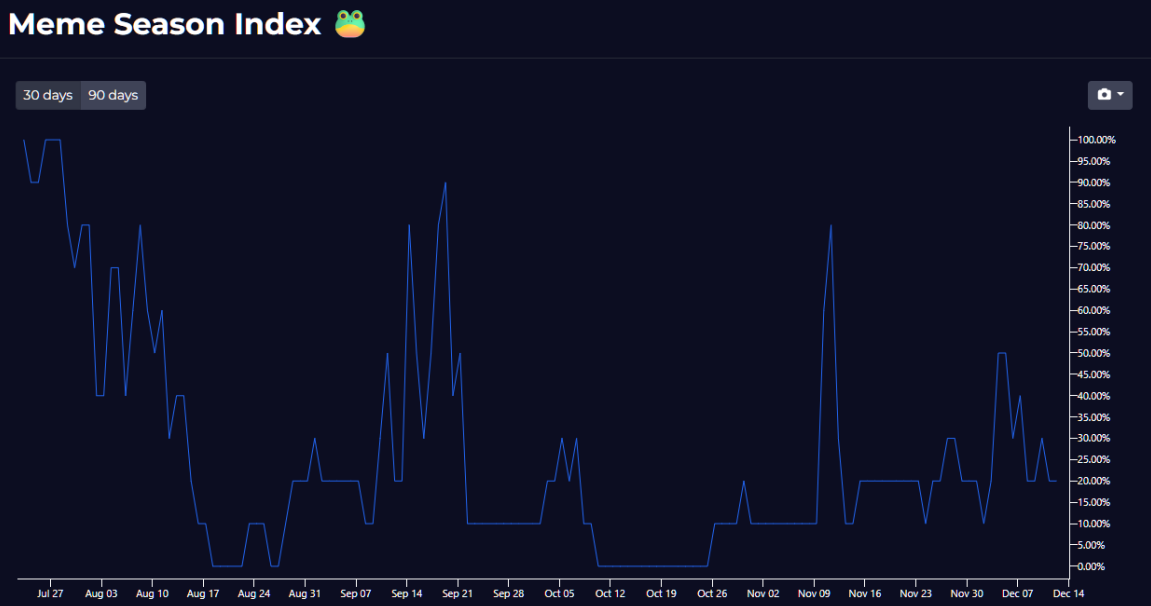
Source : https://whaleportal.com/meme-season-index/

It is foreseeable that, regardless of bull or bear markets, the Memecoin market will not fall silent, because as long as there is attention, someone will go all-in on a dog picture to spread emotion.

However, in the flash-in-the-pan era, Memecoins are beginning to transform from "jokes" into "cultural indices." For example, older tokens like DOGE, SHIB, and BONK are shedding their religious constraints, continuously undergoing technical upgrades, and applications are empowering the Meme. Meanwhile, more newly produced small and medium Memecoins are turning to "social media heat + data-driven," which carries higher risks but offers more refined opportunities. The rise and fall of these Memecoins also represent the ebb and flow of heat around certain social topics.

No matter how you look at it, this structural change will reshape investment logic, bringing more opportunities for participants while also demanding greater DYOR.

* This article is provided by WEEX Labs, intended solely for the purpose of trend research and discussion, and does not constitute any form of investment advice or commitment. The content, data, and opinions involved in the article are for reference only. Investors need to make their own judgments and bear the corresponding risks.


Tiền kỹ thuật số thịnh hành

Câu hỏi Liên quan

QAccording to the article, what is the main trend in the current Memecoin market cycle?

AThe market has evolved into a 'Flash Era' characterized by faster rotation speeds, smaller market caps, and multi-chain expansion, moving from a 'weekly' to an 'hourly' cycle.

QWhich blockchain was initially dominant for new token launches, and what has changed?

ASolana initially monopolized about 90% of new token launches, but its share has now decreased to 57% as other chains like Base and BNB Chain have gained market share.

QWhat are two key characteristics of popular recent Memecoins mentioned in the article?

AThey are typically small to medium market cap coins and are heavily driven by social media热度 (heat/hype).

QName one specific Memecoin example from the article that was created due to a typo or misspelling.

A$DOYR, which was created on BNB Chain after the common crypto acronym 'DYOR' (Do Your Own Research) was misspelled.

QHow is the role of older, established Memecoins like DOGE and SHIB changing according to the article?

AThey are shedding their 'religious' or purely cultural baggage and are undergoing technical upgrades and application development to add more utility and value to the meme.

Nội dung Liên quan

Công ty đầu tư mất 2 triệu USD sau cuộc tấn công "bụi tiền mã hóa"

Một công ty đầu tư đã mất 2 triệu USD do cuộc tấn công "đánh cắp mã độc bằng bụi tiền điện tử" (address poisoning/crypto dust attack). Kẻ gian đã gửi một giao dịch vi mô 0.0002 USDC tới ví của công ty Bofur Capital trước đó 20 giờ, sử dụng địa chỉ ví giả có ký tự đầu và cuối gần giống hệt với đối tác thật. Khi thực hiện giao dịch 2 triệu USDC, có khả năng nhân viên đã sao chép nhầm địa chỉ giả mạo từ lịch sử giao dịch. Sau khi nhận được tiền, kẻ tấn công nhanh chóng chuyển đổi toàn bộ số tiền sang stablecoin DAI. Các chuyên gia cho rằng tin tặc chủ động theo dõi ví của công ty, chờ đợi một giao dịch rút tiền lớn để thực hiện hành vi lừa đảo này. Số vụ tấn công kiểu "đầu độc địa chỉ" đã tăng mạnh sau bản cập nhật Fusaka của mạng Ethereum, với số lượng giao dịch "bụi tiền điện tử" USDT tăng 612% trong ba tháng gần đây. Một nhà đầu tư khác cũng đã mất hơn 500.000 USDT. Theo một nghiên cứu của Etherscan từ năm 2022 đến giữa 2024 (trước Fusaka), đã có khoảng 17 triệu nỗ lực tấn công kiểu này, ảnh hưởng đến ít nhất 1,3 triệu người dùng và gây thiệt hại ít nhất 79,3 triệu USD. Các mạng có phí giao dịch thấp hơn, như BNB Smart Chain (BSC), ghi nhận tần suất các cuộc tấn công tương tự cao hơn tới 1355%.

cryptonews.ru6 phút trước

Công ty đầu tư mất 2 triệu USD sau cuộc tấn công "bụi tiền mã hóa"

cryptonews.ru6 phút trước

Besu khắc phục lỗ hổng bảo mật trên 5 nút: Điều người vận hành cần biết

Các nhà phát triển máy khách Ethereum Besu đã khắc phục năm lỗ hổng bảo mật được phát hiện bởi công ty an ninh blockchain CertiK. Các bản vá được phát hành trong phiên bản 23.7.1 vào ngày 27 tháng 7, với thông tin chi tiết được công bố ngày 14 tháng 8 theo mô hình "vá trước, công bố sau" nhằm cho các nhà vận hành nút mạng thời gian chuẩn bị và cập nhật trước khi chi tiết kỹ thuật bị lộ. Các lỗ hổng, mức độ từ nhẹ đến nghiêm trọng, nằm trong xử lý thông báo khối, bộ đệm đề xuất đồng thuận, giới hạn đăng ký WebSocket và tạo bộ lọc JSON-RPC. Nếu bị khai thác, chúng có thể cho phép kẻ tấn công làm cạn kiệt bộ nhớ hoặc tài nguyên luồng của nút, gây nguy hại cho tính khả dụng và quá trình đạt được đồng thuận. Jialiang Chuang của CertiK nhấn mạnh tầm quan trọng của phương pháp này, đặc biệt đối với các mạng blockchain được cấp phép cần quy trình phê duyệt phức tạp. Ông cũng chỉ ra các khoảng trống trong các mô hình kiểm thử hiện tại của ngành, thường tập trung vào sự tuân thủ giao thức hơn là kiểm thử căng thẳng tài nguyên liên tục hay hành vi nút độc hại. Ông kêu gọi một mô hình bảo mật tích lũy và liên tục, kết hợp kiểm tra tự động, nghiên cứu độc lập và kiểm thử hồi quy.

cryptonews.ru8 phút trước

Besu khắc phục lỗ hổng bảo mật trên 5 nút: Điều người vận hành cần biết

cryptonews.ru8 phút trước

Phá vỡ Term Finance: Kẻ tấn công rút 8,5 triệu USD thông qua lỗ hổng hệ thống quản trị

Sự cố bảo mật xảy ra với giao thức cho vay phi tập trung Term Finance đã dẫn đến thiệt hại 8,5 triệu USD. Vụ việc không phải do lỗ hổng hợp đồng thông minh, mà xuất phát từ việc kẻ tấn công khai thác cơ chế quản trị. Đối tượng này đã gửi một khoản rất nhỏ (0,5 ETH) vào Meta Vault, chuyển đổi token nhận được thành token có quyền biểu quyết (gtmvETH), và từ đó kiểm soát tới hơn 90% số phiếu hiện có do phần lớn người dùng không tham gia chuyển đổi. Với quyền kiểm soát này, kẻ tấn công đã đưa ra và tự thông qua một đề xuất hợp lệ để tắt cơ chế trì hoãn rút tiền (timelock) 7 ngày, thêm một chiến lược rút tiền tùy chỉnh và chuyển toàn bộ tài sản trong các khoản chứa (vault) về địa chỉ của chúng. Đề xuất này đã được công khai trên blockchain trong gần 6 ngày nhưng không bị ngăn chặn. Khoảng 2.841 ETH và 1,68 triệu USDC đã bị rút đi ngay sau khi đề xuất được thực thi. Nhóm Term Labs đã xác nhận vụ việc, hủy bỏ mọi vai trò quản trị DAO và đóng cửa vĩnh viễn các Meta Vault. Tuy nhiên, giao thức cơ bản và thị trường cho vay trực tiếp không bị ảnh hưởng. Sự cố này làm nổi bật rủi ro hệ thống khi quyền biểu quyết tách rời khỏi sự tham gia kinh tế, cùng với tỷ lệ biểu quyết (quorum) quá thấp và sự thờ ơ của phần đông người nắm giữ token, cho phép một lượng vốn nhỏ chi phối toàn bộ quyết định quản trị.

cryptonews.ru8 phút trước

Phá vỡ Term Finance: Kẻ tấn công rút 8,5 triệu USD thông qua lỗ hổng hệ thống quản trị

cryptonews.ru8 phút trước

Giao dịch

Giao ngay

Bài viết Nổi bật

Làm thế nào để Mua ERA

Chào mừng bạn đến với HTX.com! Chúng tôi đã làm cho mua Caldera (ERA) trở nên đơn giản và thuận tiện. Làm theo hướng dẫn từng bước của chúng tôi để bắt đầu hành trình tiền kỹ thuật số của bạn.Bước 1: Tạo Tài khoản HTX của BạnSử dụng email hoặc số điện thoại của bạn để đăng ký tài khoản miễn phí trên HTX. Trải nghiệm hành trình đăng ký không rắc rối và mở khóa tất cả tính năng. Nhận Tài khoản của tôiBước 2: Truy cập Mua Crypto và Chọn Phương thức Thanh toán của BạnThẻ Tín dụng/Ghi nợ: Sử dụng Visa hoặc Mastercard của bạn để mua Caldera (ERA) ngay lập tức.Số dư: Sử dụng tiền từ số dư tài khoản HTX của bạn để giao dịch liền mạch.Bên thứ ba: Chúng tôi đã thêm những phương thức thanh toán phổ biến như Google Pay và Apple Pay để nâng cao sự tiện lợi.P2P: Giao dịch trực tiếp với người dùng khác trên HTX.Thị trường mua bán phi tập trung (OTC): Chúng tôi cung cấp những dịch vụ được thiết kế riêng và tỷ giá hối đoái cạnh tranh cho nhà giao dịch.Bước 3: Lưu trữ Caldera (ERA) của BạnSau khi mua Caldera (ERA), lưu trữ trong tài khoản HTX của bạn. Ngoài ra, bạn có thể gửi đi nơi khác qua chuyển khoản blockchain hoặc sử dụng để giao dịch những tiền kỹ thuật số khác.Bước 4: Giao dịch Caldera (ERA)Giao dịch Caldera (ERA) dễ dàng trên thị trường giao ngay của HTX. Chỉ cần truy cập vào tài khoản của bạn, chọn cặp giao dịch, thực hiện giao dịch và theo dõi trong thời gian thực. Chúng tôi cung cấp trải nghiệm thân thiện với người dùng cho cả người mới bắt đầu và người giao dịch dày dạn kinh nghiệm.

Tổng lượt xem 1.4kXuất bản vào 2025.07.17Cập nhật vào 2026.06.02

Làm thế nào để Mua ERA

Thảo luận

Chào mừng đến với Cộng đồng HTX. Tại đây, bạn có thể được thông báo về những phát triển nền tảng mới nhất và có quyền truy cập vào thông tin chuyên sâu về thị trường. Ý kiến ​​của người dùng về giá của ERA (ERA) được trình bày dưới đây.

活动图片