Author:David, Deep Chao TechFlow
Original Title: This American Earns $250 Million a Year from Podcasting, Luo Yonghao Is Learning from Him
You might not listen to podcasts, but you must have seen this scene.
In 2018, Musk holding a joint, surrounded by smoke, became one of his most viral iconic moments.
However, few people know where this scene took place, and even fewer care about who was sitting opposite him.
Actually, this was the recording of an American podcast.
The host handed Musk a joint mixed with marijuana and tobacco. Musk asked, "This is legal, right?" and then took a puff.
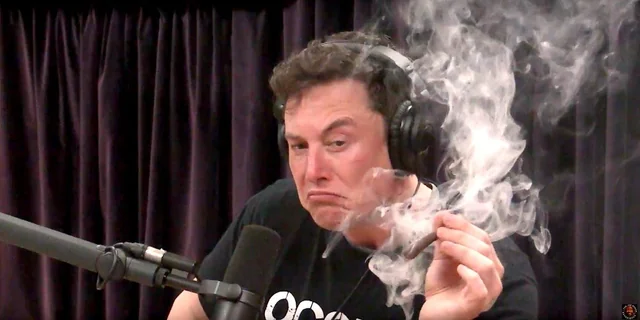
The next day, Tesla's stock price dropped by 9%.
This episode has over 69 million views on YouTube to date, making it the most-watched episode in the podcast's history.
What kind of show, what kind of host, could make the world's richest man do such a thing on camera?
During the 2024 US presidential election, Trump also spent three hours on this show, and in his victory speech, he specifically thanked the host by name; two weeks ago, NVIDIA CEO Jensen Huang also sat in this recording studio, talking about AI and the chip war for two and a half hours, garnering over 2.8 million views in two weeks.
His name is Joe Rogan. His show, "The Joe Rogan Experience," is currently the world's largest podcast.
From Comedian to Podcast King, A Show Worth $250 Million
Joe Rogan's podcast influence is built on a maverick personal resume.
Comedian, reality show host, UFC commentator. Put these three identities together, and it hardly seems like the profile of someone who would create the world's largest podcast.
He is not a traditional interview host, not the kind of straight-laced, professionally trained media person. His background is actually in entertainment and the fighting world, not journalism.
But it is precisely this "maverick" approach that allowed him to create something completely different from traditional media; his ability to connect and his viewership far surpass many professional media shows.
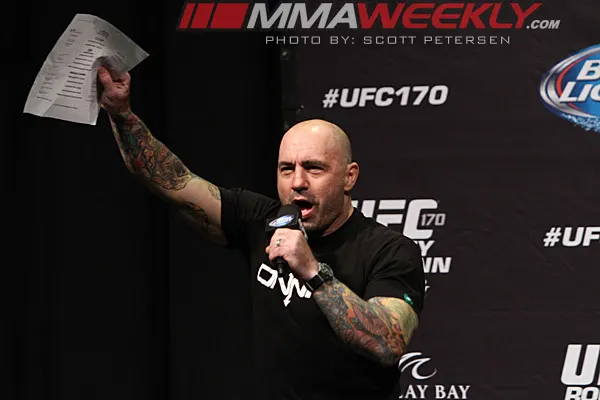
Initially, Joe Rogan was a comedian, doing stand-up in Boston clubs in the 90s. Later, he moved to Los Angeles, acted in sitcoms for a few years, and hosted a reality show called "Fear Factor."
This show followed a sensationalist route, making contestants eat bugs, jump from tall buildings, relying on gross-out and刺激 for ratings. In today's short-video environment, it would definitely be categorized as vulgar but high-traffic content.
But what really made him break through was another job.
Starting in 1997, he became a commentator for the UFC, sitting cageside to commentate mixed martial arts fights, a job he held for over twenty years. This work solidified his standing in the fighting world and accumulated a large loyal male audience.
In 2009, he started recording podcasts at home.
Like the starting point of many podcasts, the equipment was简陋, there were no sponsors, and no business plan. But each episode often lasted two to three hours, chatting with friends or guests about anything.
Looking back, all those seemingly random previous experiences actually came in handy.
Having been a comedian, he knew how to make conversations interesting and rhythmic. Having hosted a reality show, he was also comfortable and relaxed in front of the camera. Being a UFC commentator for twenty years meant this audience was accustomed to listening to him talk.
Moreover, he isn't an expert in any particular field, which gives him a maverick advantage:
He can unabashedly ask "dumb questions."
Facing a physicist, he would ask about the most basic concepts; facing a politician, he wouldn't press for policy details but would talk about "what you really think." This style is something you simply don't see in traditional media.
TV interviews have strict time limits, hosts must quickly get to the point. News interviews emphasize confrontation, journalists must dig out what the interviewee doesn't want to say.
Rogan's show does the opposite, giving you three hours, unedited, uninterrupted, talking about whatever you want.
The result is that many celebrities say things on his show they wouldn't say elsewhere. Musk smoking marijuana is just one example. Zuckerberg came on to talk about MMA training, looking more like a normal person than in any Congressional hearing.
Slowly, Joe Rogan's podcast became the go-to place for celebrities to "show their real side." Traditional media interviews are performances; here, they can be themselves.
As various celebrities appeared, the show became increasingly valuable.
In 2020, Spotify acquired the exclusive distribution rights to "The Joe Rogan Experience" for $200 million, the largest deal in podcast industry history at the time.
In 2022, Rogan faced a舆论 storm due to negative comments about certain COVID-19 vaccines on his podcast, leading to protests from musicians pulling their music from Spotify.
Right at this critical moment, another video platform, Rumble, publicly offered $100 million to poach his podcast, but Rogan didn't bite.
In 2024, he renewed his licensing deal with Spotify, but the price increased to $250 million.
Furthermore, this time he did not accept exclusivity; the show returned to being available on Spotify, YouTube, and Apple Podcasts simultaneously. Spotify paid more money but got fewer rights.
In 2025, "The Joe Rogan Experience" topped the annual podcast charts on Spotify, Apple Podcasts, and YouTube simultaneously for the first time.
A chat show that started recording at home sixteen years ago is now valued higher than many traditional media companies.
Podcast Chats, Precise Vote Pulling
On October 25, 2024, during the final stretch of the election campaign, Trump sat down in Rogan's Austin recording studio.
This episode lasted a full three hours. After recording, Trump rushed to a campaign rally in Michigan, making thousands of supporters wait an extra three hours.
What did they talk about for three hours?
UFOs. Trump said he interviewed fighter pilots who told him they saw spherical objects traveling four times faster than an F-22 fighter jet.
The White House bed. He genuinely described his feelings upon first entering the Lincoln Bedroom in the White House, thinking the bed was huge because Lincoln was six foot six.
Tariffs. Trump also proposed replacing income tax entirely with tariffs. Rogan asked: "Are you serious?"
Trump said: "Of course, why not? In the 1880s, when our country was at its wealthiest, it was thanks to tariffs."
These topics seem unrelated but share a common trait:
They are things traditional political interviews would absolutely never discuss.
TV networks ask about policy details, press on controversial statements, and stick to time limits. No serious political journalist would let a presidential candidate spend ten minutes talking about UFOs and Lincoln's bed.
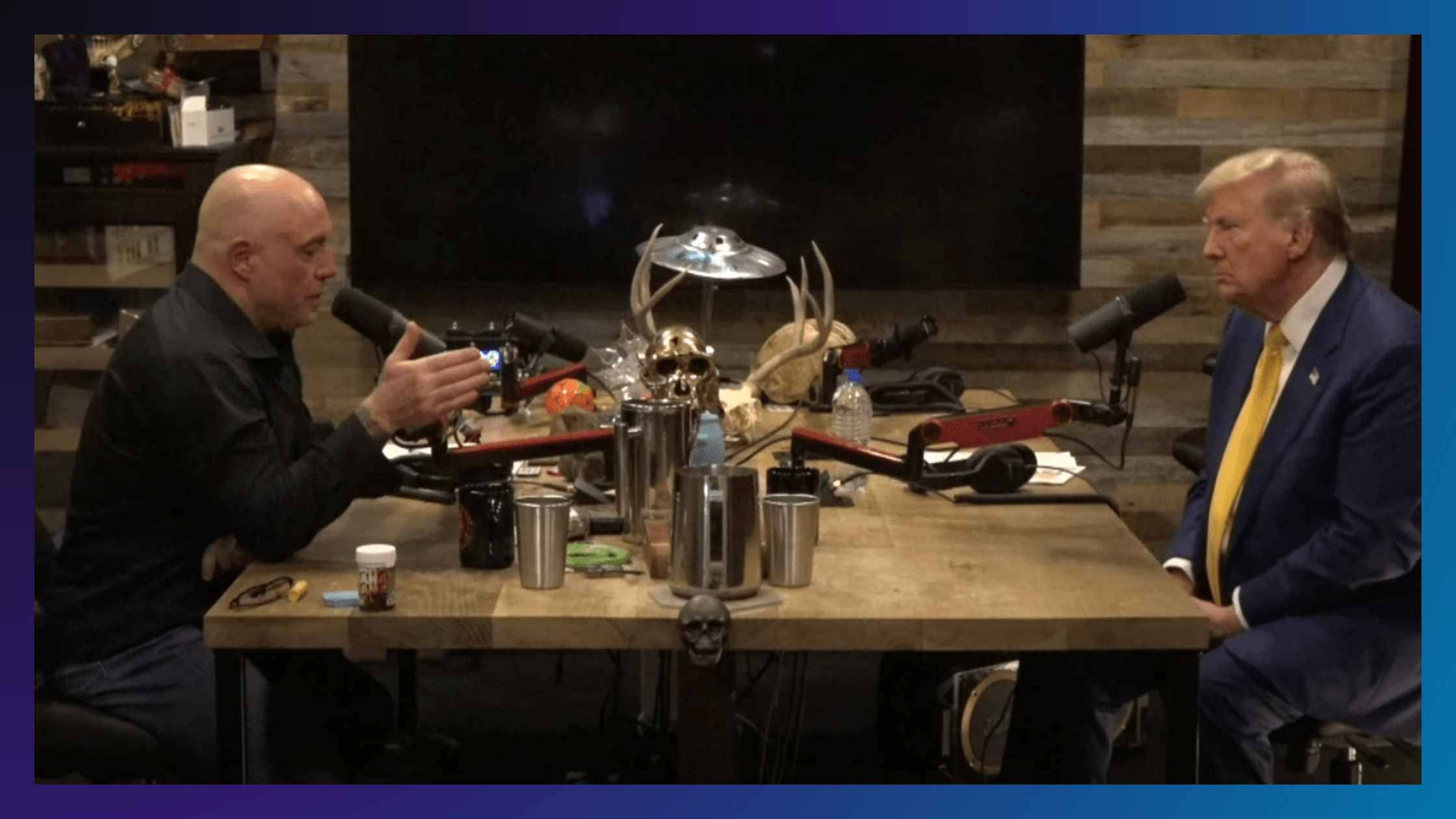
But this is precisely the characteristic of Rogan's show. Three hours, no interruptions, no set agenda, talk about whatever you want.
The audience sees not a candidate constrained by media frameworks, but a complete Trump: curious, with outrageous ideas, capable of casual conversation.
Rogan's own evaluation actually sums up the show's effect well:
"You say a lot of crazy things, but when traditional media takes those things and makes news out of them, it actually makes you more popular. Because people are tired of that scripted politician-speak. Even if they disagree with you, at least they know this person is real."
This sense of authenticity is especially effective with Rogan's audience.
Data from foreign research institutions shows that 80% of the show's listeners are male, with over half aged 18 to 34. Politically, 35% identify as independent, 32% lean Republican, and 27% lean Democratic. This group shares a common characteristic:
They don't watch traditional TV news much, generally distrust mainstream media, but they spend hours each week listening to Rogan chat.
In other words, this is a group that is hard for traditional political communication to reach. And Trump spending three hours sitting across from a host they trust, speaking in a relaxed, informal manner, had an effect far surpassing any campaign ad.
After the episode went live, YouTube views quickly surpassed 50 million.
The entire video was chopped into countless clips, spreading on X, TikTok, and Instagram. Every soundbite, every outrageous statement became independent content piece, reaching people who would never click on a three-hour video.
Meanwhile, Trump's presidential election opponent, Harris, did not go on the show.
Reportedly, both sides talked, and Rogan publicly invited her. But Harris's team wanted to limit the duration to under an hour, which Rogan refused. He said on his show:
"It's not that I didn't want to invite her, it's that she didn't want to come."
As a comparison, Trump's episode garnered over 50 million views, while Harris's appearance on another podcast, "Call Her Daddy," got 600,000 views.
The election ended, Trump won. In his victory speech, UFC President Dana White specifically thanked Joe Rogan, listing him as one of the功臣 (key contributors) to the victory.
A podcast being named in the thank-you list of a presidential victory speech is a first in American political history.
Chinese Mirror Image, Luo Yonghao's Attempts
Can Joe Rogan's model be replicated in China?
Some are trying.
In June 2025, Luo Yonghao revealed at an AI conference that DeepSeek founder Liang Wenfeng suggested he leverage his "talent for talking." A few months later, he launched a video podcast on Bilibili called "Luo Yonghao's Crossroads," positioning it as a counterpart to Joe Rogan and Lex Fridman.
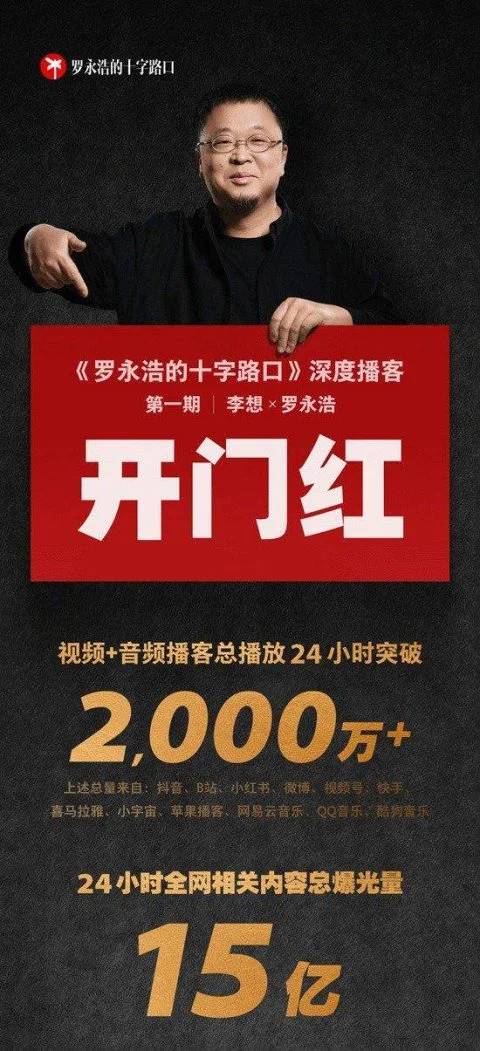
The format is very similar to The Joe Rogan Experience: long conversations, minimal editing, each episode three to five hours.
The first guest was Li Xiang, founder of Li Auto. The two talked for four hours, from childhood trauma to his relationship with Wang Xing, daring to ask and answer anything. The reaction in the comments was:
In the short-video era, this kind of "long and satisfying超大杯 (super large cup)" is too rare.
Luo Yonghao isn't the only one. Chen Luyu, Yu Qian, Li Dan, Yang Di—these famous talkers have all set up shop on Bilibili doing video podcasts. Bilibili has also made heavy investments, pouring billions in traffic support during the summer, providing free recording studios in Beijing, Shanghai, Guangzhou, and Hangzhou, and planning to launch AI creation tools专属 for podcasts.

It seems China's video "podcast元年 (first year)" has finally arrived, but it's not that simple.
When Luo Yonghao was in conversation with Tim from '影视飓风' (Film Tornado), he mentioned his video views were around 20-30 million, while Tim believed "reaching 100 million才算火 (counts as being popular)." This actually reveals a structural problem:
In China's internet traffic ecosystem, long-form content is inherently at a disadvantage.
Over the past few years, users have been trained by short videos into the habit of "watching a three-minute summary of a movie." The algorithms of Douyin and Kuaishou reward completion rates; a three-hour video has almost no survival space in the recommendation pool.
More ironically, the highlight moments of many long video podcasts are often spread through几十秒的切片 (dozens-of-second clips) on Douyin and Xiaohongshu.
At the same time, monetization is also a challenge.
The US podcast industry's advertising revenue exceeded $2 billion in 2024, with top hosts securing exclusive contracts worth hundreds of millions of dollars. In China, a podcast brand with nearly 500,000 subscribers might charge less than 40,000 RMB for a single voiced ad, with annual net income possibly only around a hundred thousand RMB.
YouTube has a mature AdSense revenue-sharing system; the longer the video, the more ad slots, the higher the income—this incentivizes long-form content through its利益机制 (profit mechanism). Bilibili's monetization capability is far from this level.
There's an even more fundamental issue:
Rogan's influence largely comes from his ability to host people like Trump, Musk, and Jensen Huang, and these people are willing to say things on his show they wouldn't say elsewhere.
This status as an "information首发地 (first release location)" requires long-accumulated trust and a unique舆论环境 (public opinion environment).
Luo Yonghao can invite Li Xiang, He XPeng, Zhou Hongyi—this is already the top-tier lineup in China's tech circle. But there are天然存在边界 (natural boundaries) in terms of topic openness.
So, can Joe Rogan's model be replicated in China?
The form can be learned, but the soil is different.
Controversy and Boundaries
Writing this far, there's an unavoidable question: Joe Rogan is a controversial figure.
In 2022, he faced a storm for questioning the effectiveness of COVID-19 vaccines on his show. Spotify did not abandon Rogan but added "content warning" labels to all episodes discussing COVID-19 and removed over 70 old episodes.
This wasn't his first brush with trouble.
In 2024, he discussed the origins of AIDS with a guest on his show, spreading some claims already refuted by the medical community, drawing public criticism from the American Foundation for AIDS Research.
A Yale University study found that among the top ten most popular podcasts in the US, eight had spread erroneous or misleading information about climate change, with Rogan's show among them.
His show is also a gathering place for various American conspiracy theories.
From the Kennedy assassination to UFOs, from big pharma to government surveillance, he maintains an "open attitude" towards these topics. Critics believe this provides a platform for misinformation, while his supporters see it as challenging mainstream narratives.
In July 2025, he posted on X:
"Salute to those who still don't believe in conspiracy theories, your ability to hold your ground is admirable." This post received over 15 million views.
This is also the complexity of Joe Rogan.
He is not a person of consistent立场 (stance). For example, supporting same-sex marriage, marijuana legalization, and universal healthcare are typical liberal positions. But he also questions mainstream media and provides a platform for controversial figures, which also makes him a darling of conservatives.
His show's influence stems precisely from the fact that he doesn't belong to any camp. Those who have lost trust in mainstream media find an "anti-establishment" alternative in him.
But the same特质 (trait) also makes him a node for spreading misinformation. When someone with an audience of hundreds of millions says "I'm just asking questions," the questions themselves are already shaping public perception.
This is also the inherent tension of the podcast medium:
Its charm lies in being real, relaxed, and unlimited, but when its influence reaches a certain scale, "unlimited" itself becomes a problem.
Joe Rogan is a product of this era and also a mirror of it.
Twitter:https://twitter.com/BitpushNewsCN
Bitpush TG Discussion:https://t.me/BitPushCommunity
Bitpush TG Subscription: https://t.me/bitpush



















