The Hidden War Behind Stablecoins: Issuers, Applications, and Users—Who Will Be the 'Biggest Winner'?

marsbitXuất bản vào 2026-02-17Cập nhật gần nhất vào 2026-02-17

Tóm tắt

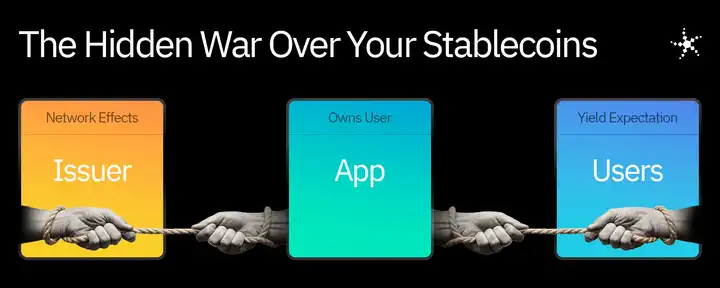
The article explores the intense competition among stablecoin issuers, applications, and users over the lucrative profits generated by stablecoins. Issuers like Tether and Circle earn significant risk-free returns by investing user funds in cash equivalents, creating a highly profitable business model. However, applications (wallets, exchanges, DeFi protocols) that control user relationships demand a share of these profits, leveraging their distribution power to negotiate revenue-sharing agreements or even launch their own branded stablecoins (e.g., Aave’s GHO or PayPal’s PYUSD via white-label services). Users, especially in developed markets, increasingly expect yield on their stablecoin holdings, pressuring applications to offer returns. This dynamic creates a three-way tug-of-war, with applications caught between profit-retentive issuers and yield-seeking users. The author suggests that users may ultimately benefit the most from this competition, gaining a larger share of the profits as the ecosystem evolves.

Author: Jonah Burian, Investor at Blockchain Capital

Compiled by: Felix, PANews

Summary: In this three-party game, users may ultimately be the beneficiaries and receive the majority of the profits.

In recent years, as stablecoin issuers have generated massive annual profits, the battle for benefits among issuers, application layers, and users has intensified. An investor from Blockchain Capital reveals the profit distribution mechanisms and evolving business logic of stablecoins. Below are the details.

Stablecoin issuers possess one of the most profitable business models on Earth, and these substantial profits have made them a target for various stakeholders. At Blockchain Capital, we have closely observed the three-way tug-of-war among issuers, application layers, and users as they compete for these profits.

We have invested in several major issuers (such as Tether, Circle, and Paxos) and also in applications trying to claim their share (such as Aave, Phantom, Polymarket, and RedotPay). Here are our observations.

Issuers Reap Significant Profits

Users send fiat currency to issuers, who then mint digital dollars on the blockchain. Behind the scenes, issuers invest this fiat in cash or cash equivalents, earning a risk-free interest rate. That’s the entire business. In contrast, banks take your deposits but must lend them out, manage credit risk, and maintain branches; insurers collect premiums but ultimately must pay claims. Stablecoin issuers essentially hold government bonds, generating cash flow without complexity or risk.

Issuer revenue grows with the increase in assets under management, while operational costs remain largely unchanged: this is a pure, unconstrained cash flow machine. Tether reports a team size of about 300 people and expects to achieve $10 billion in profits by 2025. This is arguably one of the best business models in history.

However, massive profits inevitably attract competition.

Applications Also Want a Share

Most users never interact directly with issuers; they access stablecoins through applications like Phantom, which control the user relationship.

Large exchanges, DeFi protocols, and well-known wallets have significant bargaining power over issuers. They can designate default stablecoins and integrate or deprecate them through single product decisions, exerting some control over fund flows. If tens of billions of dollars in stablecoins remain within an application, that app can demand a share of the float interest. The logic is simple: we are distributing your assets and anchoring user behavior, so you must share the profits, or we will steer users toward competing stablecoins.

This is already happening. The most typical example is the relationship between Coinbase and Circle. Early on, Coinbase was the primary distribution engine for USDC and negotiated a profit-sharing agreement. It is reported that Coinbase receives 100% of the interest income generated by USDC on its platform and 50% of the interest income from USDC outside the platform. Whether within or outside the portfolio, applications are increasingly adopting this strategy, actively negotiating for their share.

Creating Branded Stablecoins: Bypassing Issuers

Applications can also attempt to launch their own branded stablecoins or "wrappers," completely bypassing issuers. Instead of directly steering users to USDC or USDT, they offer a dollar balance backed by a combination of stablecoins and short-term notes. In this case, the distributor is partially involved in the issuance business. Aave’s GHO stablecoin is one such example.

However, applications often lack the resources or licenses required to build a full issuance infrastructure. Therefore, they opt for white-label solutions like "Issuer-as-a-Service." Paxos is currently the leading white-label provider, supporting PayPal’s PYUSD. This allows PayPal to profit from the float interest without negotiating with large issuer.

Issuer Leverage

Applications cannot fully control issuers. Established stablecoins like USDC and USDT have strong network effects. They are the reserve assets of the entire DeFi ecosystem and the base trading pairs for most transactions. Branded stablecoins may be less attractive to users due to lower liquidity and integration compared to other stablecoins.

Additionally, white-label stablecoins are not as "neutral" as USDT. A company competing with PayPal at the application layer may be reluctant to accept PYUSD, as doing so would fund a competitor. Similarly, this dynamic may have affected Circle’s early development, as exchanges like Binance may have been hesitant to fully promote USDC due to its close ties with rival Coinbase, which is why Binance instead defaulted to supporting USDT. Today, USDT trading volume on Binance is about five times that of USDC.

User Demand for Floating Returns

In developed markets, user expectations for returns put pressure on issuers and applications. When the risk-free interest rate is around 4%, users in the U.S. naturally ask why their digital dollars aren’t earning any yield. When one wallet offers returns and a competitor doesn’t, users flock to the former.

If this expectation becomes the norm, the application layer faces a dilemma. To remain competitive, we expect applications may have to return some of the profits to users, forcing them to negotiate more aggressively with issuers. If an application cannot secure a share, it will struggle to pay interest to users without incurring losses. As more products promote "stablecoin balance returns," the model where "all profits remain with the underlying issuer" will be difficult to sustain.
However, this pressure is not universal. In many overseas markets, the core value of dollar stablecoins lies in hedging against local inflation and foreign exchange controls, rather than pursuing returns. A user struggling to prevent their assets from halving in value each year may not care much about earning 4% interest. For global issuers with high penetration in these regions, user demand for returns is not as urgent as in the U.S. market. We believe this dynamic may benefit Tether, which has the largest overseas user base.

Conclusion

In summary, user expectations and issuer profits have placed applications in a difficult position. They are caught between users who expect returns and issuers who want to retain profits. The stablecoin architecture is evolving rapidly, and the distribution of profits is still being contested. My guess is: users may ultimately be the beneficiaries of this game and receive the majority of the profits.

Related reading: A Guide to Stablecoin Returns: Which of the 8 Types Is Best?

Câu hỏi Liên quan

QWhat is the core business model of stablecoin issuers and why is it considered highly profitable?

AStablecoin issuers accept fiat currency from users and mint digital dollars on the blockchain. They invest this fiat in cash or cash equivalents, earning a risk-free interest rate. This model is highly profitable because their revenue scales with the growth of assets under management, while operational costs remain largely fixed, creating a powerful cash flow machine with minimal complexity or risk.

QHow do applications (like exchanges and wallets) attempt to capture a share of the profits from stablecoins?

AApplications, which control the user relationship, use their significant bargaining power to demand a share of the float income from issuers. They can dictate the default stablecoin and influence capital flows. Their logic is that they are distributing the issuer's assets and anchoring user behavior, so they deserve a share of the profits, or they will steer users to a competitor's stablecoin.

QWhat are two strategies applications might use to bypass traditional stablecoin issuers?

AApplications can either 1) launch their own branded stablecoin or 'wrappers' backed by a combination of stablecoins and short-term notes, or 2) use a white-label 'Issuer-as-a-Service' solution from a provider like Paxos, which allows them to profit from the float without negotiating with a major issuer.

QWhat leverage do major stablecoin issuers like USDT and USDC have over applications?

AMajor stablecoins like USDT and USDC have strong network effects; they are the reserve assets for the entire DeFi ecosystem and the base trading pairs for most transactions. Their brand recognition and liquidity are superior. Furthermore, a branded stablecoin from a competitor's application may not be seen as 'neutral' and could be rejected, as it would fund a rival.

QWhy does the author speculate that users might be the ultimate beneficiaries of the stablecoin profit struggle?

AThe author speculates that user expectations for yield, particularly in developed markets, will put pressure on applications. To remain competitive, applications will be forced to pass a portion of the earnings back to users. This dynamic, driven by competition for users, could ultimately result in users capturing the majority of the收益 (yield).

Nội dung Liên quan

Việc cứu đồng Yên tác động đến Bitcoin như thế nào: QCP Capital phân tích chuỗi rủi ro cho thị trường tiền mã hóa

Công ty giao dịch QCP Capital đã phân tích tác động của việc Mỹ và Nhật Bản phối hợp can thiệp hỗ trợ đồng yên đối với thị trường Bitcoin và Ethereum. Báo cáo nhấn mạnh rằng lợi suất trái phiếu kho bạc Mỹ dài hạn và tình trạng của yên Nhật giờ đây là những chỉ số vĩ mô quan trọng ngang bằng với các quyết định của Cục Dự trữ Liên bang Mỹ (Fed). Đây là lần can thiệp phối hợp đầu tiên kể từ năm 1998 nhằm hỗ trợ đồng yên. QCP chỉ ra rằng vấn đề cốt lõi không nằm ở bản thân hành động can thiệp, mà ở áp lực gia tăng lên lợi suất trái phiếu kho bạc dài hạn của Mỹ, vốn đã chạm mức cao nhất kể từ năm 2007. Cùng lúc, thị trường trái phiếu đang hấp thụ lượng cầu vốn lớn từ việc vay nợ của chính phủ Mỹ và các công ty công nghệ lớn. Đối với tài sản tiền mã hóa, kênh tác động chính là thông qua các giao dịch carry trade bằng yên. Việc đồng yên mạnh lên đột ngột có thể thúc đẩy các nhà đầu tư đóng các vị thế vay mượn và mua lại đồng yên, điều này có thể lan sang các tài sản rủi ro khác, bao gồm thị trường tiền mã hóa. QCP đưa ra hai kịch bản: ngắn hạn, biến động mạnh của yên có thể làm tăng tính bất ổn; dài hạn, sự ổn định tiền tệ lớn hơn có thể giảm áp lực lên thanh khoản thị trường trái phiếu. Báo cáo kết luận rằng các hành động can thiệp này bổ sung thêm các chỉ số như cặp USD/JPY và lợi suất trái phiếu dài hạn vào danh sách các yếu tố vĩ mô quan trọng cần theo dõi đối với Bitcoin và Ethereum, phản ánh sự phức tạp ngày càng tăng của các điều kiện tài chính toàn cầu.

cryptonews.ru3 phút trước

Việc cứu đồng Yên tác động đến Bitcoin như thế nào: QCP Capital phân tích chuỗi rủi ro cho thị trường tiền mã hóa

cryptonews.ru3 phút trước

Một ông lớn trên thị trường Bitcoin, không hoạt động suốt bốn năm, đã chuyển số Bitcoin trị giá khoảng 46 triệu USD! Dưới đây là chi tiết

Theo dõi từ nền tảng phân tích Onchain Lens, một ví Bitcoin lớn không hoạt động trong 4 năm vừa thực hiện giao dịch chuyển 730 BTC (trị giá khoảng 46,12 triệu USD) sang một địa chỉ mới. Số BTC này đã được tích lũy trong 7 năm và lưu trữ lâu dài tại một địa chỉ duy nhất. Các nhà phân tích cho rằng hoạt động này có thể liên quan đến lỗ hổng bảo mật được phát hiện gần đây trên ví phần cứng Coldcard, khiến các nhà đầu tư dài hạn chuyển tài sản sang ví mới an toàn hơn. Hiện chưa có bằng chứng cho thấy số Bitcoin này được gửi đến sàn giao dịch, nên mục đích chính xác (bán ra hay chỉ bảo mật) vẫn chưa rõ. Sự kiện này diễn ra sau một giao dịch lớn khác, khi một holder chuyển 16.400 BTC (hơn 1 tỷ USD) sau 7 tháng không hoạt động. Các động thái này cho thấy sự gia tăng hoạt động di chuyển vốn, đặc biệt từ các nhà đầu tư dài hạn. Giới chuyên gia lưu ý việc chuyển giữa các ví không nhất thiết báo hiệu bán ra, mà có thể vì lý do bảo mật, chiến lược lưu trữ hoặc quản lý danh mục.

cryptonews.ru20 phút trước

Một ông lớn trên thị trường Bitcoin, không hoạt động suốt bốn năm, đã chuyển số Bitcoin trị giá khoảng 46 triệu USD! Dưới đây là chi tiết

cryptonews.ru20 phút trước

Bitcoin Có Nên 'Một Mực Không Thay Đổi'? Craig Wright Lại Khơi Lại Cuộc Tranh Cãi Về Lộ Trình Quản Trị

Tác giả QQlink thảo luận về cuộc tranh luận quản trị Bitcoin do Craig Wright khơi lại, xoay quanh việc giao thức Bitcoin nên cố định vĩnh viễn hay tiếp tục nâng cấp. Wright, người tuyên bố là Satoshi Nakamoto nhưng đã bị tòa án Anh bác bỏ năm 2024, cho rằng giá trị cốt lõi của Bitcoin nằm ở bộ quy tắc tiền tệ minh bạch và bất biến. Phe ủng hộ quan điểm này tin rằng tính xác định và khả năng chống kiểm duyệt là lợi thế then chốt so với hệ thống tài chính truyền thống. Tuy nhiên, phe đối lập cho rằng một hệ thống kỹ thuật cần khả năng thích ứng để đối phó với các mối đe dọa bảo mật và đáp ứng nhu cầu người dùng mới. Bitcoin thực tế đã trải qua nhiều đợt nâng cấp quan trọng như SegWit (2017) và Taproot (2021) thông qua cơ chế đồng thuận cộng đồng phức tạp, không phải do một nhóm nhỏ quyết định. Cuộc tranh luận làm nổi bật thách thức cơ bản: làm thế nào một mạng lưới phi tập trung không có cơ quan trung ương có thể quản trị và tiến hóa. Nó cũng đặt câu hỏi về vai trò và ảnh hưởng của các nhà phát triển cốt lõi. Đối với người dùng và nhà đầu tư, kết quả của cuộc tranh luận này ảnh hưởng đến niềm tin vào tính ổn định lâu dài và khả năng cạnh tranh của mạng lưới. Tương lai của Bitcoin có thể không rơi vào cực đoan nào, mà là tìm kiếm sự cân bằng giữa việc giữ vững các quy tắc cốt lõi và cho phép những nâng cấp thận trọng thông qua đồng thuận. Cuối cùng, thử nghiệm thực sự của Bitcoin không chỉ là công nghệ mà là cơ chế quản trị phi tập trung của chính nó.

marsbit54 phút trước

Bitcoin Có Nên 'Một Mực Không Thay Đổi'? Craig Wright Lại Khơi Lại Cuộc Tranh Cãi Về Lộ Trình Quản Trị

marsbit54 phút trước

Giao dịch

Giao ngay
活动图片