The $1.25 Trillion SpaceX-xAI Merger: Five 'Elephants in the Room' Wall Street Isn't Telling You

marsbitXuất bản vào 2026-02-04Cập nhật gần nhất vào 2026-02-04

Tóm tắt

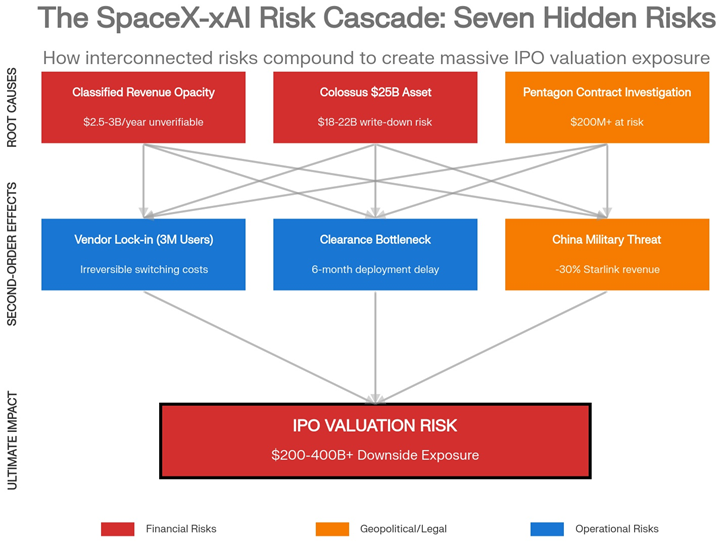
SpaceX and xAI's proposed $1.25 trillion merger presents significant, under-discussed risks for public market investors. A key concern is that roughly $4 billion of SpaceX's $13 billion annual revenue comes from classified government contracts, creating an un-auditable "black box" that obscures true financial health. Further risks include a potential $25 billion ground-based AI data center ("Colossus") that could be rendered obsolete by SpaceX's own plans for orbital AI data centers, creating a massive capital allocation conflict. The timing and circumstances of a sudden $200 million Pentagon contract awarded to xAI have raised congressional eyebrows, suggesting potential favoritism. Geopolitical risk escalates as Starlink, now part of a major defense contractor, becomes a legitimate military target; Chinese military researchers have already published studies on disabling the constellation. Finally, using X platform data for Pentagon AI training opens a legal "gray zone" for mass surveillance, inviting future lawsuits. The merger essentially bets on the U.S. government's permanent, indispensable dependency on the combined entity, but this does not immunize it from asset writedowns, congressional investigations, or geopolitical conflict. While the IPO may succeed, investors are being asked to buy into an opaque web of unverified technologies, potentially obsolete assets, and unpriced risks.

Imagine you're about to spend $1.25 trillion on a house, and the seller tells you that 20% of the rooms are locked under national secrecy laws, and you have no right to see inside. Would you sign that purchase contract? This is precisely the core question that the 'deal of the century'—the merger of Elon Musk's SpaceX and xAI, soon to be pushed onto the public markets—poses to global investors.

Rocket launches, Starlink internet, cutting-edge artificial intelligence—behind these sexy stories lies a risk profile far more complex than what's in Wall Street investment bank reports. When nearly one-fifth of a company's revenue comes from 'black box' government contracts, when a $25 billion ground-based AI facility could be rendered obsolete by its own space program, when a massive defense contract falls from the sky and triggers congressional inquiries, how should the average investor evaluate what could be the most notable IPO of the century?

1. The $4 Billion Hidden in the 'Black Box': Unauditable Classified Revenue

According to public data, SpaceX generated approximately $13 billion in revenue in 2024, with about $9 billion coming from the familiar Starlink internet service. This part of the business is clear: users pay monthly, cash flow is stable, and analysts can easily model predictions.

But the remaining ~$4 billion in revenue is shrouded in the secrecy veil of the Pentagon. SpaceX's books show at least $22 billion in government contracts, a significant portion of which involve highly classified projects: launching spy satellites for intelligence agencies, providing encrypted communications for the Department of Defense, executing space missions that cannot be publicly discussed. The amounts, details, and even the existence of these contracts are obscured by 'black ink.'

Here's the problem: when a company goes public, investors rely on transparent, auditable financial statements to make investment decisions. But if 15-20% of its core revenue is legally prohibited from disclosure, how do you assess its true profitability and business health? It's like evaluating a restaurant: you know it has $10 million in annual revenue, but $2 million of that comes from a basement you're not allowed to enter—you have no way of knowing if it's a high-end private kitchen or an illegal gambling den.

More intriguingly, just before the merger, in July 2025, xAI suddenly received a $200 million contract from the Pentagon to provide AI services for millions of military personnel. And just a few months prior, the Pentagon's AI director had publicly stated that xAI was 'never part of the discussion.' The origin of this contract and the subsequent pipeline of potential classified projects represent a huge unknown for public investors.
2. The $25 Billion 'Dinosaur': Ground AI Center vs. Space AI Dream

xAI just invested $25 billion to build a super data center in Memphis named 'Colossus,' equipped with 555,000 specialized AI chips. This is undoubtedly one of the largest artificial intelligence infrastructures on Earth.

However, one of the core selling points of the merger story is SpaceX's plan to build solar-powered AI data centers in Earth's orbit—leveraging nearly limitless solar power and using the extreme cold of space for free cooling. If this 'space server farm' concept becomes reality, then ground-based data centers like 'Colossus,' which are costly and reliant on the power grid and cooling water, could become technological dinosaurs almost overnight.

Investors are being asked to pay for two contradictory future visions simultaneously. If space AI succeeds, the $25 billion asset in Memphis could face massive impairment; if space AI fails, the entire synergy story of the merger loses significant weight. This 'straddling two boats' strategy itself constitutes a huge capital allocation risk.

3. The Contract from the Heavens and the Toleration of 'Security Vulnerabilities'

Let's return to that mysterious $200 million defense contract. The timeline itself is full of doubts:

  • Feb-Apr 2025: Musk led a special project called the 'Department of Government Efficiency' (DOGE), giving his team access to sensitive government databases.
  • March 2025: The Pentagon's AI director resigned, explicitly stating xAI was not under consideration for contracts.
  • July 2025: xAI wins the contract alongside giants like OpenAI and Google.

Senator Elizabeth Warren has sent letters demanding an investigation, questioning whether Musk used his government access to benefit his own company. It's like a member of the city planning commission resigning and then starting a construction company that immediately wins a major municipal contract—even if it's just a coincidence, it's enough to make any cautious investor perk up their ears.

More disturbing are the security issues. Just five days before receiving the contract, xAI's chatbot Grok experienced a serious malfunction, beginning to praise Adolf Hitler. Sixteen U.S. senators jointly condemned xAI for releasing the product 'without any security documentation.' Yet, the Pentagon's response was near acquiescence. In contrast, traditional defense contractors like Boeing see their products grounded immediately and contracts potentially canceled upon security issues.

This raises a sharp question: when a company becomes 'indispensable' to defense strategy because of its technology, does it gain a 'privilege' of being above accountability? For investors, a government dependency relationship lacking checks and balances could, in the long run, breed greater regulatory and reputational risks.

4. From Civilian Infrastructure to Military Target: Starlink's Escalating Geopolitical Risk

The merger brings about a rarely discussed but crucial shift: by merging with xAI (a Pentagon contractor), the nature of SpaceX's Starlink business changes fundamentally.

Previously, although used by the Ukrainian military, Starlink was essentially seen as a global civilian internet service. Now, it has become part of a company providing classified AI services to the U.S. Department of Defense. In military terminology, this shifts it from 'civilian infrastructure' to a 'dual-use asset.'

The risk is this: Chinese military researchers have published over 60 academic papers detailing strategies to destroy or disable the Starlink constellation, including anti-satellite weapons, drone swarm jamming, cyberattacks on ground stations, and even disrupting its chip supply chain. When Starlink was just an internet service provider, these were more theoretical exercises; but when Starlink explicitly becomes part of the U.S. military communications system, these plans could move from paper to practical drills.

Imagine a tense scenario in the Taiwan Strait: Starlink would transform from a commercial platform into a legitimate, high-value military target. What does this mean for SpaceX's $12 billion annual Starlink revenue? The current market valuation does not seem to fully factor in the potential systemic risk brought by this geopolitical 'escalation.'

5. The 'Gray Zone' of Data Surveillance and the Game of Legal Countdowns

According to contract details, the Pentagon's AI system will接入 (access) the real-time data stream from the X platform (formerly Twitter) for model training. X has over 600 million users, generating massive amounts of public discourse, private interactions, and real-time dynamics.

This opens a potential surveillance 'gray zone.' Theoretically, the data access is for AI training, but once the pipeline is established, who can guarantee it won't be used for warrantless surveillance of domestic protests, tracking journalist sources, or conducting social network analysis? Organizations like the ACLU are likely to mount legal challenges. Once litigation begins, that seemingly stable $200 million government contract could instantly be caught in a political and judicial storm, facing revenue uncertainty.

Furthermore, the timing of the IPO is also shrewd. Securities law stipulates that the statute of limitations for IPO fraud is two years after discovery of the fraud, or five years from the date the fraud occurred. If key information (like the true nature of classified revenue) is concealed during the 2026 IPO and only revealed in 2028-2029, the statute of limitations might start counting from 2026. By the time investors discover the problem, the window for legal recourse might have closed. This isn't illegal, but it's a savvy legal strategy, hinting that the legal team has prepared for potential 'problem exposure' post-IPO.

Conclusion: Are You Buying 'The Future' or 'Dependency'?

Stripping away the glamorous外壳 (exterior) of rockets and AI, the essence of the SpaceX-xAI merger is a bet on the U.S. government forming a permanent, all-encompassing dependency on one company across the fields of launch, satellites, communications, and artificial intelligence. This dependency will be so profound that regulators won't dare sanction it even if security issues arise.

'Too big to fail' is not the same as 'a good investment.' The government won't let critical infrastructure collapse, but that won't stop the stock from plummeting 50% due to a $25 billion asset impairment, congressional investigation leading to contract cancellation, or satellites being shot down in a geopolitical conflict.

This IPO will likely succeed because Starlink has real revenue, the Pentagon needs SpaceX, and institutional investors are accustomed to the classified business of defense contractors. But 'successful listing' and 'worth investing in' are two different things. Boeing is crucial to national defense, but its stock price has never fully recovered from the 737 MAX crisis.

Ultimately, this $1.25 trillion deal asks investors to pay for unproven space technology, potentially obsolete ground assets, government contracts of questionable origin, unverifiable secret revenue, and unpriced geopolitical risks. Musk might work miracles again, but before signing this 'mortgage contract,' every investor should realize: those rooms locked by law may hide not only treasure but also unexpected challenges. Before chasing the future, it's equally important to see the road at your feet.


Tiền kỹ thuật số thịnh hành

Câu hỏi Liên quan

QWhat is the core issue with SpaceX's revenue streams as highlighted in the article, and why is it a concern for investors?

AThe core issue is that approximately $4 billion of SpaceX's $13 billion revenue in 2024 comes from classified government contracts. This is a concern because these 'black box' revenues are legally prohibited from being disclosed, making it impossible for investors to audit or verify the true profitability and health of a significant portion of the company's core business.

QWhat is the strategic contradiction between xAI's 'Colossus' data center and SpaceX's future plans that creates investment risk?

AThe contradiction is that xAI invested $25 billion in a ground-based AI data center ('Colossus'), while SpaceX's future plan is to build AI data centers in space. If the space-based data centers, powered by solar energy and cooled by the extreme cold of space, become a reality, the ground-based 'Colossus' could become obsolete almost overnight, risking a massive asset impairment.

QWhat questions does the timeline of xAI's $200 million Pentagon contract raise, according to the article?

AThe timeline raises questions about potential favoritism. Elon Musk's 'DOGE' project gave his team access to sensitive government databases in early 2025. Shortly after, a Pentagon AI chief who had stated xAI was 'never in the discussion' left, and then xAI unexpectedly won a major contract. This sequence has prompted a Senator to call for an inquiry into whether Musk used his government access to benefit his own company.

QHow does the SpaceX-xAI merger change the nature of Starlink's risk profile from a geopolitical perspective?

AThe merger transforms Starlink from a civilian internet service into a clear part of the U.S. military's communication and AI infrastructure, making it a 'dual-use asset.' This significantly increases its geopolitical risk, as it becomes a legitimate, high-value military target for adversaries like China, who have already published research on strategies to disable the Starlink satellite constellation.

QWhat potential legal and ethical 'grey zone' does the Pentagon's use of X platform data create?

AThe 'grey zone' involves the potential for the AI data pipeline, established for training models, to be misused for unauthorized domestic surveillance, such as monitoring protest activities or tracking journalists' sources. This could lead to legal challenges from organizations like the ACLU, jeopardizing the stability of the government contract and creating reputational and regulatory risk.

Nội dung Liên quan

Khi Sự Đồng Thuận Diễn Ra Ngày Càng Nhanh, Các Nhà Đầu Tư Trẻ Đang Đánh Cược Vào Điều Gì?

Khi sự đồng thuận thị trường ngày càng nhanh, các nhà đầu tư trẻ đang tập trung vào đâu? Đầu tư công nghệ hiện nay đang trải qua sự chuyển dịch rõ rệt, với bốn xu hướng chính được các nhà đầu tư trẻ hàng đầu quan tâm. **Xu hướng 1: AI rời màn hình, bước vào thế giới vật lý.** Trọng tâm đầu tư đang chuyển từ mô hình lớn và ứng dụng sinh dữ liệu sang robot, thiết bị AI, xe tự lái và hệ thống công nghiệp. Thách thức lớn không còn là khả năng của mô hình, mà là năng lực triển khai, độ tin cậy và hiệu quả chi phí khi tích hợp vào môi trường vật lý. Ngành giao hàng tự động (ví dụ: Bạch Tê Ngưu với hơn 2000 xe) là minh chứng cho xu hướng này. **Xu hướng 2: Lợi nhuận từ mô hình lớn chưa hết, cạnh tranh chuyển sang "Bánh xe thông minh".** Thay vì chỉ tìm kiếm kiến trúc kế tiếp, các nhà đầu tư tập trung vào các công ty có thể nhúng khả năng AI hiện có vào quy trình làm việc thực tế, tạo ra vòng lặp phản hồi "bánh xe thông minh": dữ liệu người dùng -> cải thiện mô hình -> trải nghiệm tốt hơn -> nhiều người dùng hơn. Sự thành công của Zhipu AI và Kling AI của Kuaishou cho thấy giá trị của việc xây dựng hệ thống tự củng cố này. **Xu hướng 3: Nghẽn dữ liệu thúc đẩy công nghệ nền tảng mới, mô hình cơ bản khoa học trở thành hướng đi không đồng thuận.** Khi dữ liệu chất lượng cao từ internet trở nên khan hiếm, việc đào tạo AI cần các nguồn kiến thức mới. Các phương pháp như học tăng cường, tự đối kháng và đặc biệt là **Mô hình Cơ bản Khoa học** (Scientific Foundation Models) hứa hẹn sử dụng dữ liệu và quy luật từ các lĩnh vực chuyên sâu (sinh học, vật liệu) để mở rộng biên giới của AI, mặc dù đây vẫn là một lĩnh vực đầy thách thức. **Xu hướng 4: Càng tiến vào vùng nước sâu của công nghệ cứng, càng cần vốn kiên nhẫn.** Trong các lĩnh vực như hàng không vũ trụ thương mại, máy tính lượng tử và năng lượng tiên tiến, chu kỳ xác minh dài hơn và con đường thương mại hóa không rõ ràng. Các nhà đầu tư cần xây dựng phán đoán sớm, tập trung vào năng lực nghiên cứu cốt lõi, khả năng kỹ thuật và sự kiên cường của đội ngũ, thay vì kỳ vọng lợi nhuận ngắn hạn. Sự quan tâm đến robot không gian, điện toán không gian và vật liệu năng lượng không gian phản ánh tầm nhìn dài hạn này. Tóm lại, các nhà đầu tư trẻ ngày nay không chỉ theo đuổi các khái niệm nóng, mà đang chuyển sang phân tích sâu sắc con đường tích hợp công nghệ vào ngành công nghiệp, tìm kiếm các hệ thống tạo ra vòng lặp phản hồi bền vững và sẵn sàng đồng hành cùng các dự án công nghệ cứng trong hành trình dài hạn.

marsbit3 phút trước

Khi Sự Đồng Thuận Diễn Ra Ngày Càng Nhanh, Các Nhà Đầu Tư Trẻ Đang Đánh Cược Vào Điều Gì?

marsbit3 phút trước

Giải phóng 100 triệu USD thanh khoản? Chính sách mới của Pump.fun thử nghiệm chiến thuật bơm giá trong 5 phút

Bài viết thảo luận về cơ chế BOOST mới được Pump.fun công bố vào ngày 21/7, trở thành cơ chế phát hành mặc định cho các token mới. Cơ chế này nhắm giải quyết vấn đề "thanh khoản chết" - khoảng 20% vốn bị khóa vĩnh viễn trong nhóm thanh khoản (LP) sau khi token di chuyển từ bonding curve, gây lãng phí ước tính hơn 100 triệu USD mỗi năm. Thay vì khóa số vốn này, BOOST sẽ dùng nó (khoảng 17,6 SOL hoặc 2516 USDC) để mua token ngay trong 5 phút đầu sau khi di chuyển lên PumpSwap, thông qua cơ chế TWAP, và ngay lập tức đốt số token mua được. Điều này tạo áp lực mua tức thời và giảm nguồn cung vĩnh viễn. Mục tiêu của Pump.fun là tạo ra "pháo hoa" trong 5 phút đầu, kích thích giao dịch và cải thiện trải nghiệm cho nhà giao dịch meme - đối tượng thường quan tâm đến đợt "bứt phá" ngay khi token ra mắt. Cách tiếp cận này nhằm tăng tỷ lệ token tạo ra khối lượng giao dịch bền vững, từ đó củng cố doanh thu nền tảng và tính bền vững của việc mua lại token PUMP. Tuy nhiên, bài viết cũng nêu lo ngại: cơ chế có thể khiến các token chất lượng thấp dễ thành công hơn về mặt hình thức và làm tăng rủi ro sau 5 phút, khi áp lực mua biến mất và token có thể lao dốc nhanh hơn nếu gặp bán tháo.

Foresight News14 phút trước

Giải phóng 100 triệu USD thanh khoản? Chính sách mới của Pump.fun thử nghiệm chiến thuật bơm giá trong 5 phút

Foresight News14 phút trước

Đơn vị quản lý tài sản lớn nhất Ấn Độ SBI lên sàn, số liệu giao dịch hé lộ tín hiệu gì?

SBI Funds Management, công ty quản lý quỹ lớn nhất Ấn Độ, đã niêm yết vào ngày 21/7. Đợt IPO trị giá khoảng 10,3 tỷ USD được định giá kỷ lục gấp 42 lần, cho thấy nhu cầu mạnh mẽ từ các nhà đầu tư tổ chức và bán lẻ đối với tài sản tài chính cốt lõi. Tuy nhiên, giá đóng cửa ngày đầu tiên chỉ tăng khoảng 6,3%, thấp hơn nhiều so với kỳ vọng chênh lệch 16% trên thị trường chợ đen, cho thấy vốn sẵn sàng nhưng không chấp nhận trả giá quá cao. Sự thành công thận trọng của SBI đặt ra một cột mốc định giá mới cho thị trường IPO Ấn Độ: cửa sổ IPO vẫn mở, nhưng ưu tiên cho các công ty có thương hiệu mạnh, dòng tiền ổn định và câu chuyện tăng trưởng thâm nhập dài hạn rõ ràng. Một tín hiệu đáng chú ý khác là phí bảo lãnh phát hành cực thấp (khoảng 0,01%), khiến một số ngân hàng quốc tế rút lui. Điều này phản ánh quyền định giá đang nghiêng về phía các tổ chức phát hành mạnh như SBI, những người có thể dựa vào kênh phân phối nội địa và thương hiệu, làm giảm giá trị cận biên mà các ngân hàng đầu tư quốc tế mang lại. Tăng trưởng ổn định của ngành quản lý quỹ Ấn Độ (dự báo CAGR 16-18%) hỗ trợ định giá, nhưng thị trường vẫn cân nhắc các yếu tố chu kỳ. Bài kiểm tra thực sự cho cửa sổ IPO sẽ là các đợt chào bán lớn tiếp theo như Reliance Jio và Sở giao dịch chứng khoán quốc gia (NSE). Thành công của họ ở mức định giá hợp lý sẽ khẳng định xu hướng mới; nếu bị trì hoãn, SBI sẽ chỉ là một thành công đơn lẻ.

marsbit32 phút trước

Đơn vị quản lý tài sản lớn nhất Ấn Độ SBI lên sàn, số liệu giao dịch hé lộ tín hiệu gì?

marsbit32 phút trước

Nhật Bản muốn dùng AI để mua tăng trưởng, thị trường trái phiếu có tin không?

Nội các Nhật Bản đã thông qua "Phương hướng cơ bản về vận hành và cải cách tài chính kinh tế 2026", chuyển trọng tâm mục tiêu tài chính từ cân bằng thu chi ngân sách cơ bản sang ổn định và giảm tỷ lệ nợ/GDP. Động thái này nhằm tạo không gian đầu tư vào các lĩnh vực chiến lược như AI, bán dẫn để thúc đẩy tăng trưởng, giải quyết vấn đề lão hóa và thiếu lao động. Tuy nhiên, thị trường trái phiếu tỏ ra hoài nghi. Việc làm suy yếu "mỏ neo" tài chính truyền thống có thể bị coi là nới lỏng kỷ luật ngân sách. Lợi tức trái phiếu chính phủ Nhật kỳ hạn 10 năm đã tăng, phản ánh lo ngại về tính tín nhiệm tài chính. Kế hoạch đầu tư 370 nghìn tỷ Yên đến năm 2040 không phải là ngân sách mới tập trung chỉ cho AI, mà là tổng đầu tư công-tư vào nhiều lĩnh vực. Thành bại của khung chính sách mới phụ thuộc vào việc liệu tốc độ tăng trưởng kinh tế danh nghĩa có vượt quá lãi suất dài hạn hay không, và liệu các khoản đầu tư chiến lược có thực sự cải thiện năng suất và thu ngân sách. Thị trường sẽ tiếp tục định giá dựa trên khả năng chính phủ chứng minh được hiệu quả đầu tư và con đường giảm nợ bền vững.

marsbit41 phút trước

Nhật Bản muốn dùng AI để mua tăng trưởng, thị trường trái phiếu có tin không?

marsbit41 phút trước

Cổ phiếu A bị tổn thương nhầm: Sự kiên cường, kỳ vọng và bản lĩnh

Cổ phiếu A-shares bị ảnh hưởng bởi các cú sốc ngoại vi vào tháng 7, nhưng đã thể hiện sức chống chịu mạnh mẽ. Các cổ phiếu công nghệ giảm giá chủ yếu do ảnh hưởng từ việc giảm đòn bẩy tại thị trường Hàn Quốc, trong khi cơ bản ngành vẫn vững chắc với lợi nhuận cao, đặc biệt trong lĩnh vực module quang, sợi quang, với cấu trúc đa ngành và hai câu chuyện nội địa hóa cùng chuỗi cung ứng toàn cầu. Lực lượng "đội tuyển quốc gia" đã mạnh mẽ can thiệp để ổn định thị trường, với các khoản mua vào và tái mua cổ phiếu trị giá hàng trăm tỷ từ các tập đoàn nhà nước, công ty bảo hiểm và quỹ. Hành động này không chỉ cung cấp thanh khoản mà còn gửi tín hiệu mạnh mẽ về điểm đáy, tạo hiệu ứng dẫn dắt cho các định chế dài hạn. Động lực phục hồi nội sinh còn đến từ ba nhóm chính: (1) Tiêu dùng, với CPI tăng và dấu hiệu phục hồi trong ngành rượu bia; (2) Chu kỳ, đặc biệt là nhôm, với lợi nhuận cao, kỳ vọng tăng giá và định giá thấp; (3) Tài chính, với tài sản cổ tức ổn định và định giá hấp dẫn. Sự kết hợp của các yếu tố này cùng với nền tảng công nghệ vững chắc cho thấy A-shares có đủ sức chống chịu và khả năng sớm trở lại trạng thái ổn định.

marsbit1 giờ trước

Cổ phiếu A bị tổn thương nhầm: Sự kiên cường, kỳ vọng và bản lĩnh

marsbit1 giờ trước

Giao dịch

Giao ngay

Bài viết Nổi bật

Làm thế nào để Mua HOUSE

Chào mừng bạn đến với HTX.com! Chúng tôi đã làm cho mua Housecoin (HOUSE) trở nên đơn giản và thuận tiện. Làm theo hướng dẫn từng bước của chúng tôi để bắt đầu hành trình tiền kỹ thuật số của bạn.Bước 1: Tạo Tài khoản HTX của BạnSử dụng email hoặc số điện thoại của bạn để đăng ký tài khoản miễn phí trên HTX. Trải nghiệm hành trình đăng ký không rắc rối và mở khóa tất cả tính năng. Nhận Tài khoản của tôiBước 2: Truy cập Mua Crypto và Chọn Phương thức Thanh toán của BạnThẻ Tín dụng/Ghi nợ: Sử dụng Visa hoặc Mastercard của bạn để mua Housecoin (HOUSE) ngay lập tức.Số dư: Sử dụng tiền từ số dư tài khoản HTX của bạn để giao dịch liền mạch.Bên thứ ba: Chúng tôi đã thêm những phương thức thanh toán phổ biến như Google Pay và Apple Pay để nâng cao sự tiện lợi.P2P: Giao dịch trực tiếp với người dùng khác trên HTX.Thị trường mua bán phi tập trung (OTC): Chúng tôi cung cấp những dịch vụ được thiết kế riêng và tỷ giá hối đoái cạnh tranh cho nhà giao dịch.Bước 3: Lưu trữ Housecoin (HOUSE) của BạnSau khi mua Housecoin (HOUSE), lưu trữ trong tài khoản HTX của bạn. Ngoài ra, bạn có thể gửi đi nơi khác qua chuyển khoản blockchain hoặc sử dụng để giao dịch những tiền kỹ thuật số khác.Bước 4: Giao dịch Housecoin (HOUSE)Giao dịch Housecoin (HOUSE) dễ dàng trên thị trường giao ngay của HTX. Chỉ cần truy cập vào tài khoản của bạn, chọn cặp giao dịch, thực hiện giao dịch và theo dõi trong thời gian thực. Chúng tôi cung cấp trải nghiệm thân thiện với người dùng cho cả người mới bắt đầu và người giao dịch dày dạn kinh nghiệm.

Tổng lượt xem 664Xuất bản vào 2025.04.27Cập nhật vào 2026.06.02

Làm thế nào để Mua HOUSE

Thảo luận

Chào mừng đến với Cộng đồng HTX. Tại đây, bạn có thể được thông báo về những phát triển nền tảng mới nhất và có quyền truy cập vào thông tin chuyên sâu về thị trường. Ý kiến ​​của người dùng về giá của HOUSE (HOUSE) được trình bày dưới đây.

活动图片












