Stock Price Surges Over 35%! Circle's Earnings Report Exceeds Expectations: USDC Circulation Soars 72%

marsbitXuất bản vào 2026-02-26Cập nhật gần nhất vào 2026-02-26

Tóm tắt

Circle (CRCL) reported strong Q4 and full-year 2025 financial results, with total revenue and reserve income reaching $770 million in Q4, up 77% year-over-year, exceeding expectations. This drove a 35% surge in its stock price. Key highlights include a 72% YoY increase in USDC circulation to $75.3 billion and a 247% rise in on-chain transaction volume to $11.9 trillion in Q4. Reserve income remained the core revenue driver at $733 million, while non-interest income reached $37 million. For the full year, total revenue grew 64% to $2.7 billion. Although the company reported a net loss of $70 million due to a one-time $424 million stock-based compensation expense from its IPO, adjusted EBITDA doubled to $582 million, indicating profitable core operations. Strategic developments include the stable testnet performance of its Arc blockchain, expansion of the Circle Payments Network with 55 financial institutions onboarded, and a key partnership with Polymarket to use native USDC. Regulatory progress includes conditional approval for a national trust bank. Looking ahead, Circle targets a 40% compound annual growth rate for USDC circulation. CEO Jeremy Allaire emphasized AI-driven payment demand, with 99% of agent-based payments currently using USDC. Despite challenges like declining yields and new competitors like USAT, Circle continues to execute its strategy as a growing internet financial infrastructure provider.

Author:Zhou, ChainCatcher

On February 25, stablecoin issuer Circle (NYSE code: CRCL) released its 2025 fiscal year fourth quarter and full-year financial report.

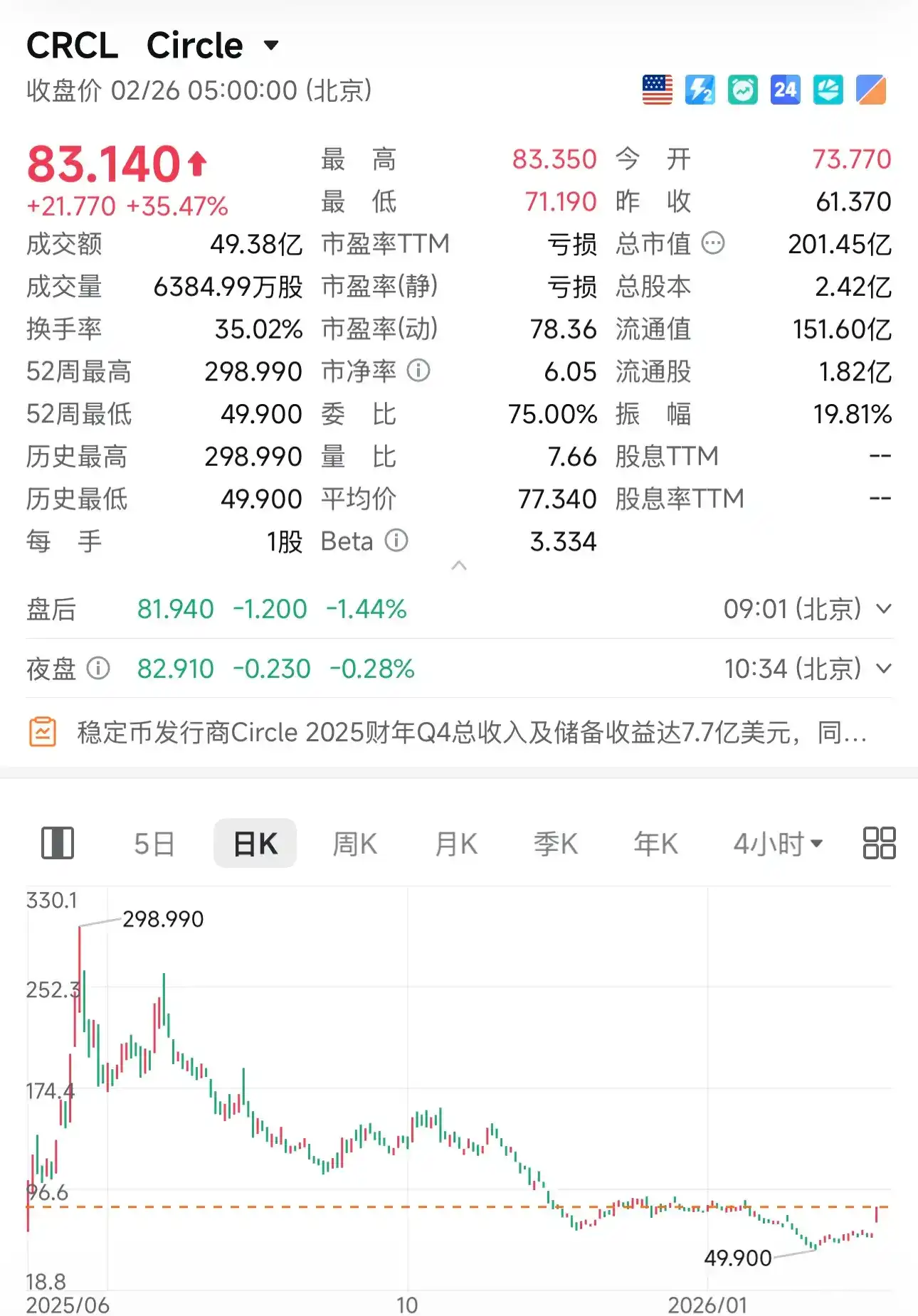
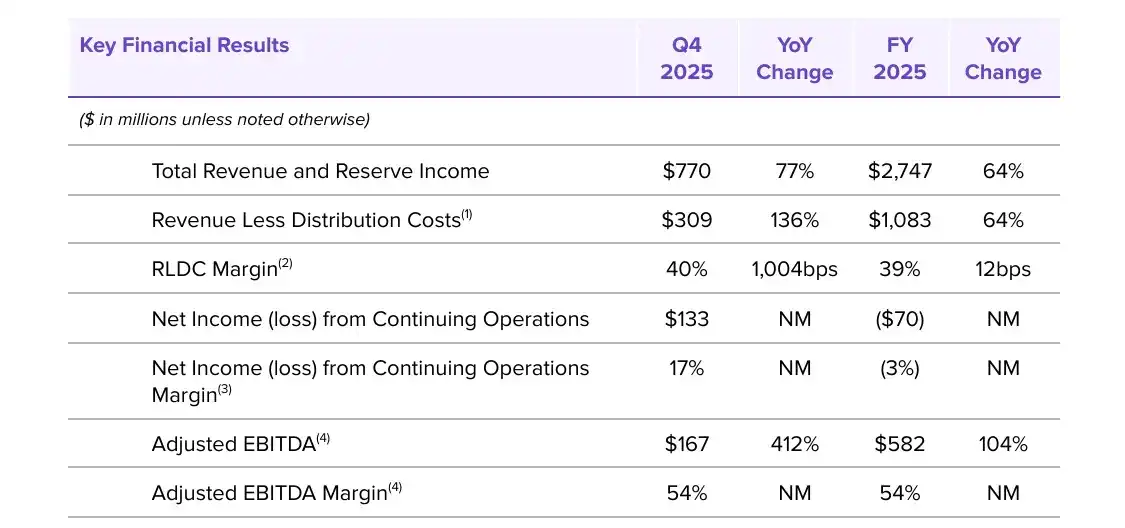
The report shows that the company's total revenue and reserve income for the fourth quarter reached $770 million, a year-on-year increase of 77%, exceeding market expectations.

Driven by this, CRCL stock price rose over 35% at Wednesday's close.

Specifically, the growth of its stablecoin USDC was the core highlight of this earnings report. As of year-end, the circulation of USDC reached $75.3 billion, a year-on-year increase of 72%.

Meanwhile, network activity showed explosive growth, with on-chain transaction volume in the fourth quarter reaching $11.9 trillion, a year-on-year increase of 247%.


In terms of revenue composition, reserve income remains the company's main revenue pillar, contributing $733 million in Q4, a year-on-year increase of 69%.

Although market yields decreased by 68 basis points during the period, this pressure was offset by the significant expansion of USDC's average circulation scale.

At the same time, non-interest income reached $37 million, mainly due to the steady accumulation of subscription services and transaction fees.

Looking at the full-year performance, the company's total revenue and reserve income was $2.7 billion, a year-on-year increase of 64%.

Although continuing operations recorded a net loss of $70 million, this was mainly affected by the one-time inclusion of $424 million in stock-based compensation expenses during the IPO process.

As this expense is non-cash in nature, the company's core business is profitable after exclusion. Adjusted EBITDA reached $582 million, doubling year-on-year, showing that operating leverage is gradually emerging.
极

In terms of strategic layout, Circle is gradually transforming from a pure stablecoin issuer to an internet financial infrastructure provider, strengthening its underlying position in the real-time transaction field through various technological initiatives.

The report shows that the Arc public blockchain testnet is running stably, with transaction finality time shortened to about half a second, and total transactions have exceeded 166 million. The mainnet is expected to be officially launched within the year.

In terms of the payment network, the ecosystem of the Circle Payments Network continues to expand. Currently, 55 financial institutions have officially joined, with another 74 in the qualification review stage. The annualized transaction volume over the past 30 days has reached $5.7 billion.

It is worth mentioning that the strategic cooperation with Polymarket further highlights the value of USDC in emerging fields. As one of the world's largest prediction market platforms, Polymarket will gradually switch all betting and settlement to native USDC.

This cooperation not only eliminates bridging risks and improves capital efficiency but also directly converts the user growth of the prediction market into long-term increments in USDC circulation and transaction volume.

In addition, Circle is also gradually penetrating the traditional financial ecosystem. The company has not only achieved all-day settlement cooperation with Visa but also broadened application scenarios through platform integration with Intuit.

At the regulatory compliance level, the company received conditional approval from the U.S. Office of the Comptroller of the Currency to establish a national trust bank in December 2025, and further consolidated its first-mover advantage in compliance under the GENIUS Act framework.

The secondary market has given a relatively positive response. Technically, before the earnings release, the company's stock price had rebounded from its low and stabilized above the 7-day and 30-day moving averages.

On the institutional side, ARK Invest, under Cathie Wood, increased its holdings of Circle stock multiple times during market corrections. The latest holdings are about 4.14 million shares, worth approximately $261 million.

Mizuho Securities upgraded CRCL's rating from underweight to neutral at the end of January, setting a target price of $77. The institution believes that the growth of Polymarket will directly drive the expansion of USDC scale and revenue.

However, Circle still needs to deal with potential headwinds in the future.

On the one hand, the downward trend in interest rates may continue to put pressure on reserve income, which has been reflected in the decline in yield in the fourth quarter.

On the other hand, the stablecoin competitive landscape is changing. The USAT stablecoin, launched by Tether and issued by Anchorage Digital, is targeting the U.S. institutional market and is regarded as the first substantive compliant competitor for USDC domestically. This competition may lead to some diversion in the compliant institutional share.

In addition, overall cryptocurrency market volatility and macro cycles will still create uncertainty for circulation growth. According to Coinglass data, the current total stablecoin market capitalization is about $264 billion, with USDC accounting for about 28.5%. Although USDC leads the industry in growth rate, Tether still dominates.


Worthy of special attention from investors is Circle management's expectations and execution plans for the future. The company provided clear guidance for the 2026 fiscal year:

  • USDC circulation targets a compound annual growth rate of 40% over a multi-year cycle;
  • Other income (subscription, service, and transaction fees) is expected to be $150 to $170 million;
  • RLDC margin (revenue minus distribution and transaction cost margin) remains in the high range of 38% to 40%;
  • Adjusted operating expenses are expected to be $570 to $585 million.

These guidelines also reflect management's confidence in continued scale expansion, cost control, and accelerated growth in non-interest income.

Furthermore, Circle CEO Jeremy Allaire repeatedly mentioned AI agents and their payment needs during the earnings call.

He said, we are about to enter a world where there may be billions or even hundreds of billions of AI agents interacting on the internet and performing economic functions.

These AI agents need programmable digital dollars and open infrastructure to enable autonomous transactions, and Circle's products are built for this.

Specifically, Circle is heavily investing in agent-based payment infrastructure.

Currently, Circle Gateway has entered the test network phase, supporting AI agents to autonomously initiate cross-chain USDC transactions, with a single transaction cost as low as $0.00001 (extremely low fees, suitable for micro-payments and high-frequency machine-to-machine transactions).

It was also mentioned in the meeting that currently about 99% of agent-based payments use USDC, thanks to Circle's cross-chain deployment and participation in agent payment standards (such as the x402 standard, in cooperation with Google etc.).

Overall, this earnings report validates Circle's strategic execution capability in a complex regulatory environment, and the new story of AI+ payments has expanded the company's valuation imagination space. Despite facing yield fluctuations and emerging competitive challenges, Circle continues to exert efforts on the track of "financial infrastructure-ization" and "compliant expansion".

Câu hỏi Liên quan

QWhat was the percentage increase in Circle's total revenue and reserve income in Q4 2025, and what was the exact figure?

ACircle's total revenue and reserve income increased by 77% in Q4 2025, reaching $770 million.

QBy what percentage did the circulating supply of USDC grow year-over-year, and what was its total value at the end of the period?

AThe circulating supply of USDC grew by 72% year-over-year, reaching a total value of $75.3 billion.

QWhat was the main reason for Circle's net loss from continuing operations, and what was the adjusted EBITDA figure that showed core profitability?

AThe net loss was primarily due to a one-time, non-cash stock-based compensation expense of $424 million related to its public listing. The adjusted EBITDA, which excludes this, was $582 million, showing core profitability.

QName one new significant competitor for USDC in the U.S. institutional market mentioned in the article and which company is behind it.

AA new significant competitor is the USAT stablecoin, which is issued by Anchorage Digital and backed by Tether, targeting the U.S. institutional market.

QWhat future technology trend did CEO Jeremy Allaire highlight as a major growth driver for USDC, and what specific infrastructure is Circle building for it?

ACEO Jeremy Allaire highlighted AI agents and their payment needs as a major future growth driver. Circle is building 'agentic payment infrastructure,' including the Circle Gateway currently in testnet, to support autonomous, low-cost USDC transactions for AI.

Nội dung Liên quan

43 phút của Trump: Cốt truyện người mạnh mất kiểm soát, chiến tranh truyền thông leo thang

Trong bài diễn văn kéo dài 43 phút sau hơn một tuần vắng bóng công chúng, Tổng thống Mỹ Donald Trump đã cố gắng thể hiện hình ảnh một nhà lãnh đạo mạnh mẽ và kiểm soát. Tuy nhiên, phần lớn thời gian được dành cho các chủ đề phụ như hồ phản chiếu trên National Mall, so sánh quy mô đám đông với Martin Luther King Jr., cùng những lời công kích nhắm vào phóng viên, đảng Dân chủ và các thành phố lớn. Ông còn ký sắc lệnh hành pháp hủy bỏ các biện pháp bảo vệ việc làm cho hàng nghìn công chức cấp cao liên bang, một động thái có thể gia tăng sự phụ thuộc vào lòng trung thành cá nhân hơn là năng lực chuyên môn trong chính phủ. Bài viết nêu bật trạng thái cá nhân đầy lo lắng và phòng thủ của Trump, thể hiện qua việc ông đột ngột kết thúc sự kiện và nhân viên nhanh chóng dọn dẹp hiện trường. Tác giả cũng phân tích cuộc tấn công của Trump vào nữ phóng viên CNN, Kaitlan Collins, coi đó là một phần của nỗ lực làm mất uy tín giới truyền thông. Bài báo cảnh báo về áp lực ngày càng lớn từ quyền lực chính trị và lợi ích thương mại lên các cơ quan báo chí chính thống, dẫn đến cuộc khủng hoảng về tính độc lập biên tập, như trường hợp Scott Pelley của CBS. Thông điệp chính kêu gọi công chúng ủng hộ các nhà báo và phương tiện truyền thông độc lập, những người được coi là lực lượng quan trọng duy trì sự thật khi các thể chế khác bị xâm phạm. Bài viết kết thúc với viễn cảnh lạc quan khi đề cập đến việc Hạ viện, với sự ủng hộ của một số thành viên đảng Cộng hòa, đã thông qua nghị quyết yêu cầu chấm dứt hành động quân sự ở Iran, cho thấy sự bất đồng ngày càng tăng ngay trong nội bộ đảng của Trump.

marsbit1 giờ trước

43 phút của Trump: Cốt truyện người mạnh mất kiểm soát, chiến tranh truyền thông leo thang

marsbit1 giờ trước

Kalshi, MTS và tham vọng của a16z

Trí tuệ thị trường dự đoán và tham vọng "Truyền thông Mới" của a16z Bài viết phân tích sự trỗi dậy của thị trường dự đoán (prediction markets), đặc biệt là công ty Kalshi được định giá 220 tỷ USD, dưới góc nhìn chiến lược đầu tư và truyền thông của quỹ mạo hiểm a16z. Tác giả điểm lại lịch sử tư tưởng của thị trường dự đoán, từ học thuyết của Hayek về việc thị trường tổng hợp tri thức phân tán, đến cơ chế khuyến khích của Robin Hanson (LMSR) và ý tưởng chính phủ dựa trên dự đoán (Futarchy). Trọng tâm bài viết nằm ở việc a16z, sau khi đầu tư vào Kalshi, đã định vị lại giá trị cốt lõi của thị trường dự đoán không chỉ là sòng bạc hay sàn giao dịch, mà là một phương tiện truyền thông mới mang lại "cảm giác hiện diện" (presence). Trong một thế giới ngày càng bị che khuất và bất lực, việc dùng tiền thật để đặt cược vào các sự kiện toàn cầu giúp cá nhân tái khẳng định vai trò "người quan sát tối thượng", can thiệp và diễn giải thực tại. Kalshi, theo logic này, sẽ trở thành nơi định đoạt tính xác thực và tầm quan trọng của sự kiện. Bài viết liên kết điều này với tầm nhìn "Truyền thông Mới" của a16z – một hệ thống truyền thông toàn diện từ định hình luận điệu, tài trợ, phát hành sản phẩm đến thu hút khách hàng với tốc độ và cường độ chưa từng có, nhằm "tiếp quản dòng thời gian". Ví dụ điển hình là MTS (Monitoring The Situation), một hãng truyền thông chuyên phát sóng tin tức 24/7 trên Twitter. Kết luận cho rằng sức hút thực sự của Kalshi và lý do định giá khổng lồ của nó nằm ở "trường lực bẻ cong hiện thực" – khả năng tạo ra một thực tại thay thế có sức thuyết phục cao nhờ vào khối lượng giao dịch bằng tiền thật, từ đó trở thành một mảnh ghép quyền lực trong đế chế truyền thông mới của a16z.

marsbit3 giờ trước

Kalshi, MTS và tham vọng của a16z

marsbit3 giờ trước

Bất Ngờ: Cựu Nhân Sự Trụ Cột Trong Dự Án Chip Của OpenAI Gia Nhập Anthropic

Chuyên gia chip "nhân viên số 002" của OpenAI, Clive Chan, vừa thông báo rời OpenAI để gia nhập Anthropic. Anh là một trong những thành viên sớm nhất của đội ngũ phát triển chip tự thiết kế của OpenAI, tham gia từ giai đoạn hình thành đến nay. Dù đánh giá cao đội ngũ chip tại OpenAI, Clive Chan chia sẻ anh luôn có mong muốn "chinh phục một ngọn núi mới từ chân núi", đó là lý do anh chuyển sang Anthropic. Tại Anthropic, anh ấn tượng với năng lực, giá trị cốt lõi và tham vọng của đội ngũ, đồng thời trải nghiệm cường độ làm việc rất cao. Khi được hỏi về tiến độ dự án chip của OpenAI, Clive Chan đề cập đến thông tin hợp tác công khai giữa OpenAI và Broadcom, với kế hoạch triển khai bắt đầu từ nửa cuối năm 2026. Clive Chan có kinh nghiệm làm việc tại nhiều công ty công nghệ hàng đầu như Tesla, Google, SpaceX trước khi gia nhập OpenAI vào đầu năm 2024. Việc chuyển đổi của anh là một ví dụ nữa cho thấy dòng chảy nhân tài đáng chú ý giữa OpenAI và Anthropic, sau sự kiện nhà nghiên cứu nổi tiếng Andrej Karpathy chuyển sang Anthropic hồi tháng 5. Động thái này càng thu hút sự chú ý khi Anthropic vừa hoàn thành vòng gọi vốn với định giá gần 1.000 tỷ USD.

marsbit3 giờ trước

Bất Ngờ: Cựu Nhân Sự Trụ Cột Trong Dự Án Chip Của OpenAI Gia Nhập Anthropic

marsbit3 giờ trước

a16z chuyển hướng toàn cầu hóa: VC đang trở thành "động lực thúc đẩy" của liên minh công nghệ Mỹ

Biên tập: Thông báo của Ben Horowitz cho thấy một bước chuyển quan trọng trong chiến lược toàn cầu hóa của a16z: họ không chỉ tìm kiếm dự án ở nước ngoài hay mở rộng đầu tư quốc tế, mà còn đặt mình vào khuôn khổ cạnh tranh công nghệ và hợp tác đồng minh rộng lớn hơn. Trong bối cảnh AI, robot, công nghệ quốc phòng, an ninh mạng và tái cấu trúc chuỗi cung ứng trở thành trọng tâm cạnh tranh quốc gia, con đường quốc tế hóa của startup trở nên phức tạp hơn. A16z đang phản ứng với sự thay đổi này thông qua việc thành lập văn phòng Tokyo, bổ nhiệm Anne Neuberger phụ trách các vấn đề toàn cầu, và nâng cấp nhóm quan hệ nhà đầu tư thành nhóm đối tác toàn cầu. Tín hiệu quan trọng nhất là a16z gắn kết mạng lưới toàn cầu của mình với năng lực lãnh đạo công nghệ của "Mỹ và các đồng minh". Đối với a16z, mạng lưới đầu tư mạo hiểm trong tương lai không chỉ giúp nhà sáng lập gọi vốn, tuyển dụng, bán hàng mà còn hỗ trợ họ tiếp cận thị trường trọng điểm, kết nối với chính phủ và các tổ chức chiến lược, cũng như hiểu rõ môi trường chính sách và quy định của các quốc gia khác nhau. Điều này có nghĩa vai trò của các tổ chức đầu tư mạo hiểm hàng đầu đang được định nghĩa lại. Họ không còn chỉ là trung gian vốn, mà là người tổ chức kết nối công ty khởi nghiệp, năng lực quốc gia, nguồn lực ngành, hệ thống đồng minh và vốn toàn cầu. Chiến lược toàn cầu hóa lần này của a16z có thể được xem như một sự chủ động định vị của vốn Silicon Valley trong cuộc cạnh tranh công nghệ toàn cầu mới.

marsbit3 giờ trước

a16z chuyển hướng toàn cầu hóa: VC đang trở thành "động lực thúc đẩy" của liên minh công nghệ Mỹ

marsbit3 giờ trước

Kalshi, MTS và Tham vọng của a16z

Bài viết phân tích tầm quan trọng của thị trường dự đoán (prediction markets), tập trung vào Kalshi, và tầm nhìn của quỹ đầu tư mạo hiểm a16z trong việc xây dựng một đế chế truyền thông mới. Tác giả điểm qua lịch sử tư tưởng đằng sau thị trường dự đoán, từ lý thuyết của Hayek về việc thị trường tổng hợp tri thức phân tán, đến cơ chế khuyến khích của Robin Hanson (LMSR) và ý tưởng "Futarchy". Trọng tâm bài viết là việc a16z đầu tư mạnh vào Kalshi (định giá 220 tỷ USD) và cách họ diễn giải giá trị cốt lõi của nó: mang lại "cảm giác hiện diện" (presence). Trong một thế giới mà con người ngày càng thụ động và xa cách với thực tại, thị trường dự đoán cho phép họ tham gia tích cực bằng cách dùng tiền thật để đặt cược vào các sự kiện, từ đó cảm thấy mình là người quan sát và dự báo lịch sử. a16z coi đây là mảnh ghép quan trọng cho tham vọng "truyền thông mới" của họ - một hệ thống toàn diện từ định hình narrative, tài trợ sản phẩm, đến tiếp cận khách hàng với tốc độ cực cao, nhằm "tiếp quản dòng thời gian". Công ty truyền thông MTS (Monitoring The Situation) là một ví dụ điển hình cho triết lý này. Bài viết kết luận rằng sức mạnh thực sự của Kalshi và thị trường dự đoán nằm ở "trường lực bẻ cong hiện thực" - khả năng định nghĩa tính xác thực và tầm quan trọng của sự kiện thông qua khối lượng giao dịch bằng tiền thật, từ đó giành được quyền giải thích tối cao về tương lai, một thứ quyền lực hiếm khi nằm trong tay một công ty tư nhân.

链捕手3 giờ trước

Kalshi, MTS và Tham vọng của a16z

链捕手3 giờ trước

Giao dịch

Giao ngay
Hợp đồng Tương lai
活动图片