Stable TGE Tonight, Will the Market Still Buy into the Stablecoin Public Chain Narrative?

marsbitXuất bản vào 2025-12-08Cập nhật gần nhất vào 2025-12-08

Tóm tắt

Stable, a Layer 1 blockchain supported by Bitfinex and Tether, is set for its mainnet launch on December 8th. It is designed with a focus on stablecoin infrastructure, using USDT as the native gas token to enable sub-second settlements and feeless peer-to-peer transfers. The native token, STABLE, has a fixed supply of 100 billion and is not used for gas fees but for governance, staking, and ecosystem incentives. Token allocation includes 10% for Genesis Distribution (fully unlocked at launch), 40% for ecosystem and community growth, and 25% each for the team and investors (with a 1-year cliff and linear release). The network uses a DPoS consensus model where users stake STABLE to participate in validation and governance. Prior to launch, Stable conducted two pre-deposit phases, which saw massive demand and technical issues, raising concerns over fairness and KYC delays. The project raised $28 million in seed funding at a $300 million valuation. Market expectations are mixed. Pre-launch perpetual trading suggests an FDV around $3 billion, while prediction markets indicate an 85% probability of FDV exceeding $2 billion post-launch. Pre-depositors may see returns between 7% to 16.9% based on current estimates. Exchanges like Bitget and Bybit have announced support, but major platforms like Binance and Coinbase have not.

At 21:00 Beijing time on December 8, the Stable mainnet will officially launch. Stable, a Layer 1 blockchain supported by Bitfinex and Tether, focuses on stablecoin infrastructure. Its core design involves using USDT as the native gas fee, achieving sub-second settlement and gas-free peer-to-peer transfers. As of the time of writing, including Bitget, Backpack, and Bybit have announced they will list STABLE spot trading. Additionally, Binance, Coinbase, and Korean exchanges have not yet announced listings for STABLE spot trading.

Total Supply of 100 Billion, Token Not Used for Gas Fees

The project team has released the whitepaper and tokenomics details before the mainnet launch. Its native token, STABLE, has a total fixed supply of 100 billion tokens. Transfers, payments, and transactions on the Stable network are settled in USDT. STABLE is not used for gas fees but is instead used to coordinate incentive mechanisms between developers and ecosystem participants. The STABLE token allocation is as follows: Genesis Distribution accounts for 10% of the total supply, supporting initial liquidity, community activation, ecosystem activities, and strategic distribution efforts at launch. The genesis distribution portion will be fully unlocked at the mainnet launch.

The Ecosystem & Community fund accounts for 40% of the total supply, allocated to developer grants, liquidity programs, partnerships, community initiatives, and ecosystem growth; the Team allocation accounts for 25% of the total supply, allocated to the founding team, engineers, researchers, and contributors; Investors & Advisors account for 25% of the total supply, allocated to strategic investors and advisors supporting network development, infrastructure construction, and promotion.
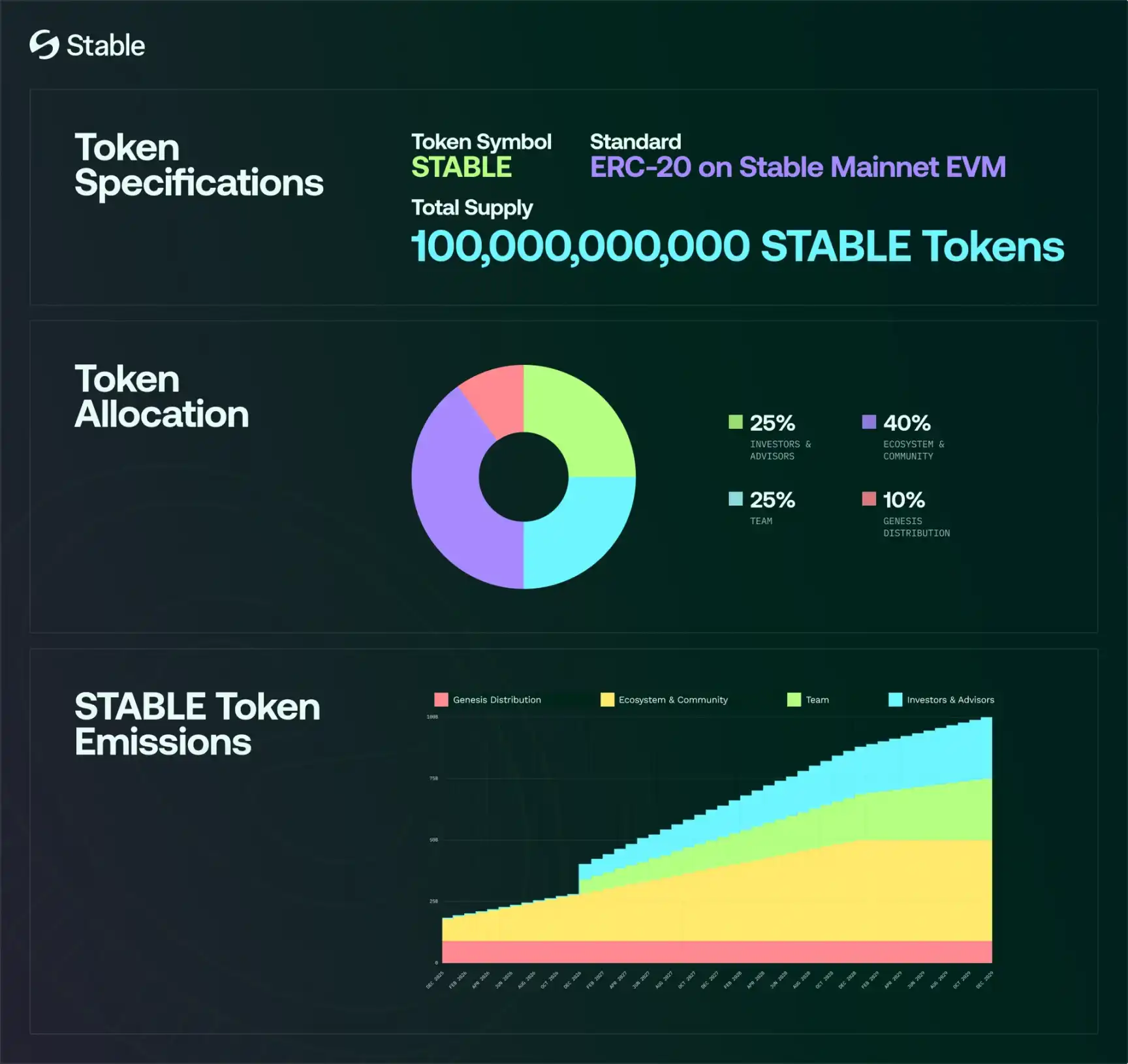
Team and investor allocations are subject to a one-year cliff, meaning zero unlocking for the first 12 months, followed by linear vesting. The Ecosystem & Community fund allocation is 8% unlocked at launch, with the remaining portion vested linearly to incentivize developers, partners, and user growth.

Stable utilizes a DPoS (Delegated Proof-of-Stake) model through its StableBFT consensus protocol. This design supports high-throughput settlement while maintaining the economic security required for a global payment network. Staking STABLE tokens is the mechanism for validators and delegators to participate in consensus and earn rewards. The primary roles of the STABLE token are governance and staking: holders can stake tokens to become validators, participate in network security maintenance, and vote in DAO governance to influence protocol upgrades, such as adjusting fee rates or introducing new stablecoin support.

Additionally, STABLE can be used for ecosystem incentives, such as liquidity mining or cross-chain bridging rewards. The project claims that this separated design can attract institutional capital because USDT's stability is much higher than that of volatile governance tokens.

Pre-deposit Controversy: Front-running, KYC Delays

Like Plasma, Stable also opened two deposit periods before the mainnet launch. The first phase of pre-deposits started in late October with an upper limit of $825 million, which was filled within minutes of the announcement. The community questioned potential front-running by some players. The top-ranked wallet deposited hundreds of millions of USDT 23 minutes before the deposit window opened.

The project team did not directly respond and opened a second pre-deposit event on November 6 with an upper limit of $500 million.

However, Stable underestimated the market's enthusiasm for deposits. The moment the second phase opened, massive traffic surge caused its website to slow down and become unresponsive. Consequently, Stable updated the rules, allowing users to deposit via the Hourglass frontend or directly on-chain; the deposit function was reopened for 24 hours, with a maximum of $1 million per wallet and a minimum deposit amount still set at $1,000.
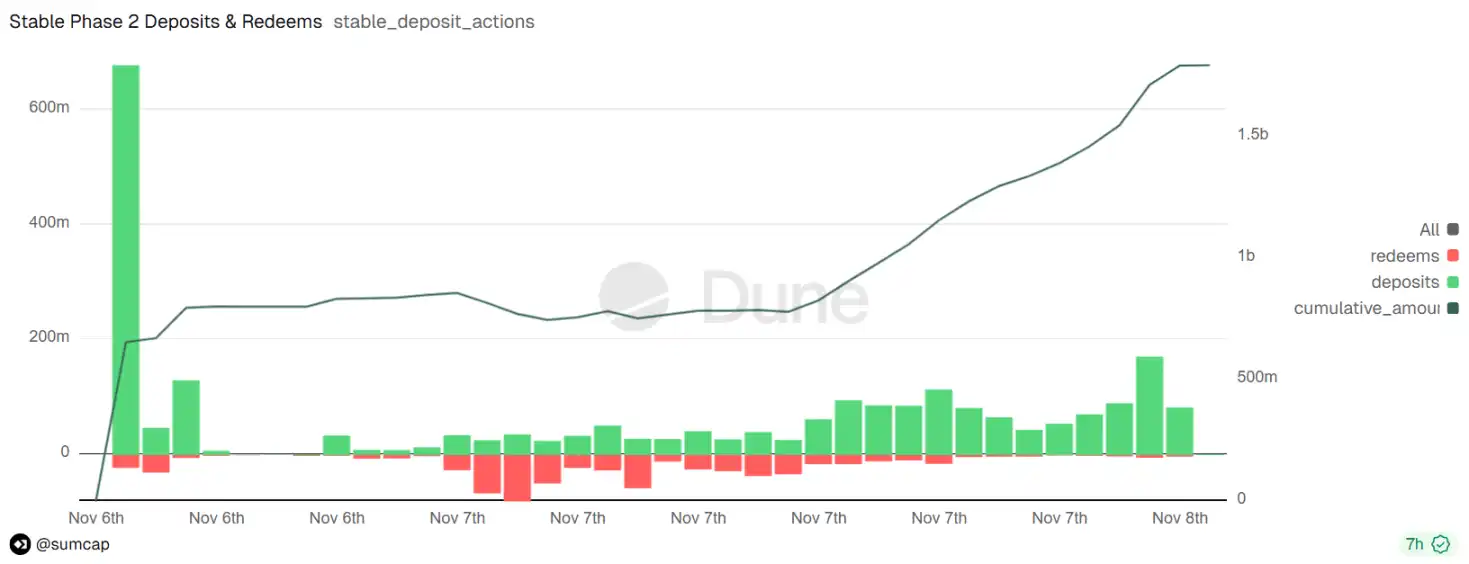
Ultimately, the total deposits in the second phase reached approximately $1.8 billion, with about 26,000 wallets participating.

The review time ranged from a few days to a week, with some users in the community complaining about system lag or repeated requests for additional materials.

Over 85% Probability of $2 Billion FDV

In late July this year, Stable announced the completion of a $28 million seed round led by Bitfinex and Hack VC, bringing its market valuation to around $300 million.

For comparison, Plasma's current market cap is $330 million, with an FDV of $1.675 billion.

Some optimists believe that the stablecoin narrative, Bitfinex's backing, and Plasma's initial price surge followed by a drop might indicate there is still some hype and potential for price appreciation in the near term. However, pessimistic voices are stronger: since gas is not paid in STABLE, its utility is limited, especially as the market has entered a bear cycle and liquidity has become tight, its token value may decline rapidly.

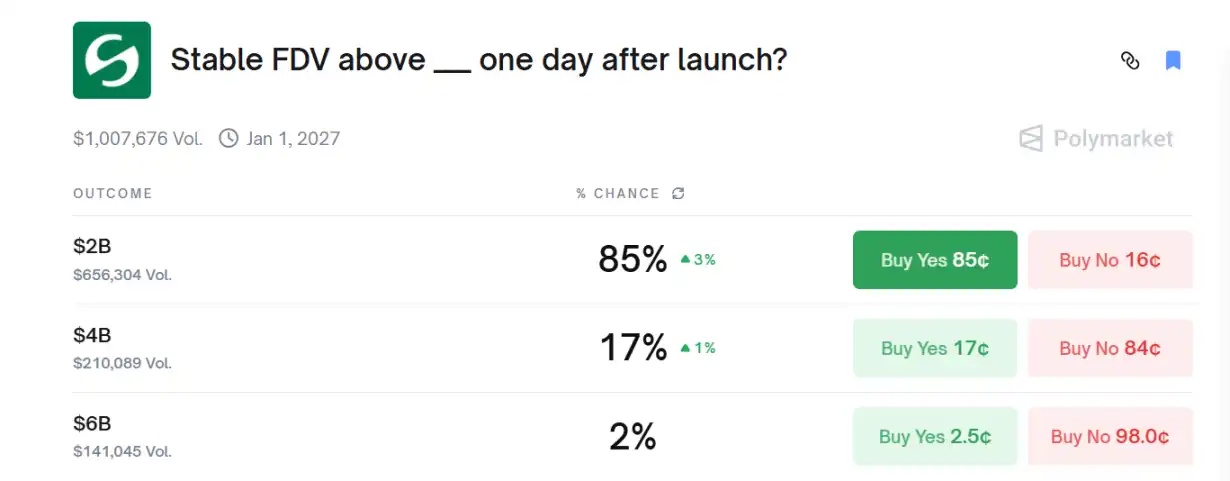
Current Polymarket data shows that the market is betting with an 85% probability that its FDV will exceed $2 billion the day after launch. Calculating conservatively at $2 billion, the STABLE token price would correspond to $0.02.
In the perpetual futures market, according to Bitget行情 data, STABLE/USDT is currently quoted at $0.032, implying an anticipated FDV rising to around $3 billion.

Stable's first pre-deposit phase reached $825 million, and the second phase actually contributed over $1.1 billion, but after proportional allocation, only $500 million was actually pooled. The total pre-deposit size is $1.325 billion. The tokenomics disclose an initial allocation of 10% (for pre-deposit incentive rewards, exchange campaigns, initial on-chain liquidity, etc.). Assuming Stable ultimately airdrops 3%-7% of the supply to pre-depositors, and based on the pre-listing price of $0.032, the corresponding returns would be approximately 7% to 16.9%, meaning every $10,000 deposit corresponds to $700 to $1,690.


Câu hỏi Liên quan

QWhat is the core design feature of the Stable Layer 1 blockchain regarding transaction fees?

AThe core design feature is that it uses USDT as the native gas fee, enabling sub-second settlements and gas-free peer-to-peer transfers.

QWhat is the total supply of the STABLE token and what is its primary use, since it is not used for gas?

AThe total supply of the STABLE token is 100 billion. Its primary uses are for governance, staking to become a validator, and participating in ecosystem incentives, rather than paying for gas fees.

QWhat controversy surrounded the pre-deposit events for the mainnet launch?

AThe controversy involved allegations of 'rat trading' where a top wallet deposited hundreds of millions of USDT 23 minutes before the first pre-deposit phase officially opened. The second phase also experienced website slowdowns and crashes due to overwhelming traffic.

QAccording to the market data on Polymarket, what is the probability that Stable's FDV will exceed $2 billion after its first day of trading?

AAccording to Polymarket data, the probability that Stable's Fully Diluted Valuation (FDV) will exceed $2 billion after its first day of trading is 85%.

QWhich major cryptocurrency exchanges have announced plans to list the STABLE token for spot trading, and which have not as of the article's publication?

AAs of the article's publication, Bitget, Backpack, and Bybit have announced they will list STABLE spot trading. Binance, Coinbase, and Korean exchanges have not made such announcements.

Nội dung Liên quan

Polymarket Bị Kẹt: Bài Kiểm Tra Thực Sự Sau Khi Vượt Qua Giai Đoạn Lưu Lượng Tăng Đột Biến

Polymarket, nền tảng dự đoán thị trường hàng đầu, đang đối mặt với thách thức lớn khi trải nghiệm giao dịch xuống cấp do hạ tầng không theo kịp đà tăng trưởng. Phó chủ tịch kỹ thuật Josh Stevens thừa nhận vấn đề và công bố kế hoạch cải tổ toàn diện, bao gồm: giảm độ trễ dữ liệu, sửa lỗi hủy lệnh, xây dựng lại hệ thống order book (CLOB), nâng cao hiệu suất website, và quan trọng nhất là di chuyển chain (chain migration). Nguyên nhân sâu xa nằm ở việc Polymarket không còn là ứng dụng dự đoán đơn thuần mà đã phát triển thành một nền tảng giao dịch tần suất cao. Polygon, từng là lựa chọn chi phí thấp hoàn hảo, giờ đây trở thành rào cản kỹ thuật. Động thái này ngay lập tức thu hút sự quan tâm của các blockchain khác như Solana, Sui, Algorand... trong khi Polygon nỗ lực giữ chân ứng dụng quan trọng này - nguồn đóng góp phí giao dịch đáng kể cho hệ sinh thái của họ. Bài kiểm tra thực sự của Polymarket không chỉ là chọn chain mới, mà là xây dựng một hệ thống giao dịch đủ mạnh và ổn định để giữ chân người dùng trong giai đoạn tăng trưởng mới, nơi độ tin cậy quan trọng hơn bao giờ hết.

Odaily星球日报2 ngày trước 03:21

Polymarket Bị Kẹt: Bài Kiểm Tra Thực Sự Sau Khi Vượt Qua Giai Đoạn Lưu Lượng Tăng Đột Biến

Odaily星球日报2 ngày trước 03:21

Điều chỉnh kỳ vọng giảm cho chu kỳ tăng giá tiếp theo của BTC

Tác giả Alex Xu, một nhà đầu tư Bitcoin lâu năm, đã chia sẻ quyết định giảm dần tỷ trọng BTC trong danh mục đầu tư của mình, từ vị thế lớn nhất xuống còn khoảng 30%, và giải thích lý do cho việc điều chỉnh kỳ vọng về đỉnh giá trong chu kỳ bull market tiếp theo. Các lý do chính bao gồm: 1. **Năng lượng tăng trưởng tiềm năng giảm:** Các chu kỳ trước được thúc đẩy bởi việc mở rộng đối tượng đầu tư theo cấp số nhân (từ cá nhân đến tổ chức). Chu kỳ tới cần sự chấp nhận từ các quỹ đầu tư quốc gia hoặc ngân hàng trung ương, điều này khó xảy ra trong 2-3 năm tới. 2. **Chi phí cơ hội cá nhân:** Tìm thấy nhiều cơ hội đầu tư hấp dẫn khác (cổ phiếu công ty) với mức giá hợp lý. 3. **Tác động tiêu cực từ sự thu hẹp của ngành crypto:** Nhiều mô hình Web3 (SocialFi, GameFi...) không thành công, dẫn đến sự thu hẹp của toàn ngành và làm chậm tốc độ tăng trưởng số người nắm giữ BTC. 4. **Áp lực từ nhà mua lớn nhất (MicroStrategy):** Chi phí huy động vốn của MicroStrategy tiếp tục tăng cao (lãi suất 11.5%), có thể làm giảm tốc độ mua vào và gây áp lực bán. 5. **Sự cạnh tranh từ Vàng được token hóa:** Sản phẩm vàng token hóa (tokenized gold) đã thu hẹp khoảng cách về tính dễ chia nhỏ, dễ mang theo và dễ xác minh so với BTC. 6. **Vấn đề ngân sách bảo mật:** Phần thưởng khối giảm sau mỗi lần halving làm trầm trọng thêm vấn đề ngân sách cho bảo mật mạng lưới. Tác giả vẫn giữ một phần BTC đáng kể và sẵn sàng mua lại nếu các lý kiến trên được giải quyết hoặc xuất hiện các yếu tố tích cực mới, với điều kiện giá cả phù hợp.

marsbit2 ngày trước 02:46

Điều chỉnh kỳ vọng giảm cho chu kỳ tăng giá tiếp theo của BTC

marsbit2 ngày trước 02:46

Giao dịch

Giao ngay
Hợp đồng Tương lai
活动图片




