Robinhood vs. Coinbase: The Final Showdown of Financial Super Apps in 2026

比推Xuất bản vào 2025-12-30Cập nhật gần nhất vào 2025-12-30

Tóm tắt

The article analyzes the escalating competition between Robinhood and Coinbase to become the dominant financial "super app" by 2026. Robinhood is building a traditional, all-in-one platform for managing personal banking, spending, and investing. Its strategy focuses on product aggregation, targeting a younger demographic with its Robinhood Gold subscription (offering a credit card, high-yield cash, and IRA matching). Its revenue is diversified across options, crypto (21%), and net interest income (35%). Coinbase is also building a super app but with a crypto-native approach and a dual strategy. It aims to be a front-end for users' on-chain and off-chain financial lives (with new stock trading, prediction markets, and a DEX aggregator) while simultaneously acting as the essential backend infrastructure for traditional finance (TradFi) institutions. Its "Crypto as a Service" platform, custody for major ETFs, and stablecoin services form a robust B2B revenue stream, with subscription services now making up 41% of its income. While both are encroaching on each other's territories with plans for 24/7 trading and prediction markets, their core visions differ. Robinhood bets on being the primary platform for the great wealth transfer to a younger generation. Coinbase bets on the broader migration of the global economy on-chain, positioning itself as the indispensable infrastructure provider. Both face risks: Robinhood's costly incentives and Coinbase's stagnant user growth. Ulti...

Source: Bankless

Author: David Christopher

Compiled and Edited by: BitpushNews


The debate between Coinbase and Robinhood has been discussed many times by many observers—including us.

But the system update released by Coinbase on December 17th gives us a reason to revisit this topic in depth. The company announced the launch of 24/5 commission-free stock and ETF trading, native prediction market integration via Kalshi, and a decentralized exchange (DEX) aggregator providing instant access to millions of tokens—a clear step towards becoming an "everything app" that can rival the breadth of Robinhood.

These announcements clarify the future Coinbase is building and allow us to compare it more comprehensively with Robinhood. Their competitive goal is now unmistakable: to become the single platform for users to manage their entire financial lives. By mastering users' fund balances, they aim to master user behavior. But the way they are building this "super app" theory reveals two very different philosophies–and 2026 will test which foundation is more solid.

HOOD (Robinhood)

Robinhood is building the financial super app the old-fashioned way—by continuously stacking products until users can manage their entire financial lives on one platform.

In addition to stock, options, and cryptocurrency trading, Robinhood offers its 3.9 million Robinhood Gold subscription users a suite of products that give it functionality comparable to a digital neobank. This subscription service, which grew 77% year-over-year, bundles a 3% cash-back credit card, 3.25% cash interest, and a 3% IRA (Individual Retirement Account) match. Users' salaries, savings, investments, and daily spending are all concentrated in the same interface—a data advantage that traditional brokerages cannot match.

This positioning seems particularly relevant when you consider demographics—75% of Robinhood's 26.9 million funded customers are under the age of 44, a highly mobile-first and "financially conscious" user base. As argued by Omar Kanji of Dragonfly and others, this foundation helps position the company to be a major beneficiary of the expected over $10 trillion wealth transfer over the next decade, as older generations pass assets down to younger ones. These inheritors are likely to consolidate assets into the platforms they use every day—and Robinhood is making itself very suitable for daily use.

Beyond digital banking features, Robinhood's revenue sources are already quite diversified. Options trading remains its "cash cow." Cryptocurrency contributes 21% of total revenue. Net interest income accounts for 35% of revenue. And the prediction market business conducted through Kalshi has reached an annualized revenue of $100 million.

The data supports this:

  • Transaction-based revenue increased 129% year-over-year, primarily driven by cryptocurrency.

  • Q3 net profit reached a record $556 million—a 271% increase year-over-year.

  • Operating expenses have remained flat since September 2022.

COIN (Coinbase)

Coinbase is also building a super app—but with a distinct "crypto-native" flavor and an underlying Layer 2 ambition.

On the front end, Coinbase wants to be the single place for users to manage their on-chain and off-chain financial lives, although it is still primarily focused on the former for now. The December system update made this clear: 24/5 commission-free stock and ETF trading, prediction markets via Kalshi, and ongoing on-chain integrations for instant access to millions of tokens. Add in direct deposit, high-yield savings via USDC lending rates, borrowing up to $5 million against BTC (up to $1 million against ETH), and earning crypto rewards for spending with a debit card—the pieces of the super app are falling into place.

While cryptocurrency prices have fallen, the builders and deliverers are still in action.

However, Coinbase is not just building products for its own users. Its grander vision seems to be turning every product it offers into plug-and-play infrastructure that powers all other institutions coming on-chain.

The theory here is that TradFi giants like JPMorgan, Fidelity, and Morgan Stanley will not build their own crypto infrastructure. They will outsource to Coinbase because it's cheaper, they lack the technical expertise, and Coinbase has 13 years of proven security. Over 200 institutions are already using Coinbase's "Crypto as a Service" platform—meaning users might be trading crypto on the front end of a traditional bank, but Coinbase is handling everything behind the scenes.

This focus on infrastructure extends across the business. Coinbase holds Bitcoin and Ethereum for most major spot ETFs—a near-monopoly position in crypto custody. They are allowing institutions to leverage Coinbase's infrastructure to issue their own stablecoins. The acquisition of Echo brought financing and token issuance in-house. And the acquisition of Deribit captured about 90% of Bitcoin options open interest.

The revenue structure reflects this dual focus. Q3 2025 revenue was $1.8 billion, with subscription and service revenue hitting a quarterly record of $747 million (41% of total revenue). Stablecoin revenue from the USDC partnership contributed $354.7 million, up 44% year-over-year. Staking brought in $185 million. Custodial assets, driven by ETF inflows, exceeded $300 billion, with custody fees reaching approximately $143 million.
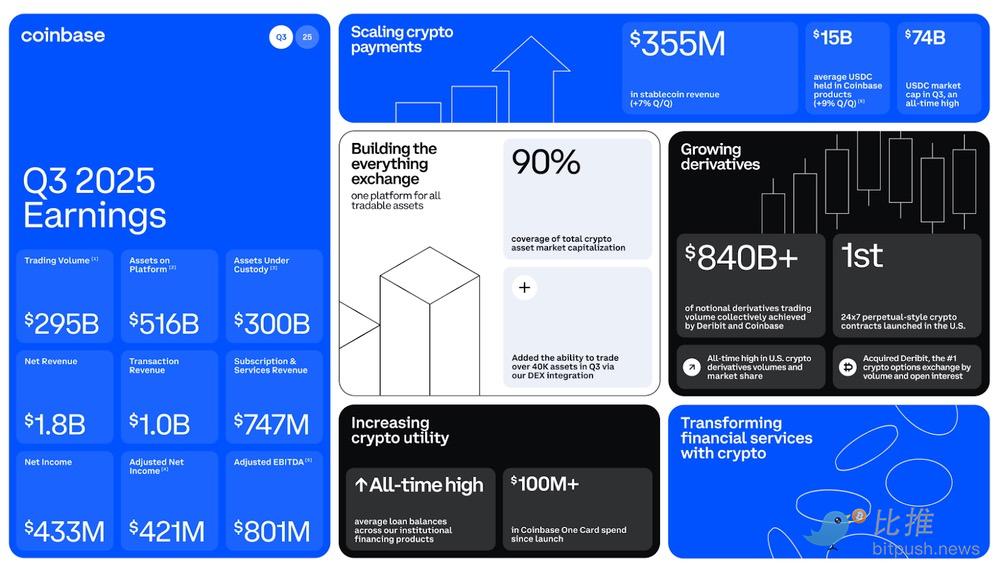
Robinhood's grand vision is to be the go-to place for handling all matters of personal financial life, while Coinbase is playing two games at once: building the best crypto super app for its own users, while simultaneously becoming the backend that powers the crypto products for everyone else.

Diverging Crypto Strategies

Both companies see cryptocurrency as core to their super app ambitions, but their approaches reflect their origins.

Robinhood treats cryptocurrency as just another asset class alongside stocks and options. It is a revenue driver that fits perfectly into the existing product suite. The acquisition of Bitstamp ($200 million) provided it with global licenses and institutional infrastructure. Tokenized equities—currently around 800 listed in the EU, including private companies like OpenAI and SpaceX—expand the product offering. The real test will be the success of the Robinhood Chain, which should make many of these tokenized equities more fungible (e.g., for loans), although we currently have few details on the extent of "DeFi" or other on-chain activities the chain will support.

Beyond that, Robinhood faces more immediate limitations, such as token selection. In the US, users have access to fewer than 50 tokens on the platform, while Coinbase offers nearly unlimited tokens indirectly (via Jupiter and Base) and directly supports over 200.

Coinbase's cryptocurrency approach is clearly different, offering everything from its own Layer 2 network to the various products mentioned in the previous section. It has set the standard for "crypto-specific" products to the point that it now seems to be pivoting to focus on building the rails for others to use. We see x402, aimed at becoming the industry standard for agent-to-agent (A2A) payments, and Coinbase's announcement that it will offer a "Stablecoin-as-a-Service" platform for companies to create whitelabel stablecoins, with Coinbase managing all the complexity. From issuance to trading to custody, Coinbase occupies every stage of the asset lifecycle.

2026 Outlook

The roadmaps for both companies are very aggressive—and increasingly overlapping.

Coinbase's December 2025 system update, with stock and ETF trading beyond traditional market hours (thanks to tokenization) and the announcement of stock perps launching next year, strongly encroached on Robinhood's territory. Native Kalshi integration brought prediction markets. Then there's Coinbase Business and Coinbase Tokenize, the former an all-in-one crypto-powered business operations platform, and the latter an "end-to-end" platform for institutional tokenization.

Robinhood's 2026 plans delve deeper into crypto infrastructure. Tokenized stocks will achieve 24/7 trading via Bitstamp in early 2026 and become withdrawable and composable in DeFi by late 2026. In prediction markets, Robinhood is moving from a distribution partner to launching its own market. The platform hopes to offer crypto staking, pending regulatory approval. It also has ambitions to "socialize" trading with Robinhood Social, an upcoming feed where traders can post content and display their actual trades and P&L. And of course, there's the Robinhood Chain.

The challenge for the Robinhood Chain will be building a developer ecosystem—an area where Base has already built momentum. Crypto-native culture is hard to manufacture artificially.

Conclusion

Perhaps a better framework here is "COIN and HOOD," rather than "COIN vs. HOOD." These two companies occupy different lanes, touching but not fully overlapping.

Robinhood is both a "super app" bet and a demographic wealth transfer bet. With 75% of its users under 44 and a full-stack digital bank keeping assets on the platform, the company is poised to become a new hub for deposits, spending, investing, and speculation.

Coinbase is a bet on a technological transition. It bets that the global economy is moving on-chain, and Coinbase will be the infrastructure layer that powers everyone else—from ETF custody to stablecoin backends to crypto-as-a-service for traditional banks.

Both face risks. Robinhood's generous Gold incentives (3% match, 3% cash back, 3.25% cash interest) are costly and have already shown vulnerability to rate cuts—the rate was recently 4-5% and is directly tied to the Fed rate. Adoption of tokenization depends on issuer decisions, which are beyond Robinhood's control. For Coinbase, user growth remains a significant risk, with its monthly active user count stagnating since 2021.

Moreover, both stocks may already be at high levels. Over the past few years, these two stocks have been major market winners—as of this writing, Coinbase (COIN) is up about 7x from its 2022 lows, and Robinhood (HOOD) is up 15x. Although they have pulled back from recent all-time highs, their valuations remain elevated after such staggering gains. This is worth investors pondering.

Ultimately, while both companies are building financial super apps—and encroaching on each other's turf in the process—their visions actually serve different goals.

  • Robinhood is committed to building an all-in-one financial platform—allowing users to manage all aspects of their financial life, from banking and daily spending to trading and investing, all in one place without leaving the platform.
    Coinbase focuses on building the infrastructure to get everyone on-chain—it does build a crypto super app for its own users, but more importantly, it is becoming the backend rails that financial institutions, fintech companies, and even traditional banks rely on when entering the crypto space.

One aims to be your financial home, the other aims to be the plumbing underneath everyone's financial home. Both could succeed.


Twitter:https://twitter.com/BitpushNewsCN

Bitpush TG Discussion:https://t.me/BitPushCommunity

Bitpush TG Subscription: https://t.me/bitpush

Original link:https://www.bitpush.news/articles/7599259

Tiền kỹ thuật số thịnh hành

Câu hỏi Liên quan

QWhat are the key differences between Robinhood and Coinbase's approaches to building a financial super app?

ARobinhood is building a traditional financial super app by layering products like banking, stocks, options, and crypto into a single platform for daily financial management. Coinbase is building a crypto-native super app with a dual focus: creating a front-end app for users and providing backend infrastructure (like custody and 'crypto as a service') for other institutions entering the crypto space.

QWhat major product update did Coinbase announce on December 17th, and how does it compete with Robinhood?

ACoinbase announced 24/5 commission-free stock and ETF trading, native prediction market integration via Kalshi, and a DEX aggregator for instant access to millions of tokens. This update directly competes with Robinhood by expanding into traditional equity trading and broadening its product suite to become a more comprehensive 'everything app'.

QWhat is Robinhood's primary revenue driver and how has its business diversified?

AOptions trading remains Robinhood's 'cash cow.' Its business has diversified with crypto contributing 21% of total revenue, net interest income making up 35%, and its prediction market business (via Kalshi) generating an annualized $100 million in revenue.

QWhat is Coinbase's larger, second-layer ambition beyond its consumer super app?

ACoinbase's larger ambition is to become the backend infrastructure provider for the entire crypto economy. It aims to offer 'crypto as a service' to traditional financial institutions (TradFi), provide custody for major ETFs, allow institutions to issue their own stablecoins, and power on-chain finance through its various infrastructure products and acquisitions.

QWhat are the primary demographic and opportunities for Robinhood, according to the article?

A75% of Robinhood's 26.9 million funded customers are under the age of 44. This positions the company to be a major beneficiary of the anticipated $10+ trillion wealth transfer over the next decade, as younger generations are likely to consolidate inherited assets onto the modern, mobile-first platform they already use daily.

Nội dung Liên quan

Kinh doanh không gian khối đã chết: Các blockchain công khai phải tìm ra hướng đi mới

Tác giả: Castle Labs Biên dịch: Deep Tide TechFlow Trong hai năm qua, chỉ có một blockchain công khai (Hyperliquid) nằm trong số 14 công ty tiền mã hóa có doanh thu hàng năm trên 200 triệu USD. Khoảng cách là rất lớn: Doanh thu 30 ngày của Arbitrum chỉ là 430 nghìn USD, trong khi Hyperliquid đạt khoảng 58 triệu USD (gấp hơn 100 lần). Điều này cho thấy mô hình kinh doanh dựa trên việc "bán không gian khối" đã lỗi thời. Các blockchain cần tìm hướng đi mới: hoặc chuyển đổi thành studio sản phẩm, nhà phân phối ứng dụng, hoặc tập trung vào các ngành dọc cụ thể như một nhà cung cấp SaaS. Thời đại của cơ sở hạ tầng trung lập đang kết thúc. Bài viết cũng thảo luận về vụ tấn công vào kho bạc LP của Ostium, gây thiệt hại hơn 40% TVL, nguyên nhân do kẻ tấn công đưa giá ảo vào hệ thống định giá ngoài chuỗi. Sự cố này nhấn mạnh rủi ro và nhu cầu về các biện pháp kiểm soát chặt chẽ hơn đối với các giao thức tích hợp thị trường truyền thống vào chuỗi. Một chủ đề khác là tương lai của quyền chọn trên chuỗi. Các chuyên gia cho rằng để đạt được sự chấp nhận rộng rãi, quyền chọn cần được "trừu tượng hóa" – không được bán dưới dạng sản phẩm phức tạp với các thuật ngữ Hy Lạp, mà nên đóng gói lợi nhuận thành các sản phẩm dễ hiểu hơn như kho bạc tạo thu nhập, quyền chọn nhị phân ngắn hạn, sản phẩm có cấu trúc hoặc thị trường dự đoán. Lợi ích của quyền chọn mới là sản phẩm thực sự. Cuối cùng, bài viết điểm qua một số dự án đáng chú ý như Flex của Yearn (thị trường vay với lãi suất cố định), những thay đổi trong chiến lược của Base, Plether (hợp đồng vĩnh viễn chỉ số USD trên chuỗi) và trọng tâm an ninh của Starknet về quyền riêng tư và khả năng chống lại các mối đe dọa lượng tử.

marsbit15 phút trước

Kinh doanh không gian khối đã chết: Các blockchain công khai phải tìm ra hướng đi mới

marsbit15 phút trước

Ghi chú podcast | Trò chuyện với Giám đốc quản lý tài sản của GSR: Đợt tăng giá tiền mã hóa này là thật hay giả, hãy theo dõi lãi suất cho vay trên Aave là biết ngay

**Tóm tắt podcast với Andy Baehr (GSR): Cách phân biệt đợt tăng giá thật hay giả trong crypto** Andy Baehr, Giám đốc điều hành Quản lý tài sản tại GSR, chia sẻ quan điểm về thị trường crypto hiện tại thông qua khung lý thuyết "dao động" (ambivalence) và "niềm tin vững chắc" (conviction). Ông cho rằng thị trường đang mắc kẹt ở trạng thái dao động, với các đợt phục hồi giống như tên lửa một tầng, thiếu sức bền. Ông đề xuất ba tín hiệu cần theo dõi: 1. **Lãi suất cho vay trên DeFi, đặc biệt trên Aave:** Lãi suất cho vay USDC hiện chỉ khoảng 3.75%, gần bằng lợi suất trái phiếu kho bạc Mỹ, phản ánh nhu cầu đòn bẩy thấp và thiếu năng lượng thị trường thực sự. Một đợt tăng giá bền vững cần lãi suất này tăng vọt do nhu cầu vay tăng cao. 2. **Sự đồng thuận về "đỉnh diều hâu" của Cục Dự trữ Liên bang Mỹ (Fed):** Thị trường cần xác định rõ điểm kết thúc của chu kỳ thắt chặt chính sách tiền tệ ("Ngày chí của Fed") để có thể tin tưởng vào một xu hướng tăng bền vững. 3. **Khả năng thông qua Đạo luật CLARITY:** Dự luật này, hiện có xác suất thông qua dưới 40% trên Polymarket, có thể trở thành một yếu tố bất ngờ thúc đẩy thị trường nếu được thông qua. Baehr cũng chỉ ra các yếu tố cản trở đà tăng: dòng tiền ETF không ổn định, các công ty kho bạc (DAT) như Strategy chưa mua vào, và sự thu hút vốn sang các cơ hội khác như IPO SpaceX hay cổ phiếu AI. Tóm lại, theo Baehr, để xác nhận một đợt tăng giá thực sự, nhà đầu tư nên theo dõi chặt chẽ lãi suất cho vay trên Aave như một thước đo trực tiếp về nhu cầu đòn bẩy và sức khỏe tổng thể của thị trường crypto.

marsbit25 phút trước

Ghi chú podcast | Trò chuyện với Giám đốc quản lý tài sản của GSR: Đợt tăng giá tiền mã hóa này là thật hay giả, hãy theo dõi lãi suất cho vay trên Aave là biết ngay

marsbit25 phút trước

Đề xuất HIP-4 của Hyperliquid tiếp sức cho HYPE staking khi niềm tin dài hạn gia tăng

Hyperliquid đã đề xuất nâng cấp HIP-4 nhằm mở rộng giao thức vượt ra ngoài thị trường hợp đồng tương lai vĩnh viễn để trở thành một lớp cơ sở hạ tầng cho các ứng dụng trên chuỗi. Theo đề xuất, các nhà triển khai phải stake 500,000 token HYPE để tạo thị trường mới, với các biện pháp kiểm soát nhằm đảm bảo chất lượng. Sự tự tin của nhà đầu tư đang tăng lên, được phản ánh qua việc lượng HYPE được stake đã đạt khoảng 438.7 triệu token, chiếm 43.9% tổng nguồn cung. Một trader lớn cũng chọn stake số HYPE trị giá 15.5 triệu USD thay vì chốt lời. Điều này cho thấy sự tin tưởng dài hạn vào mạng lưới. Cấu trúc thị trường cũng cho thấy động lực tích cực, với lãi suất tài trợ cân bằng và thanh lý hạn chế, cho thấy cách tiếp cận đầu tư có đo lường. Tổng giá trị bị khóa (TVL) và doanh thu giao thức đang tăng, củng cố triển vọng tăng trưởng cơ bản. Tóm lại, việc mở rộng cơ sở hạ tầng, sự tham gia stake mạnh mẽ và cấu trúc thị trường lành mạnh đang củng cố vị thế của Hyperliquid như một nền tảng cho tài chính kỹ thuật số trong tương lai, phụ thuộc vào việc áp dụng của người dùng và triển khai thành công các bản nâng cấp sắp tới.

ambcrypto1 giờ trước

Đề xuất HIP-4 của Hyperliquid tiếp sức cho HYPE staking khi niềm tin dài hạn gia tăng

ambcrypto1 giờ trước

7 tháng sau sự sụp đổ của Huiwang, thị trường nền tảng ký quỹ Đông Nam Á đại phẫu thuật

Sau 7 tháng sụp đổ của Huiwang, một nền tảng bảo đảm thanh toán được mệnh danh là "Alipay Đông Nam Á", thị trường bảo đảm trong khu vực đang trải qua một cuộc đại tái cấu trúc. Sự sụp đổ của tập đoàn Thái Tử ở Campuchia và việc tịch thu 12.7 vạn Bitcoin (trị giá khoảng 150 tỷ USD) của Mỹ đã chặt đứt nguồn cung thanh khoản, khiến Huiwang phá sản, 90 vạn người dùng mất trắng. Tuy nhiên, khoảng trống quyền lực nhanh chóng bị lấp đầy bởi các nền tảng bảo đảm mới nổi, thường hoạt động trong bóng tối và gắn liền với các hoạt động bất hợp pháp. Các cái tên nổi bật bao gồm: * **Tân Tệ (XinBi/Newpay):** Thu hút lượng lớn người dùng từ Huiwang, tổng doanh thu đã vượt quá 1.6 tỷ USDT. * **Lĩnh Hàng/Tiger Bảo đảm:** Chuyên cung cấp dịch vụ bảo đảm cho các giao dịch liên quan đến buôn bán người và lao động cưỡng bức. * **Kim Bối/Kim Bác:** Ban đầu liên kết với tập đoàn Thái Tử và các sòng bạc, chuyên phục vụ ngành cờ bạc trực tuyến. * **Đạt Lợi/Thiên Thành:** Kế thừa nhiều nhóm giao dịch công khai từ Huiwang, có mức tăng trưởng người dùng đáng kể. * **Phúc Lợi Lai:** Gắn liền với tập đoàn tội phạm gia đình họ Lưu ở miền Bắc Myanmar, chủ yếu phục vụ các khu công viên lừa đảo. Báo cáo từ Elliptic cho thấy thị trường bảo đảm Huiwang đã xử lý hơn 31 tỷ USD, trở thành thị trường bất hợp pháp trực tuyến lớn nhất từ trước đến nay. Các nền tảng bảo đảm này, thường được ngụy trang dưới vỏ bọc dịch vụ tài chính, trên thực tế đã trở thành trung gian quan trọng cho mạng lưới tội phạm bao gồm lừa đảo, rửa tiền, cờ bạc và buôn bán người tại Đông Nam Á. Danh hiệu "Alipay Đông Nam Á" chỉ là cái cớ, che đậy cho một hệ sinh thái tài chính ngầm đầy rủi ro và nguy hiểm.

Odaily星球日报1 giờ trước

7 tháng sau sự sụp đổ của Huiwang, thị trường nền tảng ký quỹ Đông Nam Á đại phẫu thuật

Odaily星球日报1 giờ trước

Giao dịch

Giao ngay

Bài viết Nổi bật

Làm thế nào để Mua SUPER

Chào mừng bạn đến với HTX.com! Chúng tôi đã làm cho mua SuperFarm (SUPER) trở nên đơn giản và thuận tiện. Làm theo hướng dẫn từng bước của chúng tôi để bắt đầu hành trình tiền kỹ thuật số của bạn.Bước 1: Tạo Tài khoản HTX của BạnSử dụng email hoặc số điện thoại của bạn để đăng ký tài khoản miễn phí trên HTX. Trải nghiệm hành trình đăng ký không rắc rối và mở khóa tất cả tính năng. Nhận Tài khoản của tôiBước 2: Truy cập Mua Crypto và Chọn Phương thức Thanh toán của BạnThẻ Tín dụng/Ghi nợ: Sử dụng Visa hoặc Mastercard của bạn để mua SuperFarm (SUPER) ngay lập tức.Số dư: Sử dụng tiền từ số dư tài khoản HTX của bạn để giao dịch liền mạch.Bên thứ ba: Chúng tôi đã thêm những phương thức thanh toán phổ biến như Google Pay và Apple Pay để nâng cao sự tiện lợi.P2P: Giao dịch trực tiếp với người dùng khác trên HTX.Thị trường mua bán phi tập trung (OTC): Chúng tôi cung cấp những dịch vụ được thiết kế riêng và tỷ giá hối đoái cạnh tranh cho nhà giao dịch.Bước 3: Lưu trữ SuperFarm (SUPER) của BạnSau khi mua SuperFarm (SUPER), lưu trữ trong tài khoản HTX của bạn. Ngoài ra, bạn có thể gửi đi nơi khác qua chuyển khoản blockchain hoặc sử dụng để giao dịch những tiền kỹ thuật số khác.Bước 4: Giao dịch SuperFarm (SUPER)Giao dịch SuperFarm (SUPER) dễ dàng trên thị trường giao ngay của HTX. Chỉ cần truy cập vào tài khoản của bạn, chọn cặp giao dịch, thực hiện giao dịch và theo dõi trong thời gian thực. Chúng tôi cung cấp trải nghiệm thân thiện với người dùng cho cả người mới bắt đầu và người giao dịch dày dạn kinh nghiệm.

Tổng lượt xem 364Xuất bản vào 2024.12.11Cập nhật vào 2026.06.02

Làm thế nào để Mua SUPER

Thảo luận

Chào mừng đến với Cộng đồng HTX. Tại đây, bạn có thể được thông báo về những phát triển nền tảng mới nhất và có quyền truy cập vào thông tin chuyên sâu về thị trường. Ý kiến ​​của người dùng về giá của SUPER (SUPER) được trình bày dưới đây.

活动图片













