Ripple President Long Unveils Her 2026 Crypto Predictions

bitcoinistXuất bản vào 2026-01-21Cập nhật gần nhất vào 2026-01-21

Tóm tắt

Ripple President Monica Long predicts that by 2026, institutional crypto adoption will shift decisively from pilots to production stage, driven by four key trends: stablecoins, tokenization, custody consolidation, and AI automation. She expects stablecoins like Ripple USD (RLUSD) to become the foundational global settlement layer, especially in B2B payments, citing growing regulatory support and significant idle corporate capital. Tokenization will drive institutional adoption, with over $1 trillion in digital assets on balance sheets and half of Fortune 500 companies formalizing digital asset strategies. Custody services will consolidate as the sector matures, with major banks expanding custody relationships. Finally, AI and blockchain will converge to automate treasury and risk management through smart contracts and privacy-preserving tech like zero-knowledge proofs.

Ripple President Monica Long says 2026 will be the year institutional crypto usage shifts decisively from pilots to production, as regulated infrastructure and clearer rules pull banks, corporates, and market intermediaries deeper onchain. In a January 20 blog post, Long frames the next leg of adoption around four forces: stablecoins, tokenized assets, custody consolidation, and automation powered by AI.

#1 Stablecoins (Ripple USD) As The Settlement Layer

Long’s central prediction is that stablecoins will stop being treated as an “alternative rail” and become foundational to global settlement. “Within the next five years, stablecoins will become fully integrated into global payment systems—not as an alternative rail, but as the foundational one,” she wrote. “We’re seeing this shift not in theory, but in practice, as heavyweights like Visa and Stripe hard-wire these rails into incumbent flows.”

She ties that trajectory to US policy momentum, arguing the GENIUS Act “inaugurated the digital dollar era,” and positioning “highly compliant, US issued stablecoins, including Ripple USD (RLUSD)” as a standard for programmable, 24/7 payments and collateral use in markets. Long also points to “conditional approval from the OCC to charter the Ripple National Trust Bank” as part of Ripple’s compliance strategy.

The near-term demand driver, in her telling, is B2B, not retail. Long cites research claiming B2B payments became the largest real-world stablecoin use case last year, reaching an annualized $76 billion run-rate—up sharply from early 2023 levels. She argues stablecoins can unlock liquidity and reduce working-capital drag, citing “over $700 billion” of idle cash on S&P 1500 balance sheets and “more than €1.3 trillion across Europe.”

#2 Institutional Exposure And Tokenization

Long argues crypto is increasingly used as financial infrastructure rather than just a speculative asset. “Crypto has evolved from a speculative asset into the operating layer of modern finance,” she wrote. “By the end of 2026, balance sheets will hold over $1 trillion in digital assets, and roughly half of Fortune 500 companies will have formalized digital asset strategies.”

She points to a 2025 Coinbase survey she says found 60% of Fortune 500 companies are working on blockchain initiatives, and notes “more than 200 public companies” holding bitcoin in treasury. She also highlights the rise of “digital asset treasury” firms, claiming they grew from four in 2020 to more than 200 today, with nearly 100 formed in 2025 alone.

On market structure, Long forecasts “collateral mobility” as a key institutional use case, with custodians and clearing houses using tokenization to modernize settlement. Her stated expectation is that “5–10% of capital markets settlement” moves onchain in 2026, supported by regulatory momentum and stablecoin adoption by systemically important institutions.

#3 Custody Consolidation Accelerates

Long frames digital asset custody as the institutional on-ramp and predicts consolidation as custody offerings commoditize. “M&A activity in this space is a signal of maturity, not just momentum,” she wrote, citing $8.6 billion in crypto M&A in 2025. She argues regulation will push banks toward multi-custodian setups and predicts “more than half of the world’s top 50 banks” will add at least one new custody relationship in 2026.

She also points to convergence between crypto and traditional finance through deals such as Kraken’s purchase of NinjaTrader and Ripple’s acquisitions of GTreasury and Hidden Road, positioning them as steps toward safer, more integrated institutional workflows.

#4 Blockchain And AI Converge

Long’s final theme is automation: smart contracts paired with AI models running treasury and asset-management processes continuously. “Stablecoins and smart contracts will enable treasuries to manage liquidity, execute margin calls and optimize yield across onchain repo agreements, all in real-time without manual intervention,” she wrote.

She argues privacy tech is critical for regulated deployment, pointing to zero-knowledge proofs as a way for AI to assess risk or creditworthiness without exposing sensitive data.

Long’s overarching claim is that 2026 marks a transition from experimentation to infrastructure: stablecoins as settlement and collateral, tokenization in core market plumbing, custody as a trust anchor, and AI-driven automation as the efficiency layer.

At press time, XRP traded at $1.905.
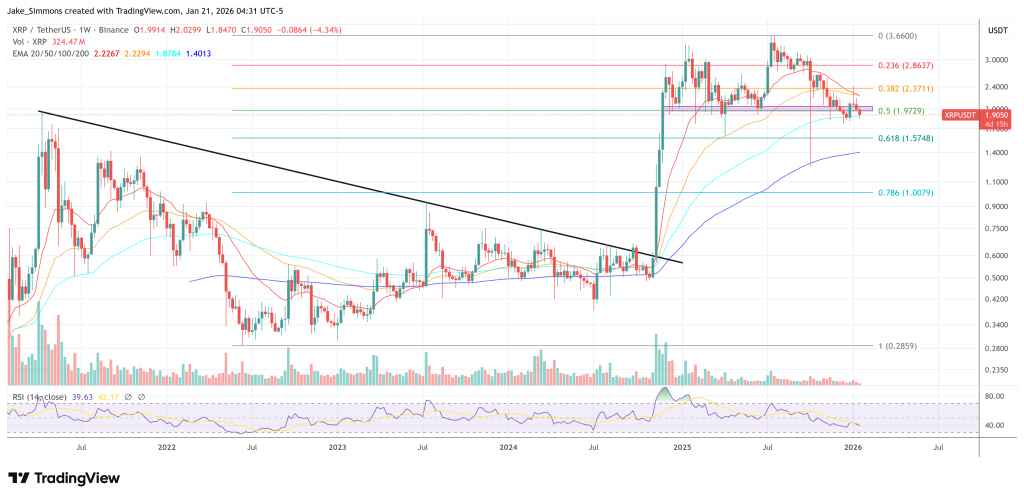
XRP bulls must defend the 100-week EMA, 1-week chart | Source: XRPUSDT on TradingView.com

Câu hỏi Liên quan

QWhat are the four key forces that Ripple President Monica Long predicts will drive institutional crypto adoption by 2026?

AThe four key forces are stablecoins, tokenized assets, custody consolidation, and automation powered by AI.

QAccording to Long, what role will stablecoins like Ripple USD (RLUSD) play in the global financial system by 2026?

AStablecoins will become the foundational layer for global settlement, fully integrated into payment systems for programmable, 24/7 payments and collateral use, moving beyond being an 'alternative rail'.

QWhat percentage of Fortune 500 companies does Long predict will have formalized digital asset strategies by the end of 2026?

AShe predicts roughly half (about 50%) of Fortune 500 companies will have formalized digital asset strategies by the end of 2026.

QHow does Long characterize the role of digital asset custody in the institutional adoption of crypto?

AShe frames digital asset custody as the institutional on-ramp and predicts consolidation in the space as custody offerings become commoditized, with more than half of the world's top 50 banks adding new custody relationships.

QWhat convergence does Long highlight as a key driver for automation in treasury and asset management processes?

AShe highlights the convergence of blockchain and AI, where smart contracts paired with AI models will enable real-time, automated treasury management, liquidity management, and risk assessment without manual intervention.

Nội dung Liên quan

CẬP NHẬT – Michael Saylor Cố Gắng Giảm Nhiệt Cho Cuộc Xung Đột Nội Bộ Trong Bitcoin — Nhưng Ông ấy Có Thành Công?

Michael Saylor, chủ tịch điều hành của MicroStrategy, đã công bố một bài viết phân chia cộng đồng Bitcoin thành bốn nhóm chính: Người theo chủ nghĩa tối đa (Bitcoin Maximalists), Nhà tư bản Bitcoin (Bitcoin Capitalists), Nhà công nghệ Bitcoin (Bitcoin Technologists) và Người theo chủ nghĩa cơ bản (Bitcoin Fundamentalists). Ông cho rằng sự khác biệt này phản ánh sự trưởng thành và phát triển của Bitcoin chứ không phải là dấu hiệu sụp đổ. Mỗi nhóm có quan điểm riêng về cách Bitcoin nên phát triển, từ việc giữ nguyên tính chất "tiền tệ mạnh" chống lạm phát cho đến việc tích hợp sâu vào hệ thống tài chính truyền thống, hay tập trung cải tiến công nghệ và bảo vệ các nguyên tắc phi tập trung ban đầu. Saylor lập luận rằng Bitcoin có thể giữ vững lớp nền tảng (base layer) trong khi vẫn cho phép thị trường và các sản phẩm tài chính phát triển xung quanh nó. Bài viết của ông xuất hiện trong bối cảnh MicroStrategy vừa thực hiện lần bán Bitcoin đầu tiên kể từ năm 2022, gây chú ý trên thị trường. Câu hỏi đặt ra là liệu Saylor có thể xoa dịu những tranh cãi nội bộ này hay không, khi mà tiền bạc, chính trị và nguyên tắc đều đang va chạm trong hệ sinh thái Bitcoin.

bitcoinist3 giờ trước

CẬP NHẬT – Michael Saylor Cố Gắng Giảm Nhiệt Cho Cuộc Xung Đột Nội Bộ Trong Bitcoin — Nhưng Ông ấy Có Thành Công?

bitcoinist3 giờ trước

Hoskinson Phủ Nhận Tin Đồn Rời Cardano: ‘Tôi Không Bỏ Đi’

Người sáng lập Cardano Charles Hoskinson đã bác bỏ tin đồn rời khỏi hệ sinh thái, khẳng định trong một buổi phát trực tiếp ngày 4/6 rằng ông chỉ tạm lùi lại khỏi các kênh giao tiếp công chúng chứ không từ chức. Động thái này được đưa ra sau một bài đăng "tạm nghỉ ngơi" trên X của ông khiến cộng đồng lo lắng. Trong buổi phát trực tiếp, Hoskinson tập trung chỉ trích môi trường mạng xã hội độc hại, đặc biệt là trên X, nơi ông cho biết khoảng 30% phản hồi cho các tweet của mình là thù địch, lạm dụng hoặc chứa nội tục tĩu, khiến việc tương tác ý nghĩa trở nên bất khả thi. Ông nói rằng chi phí tâm lý để duy trì hoạt động ở đó là quá cao. Hoskinson cũng nêu bật sự khác biệt giữa tiến bộ công nghệ của Cardano và hiệu suất giá của ADA, gọi đây là "câu chuyện về hai Cardano". Trong khi giao thức, nghiên cứu và tính phi tập trung đã tiến bộ vượt bậc kể từ năm 2021, thì giá ADA lại sa sút khiến nhiều người chỉ trích. Ông kêu gọi cộng đồng cần giải quyết sự "mâu thuẫn nhận thức" này bằng cách rời bỏ X như là địa điểm thảo luận chính, suy nghĩ lại về động lực cho các nhà phát triển và xây dựng một lộ trình mới. Hoskinson chỉ trích cấu trúc quản trị của Quỹ Cardano, gọi đó là "sai lầm tồi tệ nhất" trong sự nghiệp của mình. Kết thúc, Hoskinson tuyên bố sẽ tạm nghỉ khỏi các video công khai, phỏng vấn và mạng xã hội để tập trung làm việc cho Midnight, đồng thời suy ngẫm và đưa ra các đề xuất cho tương lai của Cardano sau đó.

bitcoinist4 giờ trước

Hoskinson Phủ Nhận Tin Đồn Rời Cardano: ‘Tôi Không Bỏ Đi’

bitcoinist4 giờ trước

Giao dịch

Giao ngay
Hợp đồng Tương lai
活动图片





