Ripple President Long Unveils Her 2026 Crypto Predictions

bitcoinistXuất bản vào 2026-01-21Cập nhật gần nhất vào 2026-01-21

Tóm tắt

Ripple President Monica Long predicts that by 2026, institutional crypto adoption will shift decisively from pilots to production stage, driven by four key trends: stablecoins, tokenization, custody consolidation, and AI automation. She expects stablecoins like Ripple USD (RLUSD) to become the foundational global settlement layer, especially in B2B payments, citing growing regulatory support and significant idle corporate capital. Tokenization will drive institutional adoption, with over $1 trillion in digital assets on balance sheets and half of Fortune 500 companies formalizing digital asset strategies. Custody services will consolidate as the sector matures, with major banks expanding custody relationships. Finally, AI and blockchain will converge to automate treasury and risk management through smart contracts and privacy-preserving tech like zero-knowledge proofs.

Ripple President Monica Long says 2026 will be the year institutional crypto usage shifts decisively from pilots to production, as regulated infrastructure and clearer rules pull banks, corporates, and market intermediaries deeper onchain. In a January 20 blog post, Long frames the next leg of adoption around four forces: stablecoins, tokenized assets, custody consolidation, and automation powered by AI.

#1 Stablecoins (Ripple USD) As The Settlement Layer

Long’s central prediction is that stablecoins will stop being treated as an “alternative rail” and become foundational to global settlement. “Within the next five years, stablecoins will become fully integrated into global payment systems—not as an alternative rail, but as the foundational one,” she wrote. “We’re seeing this shift not in theory, but in practice, as heavyweights like Visa and Stripe hard-wire these rails into incumbent flows.”

She ties that trajectory to US policy momentum, arguing the GENIUS Act “inaugurated the digital dollar era,” and positioning “highly compliant, US issued stablecoins, including Ripple USD (RLUSD)” as a standard for programmable, 24/7 payments and collateral use in markets. Long also points to “conditional approval from the OCC to charter the Ripple National Trust Bank” as part of Ripple’s compliance strategy.

The near-term demand driver, in her telling, is B2B, not retail. Long cites research claiming B2B payments became the largest real-world stablecoin use case last year, reaching an annualized $76 billion run-rate—up sharply from early 2023 levels. She argues stablecoins can unlock liquidity and reduce working-capital drag, citing “over $700 billion” of idle cash on S&P 1500 balance sheets and “more than €1.3 trillion across Europe.”

#2 Institutional Exposure And Tokenization

Long argues crypto is increasingly used as financial infrastructure rather than just a speculative asset. “Crypto has evolved from a speculative asset into the operating layer of modern finance,” she wrote. “By the end of 2026, balance sheets will hold over $1 trillion in digital assets, and roughly half of Fortune 500 companies will have formalized digital asset strategies.”

She points to a 2025 Coinbase survey she says found 60% of Fortune 500 companies are working on blockchain initiatives, and notes “more than 200 public companies” holding bitcoin in treasury. She also highlights the rise of “digital asset treasury” firms, claiming they grew from four in 2020 to more than 200 today, with nearly 100 formed in 2025 alone.

On market structure, Long forecasts “collateral mobility” as a key institutional use case, with custodians and clearing houses using tokenization to modernize settlement. Her stated expectation is that “5–10% of capital markets settlement” moves onchain in 2026, supported by regulatory momentum and stablecoin adoption by systemically important institutions.

#3 Custody Consolidation Accelerates

Long frames digital asset custody as the institutional on-ramp and predicts consolidation as custody offerings commoditize. “M&A activity in this space is a signal of maturity, not just momentum,” she wrote, citing $8.6 billion in crypto M&A in 2025. She argues regulation will push banks toward multi-custodian setups and predicts “more than half of the world’s top 50 banks” will add at least one new custody relationship in 2026.

She also points to convergence between crypto and traditional finance through deals such as Kraken’s purchase of NinjaTrader and Ripple’s acquisitions of GTreasury and Hidden Road, positioning them as steps toward safer, more integrated institutional workflows.

#4 Blockchain And AI Converge

Long’s final theme is automation: smart contracts paired with AI models running treasury and asset-management processes continuously. “Stablecoins and smart contracts will enable treasuries to manage liquidity, execute margin calls and optimize yield across onchain repo agreements, all in real-time without manual intervention,” she wrote.

She argues privacy tech is critical for regulated deployment, pointing to zero-knowledge proofs as a way for AI to assess risk or creditworthiness without exposing sensitive data.

Long’s overarching claim is that 2026 marks a transition from experimentation to infrastructure: stablecoins as settlement and collateral, tokenization in core market plumbing, custody as a trust anchor, and AI-driven automation as the efficiency layer.

At press time, XRP traded at $1.905.
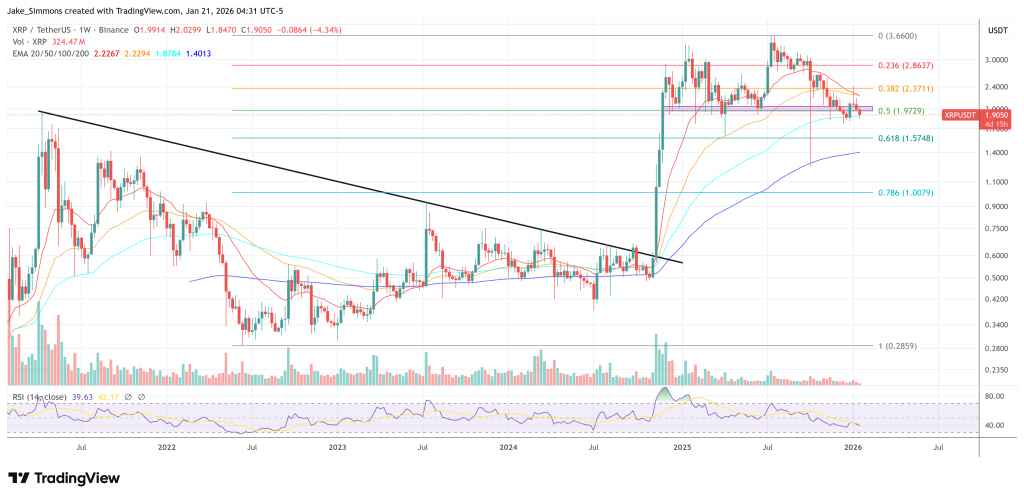
XRP bulls must defend the 100-week EMA, 1-week chart | Source: XRPUSDT on TradingView.com

Câu hỏi Liên quan

QWhat are the four key forces that Ripple President Monica Long predicts will drive institutional crypto adoption by 2026?

AThe four key forces are stablecoins, tokenized assets, custody consolidation, and automation powered by AI.

QAccording to Long, what role will stablecoins like Ripple USD (RLUSD) play in the global financial system by 2026?

AStablecoins will become the foundational layer for global settlement, fully integrated into payment systems for programmable, 24/7 payments and collateral use, moving beyond being an 'alternative rail'.

QWhat percentage of Fortune 500 companies does Long predict will have formalized digital asset strategies by the end of 2026?

AShe predicts roughly half (about 50%) of Fortune 500 companies will have formalized digital asset strategies by the end of 2026.

QHow does Long characterize the role of digital asset custody in the institutional adoption of crypto?

AShe frames digital asset custody as the institutional on-ramp and predicts consolidation in the space as custody offerings become commoditized, with more than half of the world's top 50 banks adding new custody relationships.

QWhat convergence does Long highlight as a key driver for automation in treasury and asset management processes?

AShe highlights the convergence of blockchain and AI, where smart contracts paired with AI models will enable real-time, automated treasury management, liquidity management, and risk assessment without manual intervention.

Nội dung Liên quan

Saylor: Strategy Giờ Tập Trung Vào Đường Trung Bình Động 200 Tuần Của Bitcoin

Chủ tịch điều hành của Strategy, ông Saylor, đã thông báo công ty hiện đang theo dõi đường trung bình động 200 tuần (200-week MA) của Bitcoin và mức giá vượt trên đường này trên bảng điều khiển công cụ công khai. Ông lưu ý rằng kể từ khi chỉ số này xuất hiện, Bitcoin đã giao dịch trên mức trung bình 200 tuần 92% thời gian và hiện giá đang nằm gần như chính xác trên đường này. Việc bổ sung chỉ báo này diễn ra trong bối cảnh Strategy liên tục đưa ra các số liệu mới như Net $BTC và $BTC Hurdle ARR nhằm thay đổi cách thị trường và cổ đông nhìn nhận khoản đầu tư 64 tỷ USD vào Bitcoin của họ. Đường trung bình 200 tuần từ lâu được coi là tín hiệu hỗ trợ quan trọng, thường đánh dấu sự kết thúc của thị trường giá xuống trong quá khứ. Đầu năm nay, Bitcoin đã giảm xuống dưới đường MA 200 tuần lần đầu tiên kể từ 2022, nhưng sau đó đã dần phục hồi. Hiện tại, Bitcoin đang giao dịch quanh mức 62.500 USD. Trong cuộc họp báo quý II, ông Saylor mô tả việc kiểm tra lại mức này là cơ hội mua vào hơn là một tín hiệu cảnh báo. Strategy hiện sở hữu 843.775 BTC với giá mua trung bình là 75.476 USD, nghĩa là vị thế này hiện đang lỗ so với giá thị trường. Báo cáo quý II cũng cho thấy công ty chuyển từ lãi 14 tỷ USD sang lỗ 8,2 tỷ USD, một phần do đã bán Bitcoin lần đầu tiên kể từ năm 2022 để tài trợ cho việc trả cổ tức. Tuy nhiên, ông Saylor nhấn mạnh rằng đây không phải là sự thay đổi trong chiến lược dài hạn và công ty vẫn tiếp tục là người mua. Gần đây, ông Saylor tiếp tục đưa ra các tín hiệu mua, đồng thời bác bỏ tin đồn về việc công ty đang lên kế hoạch bán lượng Bitcoin trị giá 5 tỷ USD. Mặc dù thừa nhận các yếu tố như dòng tiền thể chế chậm lại và bất ổn vĩ mô có thể hạn chế đà tăng giá, ông vẫn lạc quan về xu hướng dài hạn, cho rằng việc kiểm tra đường trung bình 200 tuần là cơ hội tốt cho người mua.

cryptonews.ru3 phút trước

Saylor: Strategy Giờ Tập Trung Vào Đường Trung Bình Động 200 Tuần Của Bitcoin

cryptonews.ru3 phút trước

SEC xem xét phê duyệt các quyền chọn Bitcoin trên Nasdaq sau khi CME khiếu nại

Ủy ban Chứng khoán và Giao dịch Hoa Kỳ (SEC) đã tạm ngừng phê duyệt đối với các hợp đồng quyền chọn chỉ số Bitcoin thanh toán bằng tiền (ticker QBTC) của Nasdaq, và sẽ xem xét lại quyết định này sau khi CME Group đệ đơn kiện. Vào tháng 5, SEC đã cấp phép có điều kiện cho Nasdaq niêm yết QBTC, nhưng sản phẩm vẫn cần được miễn trừ khỏi các quy định của Ủy ban Giao dịch Hàng hóa Tương lai (CFTC). CME Group, công ty điều hành thị trường tương lai và quyền chọn Bitcoin được quản lý, đã khiếu nại vào tháng 6. Họ lập luận rằng Bitcoin là một hàng hóa, do đó các sản phẩm phái sinh dựa trực tiếp vào giá trị của nó thuộc thẩm quyền độc quyền của CFTC, không phải SEC. Nếu CME đúng, SEC sẽ không có thẩm quyền phê duyệt QBTC. Lệnh của SEC hiện tạm hoãn việc phê duyệt và cho các bên liên quan thời gian đến ngày 24/8 để nộp ý kiến ủng hộ hoặc phản đối. Việc tạm hoãn có hiệu lực từ ngày 11/6. QBTC sẽ tiếp tục bị đình chỉ cho đến khi SEC xem xét lại toàn bộ vấn đề. CME cũng cho rằng việc phê duyệt này có thể tạo tiền lệ cho phép các sàn giao dịch chứng khoán niêm yết phái sinh trên các hàng hóa khác.

cryptonews.ru6 phút trước

SEC xem xét phê duyệt các quyền chọn Bitcoin trên Nasdaq sau khi CME khiếu nại

cryptonews.ru6 phút trước

Việc cứu đồng Yên tác động đến Bitcoin như thế nào: QCP Capital phân tích chuỗi rủi ro cho thị trường tiền mã hóa

Công ty giao dịch QCP Capital đã phân tích tác động của việc Mỹ và Nhật Bản phối hợp can thiệp hỗ trợ đồng yên đối với thị trường Bitcoin và Ethereum. Báo cáo nhấn mạnh rằng lợi suất trái phiếu kho bạc Mỹ dài hạn và tình trạng của yên Nhật giờ đây là những chỉ số vĩ mô quan trọng ngang bằng với các quyết định của Cục Dự trữ Liên bang Mỹ (Fed). Đây là lần can thiệp phối hợp đầu tiên kể từ năm 1998 nhằm hỗ trợ đồng yên. QCP chỉ ra rằng vấn đề cốt lõi không nằm ở bản thân hành động can thiệp, mà ở áp lực gia tăng lên lợi suất trái phiếu kho bạc dài hạn của Mỹ, vốn đã chạm mức cao nhất kể từ năm 2007. Cùng lúc, thị trường trái phiếu đang hấp thụ lượng cầu vốn lớn từ việc vay nợ của chính phủ Mỹ và các công ty công nghệ lớn. Đối với tài sản tiền mã hóa, kênh tác động chính là thông qua các giao dịch carry trade bằng yên. Việc đồng yên mạnh lên đột ngột có thể thúc đẩy các nhà đầu tư đóng các vị thế vay mượn và mua lại đồng yên, điều này có thể lan sang các tài sản rủi ro khác, bao gồm thị trường tiền mã hóa. QCP đưa ra hai kịch bản: ngắn hạn, biến động mạnh của yên có thể làm tăng tính bất ổn; dài hạn, sự ổn định tiền tệ lớn hơn có thể giảm áp lực lên thanh khoản thị trường trái phiếu. Báo cáo kết luận rằng các hành động can thiệp này bổ sung thêm các chỉ số như cặp USD/JPY và lợi suất trái phiếu dài hạn vào danh sách các yếu tố vĩ mô quan trọng cần theo dõi đối với Bitcoin và Ethereum, phản ánh sự phức tạp ngày càng tăng của các điều kiện tài chính toàn cầu.

cryptonews.ru44 phút trước

Việc cứu đồng Yên tác động đến Bitcoin như thế nào: QCP Capital phân tích chuỗi rủi ro cho thị trường tiền mã hóa

cryptonews.ru44 phút trước

Giao dịch

Giao ngay
活动图片