Author:David Mattin
Compiled by: Deep Tide TechFlow
Deep Tide Guide: While the entire industry is panicking over the "global economic collapse triggered by AI in 2028" depicted by Citrini Research, tech thinker David Mattin has come forward with a completely different interpretation. He believes we are in the midst of a 'global intelligence transition,' where old economic indicators (such as GDP, unemployment rate) are becoming obsolete. This article delves into how, when intelligence becomes as cheap and abundant as air, while the income side may suffer, the cost side will collapse even faster, thereby ushering in a new era driven by 'intelligence output per unit energy.' This is not just a crisis, but a radical evolution towards a 'post-human economy.'
Full text as follows:
Everyone is talking about Citrini Research's paper, "The 2028 Global Intelligence Crisis." It's a great thought experiment: a speculative report from June 2028, envisioning a scenario where artificial intelligence (AI) triggers a chain-reaction economic collapse.
The following content serves as a response to that article. You can consider it a creation in the same spirit as Citrini's original: a speculative 'reverse scenario.' It is an exploration of new ways of seeing, not a claim to have all the answers (no one can). This article draws on years of research and analysis published by Raoul Pal and myself at Global Macro Investor and in our jointly operated tech-focused research service, "The Exponentialist."
Citrini Research's paper has garnered significant attention, and for good reason. It is a brilliantly conceived thought experiment: a speculative briefing from June 2028, rehearsing an AI-induced chain-reaction economic meltdown. The S&P 500 drops 38%. Unemployment reaches 10.2%. Prime mortgages crack. The private credit complex implodes through a series of correlated bets on white-collar productivity growth.
The scenario is logically coherent, the financial mechanics are meticulously researched, and its core thesis—that extreme abundance of intelligence destroys the consumer economy it was supposed to enhance—is deeply provocative. Parts of it will likely prove prescient. There is real turbulence ahead, perhaps even extreme hardship. The transition to an age of intelligence abundance will not be smooth.
For over five years, I have been immersed in this kind of thinking. I have been building frameworks to understand what happens when intelligence becomes abundant, the AI-energy flywheel begins to spin, and we transition from a human-centric economy to something radically new. In related articles I've written, I've described it as a shift to a fundamentally new kind of economic system: a form of "Post-human Economics." From the perspective of this work, I want to offer a considered response to Citrini's argument—one based on my years of analysis—that leads to a starkly different conclusion.
Citrini's argument is that abundant intelligence destroys the income side of the economy—wages, jobs, consumer spending—triggering a financial crisis. My argument is that abundant intelligence is also destroying the cost side of the economy, and likely faster. When the price of goods and services collapses along with wages, you don't have a crisis. You are in a transition to a radically new system; a system in which all the old norms, rules, and metrics become incoherent.
So, what is the core error in Citrini's article? Their article is using the instruments of the 'human economy' to measure the 'post-human economy.' Then, it mistakes the instrument's erratic readings for the system itself collapsing.
No one has a crystal ball, no one has all the answers. We are all piecing together a seven-dimensional puzzle that no one fully understands. But I believe Citrini's article, sophisticated as it is, may be making a profound and instructive error. And my own work points directly to it.
My timeframe is also longer than Citrini's. Their scenario plays out over two years. I'm looking at a ten to twenty-year span. I concede there may be serious turbulence ahead: a 'Fourth Turning'-style moment of chaos, social unrest, and institutional collapse. Some version of what they describe may indeed come to pass. But my argument is that AI and the broader forces of the 'Exponential Age' can ultimately take us into a new kind of economy. One that actually works. One that is, in many ways, better than anything we've known.
The Wrong Metrics
This is the core argument I want to make; if I'm right, it reframes everything.
Every single data point used in Citrini's article to build its case—the 10.2% unemployment, the 38% drop in the S&P 500, the spike in San Francisco mortgage delinquencies, the stalled velocity of money—is all denominated in the old system. Every metric is native to the economy we have been living in. The one built around human labor input, conditions of material scarcity, and GDP as the scorecard.
The authors of the article look at these readings and see disaster, understandably. But what if these metrics are not recording the death of the economy? What if they are recording the death of an 'economic measurement framework' that can no longer describe what is actually happening?
Think of it this way. At the heart of Citrini's article is a powerful concept: "Ghost GDP." Output that appears in the national accounts but never circulates in the real economy. They present it as evidence of dysfunction. But I would flip this entirely. Ghost GDP is not a bug, it's a signal. It's telling us that GDP itself is breaking down as a meaningful measure of reality. The instrument is failing, and Citrini is mistaking the failing instrument's readings for the true condition of the patient.
In my work on post-human economics, I have argued that as we transition to an economy built on automated inputs and radical abundance, GDP becomes incoherent. It cannot capture an economy where the cost of many goods and services is trending towards zero—unevenly, in different domains, but falling nonetheless. It cannot capture the massive uplift in human wellbeing when intelligence is hyper-abundant and near-free. And it certainly cannot capture the emergence of 'Autonomous Economic Activity'—AIs transacting with other AIs—which has no substantive link to the human labor market at all.
In the post-human economy, GDP is not a coherent measure of anything. So what should we watch instead?
Intelligence Output Per Unit Energy
This is my answer; an idea at the heart of my thinking about the future post-human economy.
In the coming economy, the most coherent measure of prosperity is intelligence output per unit energy. How efficiently is our civilization converting energy into useful intelligence?
This is the metric that resolves the paradox at the heart of the Citrini scenario. Because at the very moment their scenario shows GDP shrinking, the S&P plunging, and unemployment spiking, intelligence output per unit energy is going vertical.
Think about what's driving the crisis Citrini predicts. AI models are getting more powerful, compute costs are falling, and inference costs are falling through the floor. Energy systems managed by AI are becoming more efficient. Every single force—the very forces that are destroying the old economic metrics—is simultaneously sending intelligence output per unit energy into the stratosphere.
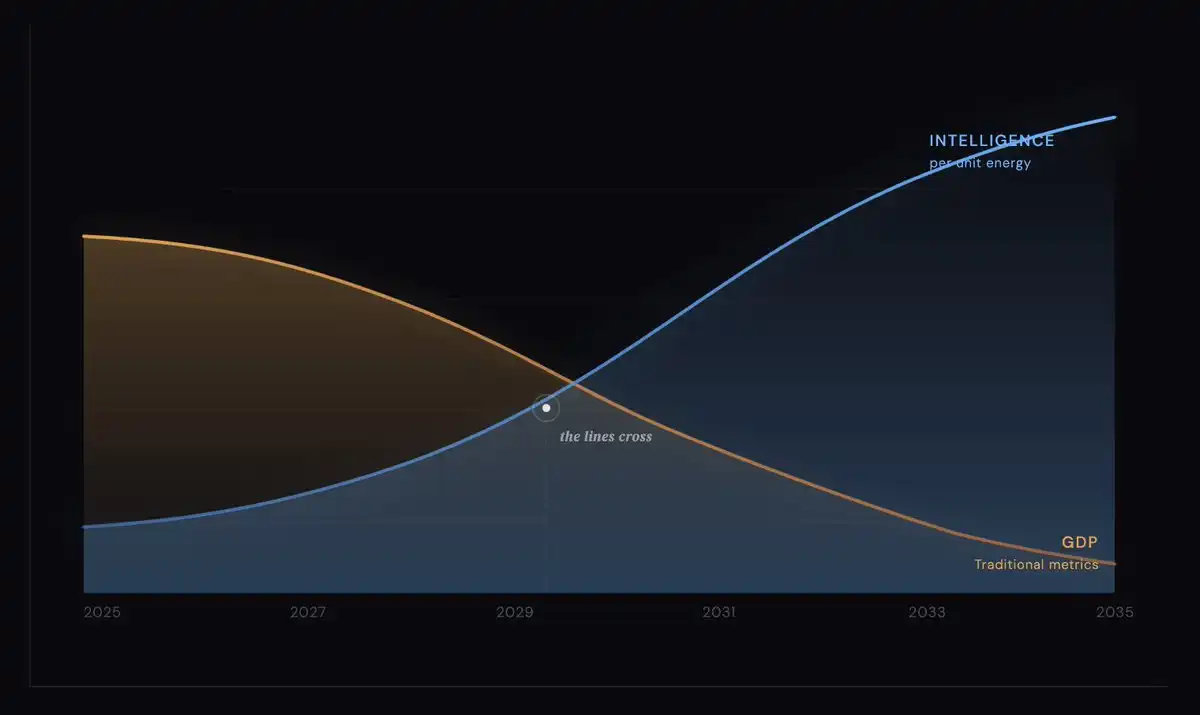
This is the key insight: there are two lines on the chart. One line—GDP, employment, consumer spending—is going down; the other line—intelligence output per unit energy—is going up exponentially. Citrini's article stares only at the line going down and concludes we are in crisis. My contention is that the line going up is the real signal, and the signal going down is just the noise of the old system dying.
In a world of hyper-abundant intelligence, everything is downstream of better, more abundant intelligence. Scientific breakthroughs, new materials, advanced medicine, cheaper energy, better infrastructure, more efficient manufacturing—all of it flows from the same source: our relentlessly increasing ability to convert energy into intelligence.
Citrini's article looks at a GPU cluster in North Dakota and says: that machine just destroyed 10,000 white-collar jobs in Manhattan. I look at the same GPU cluster and say: that machine just collapsed the cost of drug discovery, materials science, legal services, education, energy management, and software development. Both observations are true, but the article stares only at the income side of the ledger and barely glances at the expenditure side.
And that is the deeper error.
Radical Prosperity
Yes, output is decoupling from the labor market. Citrini is right about that. But the same force that is destroying wages is also destroying costs. When AI drives the price of legal services towards zero, you don't need a $180k annual salary to afford a lawyer; when AI collapses the cost of medical diagnosis, you don't need expensive health insurance to get a diagnosis. When coding agents make software near-free, the $500k annual SaaS renewal bill that Citrini frets about is not just a problem for the vendor—it's a massive saving for the buyer.
Seen through the lens of GDP, this looks like the collapse of the consumer economy; seen from another angle, it is the birth of deflationary prosperity. Wealth through abundance. Even as nominal incomes fall, real purchasing power explodes. The obtaining power of the average person surges in ways traditional metrics cannot capture.
Is a person who earns $50k, but lives in a world where AI has driven the cost of healthcare, education, legal advice, financial planning, software, entertainment, and creative services to near-zero, richer or poorer than the person earning $180k in 2024?
Citrini's paper never considers this. It tracks the fall in wages, but not the synchronous fall in the cost of living.
I can hear some readers screaming at me. I am not naive. There are important goods and services whose costs will not fall quickly, or perhaps at all, like housing, physical food, and (for a time at least) energy. This process will be wildly uneven. Some domains will see cost collapse in a few years, others may take a decade or more. This transition will be painful for many, a key social reality we must grapple with, the depth of which is beyond the scope of this article, but which I have written about elsewhere. I have written about the 'hairpin turn' ahead, and warned that a 'Fourth Turning' moment is highly likely. There will be social and political turmoil, I do not dispute that.
The Foundation Layer Flywheel: The Real Braking Mechanism
But the Citrini scenario paints this transition as a one-way spiral to ruin. They say there is no natural brake, no floor to the displacement loop.
I disagree. The brake is abundance itself.
This brings us to the engine I call the Foundation Layer Flywheel.
Back in 2023, I wrote about the deep symbiosis between AI and clean energy. AI needs vast energy, but AI is also the only technology that can manage the kind of hyper-complex, distributed energy systems we are building. More AI unlocks more energy, more energy powers more AI. Round and round.
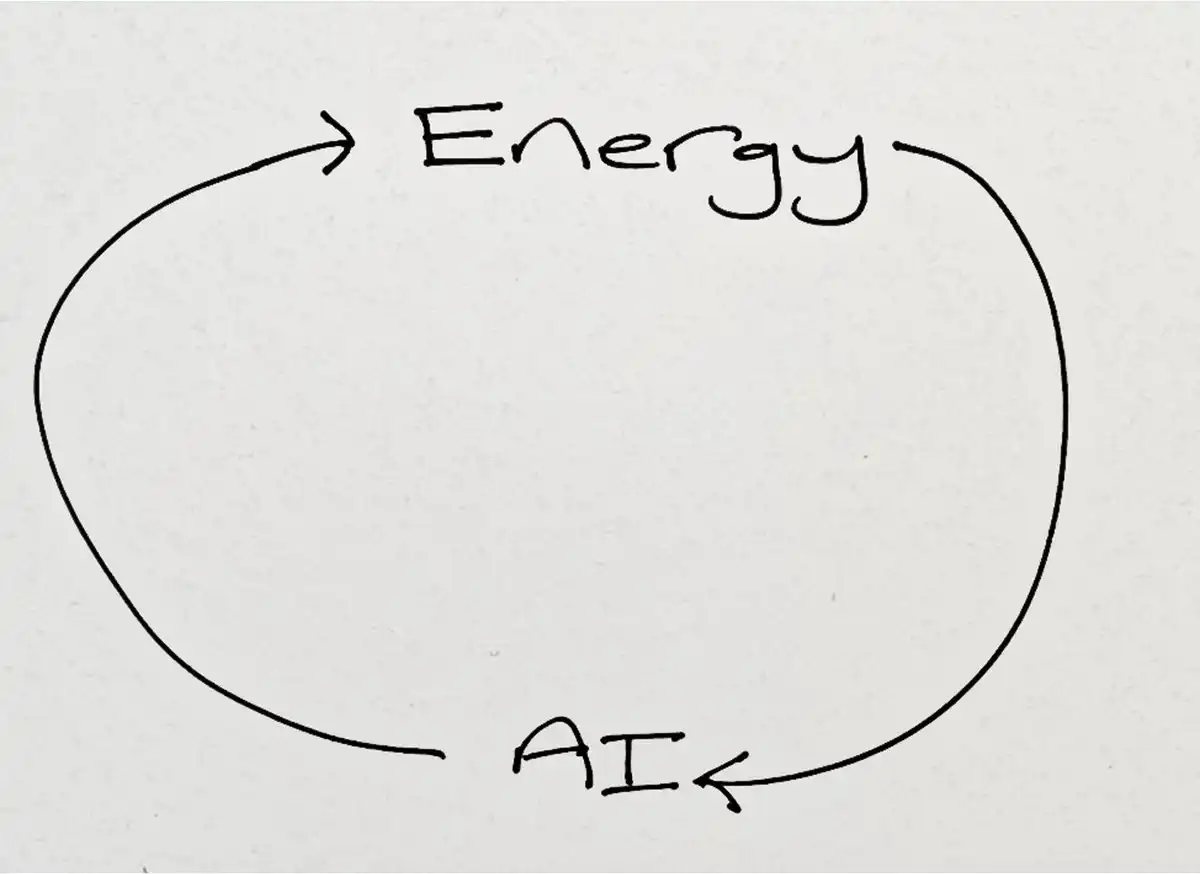
This flywheel is the foundation of the entire Exponential Age. It underpins everything that happens above it. It is also why there is a natural brake on Citrini's displacement spiral—and their model fails to account for it.
As intelligence output per unit energy rises, the flywheel spins faster. Cheaper, more abundant AI makes energy systems smarter; smarter energy systems deliver cheaper energy; cheaper energy makes AI cheaper. Cheaper AI then percolates downstream into everything: cheaper materials science, cheaper manufacturing, cheaper medicine, cheaper infrastructure.
Citrini's article imagines a negative feedback loop: AI destroys jobs -> unemployed workers consume less -> companies buy more AI -> repeat, with no natural brake.
But running in parallel is a positive feedback loop, and it is at least as powerful: AI gets smarter -> energy gets cheaper -> intelligence output per unit energy rises -> the cost of everything downstream of intelligence falls -> material conditions of life improve even as nominal GDP shrinks.
Which loop will dominate? That is the question. In my view, the positive loop has the laws of physics on its side. It is driven by the exponential improvement in the conversion of energy to intelligence—a curve that has been steepening for years and shows no sign of slowing. The negative loop, by contrast, is driven by institutional and political inertia: slow-moving mortgage markets, fiscal policy, and labor market adjustments. These are real and will cause real pain, but they are not immutable laws of nature. They are human constructs, and humans can change them.
AI and Robots Are Demographics
There is another point, entirely missed by Citrini's article, that is one of the most important macro forces of our time.
Demographics.
The developed world is running out of workers. Working-age populations are shrinking precipitously in the US, Europe, Japan, South Korea, and China. This is the demographic doom loop I often write about. Fewer babies, longer lives, population pyramids of a height that has never existed in human history.
As Raoul has long made clear, the golden rule is: GDP growth = population growth + productivity growth + debt growth. Population growth is gone. It has been gone for a while. That means the only way to keep the GDP game going is to add debt. We borrow from tomorrow to keep today's party going.
Now think about what happens when AI and humanoid robots enter this environment. Citrini's article frames the arrival of machine intelligence as an invasion of a healthy labor market. AI crashes through the gates, millions of workers are cast aside.
But that's not the reality. AI is entering a world that desperately needs it. We are running out of people. The working-age population of the global north is shrinking fast, and without AI and robotics, GDP growth was headed for structural decline anyway.
Kevin Kelly calls what's coming 'The Handover.' As the human population peaks and declines, billions of AI agents and tens of millions of humanoids come online to fill the gap. We are handing over the economy to non-human actors.
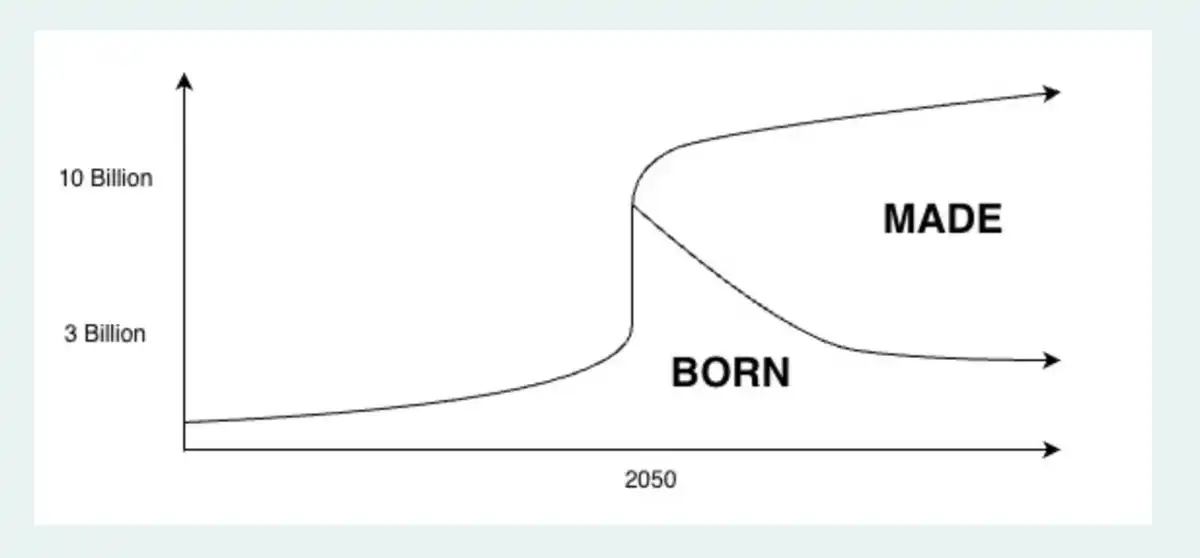
This doesn't erase the pain of individual transitions. Real people losing real jobs face real difficulty, and we need to face that squarely. But at the macro level, AI and robots are not displacing workers; they are filling a demographic hole that was about to swallow the entire economy.
The Citrini scenario imagines a world where AI destroys the job market and no one can find work. But what if the reality in 2028 looks more like this: AI and humanoids fill millions of positions left vacant by labor shortages, and humans displaced from knowledge jobs move—painfully, but supported—into the emerging economy I'm about to describe?
The Human Residue
Because this is what Citrini's article never considers. As the old economy contracts, a new economy is self-organizing from the ground up.
I've written about the rise of the sovereign industrialist. Sam Altman talks about the one-person billion-dollar company. In some domains, AI tools and agents allow a single highly productive individual to output what once required hundreds of employees. We will see millions of these new economic actors—sovereign operators and micro-teams managing vast fleets of AI agents—creating enormous value in ways the old economic framework cannot foresee.
Anthropic's research into how people use Claude reveals the contours of this future. Software development. Consulting. Financial services. Marketing. Content creation. In every field, high-capability individuals augmented by AI are becoming one-person enterprises. This is new economic activity. And much of it will happen outside the structures monitored by Citrini's work.
But a deeper shift is underway. When machine intelligence handles all the mental work—coding, legal documents, financial analysis, data processing—economic value migrates up the Maslow hierarchy to the level that only humans can provide.
I call this 'The Human Residue.' The part of value creation that requires being human. It is the attention, empathy, and recognition from another person who truly sees you. It is art and narrative from a real, lived experience. It is the counselor who guides you through a stressful move, the guide who helps you navigate a life crisis, the community builder who creates the space where you feel you belong.
When AI does all the paperwork, what is left that is scarce? Feeling. Connection. Meaning. A vast new economy will form around these irreducible human outputs. It will command enormous value. But it won't be reflected in GDP, and it won't be captured by the metrics tracked in Citrini's article.
This is the economy emerging on the other side of the singularity. Not a dead zone of mass unemployment. But an old economy being composted to nourish something new, strange, and in many ways richer.
System Transition
Let's bring this all together.
Citrini's article asks a core question: What happens when a scarce input (intelligence) becomes abundant?
This is exactly the right question. Throughout modern economic history, human intelligence has been that scarce, premium input. They argue that premium is dissipating, and that is true. In more and more tasks, machine intelligence is becoming a competent and rapidly evolving substitute for human intelligence. On this, we agree.
But Citrini concludes that the dissipation of the human intelligence premium is a 'crisis.' I believe it is the 'transition.' They are staring at the dissolving caterpillar and screaming that the creature is dying. In a sense, they are right—the caterpillar is dying. But inside the chrysalis, something else is forming.
What is forming is a Post-human Economy. An economy where intelligence is no longer scarce but abundant, like air. An economy where the cost of knowledge work and, eventually, much physical production trends towards zero—not overnight, not evenly across domains, but relentlessly. An economy where the fundamental measure of prosperity is no longer how much nominal economic output we produce, but how efficiently we convert energy into intelligence. An economy where the value we exchange with each other migrates from mental labor to something deeper: empathy, meaning, connection, creativity, and the sheer experience of being alive with other conscious beings.
We are not headed for a 'Global Intelligence Crisis,' we are headed for a 'Global Intelligence Transition.' We are moving into a wholly new kind of economic system, one we are all struggling to understand. Yes, the transition will be bumpy, perhaps even violently so. There will be chaos, pain, and political shock. A 'Fourth Turning' is likely real. Some version of what Citrini describes—job losses, SaaS industry collapse, friction going to zero—is probably coming, and faster than most think.
But on the longer timeframe I'm looking at—ten to twenty years, not a mere two—their conclusion begins to look untenable. A Great Recession-style 57% drawdown with no natural braking mechanism? That conclusion depends entirely on the assumption that those old metrics still reflect the truth of the system.
I do not believe they do. There will be real suffering, but that suffering is characteristic of the transition, not evidence that the destination is necessarily disaster.
There are two lines on the chart:
- GDP is going down.
- Intelligence output per unit energy is going up.
One of these lines is the real signal, and the other is just the noise of a dying measurement system.
If we want to understand what is happening around us now, we need to make sure we are watching both lines.







