Author: Frank, PANews
On February 18, 2026, Polymarket announced that starting from this day, the platform would begin piloting the collection of market order fees in the sports market. The first wave of events covered includes U.S. college basketball (NCAA) and Serie A (Italian football league), with plans to gradually extend to all sports events in the future.
Previously, relying solely on fees from its 15-minute cryptocurrency up/down markets, Polymarket's recent weekly revenue had already surpassed $1.08 million. According to on-chain data, the sports market accounts for nearly 40% of the platform's total trading activity. If converted to annual revenue, fees from the crypto market alone could contribute approximately $56 million in annualized income. Therefore, when the larger share of the sports market also begins charging fees, Polymarket might become the biggest money printer in the crypto space.
PANews conducted an in-depth analysis of Polymarket's fee mechanism, revenue model, competitor benchmarking, and token airdrop expectations.
From "Zero Revenue" to Millions Weekly: The $9 Billion Giant Starts Eagerly Making Money
For a long time, Polymarket operated with almost "zero revenue," as the vast majority of markets did not impose any trading fees. This free strategy brought it astonishing growth: total trading volume for the full year 2025 reached $21.5 billion, accounting for nearly half of the global prediction market volume ($44 billion); the single-month trading volume in January 2026 even hit a record high of over $12 billion.
However, with the upcoming token listing this year, the zero-revenue model clearly could not match its valuation. Its valuation had already reached $9 billion in the latest funding round. In October 2025, Intercontinental Exchange (ICE), the parent company of the New York Stock Exchange, injected a massive $2 billion into Polymarket. According to data from PM Insights, as of January 19, 2026, the implied valuation of Polymarket equity in the secondary market had climbed to $11.6 billion, a nearly 29% increase from the previous funding round. There are reports that the valuation in subsequent funding rounds could reach $12 billion to $15 billion. Such a high valuation requires matching revenue to support it.
The turning point came in January 2026; it was evident that Polymarket had become eager since the start of the year.
In January, Polymarket formally introduced a "Taker Fee" for its high-frequency trading product, the 15-minute cryptocurrency up/down markets, with a maximum rate of 3%. The data showed immediate results: in early February 2026, weekly fee revenue broke through $1.08 million, with the 15-minute up/down markets alone contributing $787,000 in a certain week in January, accounting for 28.4% of the total platform's prediction market fee revenue ($2.7 million) during the same period. To date, Polymarket has generated over $4.7 million in fees, ranking among the top in revenue charts.
The Ingenious Design Behind 0.45%: A Fee Model Not Just for Profit
The fee introduced by Polymarket for the sports market is a carefully designed dynamic fee model.
According to Polymarket's official documentation and community analysis, the sports market fee is only charged on market orders (Taker). Limit orders (Maker) are not only free but also receive a 25% rebate from the Taker fees. Similar to the crypto market fee model, the rate is not a fixed value but fluctuates with changes in event probability:
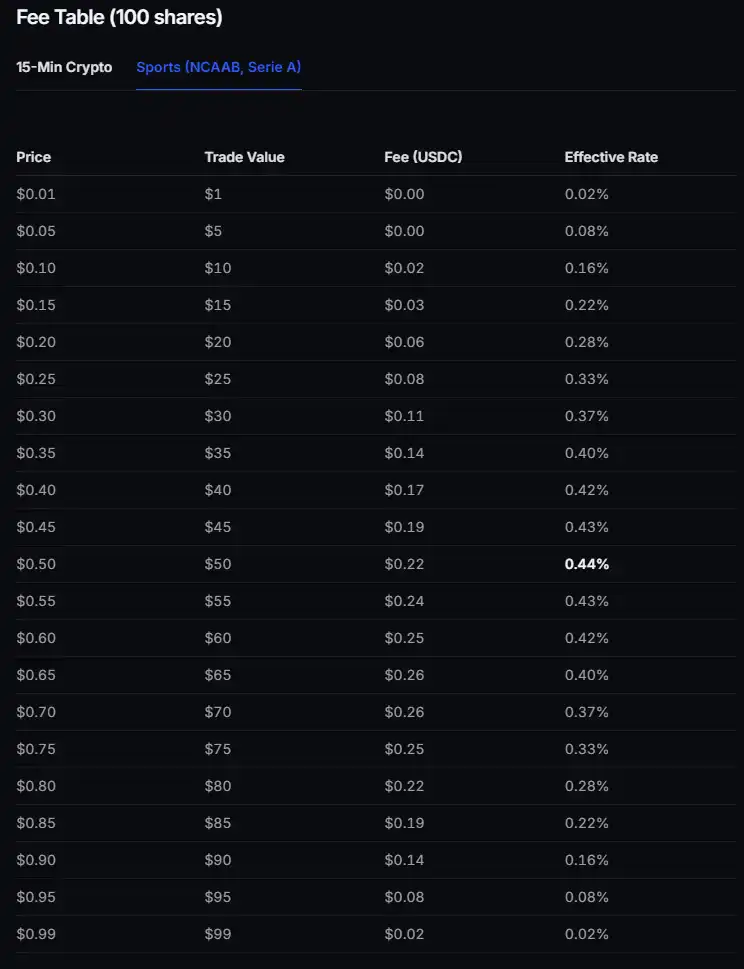
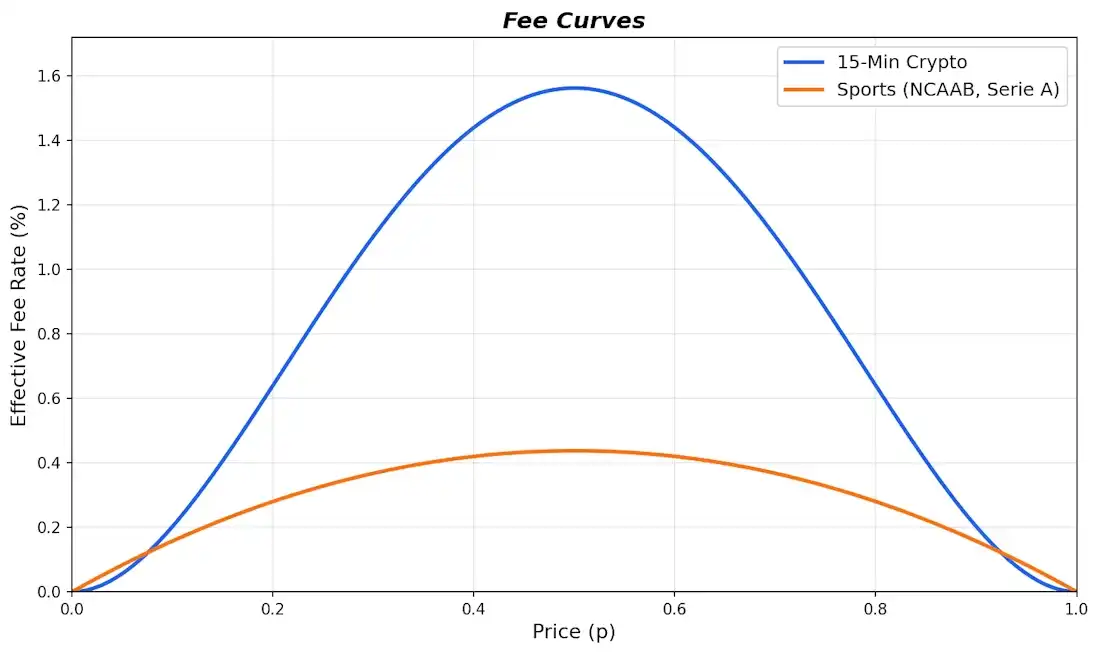
Simply put, the more uncertain the market, the higher the fee, peaking at 0.44% at a 50% probability, and dropping to only 0.13%-0.16% at probabilities of 10% or 90%.
However, by standard, the sports market fee rate is significantly lower than that of the crypto market. Nevertheless, this does not diminish the revenue potential of the sports market.
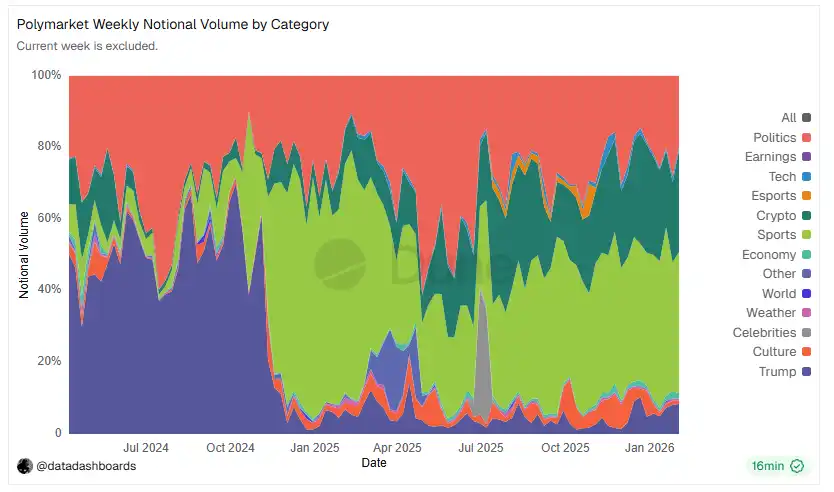
Data shows that sports markets currently account for 39% of Polymarket's total trading activity, surpassing political (20%) and crypto (28%) categories. More crucially, according to previous PANews analysis data, the average trading volume of short-term sports markets on Polymarket ($1.32 million) is 30 times that of short-term crypto markets ($44,000). This means that if fees are fully rolled out in the sports market, revenue will experience massive growth.
Taking the 2026 Super Bowl as an example, Polymarket's total trading volume in related markets reached approximately $795 million, covering various sub-markets such as game outcome, player performance, and halftime show predictions. The total weekly prediction market volume was once driven by sports events to break $6.3 billion.
Based on existing data, PANews constructed three profit forecast scenarios (assuming an average effective fee rate of 0.25% for sports markets, considering probability distribution and free limit orders):
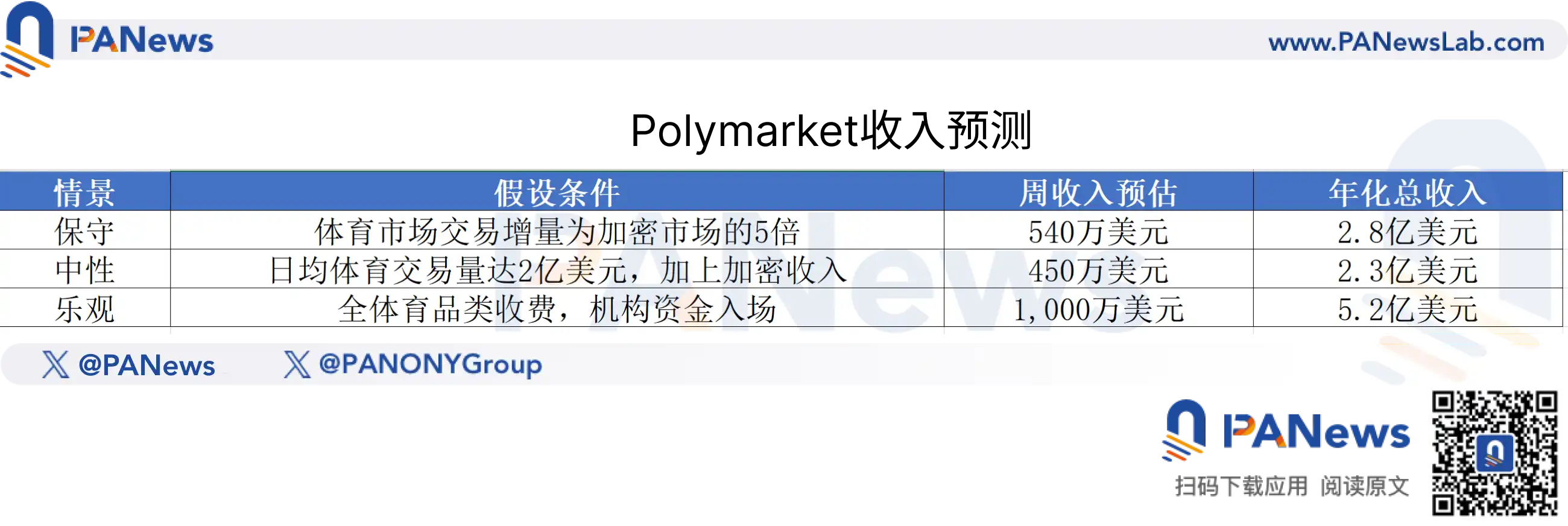
Even under the most conservative estimate, Polymarket's annualized revenue after full fee implementation would exceed $200 million, enough to place it among the highest-revenue protocols in the Web3 space.
While surpassing Tether's treasury interest income or Ethereum mainnet gas fees might be unrealistic, at the application layer, Polymarket has the full potential to compete for the title of "most profitable dApp." Especially considering its user retention rate is as high as 85%, far exceeding that of general DeFi protocols, this high stickiness implies higher quality revenue.
POLY Token and Airdrop: A "Wealth Feast" Worth Billions?
Polymarket's high valuation and massive user base make its token airdrop one of the most anticipated events of 2026.
Polymarket's Chief Marketing Officer, Matthew Modabber, has clearly stated: "There will be a token, there will be an airdrop." Market predictions indicate a 62%-70% probability that Polymarket will issue its token before December 31, 2026. Considering the progress of restarting U.S. operations, the Token Generation Event (TGE) is likely to be completed around mid-2026.
On February 4, 2026, its parent company, Blockratize Inc., applied for the trademarks "POLY" and "$POLY," which is also considered by the industry as a significant milestone for TGE. According to general practices in the crypto industry, it typically takes 3-6 months from trademark registration to TGE.
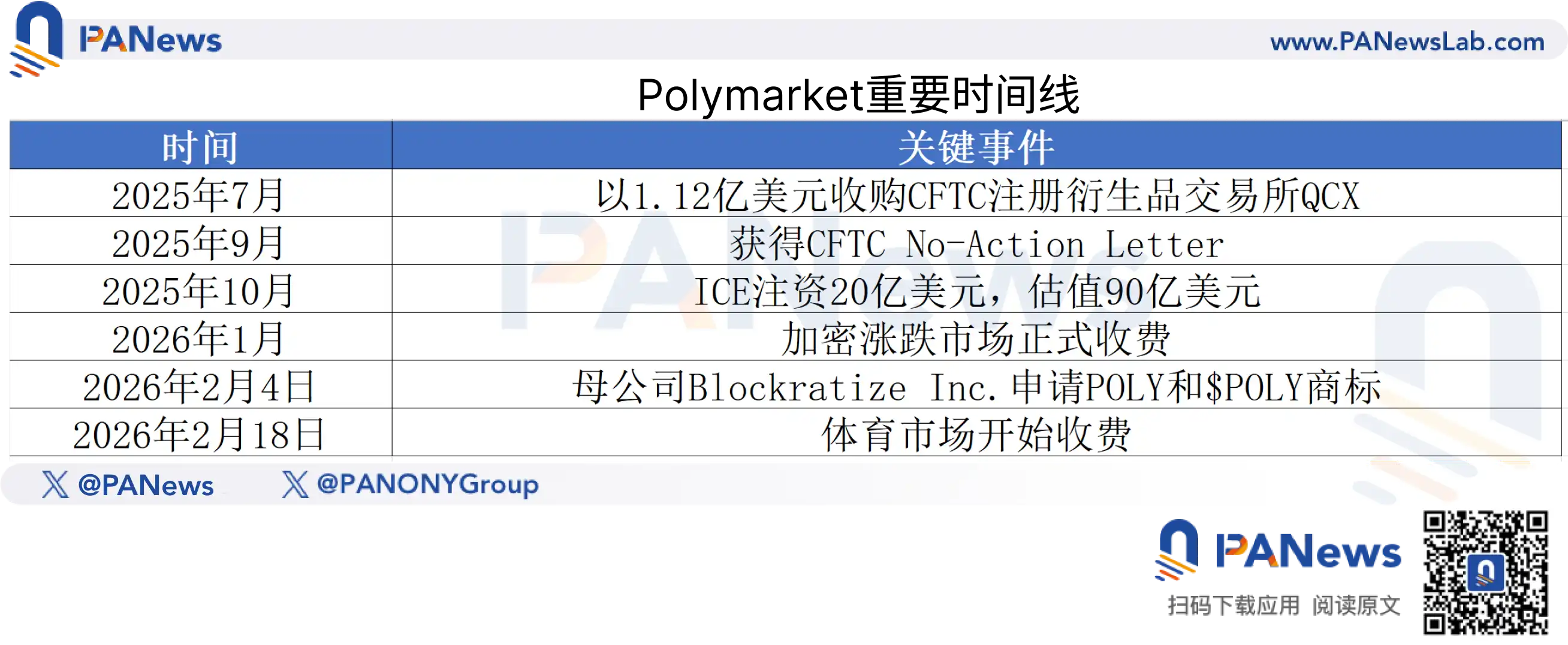
Airdrop Scale May Surpass Hyperliquid; The Era of Volume Farming is Over
Referring to recent airdrop ratios of top projects (Arbitrum, Jupiter, Hyperliquid), the community allocation usually ranges between 5%-15% of the total supply. PANews calculated based on different valuation assumptions:
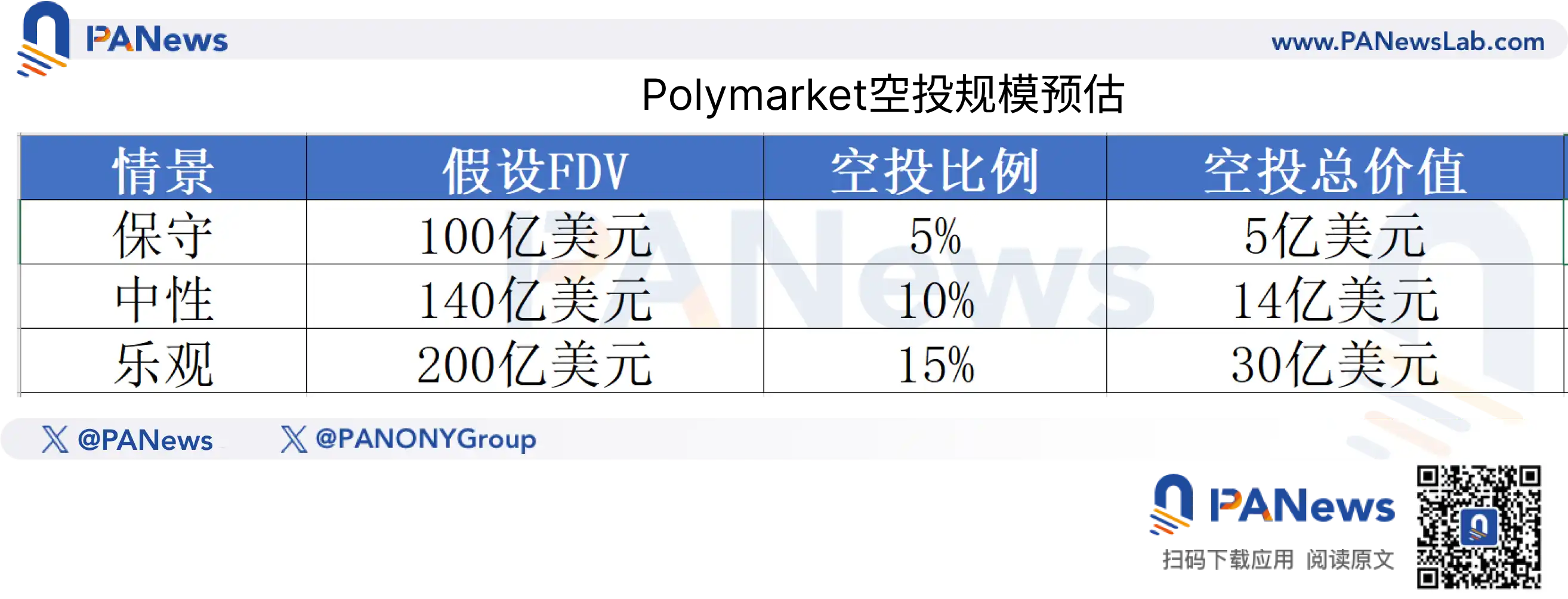
If the total airdrop is $1.4 billion, and assuming there are 500,000 eligible active addresses, the average airdrop value per account could be around $2,800. However, according to the "Pareto principle," top users might reap rewards ranging from hundreds of thousands to even millions of dollars, so ordinary retail users need to manage their expectations reasonably.
It is worth noting that, simultaneously with the fee launch, Polymarket introduced a 4% annualized holding reward, with hourly snapshots and daily distributions. This mechanism reveals the project's clear preference: the duration funds are held is far more important than trading frequency.
Moat and Concerns: Where are the Risks for This "Money Printer"?
Charging fees means users incur additional costs. So, what gives Polymarket the confidence to sustain this?
A triple moat is clearly visible: First, the platform possesses unmatched liquidity depth in the prediction market space, which is crucial for large-volume traders. Second, compared to the 5%-10% rake in traditional betting and Kalshi's 1%-3.5%, the peak fee rate of 0.45% still holds an overwhelming cost advantage. Third, ICE's involvement not only brought capital but also data distribution capabilities. ICE plans to integrate Polymarket's real-time prediction data for its global institutional clients, constituting a "second growth curve" beyond trading fees.
However, risks should not be overlooked:
Short-term trading volume fluctuations: Polymarket's monthly trading volume once dropped from a peak of $1.026 billion in November 2025 to $543 million in December 2025. Will fee introduction exacerbate this trend? However, considering the positive effects of increased order book depth and reduced spreads after introducing the Maker Rebate, long-term trading volume might actually increase.
Competitive landscape: Kalshi holds a first-mover advantage in the U.S. compliant market (2025 revenue approximately $260 million). Hyperliquid is attempting to enter the prediction market赛道 through "Outcome Trading" (FDV approx. $16 billion). Predict.fun attracts users with DeFi yield叠加.
Regulatory uncertainty: Although it has obtained a No-Action Letter from the CFTC and acquired the compliant exchange QCX, changes in the U.S. regulatory environment remain the sword of Damocles hanging over the prediction market.
Postscript
From free to fee-based, from crypto up/down markets to global sports events, Polymarket is undergoing a meticulously planned business model upgrade. It already earns millions weekly just from the crypto market, and the sports market—this behemoth accounting for nearly 40% of the platform's volume with liquidity 30 times that of crypto—has only just begun charging. Polymarket's story provides a model worth pondering: a platform's true value might not lie in how much money it is making at the moment, but in its proven ability to charge fees whenever it decides to. When the cake is big enough and the moat deep enough, opening the fee floodgates is only a matter of time.
And for this money printer that's warming up, February 18th was just the start button being pressed.