Optical Modules Soar, Why Is NOK the Second Leader After MRVL?

marsbitXuất bản vào 2026-06-03Cập nhật gần nhất vào 2026-06-03

Tóm tắt

Nokia's stock has surged nearly 170% to around $16.8 since Nvidia's $1 billion investment and AI-RAN partnership in October 2025, reflecting a market re-rating from a cyclical telecom equipment provider to an AI infrastructure player. This rise, adding roughly $60 billion in market cap, is driven by AI capex expansion into telecom edge, RAN, and optical networks. The company's Q1 2026 results showed strong momentum, with AI & Cloud net sales up 49% and 10 billion euros in new orders, prompting Nokia to raise its AI & Cloud market growth forecast to a 27% CAGR (2025-2028). Optical network growth of 20% further strengthens its position in connecting AI data centers. Recent tests with operators like T-Mobile and the opening of an AI Networking Innovation Lab demonstrate progress from concept to early commercial deployment. Nokia's strategy integrates Nvidia GPUs into its network hardware, enabling concurrent AI processing and RAN tasks for real-time optimization and new edge services. However, with a trailing P/E nearing 100x and consensus price targets lagging the current stock price, significant future growth is already priced in. The key constraint now is the pace and scale of large-scale operator deployments. While execution signals remain positive and the company's position in AI edge infrastructure is established, high valuation leaves limited room for error, making tangible commercial contracts the critical factor for further stock performance.

Nokia's share price is currently around $16.8, having accumulated an increase of nearly 170% since Nvidia's subscription to new shares at $6.01 in October 2025. Its market capitalization has increased by approximately $60 billion, reaching a 16-year high. The market no longer views it merely as a cyclical telecom equipment supplier but is rapidly re-rating it as an AI network and edge infrastructure player. Nvidia's equity investment and technical collaboration have been the most direct catalyst.

Behind this is the major trend of AI capital expenditure shifting from core data centers to the telecom edge, wireless access networks, and optical networks. The question is, how far has this re-rating progressed, and how much support can future actual implementation provide for the stock price?

Nokia's Stock Price Has Completed the AI Infrastructure Re-rating

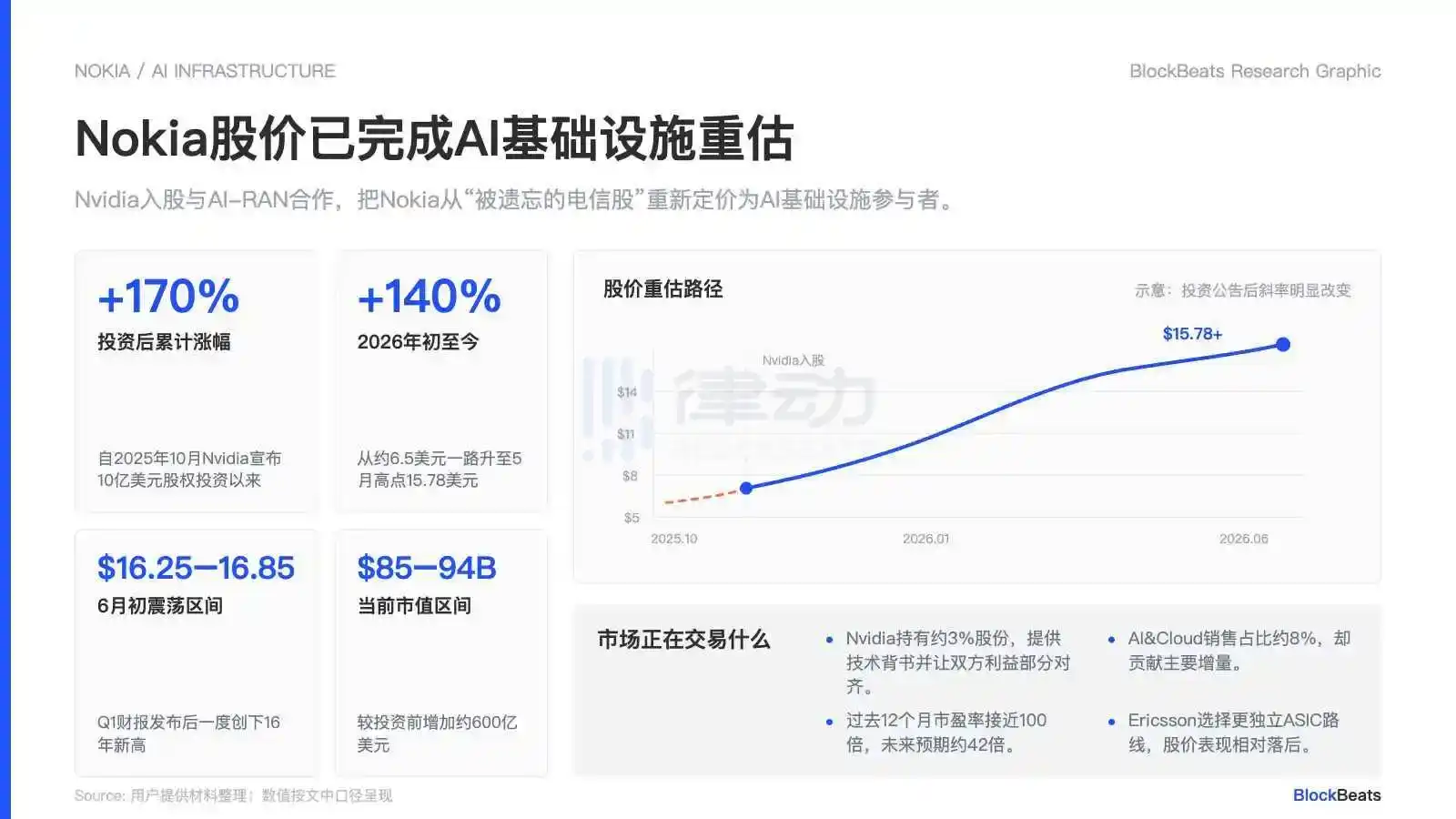
Since Nvidia announced a $1 billion equity investment and reached an AI-RAN strategic cooperation agreement in October 2025, Nokia's share price has accumulated gains of nearly 170%. Year-to-date in 2026, the increase exceeds 140%, rising from around $6.5 to a peak of $15.78 in May, and fluctuating in the $16.25-$16.85 range in early June. Following the Q1 earnings release, it once hit a 16-year high.

The current market capitalization is approximately $85-94 billion, an increase of about $60 billion from pre-investment. The AI&Cloud business accounts for about 8% of group sales but contributes the majority of the incremental value. The trailing twelve-month P/E ratio is close to 100 times, while the forward P/E ratio is about 42 times, significantly higher than traditional telecom peers but still lower than pure-play AI infrastructure companies. In contrast, Ericsson's share price performance lags due to its choice of a more independent ASIC chip strategy.

These changes indicate that the market is already trading on Nokia's transformation from a "forgotten telecom stock" to an AI infrastructure participant. Nvidia holds approximately 3% of the shares, providing both technical endorsement and partially aligning interests. Coupled with the narrative of the U.S. pushing to regain leadership in the telecom field, this has collectively accelerated this round of re-rating.

However, after significantly outperforming, what actual business progress is the market truly trading on?
Q1 Orders and Guidance Raise Validate Accelerated Transformation

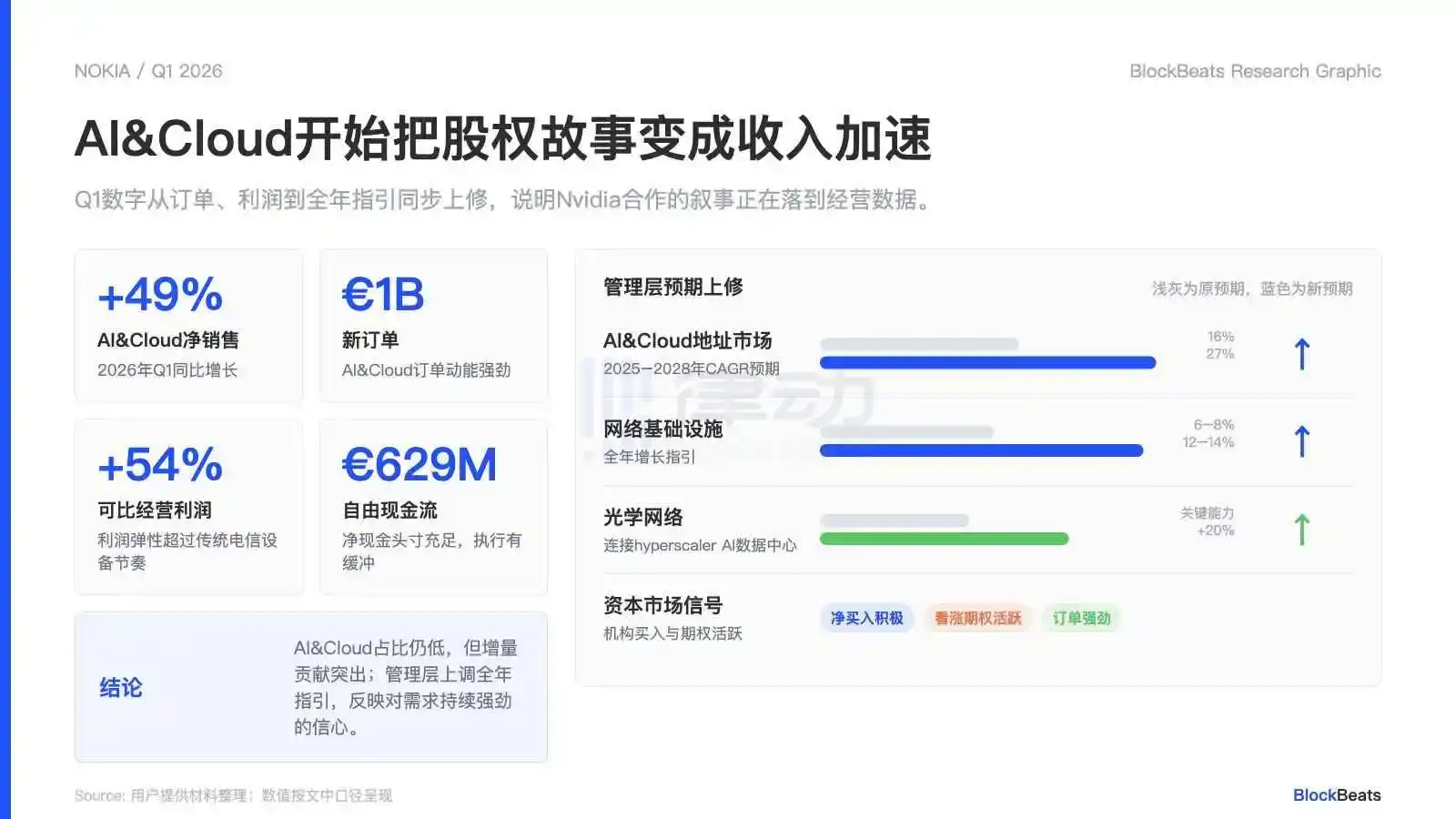
In the Q1 2026 earnings report, Nokia's AI&Cloud net sales increased by 49% year-over-year, securing €1 billion in new orders, with comparable operating profit surging by 54%. Consequently, the company raised its expected annual compound growth rate for the AI&Cloud addressable market from 16% to 27% for 2025-2028, and its full-year growth guidance for network infrastructure from 6-8% to 12-14%.

Optical network business grew by 20% during the same period, becoming a key part of connecting hyperscaler AI data centers. This capability was further strengthened following the acquisition of Infinera. New order intake is strong, free cash flow reached €629 million, and the net cash position is ample, providing a buffer for future execution.

These figures indicate that the cooperation with Nvidia is shifting from an equity story to visible revenue acceleration. Although AI&Cloud still represents a low proportion, its incremental contribution is prominent. The company's raised full-year guidance reflects management's confidence in sustained strong demand. Institutions have been net buyers over the past 12 months, and call option activity is higher than normal levels, further supporting this assessment.
MWC Tests and Innovation Lab Confirm Early Commercial Pathway

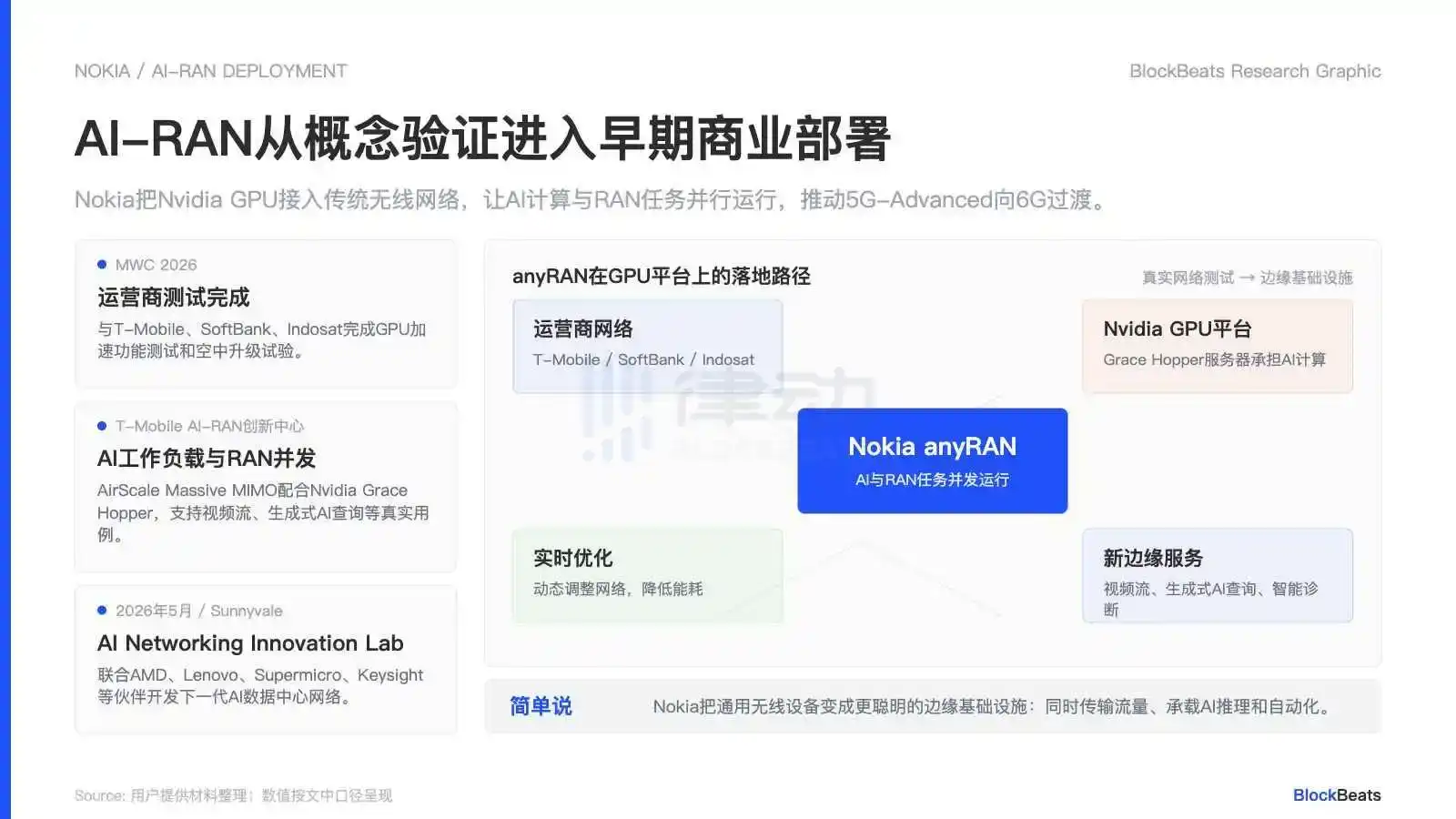
During MWC 2026, Nokia completed functional tests and over-the-air upgrade trials with operators like T-Mobile, SoftBank, and Indosat. At T-Mobile's AI-RAN Innovation Center, they used Nokia's AirScale Massive MIMO radio equipment alongside Nvidia Grace Hopper servers, successfully running AI workloads concurrently with RAN (Radio Access Network) tasks, supporting practical use cases like video streaming and generative AI queries.

In May 2026, Nokia opened the AI Networking Innovation Lab in Sunnyvale, California, collaborating with partners like AMD, Lenovo, Supermicro, and Keysight to develop next-generation AI data center networks. Concurrently, it introduced AI agent features for fixed broadband products, helping operators diagnose problems automatically, reduce costs, and accelerate fiber deployment.

These developments show that the acceleration path for Nokia's anyRAN software on Nvidia GPU platforms is now implementable. AI-RAN (using AI to optimize wireless access networks) is no longer just a concept but can deliver real-time optimization, reduce energy consumption, and generate new edge services within actual operator networks, providing a viable path for the transition from 5G-Advanced to 6G. Nokia CEO Justin Hotard stated that the cooperation is moving from validation to early commercial deployment.

Simply put, Nokia is applying Nvidia GPUs to traditional wireless network hardware, enabling AI computing and network transmission tasks to run in parallel. This allows for real-time network adjustments, saves power, and facilitates the development of new services. This approach turns general-purpose equipment into smarter edge infrastructure.
Deployment Scale Becomes the Biggest Constraint Under High Valuation

Although Q1 data, test results, and ecosystem partner expansion are relatively positive, the current P/E ratio is close to 100 times. Analyst consensus target prices are around €9.4-€12 (some investment banks have raised to around €12-€14), significantly lagging the current stock price. This indicates that the market has already priced in considerable optimism for long-term AI-RAN penetration and the 27% growth expectation, leaving a significantly compressed margin for error.

Over the next 12-24 months, the conversion speed of actual deployment contracts from major operators, the overall pace of AI capital expenditure, and differences in approach compared to Ericsson (which insists on independent ASICs, avoiding deep ties to a single GPU supplier) will become the core variables. If subsequent orders fall short of expectations or AI spending slows, the risk of a pullback will significantly increase.

Institutional net buying and bullish option preferences currently still support share price momentum, but these ultimately need to be validated by execution. Nokia's position as a representative AI edge infrastructure player has gained recognition, and the combination of optical networks with wireless access networks expands the overall market opportunity. However, there is a noticeable distance from current early orders to truly commercial deployment at hyperscaler scale.

It is still in the early acceleration phase, with overall execution signals being positive. However, the high valuation has already tightened the margin for error considerably. Investors should focus next on actual large-scale deployment progress rather than new demonstrations to gauge how much further this trend of AI expanding to the telecom edge can go.


Câu hỏi Liên quan

QAccording to the article, why has Nokia's stock price experienced a significant revaluation recently?

ANokia's stock price has been revalued because the market is no longer viewing it just as a cyclical telecom equipment vendor, but as an AI network and edge infrastructure player. This shift was catalyzed by a strategic investment and AI-RAN collaboration with Nvidia, aligning with the trend of AI capital expenditure moving from core data centers into telecom edges and optical networks.

QWhat were the key performance highlights for Nokia's AI & Cloud business in Q1 2026?

AIn Q1 2026, Nokia's AI & Cloud business saw net sales grow by 49% year-over-year, secured 1 billion euros in new orders, and comparable operating profit increased by 54%. Due to this strong performance, the company raised its growth expectations for the AI & Cloud addressable market.

QWhat practical demonstrations at MWC 2026 validated Nokia's AI-RAN path?

AAt MWC 2026, Nokia conducted functional tests and over-the-air upgrade trials with operators like T-Mobile, SoftBank, and Indosat. A key test at T-Mobile's AI-RAN Innovation Center successfully ran AI workloads concurrently with RAN tasks using Nokia's AirScale Massive MIMO hardware and Nvidia Grace Hopper servers, supporting real use cases like video streaming and generative AI queries.

QWhat is a major constraint for Nokia's stock mentioned in the article, given its current valuation?

AA major constraint is the high valuation, with a trailing P/E close to 100x. This high valuation reflects significant market optimism upfront, leaving little room for error. The key variable now is the conversion speed of large-scale operator deployment contracts and the overall pace of AI capital expenditure over the next 12-24 months.

QHow does Nokia's strategic approach differ from its competitor Ericsson's according to the article?

ANokia's strategy involves a deep technical collaboration and equity investment from Nvidia, integrating Nvidia's GPU technology into its telecom hardware. In contrast, Ericsson is pursuing a more independent ASIC chip route, avoiding deep binding to a single GPU vendor like Nvidia.

Nội dung Liên quan

Lãi Mở XRP Chạm Mốc 2,6 Tỷ USD Khi Nhu Cầu Phái Sinh Tăng

Dữ liệu từ CoinGlass cho thấy lãi mở (open interest) của hợp đồng tương lai XRP đã tăng hơn 10% trong 24 giờ, đạt mốc 2,6 tỷ USD, đưa XRP trở thành một trong những tài sản tiền điện tử có lãi mở phái sinh lớn nhất. Mức tăng này phản ánh nhu cầu giao dịch phái sinh quanh XRP đang gia tăng đáng kể. Tuy nhiên, lãi mở tăng cho thấy nhiều vị thế đang được mở ra, nhưng không tự động chỉ ra rằng dòng tiền này lạc quan hay bi quan về giá. Nó có thể đến từ các vị thế mua, bán khống, phòng ngừa rủi ro hoặc giao dịch đòn bẩy. Do đó, sự tích tụ này có thể hỗ trợ một đợt biến động mạnh hơn, nhưng cũng làm tăng rủi ro biến động và thanh lý. Các nhà giao dịch cần xem xét thêm các chỉ số khác như phí funding, khối lượng giao dịch spot, hướng giá và dữ liệu thanh lý để có bức tranh đầy đủ. Sự gia tăng lãi mở cho thấy XRP đang thu hút sự chú ý nghiêm túc từ thị trường phái sinh, nhưng sự bền vững của xu hướng sẽ phụ thuộc vào việc liệu hoạt động spot có tăng theo để xác nhận hay không. Kết quả cuối cùng có thể là một xu hướng mạnh hơn hoặc đơn giản là thêm biến động cho một thị trường vốn đã sôi động.

bitcoinist57 phút trước

Lãi Mở XRP Chạm Mốc 2,6 Tỷ USD Khi Nhu Cầu Phái Sinh Tăng

bitcoinist57 phút trước

Nhịp Đập Thị Trường BTC: Tuần 30

Bitcoin (BTC) đã hồi phục từ dưới 58.000 USD để thử nghiệm mức 65.000 USD trước khi đi vào giai đoạn củng cố quanh 64.500 USD. Động lượng tăng đã chậm lại và khối lượng giao dịch spot vẫn ở mức thấp. Mặc dù vậy, sự phục hồi được duy trì trong bối cảnh thị trường đang tìm kiếm điểm cân bằng vững chắc hơn. Chênh lệch biến động (volatility spreads) thu hẹp cho thấy thị trường phái sinh không còn định giá phí bảo hiểm rủi ro cao, phản ánh tâm lý phòng thủ giảm bớt. Dù sự tham gia của thị trường giao ngay còn yếu, khẩu vị đầu cơ đang dần quay trở lại. Lãi suất mở (open interest) cho hợp đồng tương lai và quyền chọn tăng lên, dòng tiền của nhà giao dịch vĩnh viễn (perpetual taker flow) chuyển sang mua ròng và nhu cầu bảo vệ trước rủi ro giảm xuống. Hoạt động on-chain cũng đang ổn định, được hỗ trợ bởi sự cải thiện vừa phải về thông lượng kinh tế và sự tham gia của người dùng. Dòng vốn vẫn thận trọng, nhưng dòng tiền ETF spot tại Mỹ đang phục hồi và các nhóm ETF đang trở lại gần mức hòa vốn, cho thấy áp lực bán từ tổ chức đang giảm dần. Nhìn chung, thị trường Bitcoin dường như ngày càng cân bằng hơn, với niềm tin dài hạn tạo đà hỗ trợ trong khi sự tham gia đầu cơ vẫn được kiểm soát. Tuy nhiên, tỷ trọng ngày càng tăng của vốn ngắn hạn nhạy cảm với giá cả làm tăng khả năng biến động mạnh hơn, khiến thị trường vẫn kiên cường nhưng ngày càng nhạy cảm với sự thay đổi trong động lượng và áp lực bán.

insights.glassnode3 giờ trước

Nhịp Đập Thị Trường BTC: Tuần 30

insights.glassnode3 giờ trước

Nhu cầu Bitcoin tại thị trường giao ngay suy yếu khi vốn mới do dự bất chấp dòng tiền vào ETF

Mặc dù dòng tiền vào các quỹ ETF Bitcoin đã chuyển sang tích cực kể từ giữa tháng 7, nhưng điều này vẫn chưa đủ để đưa giá Bitcoin vượt lên vùng cung địa phương quanh mốc 65.000 USD. Theo phân tích từ CryptoQuant, nhu cầu mua Bitcoin trên thị trường giao ngay (spot) trong 30 ngày đã suy yếu đáng kể, giảm từ -80.000 BTC xuống -170.000 BTC. Sự ổn định tương đối của giá hiện tại chủ yếu được hỗ trợ bởi các lệnh mua để đóng vị thế bán (short-covering) trên thị trường phái sinh và áp lực bán từ các nhà đầu tư ngắn hạn đã giảm bớt. Chỉ số "Nhà đầu tư mới vào Bitcoin", đo lường tỷ trọng vốn hóa nắm giữ bởi các đồng coin non trẻ (dưới 1 tháng tuổi), vẫn ở gần mức thấp nhất trong năm, cho thấy sự tham gia của dòng vốn mới còn yếu. Tỷ lệ lợi nhuận trên đầu ra đã chi tiêu của nhà đầu tư ngắn hạn (STH SOPR) cũng duy trì dưới mức 1.0, có nghĩa là họ vẫn đang chốt lỗ trung bình. Những chỉ báo này cùng củng cố quan điểm rằng thị trường hiện đang trong giai đoạn ổn định cục bộ, chứ chưa có dấu hiệu đảo chiều tăng mạnh. Các nhà phân tích nhấn mạnh rằng, cần theo dõi việc giá có thể vượt qua đỉnh dao động địa phương 67.300 USD hay không để xác nhận một sự đảo chiều thực sự.

ambcrypto4 giờ trước

Nhu cầu Bitcoin tại thị trường giao ngay suy yếu khi vốn mới do dự bất chấp dòng tiền vào ETF

ambcrypto4 giờ trước

Vì sao giao dịch "cá voi" 32,6 triệu USD của Chainlink có thể định hình đà tăng của LINK về phía 9 USD

Một giao dịch chuyển 3,89 triệu LINK (trị giá 32,58 triệu USD) từ ví Coinbase Institutional sang một ví ẩn danh đã thu hút sự chú ý đến Chainlink. Chuyển động này làm dấy lên suy đoán về việc các tổ chức lớn đang tích lũy thay vì bán ra ngay lập tức. Dòng tiền ròng trên sàn giao dịch đã chuyển sang dương với lượng vào khoảng 620,18 nghìn USD, đánh dấu sự thay đổi sau một thời gian dài dòng tiền ra chiếm ưu thế. Tuy nhiên, tâm lý trên thị trường phái sinh vẫn thận trọng, với chỉ số CVD 90 ngày cho thấy lệnh bán vẫn chiếm ưu thế. Về mặt kỹ thuật, LINK đang giao dịch quanh mức 8,35 USD, thử thách vùng kháng cự gần đó. Chỉ số RSI ở mức 57,71 cho thấy áp lực mua đang tăng lên. Để duy trì đà hồi phục, giá cần vượt qua được ngưỡng 8,35 USD, từ đó mở đường hướng tới mục tiêu 9,00 USD. Ngược lại, nếu bị từ chối tại đây, giá có thể quay lại kiểm tra vùng hỗ trợ 8,18 USD. Tóm lại, hoạt động của ví tổ chức và dòng tiền ròng trên sàn là tín hiệu tích cực, nhưng tâm lý bán trên thị trường phái sinh vẫn tạo ra sự thận trọng, khiến triển vọng ngắn hạn của LINK chưa thực sự rõ ràng.

ambcrypto5 giờ trước

Vì sao giao dịch "cá voi" 32,6 triệu USD của Chainlink có thể định hình đà tăng của LINK về phía 9 USD

ambcrypto5 giờ trước

Giao dịch

Giao ngay
活动图片